Wayground logo

Free Printable Worksheets

Font size

S
M
L
XL
Worksheets

Mutations and Genetics Review

Total questions: 85

Worksheet time: 7hrs 5mins

Name
Class
Date
1.

A mutation is defined as:

a)

A change in the cell's structure

b)

Anything that changes in an embryo

c)

Any change in the physical features of a human

d)

A change in the DNA sequence

2.
What causes mutations?
a)
Mistakes in replication or environmental substances
b)
The amino acids
c)
Passed down by genetics
d)
It's how your born
3.

A mutation in which only one nucleotide is altered is called a:

a)

Frameshift Mutation

b)

Deletion Mutation

c)

Point Mutation

d)

Insertion Mutation

4.

Another name for a point mutation is:

a)

Substitution

b)

Frameshift

c)

Insertion

d)

Deletion

5.

ATTTGAGCC- Original

ATTGAGCC - Mutated

The example above is an example of a

a)

Insertion

b)

Point mutation

c)

Deletion

d)

Substitution

6.

Mutations are random.

a)

True

b)

False

7.

Mutations are SOMETIMES helpful to the organism.

a)

true

b)

false

8.

True or false, mutations create genetic diversity?

a)

True

b)

False

9.

In order for offspring to get a genetic mutation, the mutation must occur in what type of cell?

a)

Cells with no nucleus.

b)

Any body cell after birth.

c)

Cells with no cell wall or cell membrane.

d)

Cells like eggs or sperm cells that are undergoing reproduction.

10.
What mutation has occurred here? 
T-G-A-C-C-A
T-G-A-G-C-A
a)
Substitution
b)
Deletion
c)
Insertion
d)
Frameshift 
11.
Which of the following would result in a frameshift mutation?
a)
Insertions only
b)
Substitution only
c)
Deletion only
d)
Insertions and Deletions
12.
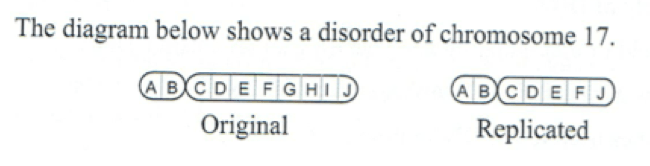
What type of chromosomal mutation has occurred?
a)
substitution
b)
insertion
c)
deletion
d)
nondisjunction
13.

Which Karyotype displays a female with Down syndrome?

a)
b)
c)
d)
14.
Identify the DELETION mutation form the following: 
ATG CCA AAT
a)
ATG TCA AAT
b)
ATG CCT AAA T
c)
ATC CA  AT
d)
ATG CCA AAT
15.
Identify the SUBSTITUTION mutation form the following: 
ATG CCA AAT
a)
ATG TCA AAT
b)
ATG CCT AAA T
c)
ATC CA  AT
d)
ATG CCA AAT
16.
A segment of DNA produces methionine, threonine, histidine, aspartate, and glycine when translated. A substitution mutation occurs and causes the sythesis of the segment shown. Which is the new peptide chain when the new DNA segment is translated?
a)
methionine, leucine, histidine, aspartate, glycine
b)
methionine, phenylalanine, histidine, aspartate, glycine
c)
Methionine, proline, histidine, aspartate, glycine
d)
methionine, serine, histidine, aspartate, glycine
17.

Genetic mutations can be...

a)

beneficial, harmful, or neutral

b)

beneficial only

c)

harmful only

d)

neutral only

18.

Would a mutation in the DNA of a skin cell be passed on to an organism's offspring?

a)

Yes, because any change to the DNA is passed on to the offspring

b)

Maybe. Sex cells only use half of the body's genetic code. It might get the copy of a gene that wasn't mutated.

c)

No. Only mutations that occur in the gametes (sex cells) are passed on to the offspring

d)

Without knowing the animal, it would be hard to tell whether or not the mutation would be passed on.

19.

What type of mutation is shown in the diagram?

a)

Point mutation - missense

b)

Frameshift Mutation - deletion

c)

Frameshift Mutation - addition

d)

Point mutation - nonsense

20.
What are the building blocks of proteins call?
a)
DNA
b)
RNA
c)
Ribosomes
d)
Amino Acids
21.
Original DNA: CAT GAT
New DNA: CAT AT
What mutation occurred?
a)
deletion
b)
substitution 
c)
tranverse
d)
insertion
22.
Original: ATC CAT
Mutation: ATC GCAT
What mutation occurred?
a)
deletion
b)
insertion
c)
silent
d)
transverse
23.
Mutated DNA sequences that can be passed from parent to offspring --
a)
occur in somatic cells (body cells)
b)
occur in gametic cells (sex cells)
c)
are rejected by meiosis
d)
only occur if the parent is exposed to harmful substances
24.
What pairs with Adenine (A)? 
a)
Guanine (G)
b)
Cytosine (C)
c)
Adenine (A)
d)
Thymine (T)
25.
What pairs with Thymine (T)?
a)
Adenine (A)
b)
Thymine (T)
c)
Guanine (G)
d)
Cytosine (C) 
26.
What pairs with Guanine (G)?
a)
Adenine (A)
b)
Thymine (T)
c)
Cytosine (C)
d)
Guanine (G)
27.
What pairs with Cytosine (C)?
a)
Guanine (G)
b)
Cytosine (C)
c)
Adenine (A)
d)
Thymine
28.
Why is DNA important?
a)
it is very small and very complicated
b)
it's in everything
c)
it serves as the blueprint for traits of all living things
d)
because we eat it every day for energy
29.

A substitution mutation that has no effect

on amino acids sequence

a)

Insertion Mutation

b)

Translocation

c)

Silent Mutation

d)

Deletion Mutation

30.

Part of a chromosome is reversed.

a)

Inversion Mutation

b)

Deletion Mutation

c)

Translocation

d)

Point Mutation

31.
What causes genetic variation in meiosis?
a)
chromosomes lining up
b)
crossing over of chromosomes
c)
separation of chromosomes
d)
chromosomes pulling apart
32.
The process of crossing over occurs in what phase of meiosis?
a)
anaphase 1
b)
prophase 1
c)
prophase 2
d)
telophase 1
33.
The chromosomes that pair up during meiosis, are called __________ chromosomes.  
a)
homozygous 
b)
asexual
c)
homologous
d)
genes
34.
Crossing over creates
a)
male genotype
b)
genetic variation (differences)
c)
DNA replication
d)
mitosis
35.
Which cellular process is shown?
a)
meiosis
b)
endocytosis
c)
mitosis
d)
phagocytosis
36.
A human zygote should have _____ chromosomes inside.
a)
46
b)
23
c)
92
d)
64
37.
Meiosis makes sperm and egg cells. In humans, sperm and egg cells each have _____ chromosomes. Therefore a fertilized human egg cell (sperm and egg cell combined) would create a cell with _____ chromosomes.
a)
23, 46
b)
46, 23
c)
2, 4
d)
50, 100
38.
How many daughter cells does Meiosis create?
a)
2
b)
4
c)
8
d)
1
39.
Asexual reproduction and mitosis occur in...
a)
Body Cells
b)
Sex Cells or Gametes
40.
How many daughter cells are produced at the end of mitosis?
a)
1
b)
2
c)
3
d)
4
41.
Before mitosis or meiosis can begin, DNA must go through Interphase. This is when...
a)
DNA replicates
b)
DNA splits
c)
DNA forms chromosomes
d)
Chromosomes cross over
42.
Which of the following cells is a gamete?
a)
egg
b)
bone
c)
heart
d)
muscle
43.
In mitosis cells are genetically _______, but in meiosis cells are genetically ______.
a)
diverse, identical
b)
identical, diverse/different
44.

Is this a normal human karyotype?

a)

YES

b)

NO

45.

Is this karyotype for a male or female?

a)

MALE

b)

FEMALE

46.
Which of these traits can a tree NOT pass to its offspring
a)
the shape of its leaves
b)
roots that grow toward the water
c)
a trunk scared by lightning 
d)
the kind of seed it forms 
47.
A mother dog and her puppy both have curly fur. Which best explains this?
a)
in dogs, curly fur is more common than straight fur
b)
in dogs, curly fur is an acquired trait
c)
the mother dog acquired curly fur and passed on that trait to her puppy
d)
the mother dog inherited curly fur and passed on that trait to her puppy
48.
Which of the following is a definition of inherited trait?
a)
a characteristic that a living thing gets from its parents
b)
a characteristic that a living thing gets during its lifetime
c)
a behavior that a living thing learns from its parents
d)
a skill that an animal develops after it is born 
49.
Which characteristic would most likely be inherited by a baby?
a)
brown hair
b)
crying a lot
c)
ability to jump high
d)
his ability to talk
50.
Which of the following cell types is formed by meiosis?
a)
muscle cells
b)
skin cells
c)
sperm cells
d)
blood cells
51.
What is a phenotype?
a)
The expression of a trait; what you see.
b)
refers to the genetic makeup of an individual
c)
An organism that has the same genes for a trait (ex. TT or tt)
d)
the passing of traits from parent to offspring
52.
The inherited combination of alleles is known as the offspring's
a)
heredity
b)
phenotype
c)
genotype
d)
redigree
53.
An organism's appearance is known as its
a)
heredity
b)
phenotype
c)
genotype
d)
pedigree
54.
What does heterozygous mean?
a)
An organism that has the same genes for a trait (TT or tt)
b)
An organism that has different genes for a trait (Tt)
c)
When neither gene is fully dominant; offspring is a mixture of both
d)
the different forms of a trait (hair color--> brown, blonde, red
55.
A heterozygous yellow pea plant's genotype would be:
a)
YY
b)
yy
c)
Yy
d)
Yg
56.
A corn plant heterozygous for tall sprouts mates with a corn plant with short sprouts. If tall sprouts are dominant, how many different phenotypes are possible in the offspring?
a)
1
b)
2
c)
3
d)
4
57.
If T=Tall & t=short, what is the genotypic ratio?
a)
1:3
b)
3:1
c)
1:2:1
d)
2:2
58.
If a heterozygous tall pea plant is crossed with a short pea plant, what are the possible genotypes of the future offspring?
a)
100% Tt
b)
50% Tt, 50% tt
c)
75%Tt, 25%tt
d)
25%TT, 50%Tt, 25%tt
59.
A dog gives birth to 5 puppies. What percentage of the chromosomes does each puppy share with the mother?
a)
25%
b)
50%
c)
75%
d)
100%
60.
trait shows only if both parents pass it on
a)
recessive
b)
dominant
c)
codominan
61.
when you have two different genes
a)
heterozygous
b)
dominant
c)
homozygous
62.
when you have two of the same genes
a)
heterozygous
b)
recessive
c)
homozygous
63.
Dd letters are an example of....
a)
heterozygous genes
b)
homozygous genes
c)
dominant genes
d)
recessive genes
64.
DD is an example of
a)
homozygous recessive
b)
dominant
c)
Homozygous dominant
d)
recessive
65.
the following letters are an example of _______  dd
a)
recessive
b)
homozygous recessive
c)
homozygous dominant
d)
dominant
66.
What type of "square" helps us solve genetic problems?
a)
carpenter square
b)
Mendel square
c)
Punnett square
d)
genetic square
67.
Y for yellow body is dominant over y for blue body.  What alleles would produce yellow bodies?
a)
YY,yy
b)
Yy,yy
c)
YY only
d)
YY,Yy
68.
"The Great White Shark was 20 feet in length.  Phenotype or Genotype?
a)
phenotype
b)
genotype
69.
Females-XX; MalesXY.  A couple has 4 girls.  What is the chance the next child will be a boy?
a)
75%
b)
100%
c)
25%
d)
50%
70.
If "T" is the allele for tall and "t" is the allele for short, then Tt would produce?
a)
tall
b)
short
c)
medium
d)
not enough info
71.
A physical characteristic that can be passed from parent to offspring.
a)
behavior
b)
trait
c)
strong muscles
d)
ability to fly a plane.
72.
Genotype refers to the ...
a)
physical expression of the genes
b)
the possible combination of alleles in a gene
c)
whether an allele is dominant or recessive
d)
how an organism will appear
73.
An offspring will receive how many alleles from each parent to determine a specific trait?
a)
one
b)
two
c)
three
d)
five
74.
Which of the following is a phenotype?
a)
BB
b)
Bb
c)
bb
d)
Blue eyes
75.
the passing of genetic traits from parent to offspring.
a)
heredity
b)
trait
c)
gene
d)
allele
76.
having two of the same genes for the trait (sometimes called purebred).
a)
homozygous
b)
hetrozygous
c)
protein
d)
chromosome
77.
having two different genes for a trait (sometimes called hybrid).
a)
protein
b)
homozygous
c)
heterozygous
d)
genotype
78.
Two brown eyed parents (Bb) have a baby. What is the chance the baby is blue eyed?
a)
0 %
b)
25%
c)
50%
d)
75%
79.
An allele whose trait only shows up when no dominant allele is present.
a)
hidden allele
b)
dominant allele
c)
recessive allele
d)
present allele
80.
One form of a gene is called_______________
a)
a DNA
b)
a Phenotype
c)
a trait
d)
an allele
81.
Which of the following genotypes is a purebred?
a)
Bb
b)
Gg
c)
bb
d)
Dd
82.
If green is dominant over purple, then what is the genotype for this individual?
a)
Purple
b)
Green
c)
GG
d)
gg
83.
Brown fur color is dominant over black fur color. Which of the following is the actual genotype of ALL of the offspring in the next generation of this cross for fur color?
AA x aa
a)
AA
b)
Aa
c)
aa
d)
brown fur
84.
 Dominant alleles are-
a)
capital
b)
lowercase
c)
both
d)
neither
85.
 Recessive alleles are-
a)
capital
b)
lowercase
c)
both
d)
neither