
 Worksheets
DNA Structure, Replication, Protein Synthesis, Meiosis
Total questions: 87
Worksheet time: 57mins
In what process is mRNA synthesized?
Transcription
Translation
DNA Replication
Mitosis
Where does TRANSCRIPTION occur?
Nucleus
Ribosome
Cytoplasm
Mitochondria
Why must transcription occur where DNA can be found?
because DNA can't leave the nucleus
because ribosomes are in the nucleus
because DNA polymerase is found there
because helicase unzips the DNA
How many codons equals 1 amino acid?
1
2
3
4
How many nucleotides equal 1 amino acid?
1
2
3
4
TRANSCRIBE this DNA sequence: TACGTTACT
AUGCAAUGA
ATGCAATGA
AUGGATUGA
TACGTTACT
Which of the following are differences in the structure between RNA and DNA? (Choose all that are correct.)
DNA uses deoxyribose sugar, RNA uses ribose sugar
DNA pairs Adenine with Uracil, RNA pairs Adenine with Thymine
DNA is a double helix, RNA is a single helix
DNA pairs Adenine with Thymine, RNA pairs Adenine with Uracil
Which organelle is the location where protein is made?
Ribosome
Nucleus
Cytoplasm
Nucleotide
When these bond together, they form a protein
Amino Acids
Peptide Bonds
Ribose
Nucleotides


In human gametes, the haploid number of chromosomes is
(a)

In which stage of MEIOSIS does crossing over occur? (The exchange of DNA between homologous chromosomes)
Anaphase I
Metaphase I
Prophase I
Telophase I
In Metaphase II, _________ line up on equatorial plane.
homologous pairs of chromosomes
single chromosomes (made up of 2 sister chromatids)
tetrads
centrosomes
Meiosis results in?
2 identical daughter cells
known as somatic cells
3 daughter cells and 1 egg cell
4 different daughter cells known as gametes
8 identical gametes
Which of the following are CORRECT observations about the differences between MITOSIS and MEIOSIS? (Check all that apply.)
Mitosis produces cells that are identical to the parent cell.
Meiosis produces cells that have half the number of chromosomes as the parent cell.
All cells go through INTERPHASE as part of the cell cycle, whether it goes to mitosis or meiosis next.
In both types of cell division, the chromosomes are only duplicated once.
Only in Mitosis, do you see chromosomes pair up to form a tetrad.
Match the following:
sperm
male gamete
egg
female gamete
zygote
diploid
gamete
haploid
meiosis
formation of gametes

In this diagram homologous chromosomes are moving to opposite poles of the cell. What phase is shown in the diagram?
anaphase 1
anaphase 2
metaphase 1
telophase 1

Prophase II
Metaphase I
Metaphase II
Anaphase I


What stage of meiosis is this?
Prophase 1
prophase 2
Metaphase 1
Metaphase 2
In mitosis, one parent cell produces (a) (b) diploid daughter cells while in meiosis, one parent cell produces (c) (d) haploid daughter cells.
Mitosis takes place in (a) cells while meiosis takes place in reproductive organs and produces (b) .

What stage of meiosis is depicted?
prophase 1
anaphase 1
anaphase 2
telophase 2
Which of the following is an important part of Interphase?
Growth and DNA replication
Chromosomes line up at the equator of the cell
Sister chromatids are pulled to opposite poles of the cell
Cytoplasm divides
Which of the following are matched correctly?
Somatic cells are haploid and Gamete cells are diploid
Somatic cells are haploid and Gamete cells are haploid
Somatic cells are diploid and Gamete cells are haploid
Somatic cells are diploid and Gamete cells are diploid

What phase of meiosis is this?
prophase 1
Metaphase 2
telophase 2
anaphase 1
Why is crossing-over important?
It starts the process of Mitosis
It allows for identical copies of chromosomes
It allows for genetically diverse chromosomes
Meiosis results in 4 identical daughter cells
There are three different types of RNA.
The function of mRNA is to...
read the DNA code
bring amino acids to the ribosome during protein synthesis
assemble the amino acids into proteins
There are three different types of RNA.
The function of tRNA is to...
read the DNA code
bring amino acids to the ribosome during protein synthesis
assemble the amino acids into proteins
There are three different types of RNA.
The function of rRNA is to...
read the DNA code.
bring amino acids to the ribosome during protein synthesis.
assemble the amino acids into proteins.
When and why does DNA need to replicate?
DNA replicates before protein synthesis can happen.
DNA only replicates in order to mutate.
It replicates before mitosis and meiosis so all cells can have the correct amount of DNA for their ultimate function.
none of the above
What is a nucleotide made of?
one glycerol and three fatty acids molecules
an amino group and a carboxyl group
monosaccharides and disaccharides
a 5-carbon sugar, a phosphate group and a nitrogen base

The original DNA is: A G A G A G A G
Which answer choices shows a SUBSTITUTION mutation in the original DNA?
A G T G A G A G
A G A G G A G
A G A A G A G A G
A G A G A G A G
The original and mutated DNA have been transcribed below. What kind of mutation is shown?
Original: ACU AUG
Mutated: ACC AUG
Insertion
Deletion
Substitution
Bifurcation
A mutation can only be passed down if it is in what kind of cell?
Body
Somatic
Sex
Stem
GAG-CTC-GAC-AGA
Mutant
GAG CTC-CAC-AGA
Mutation: ATC GCAT
What mutation occurred?
What is the order for Protein Synthesis?
Transcription -> Translation -> Protein
Translation - > Transcription -> Protein
Protein -> Transcription -> Translation
Translation -> Protein -> Transcription
Where does transcription take place?
nucleus
cytoplasm
ribosome
A mutation is defined as:
A change in the cell's structure
Anything that changes in an embryo
Any change in the physical features of a human
A change in the DNA sequence
Chromosome mutation involving loss of a section of chromosome/genes.
Deletion
Inversion
Translocation
Removal
Why can the genes of one species be spliced into another species and create a working protein?
All organisms are made of cells
All organisms have the same sequence of nucleotides
All organisms use the same carbohydrates
All organisms share the same DNA nucleotides


Original section of DNA: ACC GCC AAT TTC GGA
Mutated section of DNA: ACC GCC ATT TCG GA
What type of mutation is this?
Translocation
Insertion
Deletion
Substitution
Match the following images with their function

Directly related to the coding of genetic information

The backbone or supporting portion of the double helix

The monomer of a nucleic acid.
Match the following cell types.
Somatic cells
all body cells except for sperm and egg
Gamete cells
sperm and egg
prokaryotes
NO nucleus
eukaryotes
Nucleus
A specific protein in created based on the ________ of the nucleotide.
sequence
size
color
synthesis
What is the product of Transcription?
polypeptide bonds
transcribed lysosomes
mRNA
a perforated nucleus

Organelle that helps with Translation
Golgi bodies
Ribosomes
Mitochondria
Nucleus
What is the product of Translation?
Polysaccharide bonds
Enclosed DNA
Sunlight
Proteins

These amino acids (monomers) will come together to build which biomolecule?
Carbs
Lipids
Proteins
Nucleic Acids

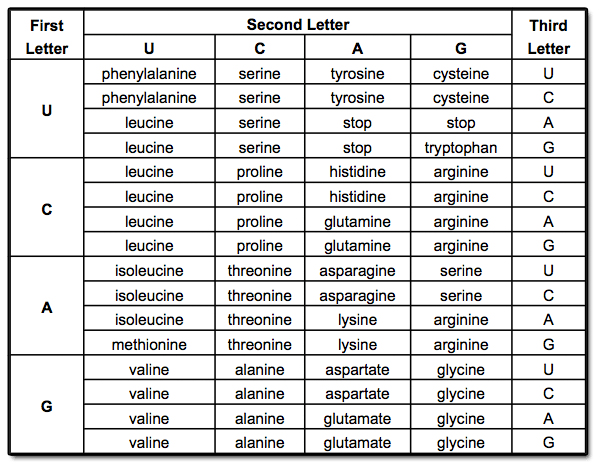
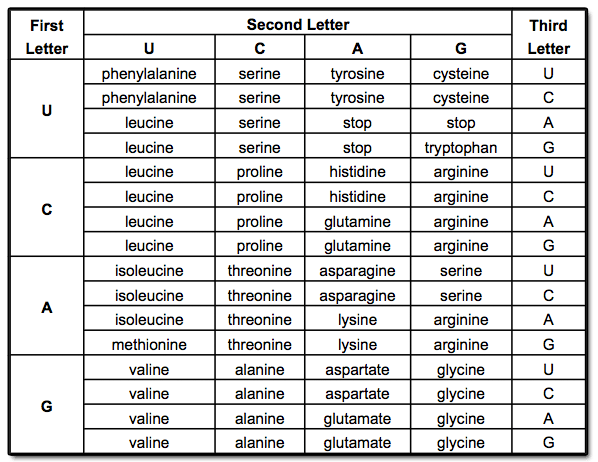
Based on this sequence
AUG GUU AAA CGA CAA UCC
What is the sequence of amino acids these codons would create?
Gly
Ser
The
Ala
Met
Asp
Phe
Ala
Arg
Met
Val
Lys
Arg
Ala
Lys
Asp
Gly
What is a substitution mutation?
When one base is changed to a different base
When a single extra base is added into the code
When a single base is removed from the code
all of the above
An insertion mutation is when a single extra base is added to the code.
True
False
What is a deletion mutation?
When one base is changed to a different base
When a single extra base is added to the code
when a single base is removed from the code
Match the biomolecules with their elements.
C H O
1:2:1 Ratio
Carbs
C H O
Lipids
C H O N
Proteins
C H O N P
Nucleic Acids

What step of Protein Synthesis is identified by this star?
Replication
Transcription
Duplication
Translation

What step of Protein Synthesis is identified by this star?
Replication
Transcription
Duplication
Translation

What is this 3 letter sequence?
uniform sequence
polysaccharide
codon
anti-codon
Match the complimentary nitrogen bases in DNA.
A
T
T
A
G
C
C
G
Match the following processes with their location?
Replication
Nucleus
DNA -> DNA
Transcription
Nucleus
DNA -> RNA
Translation
Cytoplasm

The model shows a mutation to a partial sequence of bases in a gene. Which type of mutation does the model demonstrate?
Substitution
Multiplication
Insertion
Deletion

ATT-TGA-GCC- Original
ATT-GAG-CC - Mutated
The example above is an example of a
Insertion - Frameshift
Substitution
Deletion - Frameshift
None of the above

What type of gene mutation has occurred here? Normal-
AGA-TTC-ATA-GCG
Mutant-
AGA-TTC-AAT-AGC-G
deletion frameshift
insertion frameshift
substitution
nonsense
A change in a DNA sequence that affects genetic information
mutation
fitness
transformation

The picture below shows the steps of DNA replication beginning with step one and ending with step three.
Because you are reusing the old, or parent, DNA strand DNA replication is said to be
Semi- Conservative
Semi-discontinuous
Continuous
Fully-Conserveative

The picture below shows an enzyme unwinding and unzipping DNA.
What is the name of this enzyme?
DNA Helicase
DNA Ligase
DNA polyermase
RNA Polymerase
Match he nucleotide with its complementary nucleotide. (DNA to DNA).
Adenine -
Thymine
Guanine
Cytosine
Match he nucleotide with its complementary nucleotide. (DNA to DNA).
Cytosine-
Thymine
Guanine
Adenine
Which enzyme is responsible for adding the free nucleotides to the replicating DNA?
DNA Helicase
DNA Ligase
DNA polyermase
RNA Polymerase
Which is the first step?
DNA Helicase unwinds original DNA strand
RNA Primase lays down RNA primer for new nucleotide bases.
DNA polymerase builds new strands by bring in new nucleotide bases.
Ligase knits together fragments on lagging strand
The directionality of DNA is said to be ___________, because it is side by side by goes in opposite directions.
Anti-directional
Parallel
Anti-parallel
Anti-uniform

