
 Worksheets
GRAVITATION
Total questions: 65
Worksheet time: 42mins
Which of the following options are correct?
Acceleration due to gravity decreases with increasing altitude.
Acceleration due to gravity increases with increasing depth
Acceleration due to gravity decreases with increasing depth
Acceleration due to gravity is independent of the mass of the
planet
g =0 at the center of the earth
(assume the earth to be a sphere of uniform density).
Expression for gravitational force between two point masses m1 & m2 placed at a distance d between their centers is
F =d2Gm1m2
F =dGm1m2
always attractive
can be attractive or repulsive
Gravitational force is
conservative force
long range force
independent of the nature of the medium between the masses
act along the line joining the centers of the two masses
non conservative force
Acceleration due to gravity (g) experienced by a mass (m) on a planet of mass M and radius R is
g =R2GM
g =R2Gm
g =R2GMm
g =RGM
If two masses m and M are placed at a distance apart , a point where the total gravitational force of these two on a third mass will be zero at a point
Outside the line joining m & M but close to m
Outside the line joining m & M but close to M
In between the line joining m & M but close to m
In between the line joining m & M but close to M
If two masses m and M are placed at a distance d apart , a point where the total gravitational force of these two on a third mass will be zero at a point ( x is measured from the position of M )
x =(M+m)dM
Outsid x =(M−m)dM e the line joining m & M but close to M
In betw x =(M+m)dm een the line joining m & M but close to m
In bet x =(M−m)dm ween the line joining m & M but close to M
A point mass m is placed at a distance r from the center of a uniform spherical shell of mass M. Force (F) on m due to M is
F = 0, if r < R
(any point inside M)
F = 0, only if r = 0
( m palced at the center of M)
F = 0, if r > R
F = r2GMm if r > R
F = R2GMm if r = R
A mass m is taken from the surface of earth ( mass M & radius R) to a height h
gh=gs (1−R2h) if h <<< R
gsgh=(R+hR)2 for all values of h
gsgh=(R−hR)2 for all values of h
gsgh=(RR+h)2 for all values of h
gh=gs (1+R2h) if h <<< R
A mass m is taken from the surface of earth ( mass M & radius R) to a height h
gd=gs (1+Rd)
gsgh=(R−dR)2
gsgh=(R−hR)2
gsgh=(RR+d)2
gh=gs (1−Rd)
At what height from the surface of earth, is the value of g half that on the surface of earth? (R = radius of the earth)
h = 0.414 R
h = R
h = 2 R
h = 3.5 R
h = R/2
The value of g at a height of 100 km from the surface of the Earth is nearly (Radius of the Earth = 6400 km) (g on the surface of the Earth = 9.8 m/s2)
9.8 m/s2
9.5 m/s2
10.5 m/s2
9.0 m/s2
0
At what depth from the surface of earth, is the value of g half that on the surface of earth? (R = radius of the earth)
h =32R
h = R
h = 2 R
h = 3.5 R
h =2R
At what height from the surface of earth the acceleration due to gravity will be reduced by 36 % its value o the surface of the earth?
h = 4 R
h = R
h = 2 R
h = R/4
h = R/2
Find the weight of an object at a height 6400 km above the earth's surface. The weight of the object at the surface of the earth is 20 N and the radius of the earth is 6,400 km.
W = 0
W = 5 N
W = 10 N
W = 4 N
W = 20 N
At what height from the surface of earth the acceleration due to gravity will be 36 % its value o the surface of the earth?
h = 2R/3
h = R
h = 2 R
h = R/4
h = R/2
ASSERTION (A) : Acceleration due to gravity near the pole more than that at the equator.
REASON (R) : Radius of the earth to the poles < radius of the earth to the equator
Both A & R are true and R is the correct explanation for A
Both A & R are true, but R is not the correct explanation for A
A is true but R is false
A is false but R is true
Both A and R are false
ASSERTION (A) : Escape speed from a planet increases if the mass and radius of the planet is doubled.
REASON (R) : Escape speed from a planet is directly proportional to mass of the planet inversely proportional to radius of the planet
Both A & R are true and R is the correct explanation for A
Both A & R are true, but R is not the correct explanation for A
A is true but R is false
A is false but R is true
Both A and R are false
ASSERTION (A) : Acceleration due to gravity deceases with increase in height from the surface of the earth and increases with increase in depth from the surface
REASON (R) : Acceleration due to gravity is directly proportional to depth and inversely proportional height and increases with increase in depth
Both A & R are true and R is the correct explanation for A
Both A & R are true, but R is not the correct explanation for A
A is true but R is false
A is false but R is true
Both A and R are false
ASSERTION (A) : Acceleration due to gravity on a 4 kg mass falling towards earth is double the acceleration due to gravity on a 2 kg mass falling towards earth.
REASON (R) : Acceleration due to gravity is directly proportional to mass of the object falling downwards
Both A & R are true and R is the correct explanation for A
Both A & R are true, but R is not the correct explanation for A
A is true but R is false
A is false but R is true
Both A and R are false
ASSERTION (A) : Escape speed for a 4 kg shot put from the surface of earth is twice the escape speed of a 1 kg shot put.
REASON (R) : Escape speed is directly proportional to the square root of mass of the object projected.
Both A & R are true and R is the correct explanation for A
Both A & R are true, but R is not the correct explanation for A
A is true but R is false
A is false but R is true
Both A and R are false
ASSERTION (A) : Work done by gravitational force is zero on a satellite revolving around the earth in circular orbit
REASON (R) : Gravitational force is a conservative force and work done by a conservative force is zero for a closed path.
Both A & R are true and R is the correct explanation for A
Both A & R are true, but R is not the correct explanation for A
A is true but R is false
A is false but R is true
Both A and R are false
ASSERTION (A) : Time period of a 400 kg satellite around earth is half the time period of a 100 kg satellite (assuming circular orbits).
REASON (R) : Time period of a satellite is inversely proportional to the square root of mass of the satellite.
Both A & R are true and R is the correct explanation for A
Both A & R are true, but R is not the correct explanation for A
A is true but R is false
A is false but R is true
Both A and R are false
ASSERTION (A) : Orbital speed of a satellite is independent of the mass of the satellite but depends on the orbital radius.
REASON (R) : Orbital speed of a satellite is = v =R+hGM . (M & R are mass and radius of the planet and h is the height of the satellite from the surface of earth
Both A & R are true and R is the correct explanation for A
Both A & R are true, but R is not the correct explanation for A
A is true but R is false
A is false but R is true
Both A and R are false
Gravitational potential energy of a mass m at a distance r from the center of another mass M is
U12=rGMm
U12=−rGMm
U12=r2GMm
U12=−r2GMm
The work done to dissociate a system of two particles with masses m1 and m2 separated by a distance d is
W =−dGm1m2
W =dGm1m2
W =−d2Gm1m2
W =d2Gm1m2
= negative gravitational Potential energy
Work done to dissociate a three particle system is =
r12Gm1m2+r13Gm1m3+r23Gm2m3
−(r12Gm1m2+r13Gm1m3+r23Gm2m3)
r12Gm1m2+r13Gm1m3
−(r12Gm1m2+r13Gm1m3−)
Three identical masses m each are placed at the corners of an equilateral triangle of side L. The work done to send these masses to infinite distance away from each other is
L3Gm2
LGm2
L6Gm2
−L3Gm2
−LGm2
Four identical masses m each are placed at the corners of a square of side L. The work done to send these masses to infinite distance away from each other is
L4Gm2
5.414LGm2
L6Gm2
−L4Gm2
−LGm2
Gravitational potential of a mass M at a distance r from its center is
−rGM
scalar
vector
rGM
−rGMm
The escape speed (ve) of an object of mass m from the surface of a planet ( of mass M and radius R and acceleration due to gravity g) is
ve=2gR
ve=R2GM wewer
ve=R2Gm
ve=RGM
If an object is projected with an initial speed = N times the escape speed ( N > 1), at infinity ( far away from the planet)
PE = 0
kE = 0
final velocity =
(N2−1)×ve
final velocity =
(N2−1)×ve
If an object is projected with an initial speed = N1 times the escape speed from the surface of the earth of radius R ( N > 1), find the maximum height reached before returning
h =NR
h= N −1R
h=(N2−1)R
h=(N2−1)R
If an object is projected with an initial speed half of the escape speed from the surface of the earth of radius R , find the maximum height reached before returning
h =2R
h=R
h=3R
h=(3)R
If an object is projected with an initial speed three times the escape speed from the surface of the earth, at infinity ( far away from the planet)
PE = 0
kE = 0
final velocity =
8×Ve
final velocity =
8 Ve
The orbital speed of a satellite (Vo) of mass m at a distance h from the surface of a planet of mass M and radius R is
Vo=R+hGM
Vo=R+hGm
Vo=RGM
Vo=RGm
The time period of a satellite (Vo) of mass m at a distance h from the surface of a planet of mass M and radius R is
T=2πGM(R+h)3
T=2πGM(R+h)
T=2π((R+h)3GM)
T =2GMR3
A satellite of mass m orbits around a planet of mass M at a distance r (r = R+h ) from the center of the planet, then
KE =2rGMm
PE =−rGMm
Total energy = −2rGMm
Total energy = rGMm
A satellite of mass m orbits around a planet of mass M at a distance r (r = R+h ) from the center of the planet, then
KE = - Total energy
PE= 2 x Total energy
PE= -2 x KE
PE = 2 x KE
A satellite of mass m is orbiting around a planet of mass M at a distance a from the center of the planet. Find the work done to shift the satellite to a new orbit of radius b ( b > a)
W = 2GMm(a1−b1)
W = 2GMm(b1−a1)
W = GMm(a1−b1)
W = GMm(b1−a1)
The work done to increase the radius of orbit of a satellite of mass m revolving around a planet of mass M from orbit of radius R into another orbit of radius 3R is
W = 32gmR
W = 3gmR
W=32gMR
W =23gmR
Three identical masses m each are placed at the corners of an equilateral triangle of side a. What is the net force on a fourth identical mass placed at the center of the triangle ?
F = 0
F = a3Gm2
F = aGm2
F =3 aGm2
The value of g at a particular point on the surface of earth is 9.8 m/s2 Suppose the earth suddenly shrink uniformly to half its present size without losing any mass. The value of g at the same point (assuming that the distance of the point from the center of the earth does not shrink) is
9.8 m/s2
4.9 m/s2
19.6 m/s2
2.45 m/s2

The figure shows the elliptical orbit of a planet m about the sun S. The shaded area SCD is twice the shaded area SAB. If t1 is the time for the planet to move from C to D and t2 is the time to move from A to B then
t1=2t2
t2=2t1
t1=4t2
t2=4t1
The mass of the moon is 1% of mass of the earth. The ratio of gravitational pull of earth on moon to that of moon on earth will be:
1 : 1
1 : 10
1 : 100
100 : 1
At what distance (in meter) from the center of the Moon, the intensity of gravitational field will be zero? (Take mass of Earth is 81 times the mass of moon respectively and the distance between Moon and Earth is 3.85 × 10⁸ m)
3. 9 × 10⁶
0.39 × 10⁸
8 × 10⁸
3.46 × 10⁸
If the Earth losses its gravity, then for a body its mass and weight will be
same and zero
zero and zero
two times and zero
A point mass m is placed at a distance r = R/2 fro the center a uniform spherical shell of radius R and mass M. The gravitational force exerted by the shell on the point mass is
R24GMm
R2GMm
zero
R22GMm
A point mass m is placed at a distance r = 2R fro the center a uniform spherical shell of radius R and mass M. The gravitational force exerted by the shell on the point mass is
R24GMm
4R2GMm
zero
2R2GMm
The acceleration due to gravity is g at a point distance r from the center of earth R. If r < R then
g α r2
g α r
g α r−2
g α r−1
The acceleration due to gravity is g at a point distance r from the center of earth R. If r > R then
g α r2
g α r
g α r−2
g α r−1
If R is the radius of the earth and g is the acceleration due to gravity on the earth's surface, then mean density of the earth is
4πRG3g
4πRg3G
4πR2G3g
4πR2g3G
The mass of earth is 80 times that of another planet and its diameter is double that of the planet. If the value of acceleration due to gravity on earth is 9.8 m/s2, then the value of acceleration due to gravity on the planet will be
(a) 0.98 m/s2 (b) 4.9 m/s2 (c) 9.8 m/s2 (d) 0.49 m/s2
4.9 m/s2
9.8 m/s
0.49 m/s2
0.98 m/s2
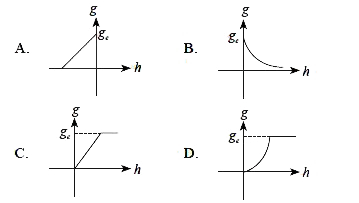
Which of the following graphs shows an approximate variation of acceleration due to gravity g with height h above the Earth's surface?
A
B
C
D
Which of the following graphs shows an approximate variation of acceleration due to gravity g with depth h below the Earth's surface?
A
B
C
D
At what height above the earth’s surface would the acceleration due to gravity be one-fourth of its value at the earth’s surface?
h = 4R
h = 2R
h = R
h = 16R
At what height h above earth, the value of g becomes g/2? (R = Radius of earth)
(2+1)R
2R
2R
(2−1)R
The ratio of the acceleration due to gravity as the bottom of a deep mine and that on the surface of the earth is 978/980. Find the depth of the mine, if the density of the earth is uniform throughout and the radius of the earth is 6300 km.
13 km
90 km
25 km
26 km
A ball is dropped from a spacecraft revolving around the earth at height of 120km. What will happen to ball ?
It will continue to move with the same speed along the original orbit of spacecraft
It will move the same speed, tangentially to the spacecraft
It will fall down to the earth gradually
It will go very far in space
The velocity with which a projectile must be fired so that it escapes earth's gravitation does not depend on
Mass of the earth
radius of the projectile’s orbit
Gravitational constan
The escape velocity for a body projected vertically upwards from the surface of earth is approximately 11 km/s. If the body is projected at an angle of 450 with the vertical, the escape velocity will be
11 km/s
11 2 km/s
211 km/s
22 km/s
The escape velocity from the earth is 11.2 km/s, the mass of another planet is 1000 times of mass of earth and its radius is 10 times the radius of earth. The escape velocity for the planet is
11200 km/s
11.2 km/s
112 km/s
56 km/s
The mass of the moon is 1/81 of earth's mass and its radius 1/4 that of the earth. If the escape velocity from the earth's surface is 11.2 km/sec. its value from the surface of the moon will be
5.0 km/s
0.14 km/s
2.5 km/s
0.5 km/s
The minimum energy required to take a m kg satellite from earth's surface in a circular orbit at a height of 2R from the surface of earth where R is the radius of earth, will be:
65mgR
56mgR
125mgR
32mgR
If the orbital radius of the earth is made 4 times, then find the duration of the year if earlier it was T?
T
2T
4T
8T
Two satellites of masses m1 and m2 (m1>m2) are revolving around the earth in a circular orbit of radii r1 and r2 (r1 > r2), respectively. Which of the following statements is true regarding their speeds v1 and v2?
v1 = v2
v1 > v2
v1 < v2
v1≤v2

