
 Worksheets
Unit 3 Midterm Review
Total questions: 118
Worksheet time: 2hrs 30mins

Which scientist was the first person responsible for proposing the idea of atoms?
Democritus
John Dalton
Ernest Rutherford
J.J. Thomson
Niels Bohr

Which scientist was the first person responsible for proposing the discovery of the electron?
Democritus
John Dalton
Ernest Rutherford
J.J. Thomson
Niels Bohr

Which scientist was the first person responsible for proposing the discovery of the nucleus?
Democritus
John Dalton
Ernest Rutherford
J.J. Thomson
Niels Bohr

Which scientist claimed that the atom was a small, dense, solid sphere?
Democritus
John Dalton
Ernest Rutherford
J.J. Thomson
Niels Bohr

Which scientist's model is referred to as the Plum Pudding Model?
Democritus
John Dalton
Ernest Rutherford
J.J. Thomson
Niels Bohr

Which scientist's model is referred to as the Planetary model?
Democritus
John Dalton
Ernest Rutherford
J.J. Thomson
Niels Bohr

Which scientist proposed the idea that the electrons orbited the nucleus on fixed paths with designated energies?
Democritus
John Dalton
Ernest Rutherford
J.J. Thomson
Niels Bohr
Which scientist proposed that the atom was indivisible using the word "atomos"?
Democritus
John Dalton
Ernest Rutherford
J.J. Thomson
Niels Bohr

Which model of the atom is the most up to date model?
The Billiard Ball Model
The Plum Pudding Model
The Planetary Model
The Quantum Mechanical Model
The Nuclear Model

Which model of the atom describes the location of electrons as probable within a dense "cloud" surrounding the nucleus of an atom?
The Billiard Ball Model
The Plum Pudding Model
The Planetary Model
The Quantum Mechanical Model
The Nuclear Model
What is the atomic number?
the number of protons in the nucleus
the number of protons and neutrons in the nucleus
the number of neutrons in the nucleus
the number of protons in the energy levels
What is the mass number?
the number of protons in the nucleus
the number of protons and neutrons in the nucleus
the number of neutrons in the nucleus
the number of protons and electrons in the atom
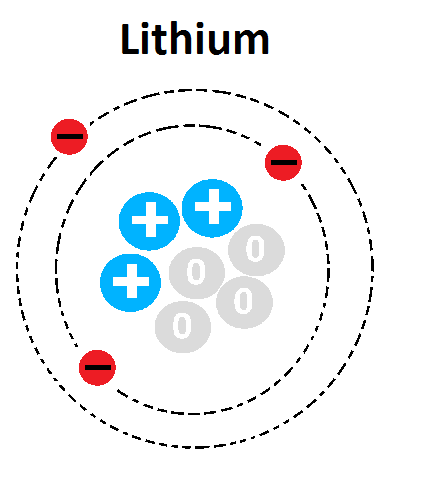
What is the atomic number of this atom?
1
3
4
7
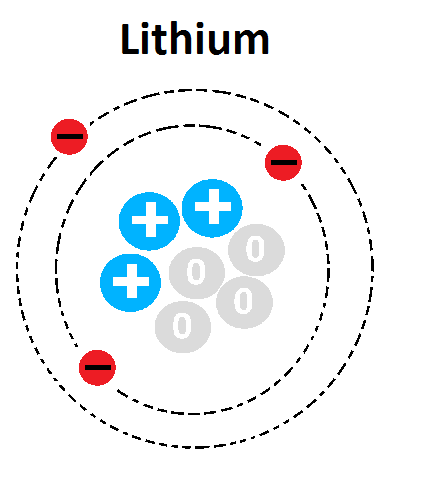
What is the mass number of this atom?
1
3
4
7
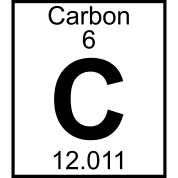

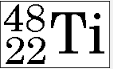
What does the 6 represent?
Atomic mass
atomic number
chemical symbol
element name
An atom has 10 protons, 15 neutrons and 10 electrons what is its mass number.
20
10
35
25
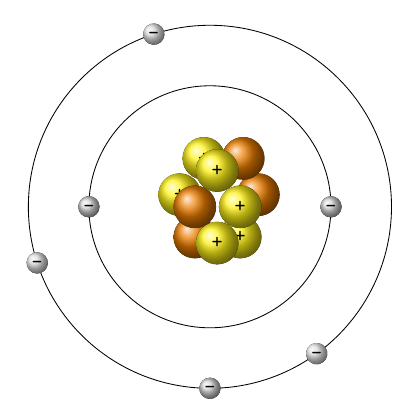
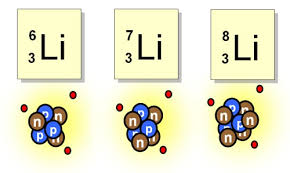
How many electrons does this atom have?
2
4
6
10




What is the charge of a sodium ion?
+2
+1
-1
-2


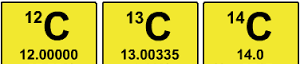
What is the average mass of this element?

Calculate the average atomic mass of the element iron (Fe) using the following data:
[Isotope / % abundance]
[Iron 54 / 6% ] [Iron 56 / 92% ] [ Iron 57 / 2% ]
53.7 amu
54.9 amu
5592.0 amu
55.9 amu
What happens to the atomic numbers as you move from left to right on the periodic table?
Increase
Decrease
Stay the same
Nothing
Which of the following elements is most likely to have similar properties to those of sodium (Na)?
Magnesium (Mg)
Sulfur (S)
Francium (Fr)
Titanium (Ti)
If an element has 117 protons which group will it be in on the periodic table?
1
7
11
17
Which element is located in group 3?
Yttrium (Y)
Carbon (C)
Sodium (Na)
Lithium (Li)
Which element is located in period 4?
Zirconium (Zr)
Silicon (Si)
Beryllium (Be)
Iron (Fe)
Two elements that have similar physical and chemical properties are most likely in the same...
period
row
group
Which element is most likely to have three electron energy levels?
Argon (Ar)
Lithium (Li)
Boron (B)
Europium (Eu)
Which element is most likely to have six electrons in its 4th energy level?
Oxygen (O)
Selenium (Se)
Krypton (Kr)
Potassium (K)
In which group would an element that is not reactive most likely be located?
1
2
16
18
In which group would an element that is very reactive most likely be located?
1
5
15
18
In which group would an element that is a gas most likely be located?
1
3
12
18
Which of the following elements is most likely a poor conductor of electricity?
Beryllium (Be)
Gold (Au)
Phosphorus (P)
Copper (Cu)
elements that are shiny, malleable, ductile, and good conductors of heat and electricity
metals
nonmetals
metalloids
semiconductors
metals that can be hammered and rolled into sheets
malleable
ductile
metallic luster
ions
metals that can be drawn into wires
malleable
ductile
metallic luster
ions
Which family is found to the left of the stair step line?
metals
nonmetals
metalloids
semiconductors
In ionic bonding, metals become the ___________ ion
postive
negative
In ionic bonding, nonmetals become the ______ ion
postive
negative
charged particles with more or fewer electrons than the neutral atom
metallic bonding
ions
ionic bond
isotopes
Which elements are shiny?
metals only
nonmetals only
metals and nonmetals
metals and MAYBE metalloids

Which elements are to the right of the zig zag?
metals
nonmetals
metalloids

Sulfur is considered:
malleable
brittle
ductile
a good conductor
How did you find out if an element is a good conductor?
it lit up a light bulb
hit it with a hammer
bubbled in the presence of acid
turned black
copper can be used to make statues like the statue of liberty
therefore copper is malleable
therefore copper is ductile
therefore copper is shiny
therefore copper is a conductor

Which elements are colored red?
nonmetals
metals
metalloids

Which of the following elements is an alkali metal?
calcium
magnesium
mercury
sodium
In Mendeleev's periodic table, elements in each column had similar
atomic masses.
properties.
atomic numbers.
symbols.
The three main groups of elements are metals, nonmetals, and
inert gases.
alkali metals.
radioactive isotopes.
semiconductors/metalloids.
Most elements are
metals.
nonmetals.
metalloids.
semiconductors.
The order of elements in the modern periodic table is based on an element's
atomic number.
name.
chemical symbol.
atomic mass.
Metals tend to be
gases.
dull.
brittle.
good conductors.
Which group is very stable due to the fact that they have a full outermost energy level?
alkali metals
halogens
alkaline-earth metals
noble gases
Which of the following is a property of group 18 elements?
malleable
brittleness
high electrical conductivity
unlikely to react with other elements
Based on its location on the periodic table, which of these elements most likely has physical and chemical properties most similar to boron (B)?
magnesium (Mg)
aluminum (Al)
neon (Ne)
chlorine (Cl)
Alkali metals are extremely reactive because they
have every small atomic masses.
are not solid at room temperature.
have one valence electron that is easily removed to form a positive ion.
have two valence electrons that form compounds with calcium and magnesium.
Which atom has the largest atomic radius?
potassium
rubidium
francium
cesium
Which statement correctly and completely identifies a trend?
Atomic radius decreases across a period and increases down a group.
Electronegativity decreases across a period and decreases down a group.
Ionization energy increases across a period and increases down a group.
Ionic radius increases across a period and increases down a group.
Ra, Be, Ca, Rb, H
N or C?

