

wayground logo

Free Printable Worksheets

Font size

S
M
L
XL
Worksheets

Semester Review

Total questions: 63

Worksheet time: 3hrs 45mins

Name
Class
Date
1.
Which is NOT a step of the scientific method?
a)
hypothesis
b)
draw conclusions
c)
observations
d)
identify boundaries
2.
Which is an example of a hypothesis
a)
The plant will grow.
b)
The plant died after 5 days.
c)
Water the plant with 1/2 cup of water per day.
d)
The plant in the sunlight will grow faster than the plant in the dark.
3.
Which is not part of a typical lab report?
a)
Materials
b)
Results
c)
Works Cited page
d)
Conclusion
4.
What is a controlled variable?
a)
The condition kept constant so as not to confuse results.
b)
The variable responding to the changes being made.
c)
The variable that changes throughout the experiment.
d)
The tools used in the experiment.
5.
What does the arrow mean in a food chain?
a)
Who is eating who
b)
The passing of energy
c)
The highest consumer
d)
The direction that water is passed
6.
Which is an example of a producer?
a)
Rabbit
b)
Corn
c)
Deer
d)
Wolf
7.
The top of the food chain is likely to be a...
a)
omnivore
b)
herbivore
c)
carnivore
d)
none of these
8.
Trophic level means...
a)
Located in the tropics
b)
Food level
c)
Energy level
d)
Award-winning
9.
How is a food web different from a food chain?
a)
It shows a more balanced ecosystem
b)
It shows how organisms can get food from various sources
c)
It includes all of the organisms and what they eat
d)
All of the above
10.
What happens to the primary consumer if the producer decreases?
a)
it will increase
b)
it will decrease
c)
it will remain the same
11.
What happens to the secondary consumer if the quaternary consumer increases?
a)
it will decrease
b)
it will increase
c)
it will stay the same
12.
What is carrying capacity?
a)
The lowest amount of consumers that can eat the producers
b)
The biggest size of an organism in the ecosystem
c)
The maximum number of individuals of that species that can be supported by the ecosystem.
d)
The highest number of predators in an ecosystem.
13.
Which cycle is most directly affected by the burning of fossil fuels?
a)
nitrogen
b)
carbon-oxygen
c)
water
d)
phosphorus
14.
Which nutrient present in our air is unusable unless it is converted into another form in the soil?
a)
nitrogen
b)
carbon-oxygen
c)
water
d)
phosphorus
15.
How do organisms survive natural selection?
a)
adapt and reproduce
b)
do not adapt to environment
c)
migrate to a new area
d)
destroy other organisms' habitats
16.
Divergent evolution is...
a)
organisms that adapt to become more alike
b)
organisms that do not adapt and die off
c)
organisms that start from a common ancestor and adapt to become more different
d)
organisms that migrate to new areas
17.
Convergent evolution is...
a)
organisms that adapt to become more alike
b)
organisms that do not adapt and die off
c)
organisms that start from a common ancestor and adapt to become more different
d)
organisms that migrate to new areas
18.
Which structures are found in organisms that came from a common ancestor?
a)
homologous
b)
analogous
c)
selective
d)
convergent
19.
How do scientists use uranium or carbon dating as it relates to fossils?
a)
To find fossils
b)
To identify fossils
c)
To determine the age of fossils
d)
To name unknown fossils
20.
Which lists the levels of classification in the correct order from most broad to most specific?
a)
Domain, Kingdom, Phylum, Class, Order, Family, Genus, Species
b)
Domain, Order, Family, Species, Class, Phylum, Genus, Kingdom
c)
Kingdom, Phylum, Class, Family, Order, Genus, Species, Domain
d)
Kingdom, Domain, Phylum, Class, Order, Family, Genus, Species
21.
What organic molecule provide short term energy for us?
a)
lipids
b)
proteins
c)
carbs
d)
nucleic acid
22.
What is the correct order of levels of organization that make up an organism?
a)
organ, organ system, cell, tissue
b)
cell, organ, tissue, organ system
c)
cell, tissue, organ, organ system
d)
organ, tissue, organ system, cell 
23.
When the volume increases from 0.4 to 0.5 the rate of reaction
a)
increases
b)
decreases
c)
both increase and decreases
d)
remains the same
24.
What is an function of an enzyme?
a)
to increase the rate of a reaction
b)
to increase the synthesis of proteins 
c)
to increase the synthesis of mRNA
d)
to reduce digestion 
25.
The shape of an enzyme determines its
a)
function
b)
growth
c)
size
d)
concenration 
26.
An enzyme is a 
a)
lipid
b)
messanger
c)
catalyst
d)
timer
27.
Photosythesis is a process that occurs in the 
a)
mitochondria
b)
chloroplast
c)
cytoplasm
d)
nucleus
28.
Cellular respiration occurs in the 
a)
mitochondria
b)
chloroplast
c)
cytoplasm
d)
nucleus
29.
All of these organisms contain mitochondria execpt
a)
animals
b)
fungus
c)
plants
d)
bacteria
30.
What is the function of mitochondria?
a)
 to allow cells make its own food
b)
to process fats
c)
to package proteins
d)
to convert energy from food into ATP
31.
What is the function on chloroplast
a)
To convert carbs to fat
b)
To package proteins
c)
To allow cells make thier own food
d)
To convert energy from food to ATP
32.
What statement support the endosymbiotic theory?
a)
Mitochondra nad chloroplast share some common features with bacteria
b)
Eukaryotes eat bacteria for energy to evolve
c)
Bacteria infect eukaryotic cells 
d)
Bacteria are eukaryotic 
33.
If fever, headaches, and body aches occur withing two to seven days after an viral infection occurs what type of virus reproductive cycle is occuing?
a)
lytic, because of quick onset of symptoms
b)
lysogenic, because virus affect the young and old worse
c)
lytic, because the virsus causes illness
d)
lysogenic, because this is a coronavirus virus
34.
If a person is infected with the HIV virus they may not have symptoms for a long time. During the period between infection and the onset of symptoms what is occuring in the body?
a)
The virus changes some of the nucleotides of the immune system to prevent the immune system from working well
b)
The virus uses the glucose  from the immune cells for fuel
c)
The virus damages immune cells while using thier machinery to produce more virus cells
d)
The virus will produce a toxin that will weaken the immune cells so they can't reproduce
35.
How does a vaccine keep people from getting sick with the flu virus?
a)
The vaccine cause memory  cells to be produced for that specific type of flu. When the body comes into contact with the flu memory cells will react quickly to distroy the virus 
b)
The vaccine cause the host cell to produce antiviral toxins, which will constantly be released to distroy the virus cell beofer the white bloods cells react
c)
THe vaccine will the person a mild case of the flu. Becuase the person already has an active flu virus they can not be infect again with another flu virus
d)
The vaccine will stop the flu form cuasing the host cells to become pathogenic bacteria, which is the source of symptoms because the bacterai damages the respiratory system
36.

What is the key role (function) of carbohydrates?

a)

energy storage

b)

immunity, muscles, structure for tissues, cell metabolism

c)

instant energy for cells and body functions

d)

genetic information (heredity)

37.

Lipids key role (function ) is:

a)

immunity, chemical reactions in the body, cell metabolism, contract muscles, regulate other proteins

b)

store energy

c)

instant energy for cells/body

d)

heredity/genetic information

38.

Carbohydrates are more digestible than lipids.

a)

True

b)

False

39.

How how carbohydrates and lipids similar?

a)

both contain C, H, O, N, P and store energy

b)

both contain C, H, O, N and give energy

c)

both contain C, H, O, N, S and store energy

d)

both contain C, H, O and give energy

40.

Which organelle is known as the "powerhouse" of the cell because it converts energy in food molecules to energy the cell can use to carry out its functions?

a)

Mitochondria

b)

Chloroplasts

c)

Lysosomes

d)

Vacuoles

41.

What are the three things that all cell types have in common?

a)

Nucleus

b)

Genetic Material

c)

Cell Wall

d)

Cell Membrane

e)

Cytoplasm

42.

The 3 parts of the Cell Theory are...?

a)

All living things are composed of cells

Cells are the basic units of structure and function in living things

All cells are produced from other cells

b)

All living things are composed of cells

Cells are the basic units of dance and vibes in living things

All cells are destroyed from other aliens

c)

All living things are composed of Jell-O

Cells are the basic units of structure and function in living things

All cells are produced from factories in Canada

d)

All living things are composed of cells

Cells do karate and practice eating whole pies in their free time

All cells are produced from other cells
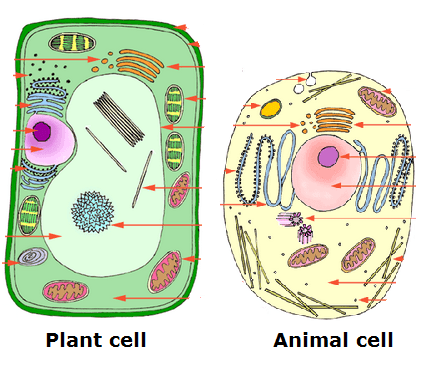
43.

What distinguishes a plant cell from an animal cell? (How do you tell them apart) Hint: There's 3 ways (Check all 3)

a)

Central Vacuole

b)

Mitochondria

c)

Cell Wall

d)

Ribosomes

e)

Chloroplasts

44.

These foods contain A LOT of which Bio-molecule that our body LOVES to use for Energy?

a)

Protein

b)

Nucleic Acids

c)

Baconidis

d)

Carbohydrates

45.

Our bodies use this Bio-molecule as it's building material. Often found in meats, eggs, and dairy products.

a)

Carbohydrates

b)

Proteins

c)

Lipids

d)

Baconidis

46.

Cellular Respiration occurs within me and I am in BOTH plant and animal cells. I am a....

a)

Nucleus

b)

Golgi Body

c)

Cytoskeleton

d)

Mitochondria

47.

I like to be thought of as the "storage bubble" for both plant and animal cells. I am a...

a)

Cell Membrane

b)

Cytoskeleton

c)

Vacuole

d)

Endoplasmic Reticulum

48.

Photosynthesis takes place within me. I am a...

a)

Mitochondria

b)

Cell Wall

c)

Chlorine

d)

Chloroplast

49.
What process occurs when WATER diffuses across a membrane?
a)
endocytosis
b)
mitosis
c)
osmosis
d)
nuclear fission 
50.

Animal and Plant Cells are...

a)

Shopkoytes

b)

Eukaryotes

c)

Prokaryotes

d)

The building blocks of non-living things

51.
What does “high concentration area” mean?
a)
Spread out
b)
Tightly packed together
c)
Uncrowded
d)
Spacious
52.
Which way will the water molecules move during osmosis?
a)
Out of the cell, so the cell shrinks.
b)
Out of the cell, so the cell swells.
c)
Into the cell, so the cell shrinks.
d)
Into the cell, so the cell swells.
53.
Passive transport requires no
a)
concentration gradients
b)
osmosis
c)
motion
d)
energy
54.

The diffusion of particles through the cell membrane from high to low concentration is called ....

a)

exocytosis

b)

active transport

c)

passive transport

d)

osmosis

55.
What does selectively-permeable mean?
a)
The cell controls what passes in and out of the cell
b)
Nothing gets through
c)
The cell lets only large substances through
56.
A chemical equation shows:
reactant + ________ -----> product + ___________.
a)
reactant  /  product
b)
product  /  reactant
c)
reactant  /  reactant
d)
product  /  product
57.
In which process is energy a product?
a)
Photosynthesis
b)
Cellular respiration
58.
Which Chemical Reaction?
Carbon dioxide, water and sunlight become oxygen and glucose
a)
Photosynthesis
b)
Fermentation
c)
Cellular Respiration
59.
What are products in photosynthesis?
a)
oxygen and carbon dioxide
b)
carbon dioxide and water
c)
glucose and oxygen
d)
sunlight and oxygen
60.
Which cell process is represented by this equation:
C6H12O6 + 6O2 →          6CO2  +  6H2O +  ATP
a)
diffusion
b)
photosynthesis
c)
cell respiration
d)
mitosis
61.
Which of the following is the correct equation for PHOTOSYNTHESIS?
a)
6CO2 + 6H2O --> 6O+ C6H12O6
b)
6CO+ C6H12O6 + 6H2O --> O
c)
6O2 + 6H2O --> 6CO+ C6H12O6
d)
C6H12O6 + 6O2 ---> 6H2O + 6CO2 
62.
In respiration, how is chemical energy stored?
a)
ATP
b)
Glucose
c)
Oxygen
d)
Carbon Dioxide
63.
The main purpose of Cellular Respiration is to
a)
make carbon dioxide
b)
make water
c)
make glucose
d)
make ATP
