wayground logo

Free Printable Worksheets

Font size

S
M
L
XL
Worksheets

Earth Systems Final Review 1st Semester

Total questions: 115

Worksheet time: 3hrs 32mins

Name
Class
Date
1.
how many meters are in 1 kilometer?
a)
10 m
b)
100 m
c)
1,000 m
d)
10,000 m
2.
20 cm = ______ m
a)
20 m 
b)
0.2 m
c)
0.002 m
d)
2,000 
3.
6 g = ________ kg
a)
60 kg
b)
600 kg
c)
6,000 kg
d)
0.6 kg
4.
To find the volume of a rock, a student submerges the rock in beaker and finds the difference between the initial volume and the final volume. What is this process called?
a)
volume by displacement
b)
volume by gravity
c)
mass by volume
d)
weight
5.
19 ml = _______ cl
a)
1.9 cl
b)
19 cl
c)
190 cl
d)
0.19 cl
6.

The SI unit for measuring length is the __________.

a)

meter

b)

kilogram

c)

liter

d)

Newton

e)

second

7.

The SI unit for mass is the ___________.

a)

meter

b)

kilogram

c)

liter

d)

second

e)

Newton

8.

The SI unit for volume is the __________.

a)

meter

b)

kilogram

c)

liter

d)

second

e)

Newton

9.

The SI unit for time is the __________.

a)

meter

b)

kilogram

c)

liter

d)

second

e)

Newton

10.

To change milligrams to grams, move the decimal place...

a)

3 to the right.

b)

3 to the left.

c)

2 to the right.

d)

1 to the left.

11.

To change kilometers to meters, move the decimal place...

a)

3 to the right.

b)

3 to the left.

c)

2 to the right.

d)

1 to the left.

12.

To change cm to m, move the decimal place...

a)

3 to the right.

b)

3 to the left.

c)

2 to the left.

d)

1 to the right.

13.

To change ms to s, move the decimal place...

a)

3 to the right.

b)

3 to the left.

c)

2 to the right.

d)

1 to the left.

14.

Convert 323 m to km.

a)

0.323 km

b)

3.23 km

c)

323,000 km

d)

3,230 km

15.

Convert 1.98 ms to s.

a)

0.00198 s

b)

198 s

c)

1,980 s

d)

0.0198 s

16.

Convert 0.75 L to mL.

a)

750 mL

b)

75 mL

c)

75,000 mL

d)

0.0075 mL

17.

Convert 8,562 cm to km.

a)

0.08562 km

b)

8,562,000 km

c)

8.562 km

d)

85,620 km

18.
According to the pie chart, the United States relies on fossil fuels for about what percentage of its energy?
a)
30%
b)
45%
c)
60%
d)
80%
19.
According to the pie chart, the United States relies on fossil fuels for about what percentage of its energy?
a)
30%
b)
45%
c)
60%
d)
80%
20.
Which of the following best describes the motion of the squirrel between 5 s and 8 s? 
a)
The squirrel's speed increased.
b)
The squirrel's speed decreased.
c)
The squirrel's speed did not change.
d)
The squirrel moved backward.
21.
What is the control for the experiment? 
a)
the thing being tested
b)
the normal situation
c)
what we measure in the end
d)
what we change 
22.
What is a constant? 
a)
the normal situation
b)
the thing we measure in the end
c)
the thing we are testing
d)
the thing we keep the same for every part of the experiment
23.
The graph shows the results of a survey to determine student's favorite pets. Why is this graph misleading?
a)
The slices are the wrong color
b)
The slices are not the correct size
c)
The percents do not add up to 100
d)
Not misleading
24.
The Independent/Manipulated Variable goes on the ___ axis
a)
x
b)
y
25.
The Dependent/Responding Variable goes on the ___ axis
a)
x
b)
y
26.
Which type of graph would you create for this data table?
a)
Bar
b)
Line
27.
Which type of graph would you create for this data table?
a)
Bar
b)
Line
28.
If I was only going to graph the data for the Amoebae, which would go on the x-axis?
a)
Type of biocrust
b)
# of Amoebae
29.
Which would go on the y-axis?
a)
Time
b)
# of Bacteria 
30.

Which planet is the closest planet to the sun?

a)

Mercury

b)

Venus

c)

Mars

d)

Pluto

31.
What is similar about all of the Outer Planets?
a)
small
b)
large
c)
few moons
d)
takes a short amount of time to go around the sun
32.
Which planet is the largest?
a)
Jupiter
b)
Saturn
c)
Neptune
d)
Uranus
33.
Besides Pluto, which planet is the smallest?
a)
Mercury
b)
Venus
c)
Earth 
d)
Mars
34.

The "Great Red Spot" is a storm on which planet?

a)

Earth

b)

Mars

c)

Jupiter

d)

Saturn

35.
They are small and have rocky bodies. 
a)
this describes the inner planets 
b)
this describes the outer planets 
36.
Hydrogen and Helium make up the _______.
a)
Inner Planets 
b)
Gas gaints
c)
Middle Planets 
d)
Terrestrial Planets 
37.
Geocentric model is where ____ is at the center.
a)
Sun
b)
Earth 
38.
Heliocentric is where the ____is at the center. 
a)
Earth
b)
Sun
39.
Earth is the 3rd planet from the Sun. 
a)
True
b)
False
40.
Terrestrial planets are usually:
a)
closer to their star than gas giants.
b)
less dense than ice giants.
c)
larger than gas giants.
d)
older than ice giants.
41.
As you move further away from the center of the solar system:
a)
the planets get smaller.
b)
the planets get less dense.
c)
the planets get warmer.
d)
all of the above.
42.
Which of the following lists the types of planets in the correct order from least dense to most dense?
a)
terrestrial, gas giant, ice giant
b)
ice giant, terrestrial, gas giant
c)
gas giant, ice giant, terrestrial
d)
gas giant, terrestrial, ice giant
43.
Based on current scientific evidence, how old is the Earth?
a)
6,000 years old
b)
460 million years old
c)
4.6 billion years old
d)
46 billion years old
44.

Earth's atmosphere is made up mostly of ______________?

a)

Oxygen

b)

Nitrogen

c)

Helium

d)

Iron

45.

What percent of Earth's surface is water?

a)

85%

b)

35%

c)

50%

d)

75%

46.
All stars begin as a __________?
a)
giant
b)
black hole
c)
white dwarf
d)
nebula
47.
Stars are formed in a large cloud of gas and dust called a
a)
cumulonimbus cloud
b)
nebula
c)
neutron star
d)
black hole
48.

The center of the nebula begins to get hot and dense. Then what?

a)

The nebula begins to spin and flatten.

b)

The SUN is born, fusion begins in the core.

c)

A protostar forms in the center of the nebula.

49.

What is the FIRST event in the formation of the solar system?

a)

About 4.5 billion years ago pieces of rock and ice accumulate more material until they grow into planets and moons.

b)

About 4.6 billion years ago, a cloud of stellar dust or nebula exists within the Milky Way.

c)

None of the above.

50.
The theory that explains the formation of the solar system is called ____.
a)
Nebulis Theory
b)
Nebular Theory
c)
Big Bang Theory
d)
Big Nebulan Theory
51.
Nebulae are primarily composed of what element?
a)
Hydrogen
b)
Helium
c)
Other hard elements
d)
Zinc
52.
the process that provides the sun with its energy
a)
solar flare
b)
Photosphere
c)
radiative zone
d)
nuclear fusion
53.

Which layer contains the gases we breathe?

a)

atmosphere

b)

lithosphere

c)

hydrosphere

d)

mesosphere

54.

Which layer contains the ground we walk on?

a)

atmosphere

b)

lithosphere

c)

hydrosphere

d)

mesosphere

55.

Which layer contains the Earth's surface water such as oceans, lakes, streams, and rivers?

a)

atmosphere

b)

lithosphere

c)

mesosphere

d)

hydrosphere

56.

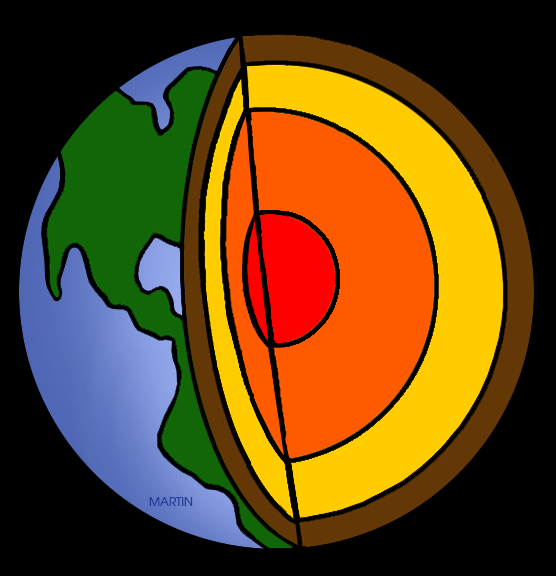
Which layer is shown in red?

a)

crust

b)

mantle

c)

outer core

d)

inner core

57.

Which layer is shown in yellow?

a)

crust

b)

mantle

c)

outer core

d)

inner core

58.

Which layer is shown in orange?

a)

crust

b)

mantle

c)

outer core

d)

inner core

59.

Which shows the order of the layers from COOLEST to HOTTEST?

a)

crust, mantle, outer core, inner core

b)

inner core, outer core, mantle, crust

c)

crust, outer core, inner core, mantle

d)

Trick question! All of the layers are the same temperature!

60.

Which layer is made (mostly) of SOLID iron and nickel?

a)

crust

b)

mantle

c)

outer core

d)

inner core

61.

Which correctly shows the 4 most abundant gasses in order from most abundant to least abundant?

a)

Nitrogen, Oxygen Argon, Carbon Dioxide, Ozone

b)

Oxygen, Nitrogen, Ozone, Carbon Dioxide, Argon

c)

Ozone, Nitrogen, Oxygen, Carbon Dioxide, Argon

d)

Oxygen, Ozone, Nitrogen, Argon, Carbon Dioxide

62.
The rock, dust, soil, and minerals of the Earth's solid crust and outer mantle make up the ____
a)
Biosphere
b)
Geosphere
c)
Cryosphere
d)
Atmosphere
63.
An investigation of the Earth’s geosphere would include the exploration of which of the following features?
a)
Glaciers, rivers, and oceans
b)
Plants, animals, and fungus
c)
Rock, soil, and sediments
d)
Nitrogen, oxygen, and carbon dioxide
64.
When a volcanic eruption spews gases and ash into the air, which two spheres are interacting?
a)
Hydrosphere and geosphere
b)
Biosphere and geosphere
c)
Geosphere and atmosphere
d)
Biosphere and atmosphere
65.
I consist of you, plants, animals, and everything that is living on earth. Which sphere am I? 
a)
Hydrosphere
b)
Biosphere
c)
Atmosphere
d)
Geosphere
66.
An example of biosphere connecting to atmosphere is...
a)
Plants produce oxygen
b)
Animals eat plants
c)
Animals live in caves
d)
Animals drink water
67.
What is the water cycle?
a)
the 3 forms of water
b)
the movement of water on, above, or below the surface of the Earth
c)
when water melts
d)
when clouds form
68.
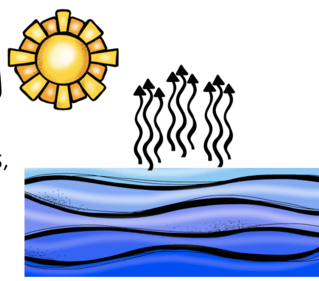
What part of the water cycle does this picture show?
a)
condensation
b)
precipitation
c)
evaporation
69.
Which is the opposite of condensation?
a)
runoff
b)
evaporation
c)
precipitation
d)
transpiration
70.
Which best explains why runoff is important?
a)
It returns water to other locations on Earth
b)
It increases the chance of flooding
c)
It makes evaporation occur faster
d)
It increases condensation
71.
Snow, sleet, hail, and rain are all examples of  ________________. 
a)
evaporation
b)
condensation
c)
accumulation
d)
precipitation
72.
What is the energy source for the water cycle?
a)
the sun
b)
the earth
c)
water
d)
the moon
73.
Evaporation happens when the sun ___________ water and turns it into vapor.
a)
cools
b)
heats up
c)
freezes
d)
lights up
74.
The water cycle has no start or end
a)
true
b)
false
75.
What is a layer of rock or sediment that holds water?
a)
glacier
b)
well
c)
aquifer
d)
natural spring
76.
Which layer or layers are impermeable?
a)
1 & 2
b)
3 & 4
c)
3
d)
4
77.
The majority of minerals, nutrients, and organic material is found in which layer?
a)
Topsoil
b)
Subsoil
c)
Partially-weathered rock
d)
Bedrock
78.
Which layer shown would have the greatest about of biologic activity?
a)
1
b)
2
c)
3
d)
4
79.
Which rock sample is impermeable?
a)
1
b)
2
c)
3
d)
4
80.
Which well will provide the best access to water?
a)
1
b)
2
c)
3
d)
4
81.
Smaller streams and rivers that feed into larger rivers are known as
a)
aquifers
b)
tributaries
c)
feeder streams
d)
springs
82.
Which layer contains organic material and humus?
a)
A
b)
B
c)
C
d)
R - Bedrock
83.
Which layer contains leached minerals, sand, silt, and clay?
a)
A
b)
B
c)
C
d)
R - Bedrock
84.
Which letter represents the zone of aeration?
a)
F
b)
G
c)
H
d)
J
85.
Which letter represents the zone of saturation?
a)
F
b)
G
c)
H
d)
J
86.
Which letter represents the water table?
a)
F
b)
G
c)
H
d)
J
87.
In order to protect groundwater near landfills, a barrier is placed between the soil and garbage. Which property should the protective barrier possess?
a)
High porosity
b)
High permeability
c)
Low permeability
d)
Low conductivity
88.
Which type of soil can hold the greatest amount of water?
a)
sand
b)
silt
c)
clay
d)
loam
89.
Wind blowing dirt and sand through the air is an example of...
a)
weathering 
b)
erosion
90.
Water gets into the cracks of rock and freezes, causing the rock to break.  What is this an example of?
a)
erosion
b)
weathering
91.
Soil is made of
a)
weathered rocks and minerals
b)
dead plants and animals
c)
air and water
d)
all of the above
92.
Humus is.....
a)
the dead parts of plants and animals in soil.
b)
A food we eat with pretzels.
c)
The tiny particles inside of soil
d)
The roots that come off of a plant and live in soil.
93.
What is the process of rocks being broken down over time called?
a)
Weathering
b)
Accumulation
c)
Condensation
d)
Evaporation
94.
Layers of soil are also known as:
a)
Soil Profiles
b)
Soil Horizons
c)
Soil sheets
d)
Soil cores
95.
This rock was another type of rock that was heated and compressed over time. What type of rock is this?
a)
Sedimentary
b)
Igneous
c)
Metamorphic
96.
This rock started as molten magma. What type of rock is this?
a)
Sedimentary
b)
Igneous
c)
Metamorphic
97.
This rock was formed by smaller pieces of rock that settled at the bottom of a lake millions of years ago. What type of rock is this?
a)
Sedimentary
b)
Igneous
c)
Metamorphic
98.
What are the 3 major types of rocks?
a)
Igneous, Metamorphic, Sedimentary
b)
Metamorphic, Igneous, Cementation
c)
magma, lava, crystals
99.

Which rock is formed form the cooling of volcanic ash on Earth's surface?

a)

intrusive igneous

b)

foliated metamorphic

c)

extrusive igneous

d)

organic sedimentary

100.

Which rock can shale transform into by heat and pressure and minerals are arranged in bands/planes?

a)

nonfoliated metamorphic

b)

foliated metamorphic

c)

organic sedimentary

d)

intrusive igneous

101.

Rocks that form from colling magma inside Earth?

a)

Igneous intrusive

b)

Igneous extrusive

c)

Metamorphic foliated

d)

Metamorphic nonfoliated

102.

40 % Sand

50% Silt

10% Clay

a)

Clay

b)

Clay Loam

c)

Silt Loam

d)

Sandy Loam

103.

70 % Sand

15% Silt

15% Clay

a)

Sandy Loam

b)

Clay

c)

Silt Loam

d)

Clay Loam

104.
What causes tectonic plates to move along the Earth's surface?
a)
wind
b)
ocean currents
c)
convection in the mantle
d)
expansion of the Earth
105.
What type of boundary occurs when two plates move away from each other?
a)
transform
b)
subduction
c)
convergent
d)
divergent
106.
What forms at a divergent boundary between two oceanic plates?
a)
rift valley
b)
mountain
c)
mid-ocean ridge
d)
trench
107.
What type of boundary occurs when two plates move toward each other?
a)
convergent
b)
divergent
c)
transform
d)
lateral
108.
What forms at a convergent boundary between a continental plate and an oceanic plate?
a)
volcanoes
b)
rift valleys
c)
faults
d)
mid-ocean ridges
109.
A rift valley occurs at a ____________ boundary.
a)
divergent
b)
convergent
c)
transform
d)
horizontal
110.
What is the process in which hot molten rock rises, then cools and sinks back to the core?
a)
plate tectonics
b)
continental drift
c)
convection
d)
divergence
111.
Mountains form at a ___________ boundary.
a)
transform
b)
divergent
c)
convergent
d)
subduction
112.
What type of boundary occurs when two plates slide past each other?
a)
divergent
b)
transform
c)
lateral
d)
convergent
113.
What type of boundary is shown at A?
a)
transform
b)
convergent
c)
divergent
d)
subduction
114.
What is the process in which two plates move toward each other but one sinks under the other?
a)
subduction
b)
convection
c)
divergence
d)
transformation
115.
What is happening at point B?
a)
subduction
b)
a divergent boundary
c)
convection
d)
an earthquake