wayground logo

Free Printable Worksheets

Font size

S
M
L
XL
Worksheets

Chemistry Midterm exam review

Total questions: 86

Worksheet time: 4hrs 34mins

Name
Class
Date
1.
The group number tells us how many _________ there are in an element.
a)
groups
b)
valence electrons
c)
energy levels
d)
chemicals
2.
The ________________ tells you how many energy levels are used in an element.
a)
group number
b)
atom
c)
protons
d)
period number
3.
The element Tellurium has the atomic mass of 127.60 and its atomic number is 52. How many neutrons are in the element Tellurium?
a)
179.60
b)
127.60
c)
52
d)
76
4.
The inner energy level can only hold ______ electrons.
a)
1
b)
0
c)
2
d)
18
5.
The characteristics or properties of metals include
a)
shiny and solid
b)
ductile and malleable
c)
lose electrons
d)
all of the above
6.
How many valence electrons do elements in group 17 have in their outer energy level?
a)
7
b)
17
c)
1
d)
0
7.
Which particle does not contribute mass to the atom?
a)
Proton
b)
Neutron
c)
Electron
d)
Nucleus
8.
Which particle contributes the negative charge to the atom?
a)
proton
b)
electron
c)
neutron
d)
nucleus
9.
Most of the mass in an atom is made up of _____________________?
a)
protons and electrons
b)
protons and neutrons
c)
neutrons and electrons
d)
electrons and quarks
10.
The tool used to measure the mass of a substance or object is a ______________.
a)
balance
b)
graduated cylinder
c)
ruler
d)
thermometer
11.
What is the volume of Object X?
a)
10.0 cm3
b)
15.0 cm3
c)
20.0 cm3
d)
25.0 cm3
12.
What is the volume of the fish?
a)
18.0 cm3
b)
6.0 cm
c)
38.0 cm3
13.
Which box has a higher density?  
a)
Box A
b)
Box B
c)
cannot be determined
d)
they are the same
14.
How many significant figures does the following number have: 0.002040
a)
6
b)
4
c)
3
d)
2
15.
How many sig figs are there?
27000000
a)
2
b)
5
c)
8
16.
Convert from meters to cm:  9 meters
a)
900 cm
b)
90 cm
c)
0.9 cm
d)
0.09 cm
17.
Convert 5 cm to mm:
a)
5,000mm
b)
0.5 mm
c)
0.05 mm
d)
50 mm
18.
1000 grams = _____ kilograms
a)
0.0001
b)
1,000,000
c)
10
d)
1
19.
Is 20 g greater than, less than, or equal to 2 kg?
a)
greater than
b)
less than
c)
equal to
20.
648 g = ____ mg
a)
6,480
b)
64,800
c)
648,000
d)
64.8
21.
0.57 mL = ___________ L
a)
5.7
b)
0.057
c)
0.0057
d)
0.00057
22.
0.932 g = ___________ mg
a)
9.32
b)
93.2
c)
932
d)
9,320
23.
 56 L = ___________ mL
a)
560
b)
5,600
c)
56,000
d)
560,000
24.

At what point is the substance solid?

a)

1

b)

2

c)

3

d)

4

e)

5

25.

At what point is the substance liquid?

a)

1

b)

2

c)

3

d)

4

e)

5

26.

At what point is the substance gas?

a)

1

b)

2

c)

3

d)

4

e)

5

27.

At what point is the substance melting or freezing?

a)

1

b)

2

c)

3

d)

4

e)

5

28.

At what point is the substance vaporizing or condensing?

a)

1

b)

2

c)

3

d)

4

e)

5

29.
Which state of matter?
a)
Solid
b)
Liquid
c)
Gas
d)
Texas
30.
Which state of matter?
a)
Solid
b)
Liquid
c)
Gas
d)
Texas
31.
Which state of matter?
a)
Solid
b)
Liquid
c)
Gas
d)
Texas
32.

The positive particles of an atom are

a)

electrons

b)

positrons

c)

neutrons

d)

protons

33.

An atom with atomic number 6 would have how many protons

a)

6

b)

12

c)

3

d)

cannot be determined

34.

Particles in an atom that are neutral and have no charge are

a)

negatrons

b)

electrons

c)

neutrons

d)

protons

35.

True or False: Neutrons have a negative charge

a)

True

b)

False

36.

What is the atomic number for an element with 3 protons?

a)

2

b)

1

c)

3

d)

6

37.

A particle that moves around the nucleus is a(n)...

a)

Proton

b)

Neutron

c)

Electron

d)

Quark

38.

In the modern periodic table, elements are arranged by:

a)

atomic mass

b)

atomic number

c)

valence electrons

d)

number of isotopes

39.

What does the 1.00794 stand for?

a)

Hydrogen

b)

atomic number

c)

atomic mass

d)

atomic explosion

40.

What subatomic particles would you find in the nucleus of an atom?

a)

Protons only

b)

Protons and Neutrons

c)

Neutrons and Electrons

d)

Protons and Electrons

41.

If an atom has 10 protons, 10 neutrons, and 10 electrons, what is the mass of the atom?

a)

10

b)

20

c)

30

42.

What particle uniquely identifies an element?

a)

Number of Valence Electrons

b)

Number of Protons

c)

Number of Electrons

d)

Atomic Mass

43.

Most of the mass in an atom is concentrated in the...

a)

electrons

b)

nucleus

c)

protons

d)

empty space

44.

What are the 3 subatomic particles of an atom?

a)

carbon atom, proton, electron

b)

quarks, neutrons, protons

c)

nucleus, protons, electrons

d)

protons, neutrons, electrons

45.
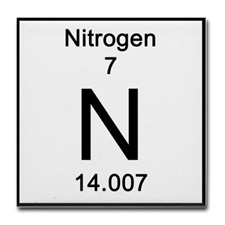
What is the number of protons that the element in this image contain?
a)
14
b)
7
c)
15
d)
18
46.
What is the atomic mass of "F"
a)
9
b)
18
c)
17
d)
19
47.
a)
2
b)
8
c)
3
d)
13
48.
a)
2
b)
6
c)
10
d)
16
49.
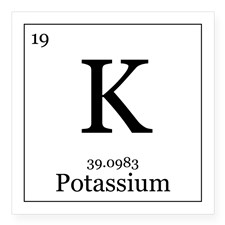
How many neutron are in the atom "K"?
a)
7
b)
2
c)
39
d)
20
50.

What does the number 11 stand for in the Sodium block?

a)

atomic number

b)

atomic weight

c)

Stranger Things

51.

What does the K stand for in the Potassium block?

a)

Atomic number

b)

Atomic weight

c)

Symbol for the atom

52.
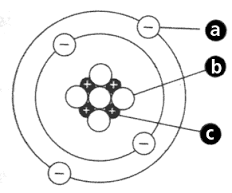
What part of the atom is the arrow pointing to?
a)
nucleus
b)
proton
c)
electron shell
d)
electron
53.
B and C are found in the ______ of an atom.
a)
Energy levels
b)
Space
c)
Nucleus
d)
Outside
54.
Which of these is the electron?
a)
A
b)
B
c)
C
d)
D
55.
Which of these is the proton.
a)
A
b)
B
c)
C
d)
None
56.
Ions are: 
a)
atoms with a positive or negative charge
b)
atoms with no charge
c)
atoms with ONLY a positive charge
d)
atoms with ONLY a negative charge
57.
When an atom loses a valence electron, it becomes a(n) _____________ ion.
a)
positive
b)
negative
c)
neutral
d)
polyatomic
58.
Negative ions form when atoms _________ valence electrons.
a)
lose
b)
gain
c)
share
59.
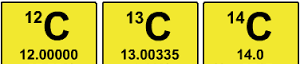
What do these isotopes of carbon all have in common?
a)
neutrons & mass number
b)
atomic number and neutrons
c)
atomic number and electrons
d)
protons, atomic number, and mass number
60.
How many neutrons does the isotope of lithium have?
a)
8
b)
3
c)
4
d)
5
61.
Four isotopes of lead include lead-204, lead-206, lead-207, and lead-208.  The average atomic mass of lead is 207.2.  Which isotope of lead is likely to be the most abundant.
a)
204
b)
206
c)
207
d)
208
62.
An atom is electrically neutral when
a)
protons and neutrons are the same
b)
protons and electrons are the same
c)
neutrons and electrons are the same
d)
neutrons balance the protons and electrons
63.
If the number of electrons in an atom changes you make a(n) __________________.
a)
ion
b)
isotope
c)
new element
d)
isomer
64.
How many electrons are in an atom that has an atomic number of 34, an atomic mass of 74 and a charge of -2?
a)
34
b)
36
c)
2
d)
40
65.
How many carbon atoms (C) are in a COmolecule?
a)
1
b)
2
c)
3
d)
0
66.
How many Oxygen atoms (O) are in a  molecule  of CO2
a)
1
b)
2
c)
3
d)
0
67.
The small number to the right of an elemental symbol  ( H2) is called?
a)
 a subscript 
b)
a coefficient 
c)
a variable 
d)
a divisor 
68.
When a molecule is made up of more than two different elements ( Example CO2)  we call this .......................
a)
a mixture 
b)
atom
c)
a compound 
69.
How many elements are in C6H12O6?
a)
1
b)
2
c)
3
d)
4
70.
How many atoms are there TOTAL in:
H2SO4
a)
6
b)
5
c)
7
d)
3
71.
What is the formula for aluminum fluoride?
a)
AlF
b)
Al2F3
c)
AlF3
d)
Al3F2
72.
A chemical bond resulting from the electrostatic attraction between positive and negative ions is called a(n)
a)
covalent bond.
b)
ionic bond.
c)
charged bond.
d)
dipole bond.
73.
How many valence electrons does a bromine atom have?
a)
1
b)
2
c)
6
d)
7
74.
AgF
a)
silver fluoride
b)
silver fluorine
c)
monosilver monofluoride
d)
silver monofluorine
75.
How do the following two elements bond together?
Al3+  O2-         
a)
AlO
b)
Al2O3
c)
Al3O6
d)
Al3O2
76.
When metals bond with non-metals they form what type of bonds
a)
covalent
b)
ionic
c)
cooperative
d)
lewis
77.
If my charge becomes 2+ what does that say about me?
a)
I am stealing 2 electrons
b)
I am losing 2 electrons
c)
I am in period 2
d)
I have an atomic # of 2
78.
If I gain electrons I become
a)
Positive because I've added to my atom
b)
negative because I've added electrons
c)
same because i'm balanced
d)
equal because now I have electrons
79.
Metals tend to 
a)
gain electrons
b)
lose electrons
80.
What is the correct formula for the compound, lithium oxide?
a)
LiO
b)
Li2O
c)
LiO2
d)
Li2O2
81.
What do Roman Numerals represent in the name of a transition metal compound?
a)
how many atoms of the metal there are
b)
the oxidation number of the nonmetal
c)
the oxidation number of the metal
d)
the mass number
82.
What do Roman Numerals represent in the name of a transition metal compound?
a)
how many atoms of the metal there are
b)
the oxidation number of the nonmetal
c)
the oxidation number of the metal
d)
the mass number
83.
Where are the Roman Numerals located in a transition metal compound?
a)
after the anion
b)
before the cation
c)
between the cation and anion
d)
they are not used for transition metals
84.
The name for CrN:
a)
Chromium nitride
b)
Chromium (I) nitride
c)
Chromium (III) nitride
d)
Chromium nitride (III)
85.
Which is the Roman Numeral for +3?
a)
I
b)
II
c)
III
d)
+III
86.
The name of Cu₃N₂ is
a)
copper (III) nitride
b)
copper (II) nitride
c)
copper nitride
d)
tricopper dinitride