wayground logo

Free Printable Worksheets

Font size

S
M
L
XL
Worksheets

PreAP Biology Final Review

Total questions: 175

Worksheet time: 6hrs 50mins

Name
Class
Date
1.
When in the lab...
a)
long sleeves and loose clothing should be rolled up
b)
closed toe shoes should be worn
c)
long hair should be pulled back
d)
all of the above
2.

You are heating a substance in a test tube. Always point the open end of the tube

a)

toward yourself

b)

toward your lab partner

c)

toward another classmate

d)

away from all people

3.

When gathering glassware and equipment for an experiment, you should

a)

use a beaker to drink water

b)

carry as much as you can at one time

c)

stack the glassware to carry it

d)

examine all glassware to check for chips and cracks

4.

What is the correct attire for lab dissections?

a)

Closed toed shoes, if you have long hair it must be tied back, pants to cover legs fully, apron on, and gloves on

b)

Any shoes are acceptable, with no restrictions on hair, and it’s optional to wear apron and gloves

c)

Closed toed shoes, if you have long hair you have the options to tie it up, legs do not need to be covered as long as apron and gloves are worn

d)

Any shoes are acceptable, with all long hair tied up, with apron and gloves on but legs do not need to be covered

5.
When experimenting with the growth of a plant, a scientist uses three (of the same type of) plants, two different fertilizers, equal light, and equal water. What type of variable is the fertilizer?
a)
Dependent
b)
Independent
c)
Control
d)
Compound
6.
An experiment is performed on plants to see how different liquids affect plant growth. Each plant in the experiment is given a different liquid; water, apple juice, or milk. Each plant has the same amount of soil, sunlight, and listens to the same music. In this investigation, what is the dependent variable?
a)
Type of plant
b)
Water, apple juice, milk
c)
Plant growth
d)
Color of the plant's leaves
7.
Dependent variable means
a)
the scientist controls what to test
b)
educated guess
c)
ask a question
d)
what is being measured
8.
An experiment is performed on plants to see how different liquids affect plant growth. Each plant in the experiment is given a different liquid: water, apple juice, or milk. What variables should be kept constant/controlled? 
a)
type of plant, flower pot,  soil, and amount of sunlight
b)
water, apple juice, milk
c)
only the amount of sunlight
d)
type of plant only
9.

Which of these can change when new evidence is presented?

a)

theory

b)

law

10.

Which of these describes a natural phenomenon or relationship that always occurs under specific conditions

a)

theory

b)

law

11.
Scientific theories are based on
a)
general assumptions of how systems work.
b)
mathematical principles that can be proven true.
c)
large amounts of data collected over time.
d)
observations from within only one scientific discipline.
12.
A possible explanation to a problem that has not yet been tested. 
a)
data
b)
theory
c)
hypothesis
d)
fact
13.

What is an educated guess, opinion, or explanation of an observation?

a)

Prediction

b)

Observation

c)

Inference

d)

Scientific question

14.
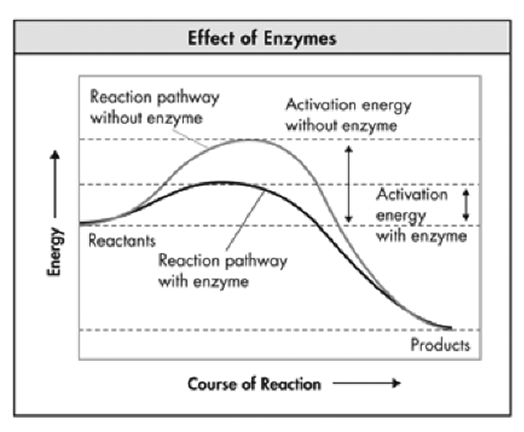
The graph shows how enzymes affect reactions in cells. Which statement best summarizes the information shown in the graph?
a)
Enzymes increase the energy of the reactants.
b)
Enzymes decrease the energy level of the products.
c)
Enzyme decrease the activation energy of the reaction.
d)
Enzymes reverse the direction of the reaction.
15.
Enzymes are...
a)
nucleic acids
b)
proteins
c)
lipids
d)
carbohydrates
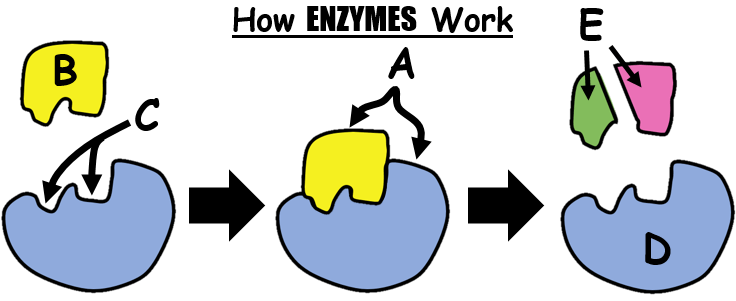
16.
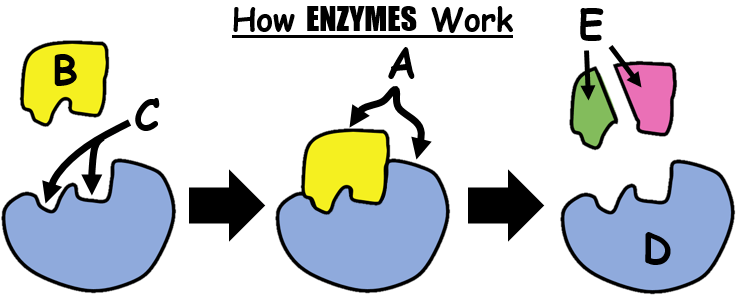
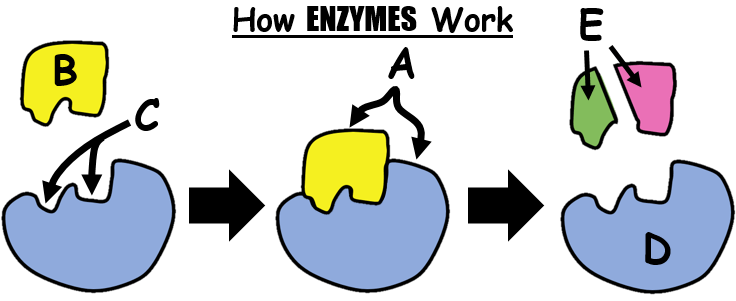
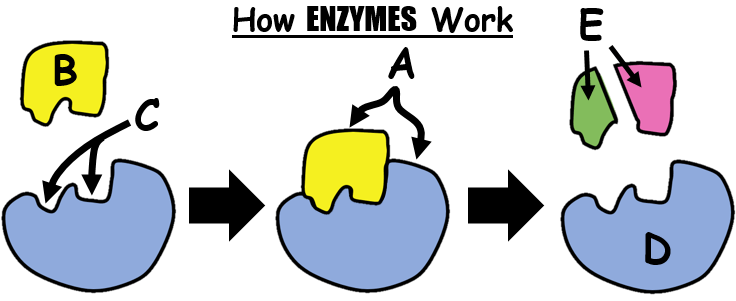
Letter D...
a)
active site
b)
enzyme
c)
substrate
d)
products
17.
Letter B...
a)
active site
b)
enzyme
c)
substrate
d)
products
18.
Letter C...
a)
active site
b)
enzymes
c)
substrate
d)
products
19.
Letter E...
a)
active site
b)
enzyme
c)
substrate
d)
products
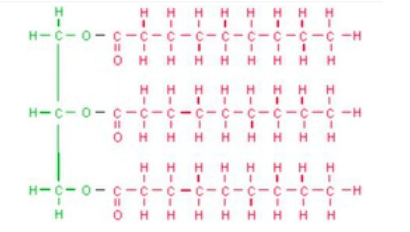
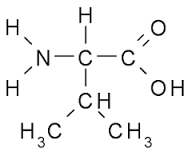
20.
Which biomolecule is this a picture of?
a)
Protein
b)
Nucleic Acid
c)
Lipid
d)
Carbohydrate
21.
Carbon, Hydrogen, Oxygen and Nitrogen are elements in what biomolecule?
a)
Carbohydrate
b)
Lipid
c)
Protein
d)
Nucleic acid
22.
Which biomolecule is this a picture of?
a)
Protein
b)
Nucleic Acid
c)
Lipid
d)
Carbohydrate
23.
The monomer of a lipid is called...
a)
a nucleotide
b)
a monosaccharide
c)
an amino acid
d)
a fatty acid
24.
The monomer of a protein is called...
a)
an amino acid
b)
a monosaccharide
c)
a fatty acid
d)
a nucleotide
25.
The monomer of a nucleic acid is called... 
a)
an amino acid
b)
a fatty acid
c)
a monosaccharide
d)
a nucleotide
26.
The monomer of a carbohydrate is called...
a)
a monosaccharide
b)
a fatty acid
c)
an amino acid
d)
a nucleotide
27.
Fatty acids and glycerol form the polymer....
a)
carbohydrates
b)
lipids
c)
proteins
d)
nucleic acids
28.
amino acids are connected with ______ bonds to form _______.
a)
peptide; proteins
b)
peptide; lipids
c)
hydrogen; proteins
d)
hydrogen; lipids
29.
What are the 4 most abundant elements in living things?
a)
hydrogen, oxygen, nitrogen, carbon
b)
hydrogen, helium, oxygen, carbon
c)
carbon, manganese, iron, hydrogen
30.
What are the building blocks of carbohydrates?
a)
simple sugars (glucose)
b)
amino acids
c)
glycerol
d)
DNA
31.
Find the total magnification: 
Eyepiece = 10X 
Objective lens = 55X
 
a)
10x
b)
55x
c)
65x
d)
550x
32.

When making a wet-mount slide, slowly lower the cover slip on top of the drop of water.

a)

TRUE

b)

FALSE

33.
A microscope is an instrument that.
a)
makes faraway objects look closer.
b)
makes small objects appear larger.
c)
decreases the size of small objects.
d)
increases the size of small objects.
34.
What determines the rate of nutrients and waste are exchanged from the cell and the environment?
a)
surface ratio
b)
volume
c)
surface area
d)
surface area to volume ratio
35.
Which cells are more efficient at obtaining nutrients?
a)
Small Cells
b)
Medium Size Cells
c)
Large Cells
d)
X-Large Cells
36.
As a cell becomes larger, its
a)
surface area increases faster than its volume.
b)
volume increases faster than its surface area
37.
High Surface area to volume ratio allows cells to do what quickly?
a)
Move materials around inside the cell
b)
Move materials in and out of the cell 
c)
Communicate to other cells
d)
Divide
38.

The smallest unit that makes up the known elements.

a)

Molecule

b)

Organelle

c)

Cell

d)

Atom

39.

Atom → molecule → organelle → cell→ tissue → organ

→ system → organism

→ population → community

→ ecosystem → biosphere.

a)

Taxonomic System

b)

Classification system

c)

Levels of Organization

d)

Periodic Table

40.

The smallest unit

of a compound consisting of two or more atoms

bonded together.

a)

Organelle

b)

Cell

c)

Molecule

d)

Atom

41.

Structures in a cell that have specialized jobs.

Similar concept to organs for the human body.

a)

Tissue

b)

Molecule

c)

Atom

d)

Organelles

42.
What type of cell has a nucleus? 
a)
eukaryotic
b)
prokaryotic 
43.
The site of photosynthesis
a)
ribosome
b)
mitochondria
c)
chloroplast
d)
nucleus
44.

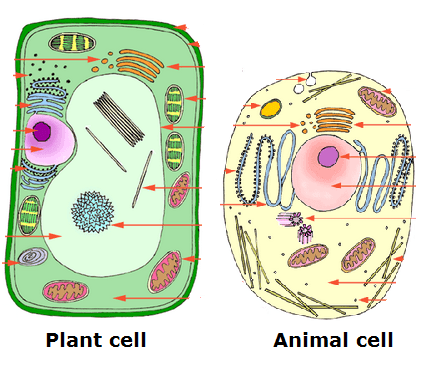
What distinguishes a plant cell from an animal cell? (How do you tell them apart) Hint: There's 3 ways (Check all 3)

a)

Central Vacuole

b)

Mitochondria

c)

Cell Wall

d)

Ribosomes

e)

Chloroplasts

45.

This part of a cell is where energy is produced:

a)

nucelus

b)

mitochondria

c)

cell membrane

d)

cell wall

46.
Which of the following are NOT found in animal cells
a)
chloroplasts and cytoplasm
b)
chloroplasts and cell wall
c)
cell wall and cell membrane
d)
mitochondria and nucleus
47.

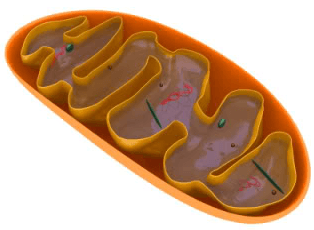
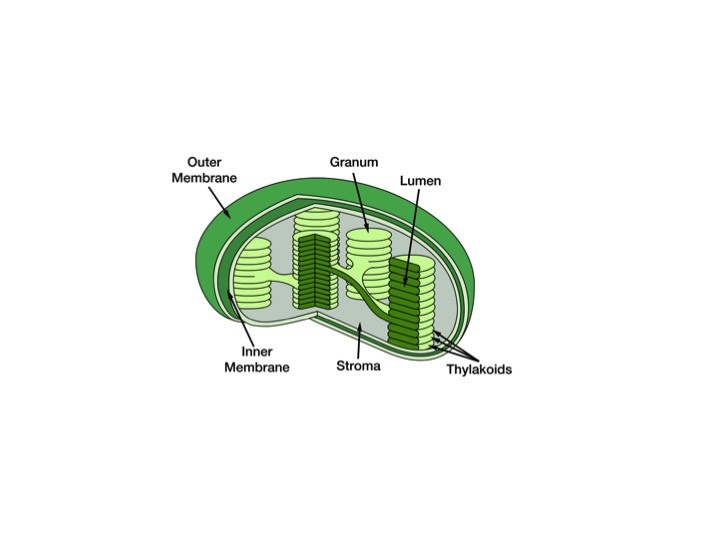
What is the name of this organelle?

a)

Mentos

b)

Mitochondrion

c)

Chlorophyll

d)

Chloroplast

48.

What is the structure that contains DNA and directs the cell?

a)

endoplasmic reticulum

b)

central vacuole

c)

cell wall

d)

nucleus

49.
What are tiny organelles that convert glucose into ATP?
a)
Ribosomes
b)
Vesicles
c)
Cytoskeleton
d)
Mitochondria
50.
All cells have a cell membrane
a)
True
b)
false
51.
All cells have a cell wall.
a)
true
b)
false
52.
How does a cell maintain homeostasis?
a)
Regulates what enters and leaves the cell
b)
Flexibility
c)
Protective barrier
d)
Structure and support
53.
Controls the passage of materials inside and outside of the cell. 
a)
Cell Membrane
b)
Lipid Cleric Layer
c)
Membrane Gate
d)
Protein Receptors 
54.

Identify the MITOCHONDRIA.

a)

K

b)

F

c)

A

d)

H

55.
This is a picture of:
a)
Prokaryote
b)
Eukaryote
56.
Chloroplasts are...
a)
Structures of animal cells to produce ATP
b)
Organelles where lipids are elaborated
c)
Specialized structures of plants where food is made
d)
Waste organelle of plants
57.
Cellular respiration takes place in
a)
chloroplasts
b)
mitochondria
c)
the nucleus
d)
endoplasmic reticulum
58.
Photosynthesis takes place in
a)
chloroplasts
b)
mitochondria
c)
lysosomes
d)
the nucleus
59.
Muscles use a lot of cellular energy because they are highly functional. Which organelle would be in abundant to provide that energy?
a)
Nucleus
b)
Endoplasmic 
c)
Vacuole
d)
Mitochondria
60.
Osmosis is the movement of _____ across a membrane.
a)
food
b)
energy
c)
oxygen
d)
water
61.
During osmosis
a)
water moves from high to low concentration
b)
large or oddly shaped molecules move across a cell membrane
c)
water moves when energy is used
d)
proteins are built
62.
Molecules will move from an area of high concentration to an area of low concentration until they reach
a)
osmosis
b)
equilibrium
c)
selective permeability
d)
diffusion
63.
In diffusion, particles move down a _______ ________
a)
Concentrate gradient
b)
Conceited gradient
c)
Concentration gradient 
d)
Concentrated orange juice
64.

Diffusion & Facilitated Diffusion are both __________ transport.

a)

Passive

b)

Active

c)

Easy

d)

Free

65.

Passive Transport uses ____ energy

a)

no

b)

a lot of

c)

a little bit of

d)

some

66.

What is a difference between diffusion and facilitated diffusion?

a)

movement of particles from [high] to [low]

b)

a protein "helper"

c)

movement of particles from [low] to [high]

d)

energy

67.

Passive Transport is the movement of particles across the membrane from an area of [ ___ ] to an area of [ ___ ]

a)

high to low

b)

low to high

c)

low to low

d)

high to high

68.
What type of transport is this?
a)
Diffusion
b)
Osmosis
c)
Facilitated Diffusion
d)
Active Transport
69.
What type of transport is this?
a)
Endocytosis
b)
Facilitated Diffusion
c)
Active Transport Pump
d)
Osmosis
70.
What type of transport is this?
a)
Endocytosis
b)
Diffusion
c)
Exocytosis
d)
Osmosis
71.
The energy is stored 
a)
in the carbon bonds
b)
in the phosphate bonds
c)
in the hydrogen bonds
d)
in all of thesse
72.
The element _______ is found in all of the organic compounds.
a)
Iron
b)
Nitrogen
c)
Carbon
d)
Oxygen
73.
Cellular respiration is a process that converts __________ into __________.
a)
Sunlight, Glucose
b)
ATP, Glucose
c)
Glucose, Sunlight
d)
Glucose, ATP
74.
When a phosphate group is removed from an ATP molecule, 
a)
a substantial amount of energy is released
b)
an enzyme is formed
c)
energy is stored
d)
activation energy is increased
75.
The formula for glucose is...
a)
C12 H22 O11
b)
NaCl
c)
NaOH
d)
C6 H12 O6
76.
Why do plants conduct photosynthesis?
a)
To make light
b)
To make mitochondria
c)
To make glucose
d)
To release carbon dioxide
77.
What is the source of energy for photosynthesis?
a)
Carbohydrates (chemical energy)
b)
Light (radiant energy)
c)
Heat (thermal energy)
d)
Wind (kinetic energy)
78.
What is the function of ATP in living things?
a)
provides energy for cells
b)
stores genetic information
c)
provides structure in the nucleus
79.
Where does glycolysis take place in cells?
a)
Cytoplasm
b)
Mitochondrion
c)
Endoplasmic Reticulum
d)
Ribosomes
80.

Which of the following is the correct chemical equation for Cellular Respiration?

a)

C6H12O6 + 6O2 --> 6CO2 + 6 H2O + ATP Energy

b)

C6H12O6 + H2O --> 6CO2 + 6 6O2 + ATP Energy

c)

6CO2 + 6 H2O + Light Energy --> C6H12O6 + 6O2

d)

C6H12O6 + 6CO2 --> 6O2 + 6 H2O + ATP Energy

81.
Which of the following is the correct equation for PHOTOSYNTHESIS?
a)
CO+ light + H2O --> O+ Sugar
b)
CO+ sugar + H2O --> O+ light
c)
O2 + light + H2O --> CO+ Sugar
d)
CO+ O2 + H2O --> Light+ Sugar
82.
Which gas is removed from the atmosphere during photosynthesis?
a)
hydrogen
b)
oxygen
c)
nitrogen
d)
carbon dioxide
83.
What are the products of photosynthesis?
a)
water and carbon dioxide
b)
oxygen and glucose
c)
oxygen and carbon dioxide
d)
oxygen and water
84.
Plants need ________ for photosynthesis
a)
oxygen
b)
soil
c)
carbon dioxide
d)
sugar
85.
What are the reactants in cellular respiration?
a)
Carbon Dioxide, Water, Sunlight
b)
Glucose, Oxygen
c)
Carbon Dioxide, Water, ATP
86.
What are the products in cellular respiration?
a)
Carbon Dioxide, Water, Sunlight
b)
Glucose, Oxygen
c)
Carbon Dioxide, Water, ATP
87.
After glycolysis, the next two steps in aerobic respiration are the ____________ and the ___________.
a)
Light reactions, Calvin Cycle
b)
Lactic acid fermentation, Alcoholic fermentation
c)
Kreb's Cycle, Electron Transport Chain
88.
The first step of cellular respiration is always
a)
The Kreb's Cycle
b)
Glycolysis
c)
the electron transport chain
d)
Fermentation
89.
What type of fermentation occurs in the cells of humans?
a)
Alcoholic
b)
Lactic Acid
90.
What does the "TP" in ATP stand for?
a)
2 phosphates
b)
tri (3) phosphates
c)
Two proteins
d)
tri (3) proteins
91.
Fermentation is the process by which 
a)
cells break down food without using oxygen
b)
plant cells create glucose
c)
cells use oxygen to produce energy 
d)
cells grow and reproduce
92.
Why would plants be better able to survive in a world without animals than animals in a world without plants?
a)
plants can produce their own carbon dioxide and water for cellular respiration
b)
animals do not produce anything plants need
c)
plants already produce glucose needed for photosynthesis
d)
animals only make oxygen for plants so animals are not needed
93.
Which of the following processes creates the most ATP during aerobic cellular respiration?
a)
glycolysis
b)
fermentation
c)
electron transport chain
d)
Kreb's cycle
94.
Please select who performs cellular respiration: 
a)
Animals 
b)
Both animals and plants 
c)
plants 
95.
The two main stages of photosynthesis are the
a)
light reactions and respiration
b)
dark reactions and the Calvin cycle 
c)
light reactions and the Calvin cycle
d)
dark reactions and fermentation
96.
Krebs Cycle takes place in the:
a)
Cytoplasm
b)
Matrix
c)
Ribsome
d)
InterMembrane Space
97.
The overall goal of cellular respiration is to make:
a)
Glucose
b)
ATP
c)
Oxygen
d)
Water
98.
After the Krebs Cycle only a small portion of the energy of glucose has been converted to ATP. At this point the majority of usable energy is contained in
a)
NADH and FADH2
b)
Carbon Dioxide 
c)
Acetyl-CoA
d)
Citrate
99.
During which phase of the cell cycle does the cell spend the most time?
a)
Mitosis
b)
Cytokinesis
c)
Interphase
100.
During which part of the cell cycle is DNA copied?
a)
Mitosis
b)
Cytokinesis
c)
S phase
101.
During which parts of the cell cycle does the cell grow?
a)
G1 and G2
b)
G1 and S
c)
M phase and cytokinesis
102.
Which phase of mitosis is shown in the picture?
a)
Interphase
b)
Metaphase
c)
Telophase
103.
Which phase of mitosis is shown in the picture?
a)
Prophase
b)
Metaphase
c)
Anaphase
104.
Which phase of mitosis is shown in the picture?
a)
Prophase
b)
Anaphase
c)
Telophase
105.
Which phase of mitosis is shown in the picture?
a)
Prophase
b)
Telophase
c)
Metaphase
106.
What is the purpose of the cell cycle?
a)
To create new daughter cells
b)
To prevent cancer from developing
c)
To help the body fight viruses and bacteria
107.
Mitosis results in the formation of...
a)
Two identical cells with all of the original chromosomes
b)
Two different cells with half of the original chromosomes
c)
Four identical cells with all of the original chromosomes
d)
Four different cells with half of the original chromosomes
108.
Which phase of the cell cycle is #1?
a)
Interphase
b)
Prophase
c)
Anaphase
d)
Metaphase
109.
Which phase of the cell cycle is #2?
a)
Interphase
b)
Prophase
c)
Anaphase
d)
Metaphase
110.
Which phase of the cell cycle is #3?
a)
Interphase
b)
Prophase
c)
Anaphase
d)
Metaphase
111.
Which phase of the cell cycle is #4?
a)
Interphase
b)
Prophase
c)
Telophase
d)
Metaphase
112.
Which phase of the cell cycle is #5?
a)
Interphase
b)
Prophase
c)
Telophase
d)
Metaphase
113.
What is the correct order of the phases of mitosis?
a)
Prophase
 Anaphase
Metaphase
Telophase
b)
Prophase
Metphase
Anaphase
Telophase
c)
Interphase
Cytokinesis
Metaphase
Prophase
d)
Interphase
Prophase
Metphase
Telophase
114.
If a parent cell going through mitosis starts with 22 chromosomes, how many chromosomes will be in the daughter cells?
a)
22
b)
11
c)
44
d)
15
115.
Which of the following statements correctly describes meiosis?
a)
Meiosis does not occur in reproductive cells.
b)
The cells produced at the end are identical 
c)
the cells produced at the end contain half the # of chromosomes
d)
cells divide only once during meiosis
116.
If an intestinal cell in a butterfly contains 24 chromosomes, a butterfly egg cell would contain___________.
a)
12 chromosomes
b)
6 chromosomes
c)
3 chromosomes
d)
24 chromosomes
117.
Which of the following sequences represents chromosome # during fertilization?
a)
2n-> n + n
b)
n + n -> 2n
c)
n -> n
d)
2n -> 2n
118.
Meiosis is the key process in the production of_________.
a)
body cells
b)
RNA
c)
white blood cells
d)
gametes
119.
A dog has 78 chromosomes in its body cells.  What is the diploid number?
a)
78
b)
39
c)
1
d)
100
120.
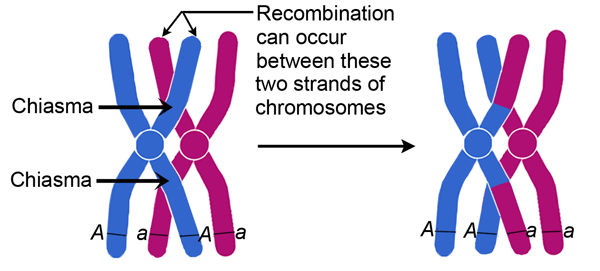
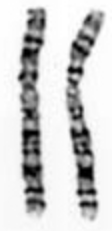
This image shows chromosomes during Prophase 1. Which of the following correctly describes the process shown?
a)
segregation of sister chromatids
b)
condensation and segregation of alleles
c)
mutationin which the DNA content of the gene is altered
d)
crossing - over in which alleles are exchanged
121.
What is the yellow dot in the middle of this picture? 
a)
Chromatid
b)
Chromosome 
c)
Centromere
122.
What is the structure that holds the sister chromatids together called?
a)
homologous chromosome
b)
centromere
c)
chromatid
d)
nondisjunction
123.
Which structure is labeled as C in the diagram?
a)
Centromere
b)
Chromosome
c)
Sister chromatids
124.
A pair of identical chromosomes shown in a karyotype, one inherited from mom, and one inherited from dad are called
a)
sister chromotids
b)
centromeres
c)
homologous chromosomes
d)
autosomes
125.

Who discovered the structure of DNA?

a)

Holmes & Watson

b)

Watson & Crick

c)

Einstein

d)

Moriarty & Crick

126.

Where is DNA found in your cells?

a)

ribosomes

b)

golgi bodies

c)

cell wall

d)

nucleus

127.

In DNA, cytosine always pairs with

a)

guanine

b)

uracil

c)

thymine

d)

adenine

128.
Guanine bonds with ______________.
a)
Adenine
b)
Guanine
c)
Cytosine
d)
Thymine
129.
Nitrogenous bases are joined by which type of bond?
a)
polar bonds
b)
ionic bonds
c)
covalent bonds
d)
hydrogen bonds
130.

DNA is made up of phosphates, sugars, and

a)

proteins

b)

lipids

c)

bases

d)

iodine

131.
Which 2 molecules form the sides (backbone) of the DNA ladder?
a)
deoxyribose sugar and adenine
b)
deoxyribose sugar and a hydrogen bond
c)
deoxyribose sugar and the nucleus
d)
deoxyribose sugar and phosphate
132.
What are the four nitrogen bases?
a)
adenine, thymine, guanine, cytosine
b)
adenine, lysine, prolene, guanine
c)
arganine, cytosine, lysine, purine
d)
lysine, cytosine, lucine, guanine
133.
RNA contains which bases?
a)
adenine, guanine, uracil, cytosine
b)
thymine, guanine, cytosine, uracil
c)
thymine, uracil, cytosine, guanines
d)
adenine, uracil, guanine, thymine
134.
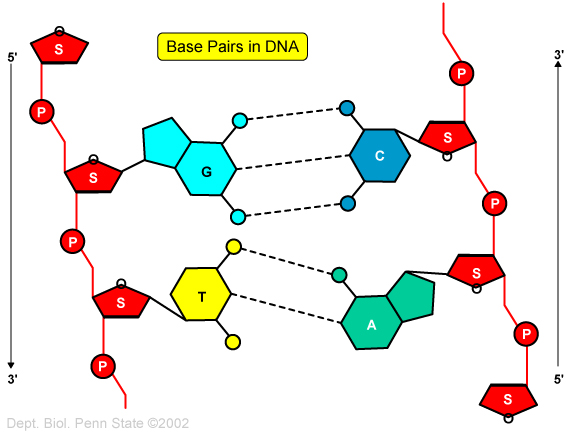
What does this picture represent?
a)
amino acid
b)
base pairing
c)
nucleotide
d)
the DNA molecule
135.
How would the DNA sequence GCTATA be transcribed to mRNA?
a)
GCUAUA
b)
CGATAT
c)
CGAUAU
d)
GCUTUT
136.

There are 3 types of RNA. What are they? (Select all that apply)

a)

tRNA

b)

rRNA

c)

mRNA

d)

xRNA

137.

What organelle is the site of translation?

a)

Nucleus

b)

Ribosome

c)

Mitochondria

d)

Chloroplast

138.

What type of RNA is shown in this image?

a)

rRNA

b)

mRNA

c)

tRNA

139.

What type of RNA is shown in this image?

a)

rRNA

b)

mRNA

c)

tRNA

140.

How many nucleotides make up a codon?

a)

1

b)

3

c)

5

d)

15

141.
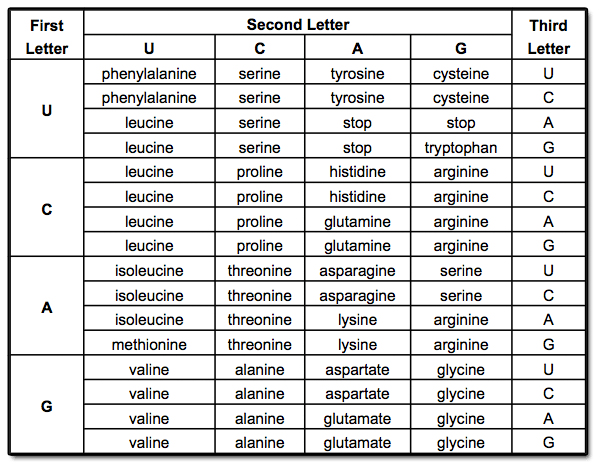
What amino acid is represented by the codon UUA?
a)
Phenylalanine
b)
Tyrosine
c)
Leucine
d)
Stop codon
142.
What is the location in the cell for transcription?
a)
nucleus
b)
cytoplasm
c)
ribosome
d)
mitochondria
143.
These are the "smaller", single ringed bases such as thymine and cytosine
a)
complementary
b)
 cytosine
c)
purine
d)
pyrimidine
144.
These are the "larger", double-ringed bases such as adenine and guanine.
a)
complementary
b)
 cytosine
c)
purine
d)
pyrimidine
145.

The passing of traits from parent to offspring is.....

a)

genetics

b)

heredity

c)

recessive

d)

dominant

146.

For snakes, L represents the gene for long offspring and l represents the gene for short offspring. If long (L) is dominant over short (l), which of the following can be said about genotype Ll?

a)

It produces a long snake

b)

It produces a short snake

c)

It produces a medium snake

d)

It produces a snake with bunny ears

147.
What does heterozygous mean?
a)
An organism that has the same genes for a trait (TT or tt)
b)
An organism that has different genes for a trait (Tt)
c)
When neither gene is fully dominant; offspring is a mixture of both
d)
the different forms of a trait (hair color--> brown, blonde, red
148.
If a gene is found only on the X chromosome and not the Y chromosome, it is said to be what?
a)
sex-linked trait
b)
polygenic trait
c)
codominant trait
d)
incomplete dominance trait
149.

When a white and red flower are crossed, all of the offspring are pink. When 2 pink flowers are crossed, what is the pheotypic ratio of the offspring?

a)

4:0

b)

1:2:1

c)

2:2

d)

3:4

150.
The allele combinations
a)
genetics
b)
mitosis
c)
genotype
d)
phenotype
151.

Gray squirrel fur color (A) is dominant over white squirrel fur color (a). What is the Dominant:Recessive ratio for this punnet square by crossing two heterozygous squirrels?

a)

1:2:1

b)

3:1

c)

1:3

d)

4:0

152.
What determines the code, or information, of a DNA molecule?
a)
the shape (structure) of the nitrogen bases
b)
the order (sequence) of the nitrogen bases
c)
the color of the nitrogen bases
d)
the frequency (number) of nitrogen bases
153.

In order for offspring to get a genetic mutation, the mutation must occur in what type of cell?

a)

Cells with no nucleus.

b)

Any body cell after birth.

c)

Cells with no cell wall or cell membrane.

d)

Cells like eggs or sperm cells that are undergoing reproduction.

154.

A mutation is defined as:

a)

A change in the cell's structure

b)

Anything that changes in an embryo

c)

Any change in the physical features of a human

d)

A change in the DNA sequence

155.

By studying this diagram, you can conclude that the affected condition is...

a)

dominant

b)

recessive

c)

codominant

d)

both dominant and recessive

156.

By studying this diagram, you can conclude that the affected condition is...

a)

dominant

b)

recessive

c)

codominant

d)

both dominant and recessive

157.
Looking at this pedigree, how many female family members are carriers?
a)
1
b)
3
c)
10
d)
7
158.
If a gene is found only on the X chromosome and not the Y chromosome, it is said to be what?
a)
sex-linked trait
b)
polygenic trait
c)
codominant trait
d)
incomplete dominance trait
159.

Mutations can be negative because

a)

They can cause cancer

b)

They can cause birth defects

c)

They can help an organism thrive in its environment.

d)

They can affect offspring.

160.

Mutations can benefit humans because they can:

a)

Cause illness

b)

Make an organism more suited to live in its environment.

c)

Make organisms live shorter lives

d)

Cause organisms to grow extra limbs.

161.

True or false, mutations create genetic diversity?

a)

True

b)

False

162.
What gamete possibilities could come from this parent's genotype?
a)
AB, AB, aB, aB
b)
Ab, AB, Ab, ab
c)
Ab, Ab, Ab, Ab
d)
AB, aB, ab, aB
163.

What goes in box 3

a)

Aabb

b)

AABB

c)

AAbb

d)

aaBb

164.
What genotype is missing from this Punnett Square?
a)
RrYy
b)
RRYY
c)
rryy
d)
RrYY
165.
Darwin observed 13 species of finches on the Galapagos Islands. What did Darwin conclude about the finches? 
a)
They evolved from a common ancestor.               
b)
They evolved from 13 different types of birds. 
c)
They all came from different continents. 
d)
They developed from other types of organisms. 
166.
The gradual change in a species over time is called
a)
mutation
b)
variation
c)
evolution
d)
migration
167.
Which of the following is a fossil?
a)
a plant that has recently died
b)
a group of organisms that can reproduce
c)
a structure or organ that no longer functions
d)
a trace of an organisms that existed in the past
168.
This image shows that 
a)
These animals have no simliarities in their structures. 
b)
two different species may have evolved from a common ancestor. 
c)
These animals are from the same species. 
d)
These animals likely evolved from different ancestors due to their differences. 
169.
A few deer wander out of their native woods into a completely new park where no deer had ever been before. They go on to create an entirely new population.
a)
Genetic Drift
b)
Natural Selection
c)
Non-random mating
d)
Mutation
170.
Five hundred years after the deer had established a flourishing population in the park, a few of them venture back to their original woods and have babies with the deer there.
a)
Genetic Drift
b)
Mutations
c)
Non-random mating
d)
Gene flow
171.
______ _________ explains how two or more organisms could evolve similar traits even though they are not related to each other.
a)
convergent evolution
b)
reproductive isolation
c)
derived characters
d)
hybrid vigor
172.
__________ characters are similar characteristics that have evolved separately in two unrelated organisms.
a)
analogous
b)
homologous
c)
cladistic
d)
phylogenic
173.
_________ characters may or may not be similar between two organisms but they developed from a common ancestor.
a)
homologous
b)
analogous
c)
cladistic
d)
phylogenic
174.
________ structures are reduced in size or function.
a)
vestigial
b)
homologous
c)
cladistic
d)
phylogenic
175.

How do you feel about the Biology Final Exam?

a)

I don't know what class I'm in.

b)

Eh, not feeling good about it.

c)

I need to study some more.

d)

Great! Let's rock it!