wayground logo

Free Printable Worksheets

Font size

S
M
L
XL
Worksheets

Fall Final Exam Review

Total questions: 132

Worksheet time: 33hrs 0mins

Name
Class
Date
1.
Which property of matter is determined by dividing its mass by its volume?
a)
elasticity
b)
buoyancy
c)
density
d)
viscosity
2.
The following liquids are poured together in a beaker: alcohol (density=0.79), corn syrup (density=1.38), water (density=1.0), and cooking oil (density=0.93).  Which of these liquids will sink to the bottom of the beaker?
a)
alcohol
b)
corn syrup
c)
water
d)
cooking oil
3.
What is the density of water?
a)
0 g/ml
b)
1 g/ml
c)
10 g/ml
d)
100 g/ml
4.
Why do some substances float on water?
a)
they are warmer than water
b)
they are cooler than water
c)
they are more dense than water
d)
they are less dense than water
5.
Which box has a higher density?  
a)
Box A
b)
Box B
c)
cannot be determined
d)
they are the same
6.
A piece of copper has a mass of 89g and a volume of 10 cm3.  What would be the density of the copper?
a)
0.89 g/cm3
b)
89 g/cm3
c)
8.9 g/cm3
d)
890 g/cm3
7.
What is the measuring unit for mass?
a)
centimeter 
b)
millimeter 
c)
grams 
d)
pounds
8.
Which units of measurement are used for volume?
a)
grams
b)
centimeters
c)
grams/milliliter
d)
milliliter
9.
Which lab tool might you use to measure the volume of a liquid?
a)
electric scale
b)
bunsen burner
c)
test tube
d)
graduated cylinder
10.
What units are used to measure Density?
a)
cm3/g
b)
g
c)
g/cm3
d)
cm3
11.
Define the term "mass".
a)
Mass/Volume
b)
Anything that has mass and takes up space 
c)
The amount of space an object occupies.
d)
The amount of matter in an object.
12.
Volume is ...
a)
Mass/Volume
b)
The amount of matter in an object.
c)
The amount of space an object occupies.
d)
Anything that has mass and occupies space.
13.
Density is...
a)
the amount of mass in an object
b)
the amount of space an object takes up
c)
the amount of mass in a given space
d)
the weight of an object
14.
True or False:  The density of a specific type of material never changes.  
a)
True
b)
False
15.
Frank has a paper clip. It has a mass of 9g and a volume of 3cm3. What is its density?
a)
3 g/cm3
b)
1/3 g/cm3
c)
27 g/cm3
d)
39 g/cm3
16.
Jack has a rock. The rock has a mass of 14g and a volume of 2cm3. What is the density of the rock?
a)
7 mL
b)
7 g/cm3
c)
28 g/cm3
d)
1/7 g/cm3
17.
What is the volume of 150 grams of lead if it has a density of 11.3 g/cm3?
a)
13.3 g
b)
13.3 cm3
c)
.075 g
d)
1695 cm3
18.
A copper penny turning greenish after a few years is an example of ...
a)
Chemical Change
b)
Physical Change
19.
A change in which NEW substances are formed.
a)
Chemical change
b)
Physical change
c)
Casual change
d)
Formal change
20.
Which of the following is NOT an example of chemical change?
a)
sour milk
b)
burning wood
c)
breaking a pencil
d)
rust
21.
Which of the following is NOT an example of a physical change?
a)
crumpled paper
b)
pencil sharpening
c)
shrunken clothing
d)
sour milk
22.
Which of the following IS a physical change?
a)
Getting a haircut
b)
Rusty metal
c)
sour milk
d)
A compound
23.
Is a rusting bicycle a chemical or physical change?
a)
chemcial
b)
physical
24.
Ripping up paper ...
a)
Chemical Change
b)
Physical Change
25.
Bubbles form when two or more substances are combined ...
a)
Chemical Change
b)
Physical Change
26.
Causes a change in odor ...
a)
Chemical Reaction 
b)
Physical Reaction
27.
Blue Color
a)
Physical Property
b)
Chemical Property
28.
Density
a)
Physical Property
b)
Chemical Property
29.
Flammability (burns)
a)
Physical Property
b)
Chemical Property
30.
Solubility (dissolves)
a)
Physical Proeprty
b)
Chemical Property
31.
Reacts with acid
a)
Physical Property
b)
Chemical Property
32.
You forgot to dry the bread knife when you washed it and reddish brown spots appeared on it. 
a)
Physical Change
b)
Chemical Change
33.
Solids are described as having a 
a)
definite shape and indefinite volume
b)
indefinite shape and indefinite volume
c)
definite shape and definite volume
d)
indefinite shape and definite volume
34.
Liquids are described as having a 
a)
definite shape and indefinite volume
b)
indefinite shape and indefinite volume
c)
definite shape and definite volume
d)
indefinite shape and definite volume
35.
Gases are described as having a 
a)
definite shape and indefinite volume
b)
indefinite shape and indefinite volume
c)
definite shape and definite volume
d)
indefinite shape and definite volume
36.

Subatomic particles with a negative charge

a)

Electrons

b)

Neutrons

c)

Protons

d)

Quarks

37.
subatomic particles found on the outermost shell & responsible for the atom's reactivity
a)
neutrons
b)
valence electrons
c)
isotopes
d)
ions
38.
Subatomic particles with a positive charge
a)
neutrons
b)
atomic mass
c)
protons
d)
isotopes
39.
Measure mainly of the nuclear particles: protons + neutrons
a)
Subatomic Particles
b)
Atomic Number
c)
Atomic Mass
d)
Gluons
40.
Value representing the number of protons in an element
a)
Atomic Mass
b)
Mass Number
c)
Valence Electrons
d)
Atomic Number
41.
Subatomic particles that are neutral in charge
a)
Neutrons
b)
Protons
c)
Nucleus 
d)
Electrons
42.
Atoms of the same element with a different number of neutrons
a)
Ion
b)
Gluons
c)
Isotope
d)
Quarks
43.
A charged atom
a)
Ion
b)
Isotope
c)
Electron Cloud
d)
Quark
44.
The smallest particle of an element that shows all the properties of that element.
a)
Subatomic Particles
b)
Atom
c)
Quarks
d)
Gluons
45.
How many protons does an aluminium atom have? (Use the image to help you)
a)
27
b)
14
c)
40
d)
13
46.
How many neutrons does a sodium atom have? (Use the image to help you)
a)
23
b)
11
c)
12
d)
34
47.
Atoms of the same element must always have the same number of _________
a)
electrons
b)
neutrons
c)
isotopes
d)
protons
48.
The _________ of an element equals the number of protons in an atom of that element
a)
mass number
b)
atomic weight
c)
atomic number
d)
isotopes
49.
The atomic number of an element that has 9 protons, 9 electrons, and 10 neutrons is _____.
a)
9
b)
10
c)
19
d)
28
50.
True or False - Protons and Neutrons have about the same mass.
a)
True - They have about the same mass
b)
False - They do not have about the same mass
51.
Which two subatomic particles make up the nucleus of an atom?
a)
Protons and Electrons
b)
Neutrons and Electrons
c)
Electrons and Protons
d)
Protons and Neutrons
52.

one or two letters that represent the name of an element

a)

element name

b)

element symbol

c)

atomic number

d)

atomic mass

53.

a row on the Periodic Table of Elements

a)

family

b)

period

c)

row

d)

isotope

54.

a grouping of elements based on similar properties, arranged by columns in the periodic table; also known as a group

a)

family

b)

period

c)

row

d)

isotope

55.
Which has the greater EN: 
Cl or Al?
a)
Cl
b)
Al
56.
Which has the greater EN: 
N or C?
a)
C
b)
N
57.
Which of the following will have a larger radius than Zinc?
a)
Gallium
b)
Aluminum
c)
Magnesium
d)
Strontium
58.
Which of the following will have a higher electronegativity than arsenic (As)?
a)
Carbon (C)
b)
Neon (Ne)
c)
Antimony (Sb)
d)
Germanium (Ge)
59.
As atoms of elements in group 16 are considered in order from top to bottom, the electronegativity of each successive element....
a)
decreases
b)
increases
c)
remains the same
d)
none of the above
60.
As you move down the periodic table atoms get bigger.  This is because ____________.
a)
The atoms have more mass.
b)
The atoms have more protons.
c)
The atoms have more energy levels
d)
The atoms have more nuetrons
61.
Electronegativity is...
a)
how good an atom is at attracting electrons
b)
the ability of an atom to lose electrons
c)
the energy required to remove an electron from a specific atom
d)
how easy it is to make friends. 
62.
The energy required to remove electrons is the definition of: 
a)
Electronegativity
b)
Atomic Number
c)
Atomic Radius
d)
Ionization
63.
What is the name of family I
a)
Alkaline Earth Metals
b)
Boron Family
c)
Alkali Metals
d)
Halogen Family
64.
Electronegativity __________ from left to right within a period and __________ from top to bottom within a group.
a)
decreases, increases 
b)
increases, increases
c)
increases, decreases 
d)
stays the same, increases
65.
Atomic Radius is...
a)
the relative size of the atom's nucleus
b)
the relative size of the atom's electron cloud
c)
the energy required to shield the outer electrons from the nucleus
d)
a measure of the ability of an atom to attract electrons
66.
Which atom has the largest atomic radius?
a)
potassium
b)
rubidium 
c)
francium
d)
cesium
67.
Which of the following will have a lower ionization energy than Scandium (Sc)?
a)
Helium (He)
b)
Titanium (Ti)
c)
Calcium (Ca)
d)
Magnesium (Mg)
68.

What is the noble gas electron configuration for sulfur?

a)

[Ar] 3p4

b)

[He] 3s23p4

c)

[Ne] 3s23p4

d)

[Na] 3s23p4

69.
What is this element? 
1s22s22p63s23p64s23d104p6
a)
Argon
b)
Krypton
c)
Selenium
d)
Bromide
70.

True or False: Electrons occupy the lowest energy level first

a)

True

b)

False

71.

Each orbital can hold ____ electrons

a)

5

b)

4

c)

8

d)

2

72.
What is this element? 
[Ar]4s2
a)
Calcium
b)
Sodium
c)
Scandium
d)
Titanium
73.
The electron configuration of an atom is 1s22s22p6.  The number of electrons in the atom is 
a)
3
b)
6
c)
8
d)
10
74.
How many electrons can the d sublevel hold?
a)
14
b)
10
c)
2
d)
6
75.
How many electrons can the s sublevel hold?
a)
14
b)
10
c)
2
d)
6
76.
How many electrons can the p sublevel hold?
a)
14
b)
10
c)
2
d)
6
77.
Which elements have the most similar chemical properties?
a)
K and Na
b)
K and Ca
c)
K and Cl
d)
K and S
78.
What atom matches this electron configuration?
1s22s22p63s23p64s23d10
a)
Zinc
b)
Copper
c)
Nickel
d)
Germanium
79.
Which electron configuration belongs to Chlorine (Cl)?
a)
1s2s2p3s3p5
b)
1s2s2p3s3p6
c)
1s2s2p3s3p7
80.
What is the shorthand electron configuration for Sulfur atom?
a)
[Ar] 3p4
b)
[He] 3s23p4
c)
[Ne] 3s23p4
d)
[Na] 3s23p3
81.
Which of the following is hydrogen (H)?
a)
Metal
b)
Nonmetal
c)
Metalloid
82.
Which of the following is helium (He)?
a)
Metal
b)
Nonmetal
c)
Metalloid
83.
Which of the following is Lithium (Li)?
a)
Metal
b)
Nonmetal
c)
Metalloid
84.
A covalent bond is a bond between a _____ and a ______
a)
metal, nonmetal
b)
metal, metal
c)
nonmetal, nonmetal
85.
A covalent bond is formed when two atoms ____ electrons
a)
share
b)
lose
c)
transfer
d)
gain
86.
Which type of bond transfers electrons?
a)
Covalent bond
b)
Ionic bond
87.
What bond is formed between a metal and a nonmetal?
a)
Covalent bond
b)
Ionic bond
88.

Zinc fluoride

a)

ZnF2

b)

Zn2F

c)

ZnF

d)

Zn2F4

89.

Write the correct formula for Sodium Chloride.

a)

SC

b)

SCl

c)

NaCl

d)

NaCl2

90.

Mg3N2

a)

Magnesium nitride

b)

Magnesium (II) nitride

c)

Trimagnesium dinitrogen

91.

What is the proper name for CH4?

a)

Monocarbon hydride

b)

Carbon tetrahydride

c)

Monocarbon tetrahydride

92.

Identify the following compound as ionic or covalent: Na2SO4

a)

ionic

b)

covalent

93.

Identify the following compound as ionic or covalent: MgO

a)

ionic

b)

covalent

94.

Identify the following compound as ionic or covalent: SO2

a)

ionic

b)

covalent

95.

Identify the following compound as ionic or covalent: CO

a)

ionic

b)

covalent

96.

Sliver (I) Phosphide

a)

Ag3P

b)

Ag3PO4

c)

Ag3PO3

d)

AgP

97.
Na2S
a)
Sodium Sulfide
b)
Sodium Sulfate
c)
Sodium Sulfite
d)
Disodium Sulfide
98.
What is the formula for magnesium chloride?
a)
MgCl
b)
Mg2Cl
c)
MgCl2
d)
Mg(ClO3)2
99.

What is the formula for selenium tetrafluoride

a)

SeF4

b)

SeF

c)

FSe4

d)

FSe

100.
Name BCl3
a)
boron chloride
b)
boron (III) chloride
c)
boron trichloride
d)
boron chlorine
101.

What is the prefix for 8?

a)

non

b)

tri

c)

di

d)

octa

102.

What is the prefix for 10?

a)

mono

b)

tetra

c)

deca

d)

hept

103.
PBr5
a)
Phosphorus Bromide
b)
Phosphorus Pentabromide
c)
Pentaphosphorus bromide
d)
Phosphorus Bromine
104.

Fill in the blank. (Copper has a charge of 2+)

Cu+ AgNO3 → Ag + _____

a)

Cu(NO3)2

b)

CuNO3

c)

CuAg

d)

Cu

105.

Predict the products of this synthesis reaction: H2 + Cl2

a)

HCl

b)

H2Cl2

c)

H2Cl

d)

HCl2

106.

What type of reaction is this?

2 C6H14 + 19 O2 → 12 CO2 + 14 H2O

a)

Single Replacement

b)

Double Replacement

c)

Combustion

d)

Decomposition

107.

Predict the products for the this Single Replacement reaction:

K + HCl →

a)

KCl + H2

b)

KHCl

c)

KH + Cl2

d)

HCl + K2

108.

Predict the products for the this Double Replacement reaction:

AgNO3 + KCl →

a)

AgCl + KNO3

b)

AgK + ClNO3

c)

KAg + NO3Cl

d)

AgCl + 3 KNO

109.

Complete the balanced equation for this Double Replacement reaction.

3 NaOH + Fe(NO3)3

a)

NaFe + OH(NO3)3

b)

NaNO3 + Fe(OH)3

c)

3 NaNO3 + Fe(OH)3

d)

3 NaFe + 3 (OH)NO3

110.

Predict the products for the this Single Replacement reaction: (Copper has a charge of 1+)

Mg + CuCl →

a)

MgCl2 + Cu

b)

Mg + Cu

c)

MgCu + Cl2

d)

MgCl + Cu2

111.

Predict the products of this single replacement reaction: Na + H2O →

a)

NaO + H2

b)

NaOH + H2

c)

NaH + O2

d)

ONaH

112.

In a ___________change, a substance changes into a different substance.

a)

Physical

b)

Chemical

113.

What are reactants?

a)

The chemicals that start the reaction.

b)

The chemicals that the reaction produced.

c)

The chemicals that are on the right side of the arrow.

114.
The reactants are on the left side of the chemical equation.
a)
True
b)
False
115.

What are products?

a)

The chemicals that start the reaction.

b)

The chemicals that the reaction produced.

c)

The chemicals that are on the left side of the arrow.
116.

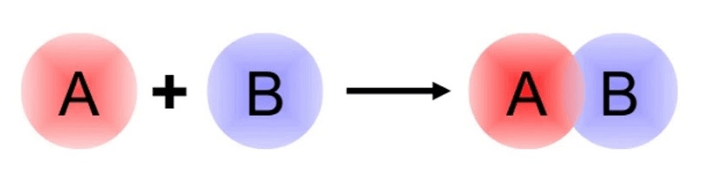
What is the type of reaction shown above?

a)

Synthesis

b)

Decomposition

c)

Single Replacement

d)

Double Replacement

117.
This pictures simulates what type of reaction?
a)
Synthesis
b)
Decomposition
c)
Single Replacement
d)
Double Replacement
118.

Identify the reaction type:

C2H6 + O2 --> CO2 + H2O

a)

Double replacement

b)

Synthesis

c)

Acid base

d)

Combustion

119.

Identify the reaction type for the following equation:

K + F2 --> KF

a)

Double replacement

b)

Single Replacement

c)

Synthesis

d)

Decomposition

120.

Identify the type of reaction:

ZnCl2 + Mg --> Zn + MgCl2

a)

Precipitate

b)

Single Replacement

c)

Double Replacement

d)

Decomposition

121.

PCl5 + ___ H2O → ___ HCl + H3PO4

a)

4, 5

b)

1, 6

c)

3, 8

d)

2,2

122.
Balance this equation.
_SnO+_H2-->_Sn +_H2O
a)
1,1,2,1
b)
1,2,1,1
c)
1,2,1,2
d)
1,2,2,1
123.
What does the Law of Conservation of Mass state?
a)
Matter cannot be gained or lost in a chemical reaction.
b)
Matter can only be lost in a chemical reaction.
c)
Matter can only be gained in a chemical reaction.
d)
Matter can be gained and lost in a chemical reaction. 
124.
Balance this equation
_Al +_HCl --> _H+_AlCl3
a)
2, 6, 3, 2
b)
it is already balanced
c)
4, 12, 3, 4
d)
2, 1, 4, 5
125.
Balance this equation.
_CF+ _Br-- _CBr+ _F2
a)
2,1,2,1
b)
1,2,2,1
c)
1,2,1,2
d)
2,2,2,2
126.
24.1% of all the isotopes of a an element have a mass of 75.23 amu, 48.7% have a mass of 74.61 amu, and 27.2% have a mass of 75.20 amu.
What is the average mass of this element?
a)
74.92 amu
b)
24.97 amu
c)
75.01 amu
d)
74.51 amu
127.
An element with 4.35% have a mass of 49.9461 amu, 83.79% have amass of 51.9405 amu, 9.50% have a mass of 52.9407 amu, and 2.36% have a mass of 53.9389amu.
a)
51.99 amu
b)
52.19 amu
c)
53.45 amu
d)
17.33 amu
128.
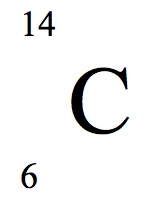
The photo above shows the isotopic notation for which isotope?
a)
Carbon 12
b)
Carbon 13
c)
Carbon 14
d)
Carbon 15
129.

When you have Br-Br, what is the polarity?

a)

Polar

b)

nonpolar

c)

Ionic

130.

When you have H-Cl, what is the polarity?

a)

nonpolar

b)

polar

c)

ionic

131.

When you have Li-O, what is the polarity?

a)

nonpolar

b)

polar

c)

ionic

132.
What information do we look for on the periodic table if we  want to examine intermolecular forces?
a)
atomic mass
b)
atomic number
c)
electronegativity
d)
ionization