wayground logo

Free Printable Worksheets

Font size

S
M
L
XL
Worksheets

1st Semester Review

Total questions: 100

Worksheet time: 1hrs 29mins

Name
Class
Date
1.
Which is an example of a lipid
a)
fat
b)
starch
c)
glucose
d)
hemoglobin
2.
Which is a Carbohydrate's monomer?
a)
Sugar
b)
Amino acids
c)
Monosacharide
d)
Nucleotide
3.
I am responsible for long term energy storage in mammals.
a)
Protein
b)
Lipid
c)
Carbohydrate
d)
Nucleic Acid
4.
The best definition of "organic" in Biology would be:
a)
 to be "fresh"
b)
to be alive
c)
to be chemical-free
d)
to contain Carbon and Hydrogen
5.
Enzymes will make a reaction go _______ and use ______ energy.
a)
faster, less
b)
faster, more
c)
slower, less
d)
slower, more
6.

Proteins are produced at this organelle.

a)

golgi body

b)

ribosome

c)

cytoskeleton

d)

cilia

7.

this organelle makes ATP.

a)

chloroplast

b)

mitochondria

c)

ribosome

d)

nucleolus

8.

The genetic material inside a cell

a)

DNA

b)

chromatin

c)

chromosomes

d)

gene

9.
To convert the radiant energy of the sun into the chemical energy of glucose through the process of photosynthesis is a function of _________.
a)
Cell Wall
b)

Large Central Vacuole

c)
Chloroplast
d)
Mitochondria
10.
Consists of a jellylike substance that contains many organelles.
a)
ribosomes
b)
cytoplasm
c)
chloroplasts
d)
cell wall
11.
What is mean by homeostasis?
a)
Controls and coordinates body activities through chemical 
b)
controls and coordinates body activities through electrical impulses
c)
For maintenance of a steady state in the internal environment
d)
remove metabolic waste products from the cel
12.

How are viruses different than bacteria, fungi, and parasites?

a)

Viruses are not living

b)

Viruses reproduce quickly

c)

Viruses can infect the cells of a variety of organisms

13.
Homeostasis
a)
allows for a wildly fluctuating internal environment
b)
is impossible in vertebrates
c)
is the maintenance of a relatively stable internal environment and often incorporates a form of feedback regulation
d)
is the maintenance of a relatively stable external environment and often incorporates a form of feedback regulation
14.
What is involuntary contractions of voluntary muscles to warm up?
a)
Shivering
b)
Sweating
c)
Vasodilation
d)
Vasoconstriction
15.
Name the levels of organization in the human body in order from smallest to largest:
a)
Tissue, organ, organ system
b)
Organ system, tissue, organs, cells
c)
Cells, tissue, organs, organ system
d)
Cells , organs, tissue, organ system
16.
Osmosis is the movement of _____ across a membrane.
a)
food
b)
energy
c)
oxygen
d)
water
17.
Which is true about active transport?
a)
It requires energy
b)
it does not require energy
c)
It moves substances down the concentration gradient
d)
it moves material from high to low concentration
18.
Molecules diffusing with the concentration gradient through a protein channel is...
a)
Facilitated Diffusion
b)
Simple Diffusion
c)
Active Transport
d)
Osmosis
19.
In a nerve cell, ATP energy is used to pump sodium (Na) out of the cell and potassium (K) into the cell. This is an example of...
a)
Facilitated Diffusion
b)
Simple Diffusion
c)
Active Transport
d)
Osmosis
20.
The cell below is in a _________ solution.
a)
Hypotonic
b)
Hypertonic
c)
Isotonic
21.
The cell below is in a _____________ solution.
a)
Hypertonic
b)
Hypotonic
c)
Isotonic
22.
A cell in an isotonic solution will
a)
swell
b)
shrink
c)
stay the same size
d)
impossible to tell
23.
When a cell is placed in a hypertonic solution water
a)
moves from the inside of the cell to the solution
b)
moves from the solution to the inside of the cell
c)
moves equally in and out of the cell
d)
none of these
24.
What type of transport is this?
a)
facilitated diffusion
b)
active transport
c)
diffusion
d)
osmosis
25.
Active transport requires ______, moves materials from __________________, and goes _______ the concentration gradient.
a)
No energy, low to high, against
b)
ATP, high to low, with
c)
ATP, low to high, with
d)
ATP, low to high, against
26.
What phase of mitosis is shown in the picture?
a)
Prophase
b)
Anaphase
c)
Telophase
d)
Metaphase
27.
What phase of mitosis is shown in the picture?
a)
Prophase
b)
Anaphase
c)
Telophase
d)
Metaphase
28.
What phase of mitosis is shown in the picture?
a)
Prophase
b)
Anaphase
c)
Telophase
d)
Metaphase
29.
What phase of mitosis is shown in the picture?
a)
Prophase
b)
Anaphase
c)
Telophase
d)
Metaphase
30.
How many chromosomes does a human cell have?
a)
42
b)
46
c)
24
d)
64
31.
The amount of space something takes up is called the.... 
a)
Surface area
b)
Perimeter 
c)
Volume
d)
Weight
32.
For cells to stay alive they require what type of SA:V?
a)
Large SA, Large V
b)
Small SA, Large V
c)
Large SA, Small V
d)
Small SA, Small V
33.
High Surface area to volume ratio allows cells to do what quickly?
a)
Move materials around inside the cell
b)
Move materials in and out of the cell 
c)
Communicate to other cells
d)
Divide
34.
This image shows how materials move into various sized cells in a given amount of time.... why does one square cell have more pink coloring than the others? 
a)
The surface area was too larger to get through
b)
The volume of the other cells was too large for the dye to get through
c)
There was not enough surface area for the dye to get through
d)
The volume was too low for the dye to stay in the square
35.
Hint: think SA: V
a)
Elephant because it has more volume to heat up 
b)
Elephant because it has larger ears to block the sun
c)
Mouse because it has more surface area than volume
d)
mouse because it doesn't have as much heat
36.
Which structures shown in the Figure make up the ADP molecule?
a)
A and B
b)
A, B and C
c)
A, B, C, and D
d)
C and D
37.
What does the "TP" in ATP stand for?
a)
2 phosphates
b)
tri (3) phosphates
c)
Two proteins
d)
tri (3) proteins
38.
Which of the following can be compared to a battery in need of recharging?  (empty wallet)
a)
ADP
b)
ATP
c)
Ribose
d)
Adenosine
39.
Which bond of the ATP molecule is broken in order to release energy?
a)
A
b)
B
c)
C
d)
D
40.
Using the figure, which parts of the molecule must the bonds be broken to form an ADP molecule?
a)
A and B
b)
B and C
c)
C and D
d)
all of the above
41.
Which structures shown in the Figure make up the ATP molecule?
a)
A and B
b)
A, B and C
c)
A, B, C, and D
d)
C and D
42.
Which of the following results in the storage of energy in terms of the ATP/ADP cycle?
a)
The breaking of the bond between the 5-carbon sugar and the 1st phosphate group
b)
The addition of a phosphate group
c)
The removal of a phosphate group
d)
The addition of glucose 
43.
What are the reactants (what's needed) for photosynthesis?
a)
glucose and oxygen
b)
light, water, and carbon dioxide
44.
What gas is released by plants during photosynthesis?
a)
sulfur
b)
carbon dioxide
c)
oxygen
d)
hydrogen
45.
What is the purpose of photosynthesis?
a)
make glucose
b)
make ATP
c)
make light
d)
release carbon dioxide
46.
In which organelle (part of the cell) does photosynthesis take place?
a)
mitochondria
b)
chloroplast
c)
nucleus
d)
cell membrane
47.
In which way are photosynthesis and cellular respiration different?
a)
Cellular respiration stores ATP, while photosynthesis releases ATP.
b)
Cellular respiration produces oxygen, while photosynthesis uses oxygen.
c)
Photosynthesis releases energy, while cellular respiration stores energy.
d)
Photosynthesis used carbon dioxide, while cellular respiration produces carbon dioxide.
48.
What is the correct equation for cellular respiration?
a)
6O2 + C6H12O6 -> 6CO2 + 6H2O + Energy
b)
6O2 + C6H12O6 + Energy -> 6CO2 + 6H2O
c)
6CO2 + 6H2O -> 6O2 + C6H12O6 + Energy
d)
6CO2 + 6H2O + Energy -> 6O2 + C6H12O6
49.
Cellular Respiration's goal is to
a)
make water
b)
make ATP
c)
make glucose
d)
make  oxygen
50.
What are the products of aerobic respiration?
a)
Glucose and oxygen
b)
Carbon dioxide and water
c)
Lactic acid
d)
Carbon monoxide
51.
The two main stages of photosynthesis are the
a)
light reactions and respiration
b)
dark reactions and the Calvin cycle 
c)
light reactions and the Calvin cycle
d)
dark reactions and fermentation
52.
Which organelle performs PHOTOSYNTHESIS?
a)
Chloroplast
b)
Mitochondria
c)
ribosomes
d)
vacuoles
53.
Which of the following is true of DNA?
a)
It can sometimes leave the nucleus
b)
It never leaves the nucleus
c)
It is portable
d)
It is temporary
54.
Which of the following molecules holds the code for ONE gene at a time?
a)
DNA
b)
RNA
55.
What happens to the RNA code when it leaves the nucleus?
a)
It remains as RNA forever
b)
It finds a ribosome and is read
c)
It leaves the cell
d)
It returns to the nucleus
56.
Why do we care so much about making proteins in our cells?
a)
Proteins compose almost EVERYTHING in our cells
b)
If a protein is made incorrectly it will not work
c)
Proteins determine our physical traits
d)
All of these are correct
57.
Which of the following is the correct order of molecules?
a)
DNA -> RNA -> Proteins
b)
Proteins -> DNA -> RNA
c)
RNA -> DNA -> Proteins
d)
There is no specific order of these molecules
58.
Which of the following is true about RNA?
a)
It is temporary
b)
It can leave the nucleus
c)
It is single stranded and less stable than DNA
d)
All of these
59.

Which of the following characteristics is NOT seen in both DNA and RNA?

a)

A single strand

b)

Adenine

c)

Cytosine

d)

A double helix

60.

In DNA adenine (A) bonds to thymine (T) and guanine (G) bonds to cytosine (C). What is the bonding scheme in RNA?

a)

A-C and G-U

b)

A-U and C-G

c)

A-T and C-G

d)

None of these

61.

Which of the following choices displays complementary DNA strands?

a)

3’-ATTGC-5’

5’-ATTGC-3’

b)

3’-AUUGC-5’

5’-UAACG-3’

c)

3'-ATTGC-5’

5’-TAACG-3’

62.
If there is 29% guanine in a section of DNA, then there is _____ thymine
a)
21%
b)
29%
c)
42%
d)
58%
63.
If a section of DNA has 13% thymine, then there is _____ adenine
a)
13%
b)
26%
c)
37%
d)
74%
64.
The percentage of A + G equals _____.
a)
26%
b)
50%
c)
80%
d)
100%
65.
If a DNA stand has 32 % guanine before semi conservative replication occurs, what percent thymine will each new strand have after replication? 
a)
A = C
b)
A=C  & C=T
c)
A + C = G+T
d)
G+C = T +A
66.

Which of these terms best describes DNA replication

a)

Conservative

b)

Semi-Conservative

c)

Dispersive

67.

Which RNA carries the message?

a)

mRNA

b)

rRNA

c)

tRNA

68.

The goal of transcription is to make RNA.

a)

True

b)

False

69.
The process by which the genetic code of DNA is copied into a strand of RNA is called
a)
translation
b)
transcription
c)
transformation
d)
replication
70.
How would the DNA sequence GCTATA be transcribed to mRNA?
a)
GCUAUA
b)
CGATAT
c)
CGAUAU
d)
GCUTUT
71.
How does RNA differ from DNA?
a)
RNA contains uracil and deoxyribose
b)
RNA contains ribose and thymine
c)
RNA contains uracil and ribose
d)
RNA contains adenine and ribose
72.

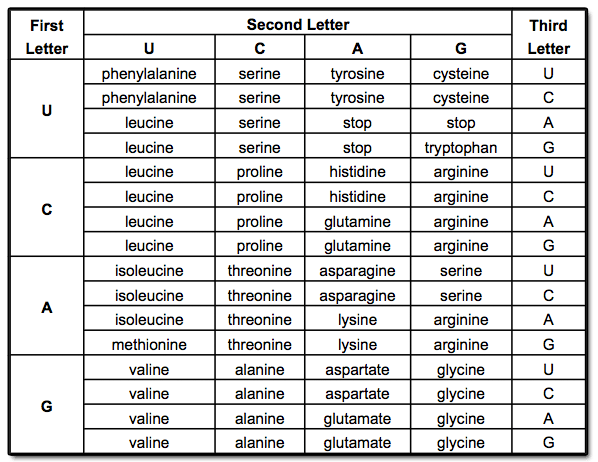
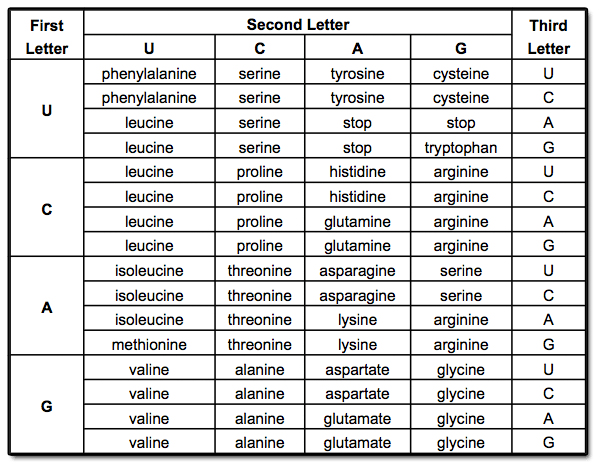
When using your codon chart, what sequence can you use to find the correct amino acid?

a)

DNA

b)

mRNA

c)

tRNA

d)

Any of these will do

73.

How many nucleotides make up a codon?

a)

1

b)

3

c)

5

d)

15

74.
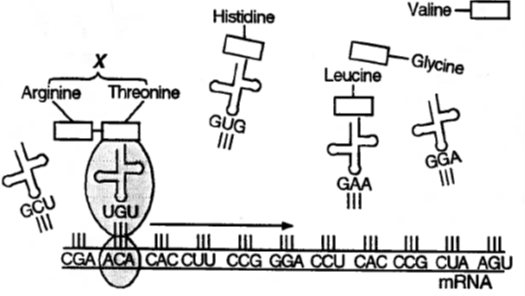
What process is going on in this photo? 
a)
Transcription 
b)
Translation 
c)
Replication 
d)
All the above 
75.

What is the order for Protein Synthesis?

a)

Transcription -> Translation -> Protein

b)

Translation - > Transcription -> Protein

c)

Protein -> Transcription -> Translation

d)

Translation -> Protein -> Transcription
76.
tRNA is involved in
a)
carrying amino acids 
b)
carrying ribosomes
c)
carrying glucose
d)
carrying lipids
77.
Which Seq could be found in RNA?
a)
ACCTGT
b)
CGCATT
c)
AUGCUU
78.
What amino acid is represented by the codon UUA?
a)
Phenylalanine
b)
Tyrosine
c)
Leucine
d)
Stop codon
79.
What process is going on in this photo? 
a)
Transcription 
b)
Translation 
c)
Replication 
d)
All the above 
80.
What is the correct amino acid sequence for the mRNA code AUGCCAGUAUGA
a)
Met-Pro-Ala-Val
b)
Met-Pro-Val
c)
Tyr-Gly-His
d)
Tyr-Gly-Arg-His
81.

What is the correct amino acid sequence for the mRNA code AUGCCAGUAUGA

a)

Met-Pro-Ala-Val

b)

Met-Pro-Val

c)

Tyr-Gly-His

d)

Tyr-Gly-Arg-His

82.
What amino acid is represented by the codon UUA?
a)
Phenylalanine
b)
Tyrosine
c)
Leucine
d)
Stop codon
83.
The codon CCU codes for what amino acid?
a)
Isoleucine
b)
Stop
c)
Methionine
d)
Proline
84.
Which amino acid pairs with the codon AGA
a)
Thr
b)
Arg
c)
Ala
d)
Glu
85.
What is does this image represent? 
a)
Mutation
b)
Translation 
c)
tRNA
d)
Transcription 
86.
How are mutations passed on to offspring?
a)
Any mutation that an organism acquires in its life can be passed on to the offspring through its gametes (sex cells)
b)
Only mutations that occur in the gametes can be passed on to the offspring
c)
Mutations are not usually passed on to the offspring. A mutation stays within the original organism.
d)
Mutations are not passed to offspring. They only occur within developing embryos.
87.

Mutation

a)

a DNA segment in a chromosome that is a copy of another segment

b)

the loss or excision of a section of genetic code, or its product

c)

the set of observable characteristics of an individual

d)

the changing of the structure of a gene, resulting in a variant form

88.
ATTTGAGCC- Original
ATTGAGCC - Mutated
The example above is an example of a 
a)
Insertion- Frameshift
b)
Deletion- Substitution
c)
Deletion -Frameshift
d)
All of the above
89.
What mutation has occurred here? 
T-G-A-C-C-A
T-G-A-G-C-A
a)
Substitution
b)
Deletion
c)
Insertion
d)
Frameshift 
90.
The mRNA leaves the ________ to find the ribosome to make proteins.
a)
cell
b)
nucleotide
c)
nucleus
91.

Place the order of events for creating a protein in order (1- 6)


  1. mRNA attaches to rRNA
  2. codons are continuously read by tRNA
  3. tRNA reaches a stop codon
  4. tRNA connects second amino acid by peptide bond to Methionine
  5. Polypeptide chain is created
  6. mRNA’s start codon AUG is translated by tRNA’s anticodon (Methionine)
a)

1,5,4,3,6,2

b)

2,4,5,3,6,1

c)

1,2,3,4,5,6

d)

1,6,4,2,3,5

92.
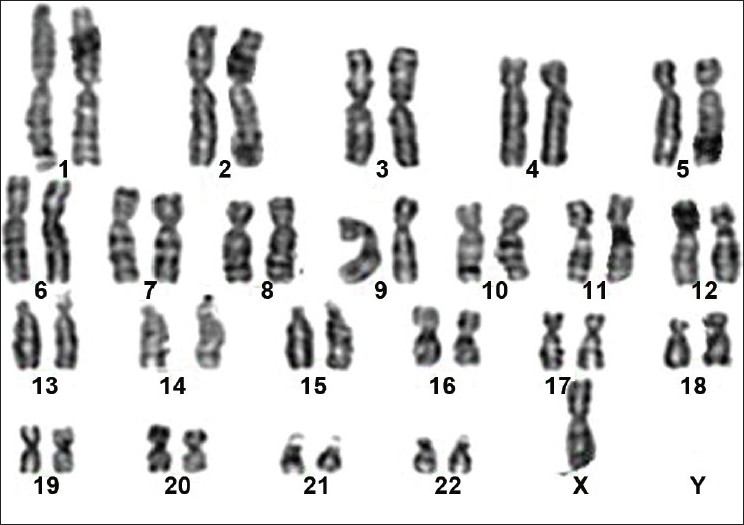
a)
This karyotype shows Trisomy 21
b)
This karyotype has no abnormality
c)
This karyotype is missing a sex chromosome (monosomy x)
d)
This karyotype is from a gamete
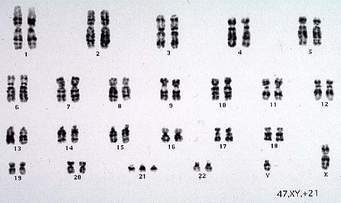
93.
Based on the Karyotype shown, at which chromosome pair can we identify a genetic disorder? 
a)
Chromosome pair 5
b)
sex chromosomes
c)
Chromosome pair 21
d)
There are no chromosomal disorders
94.
Determine the sex of the individual whose karyotype is displayed in the image.
a)
female
b)
male
95.
The phase in mitosis where chromosomes move away and are pulled apart by spindles to opposite sides of the cell.
a)
prophase
b)
anaphase
c)
metaphase
d)
telephase
96.

Which best describes nondisjunction?

a)

an inherited mutation carried in an egg or a sperm

b)

an error in meiosis where chromosomes fail to separate

c)

when chromosomes fuse together during mitosis

d)

when homologous chromosomes trade segments
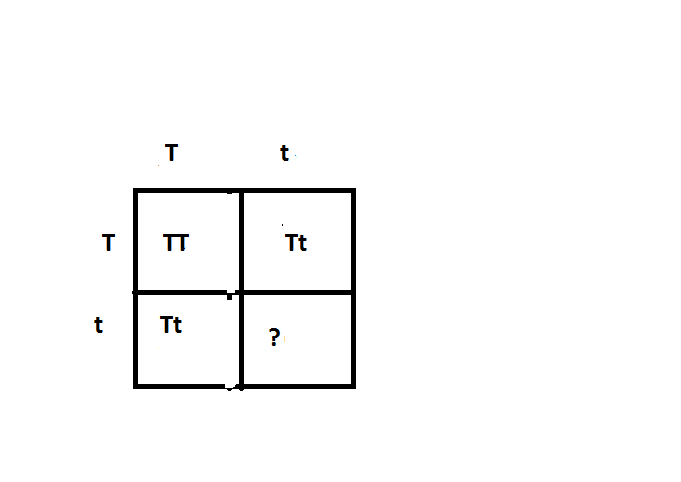
97.

T - tall and t = short

In the punnett square below, what belongs in the missing square

a)

tt

b)

Tt

c)

Bb

d)

TT

98.

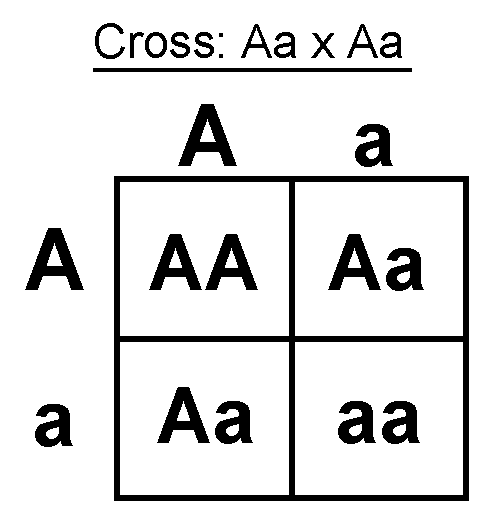
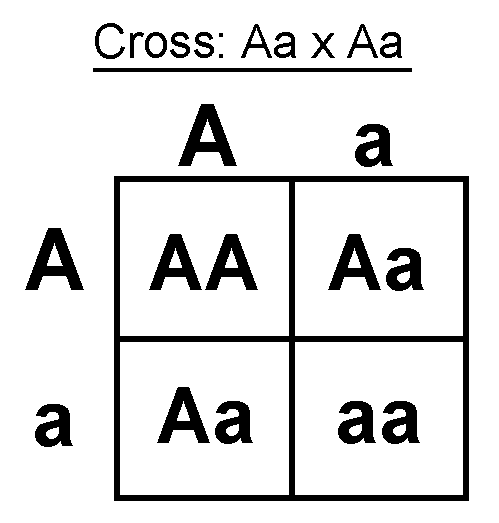
What is the genotypic ratio of the offspring?

a)

3:1

b)

1:3

c)

1:2:1

d)

2:2

99.

What are the phenotype percentages of the offspring?

(A-Brown fur color; a-white fur color)

a)

50 % Brown fur and 50% White fur

b)

25 % Brown fur and 75% White fur

c)

75 % Brown fur and 25% White fur

d)

0% Brown fur and 100% White fur

100.
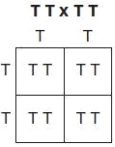
What ratio of the offspring from the cross shown will be homozygous recessive for the  trait of tallness
a)
0 in 4
b)
1 in 4
c)
2 in 4
d)
4 in 4