wayground logo

Free Printable Worksheets

Font size

S
M
L
XL
Worksheets

Science Semester Review

Total questions: 121

Worksheet time: 3hrs 48mins

Name
Class
Date
1.
Geocentrism is the theory that says that the Earth is the centre of the universe. 
a)
True
b)
False
2.
Heliocentrism is the theory that says that the Moon is the centre of the universe. 
a)
True
b)
False
3.
Nicolaus Copernicus proposed that all planets orbited and revolved around the sun.
a)
True
b)
False
4.
Galileo Galilei agreed with Copernicus. 
a)
True
b)
False
5.

What is the big bang theory?

a)

A theory that states that the universe started in a large mass and then imploded to form everything.

b)

A theory that states that the universe was there, will be and is there. Is homogeneous and isotropic.

c)

A theory that states that the universe is slowly coming back to a center.

d)

A theory that states that the universe started in a small mass and then expanded, the expansion cooled down the temperature and that resulted in the formation of matter, energy, space and time.

6.

The galaxy we are a part of is called:

a)

Milky Way

b)

Andromeda

c)

Whirlpool

d)

Sombrero

7.
Nicolaus Copernicus proposed that all planets orbited and revolved around the sun.
a)
True
b)
False
8.
What type of galaxy is this?
a)
Spiral
b)
Elliptical
c)
Irregular 
d)
Irrational
9.
Our Galaxy is called the
a)
M38
b)
Milky Way Galaxy
c)
Andromeda Galaxy
d)
Pinwheel Galaxy
10.
All stars begin as a __________?
a)
giant
b)
black hole
c)
white dwarf
d)
nebula
11.
pulls clusters of stars together in most galaxies.
a)
air
b)
Big Bang Theory
c)
gravity
d)
dark energy
12.
What are the the 3 types of galaxies?
a)
Spiral Galaxies, Regular Galaxies, and Lliptical Galaxies
b)
Spiral Galaxies, Irregular Galaxies, and Elliptical Galaxies
c)
 Milky Way, Elliptical Galaxies, and Spiral Galaxies
d)
Milky Way, Elliptical Galaxies, and Irregular Galaxies
13.
Place these objects in order from smallest to largest.
a)
Planets, solar system, universe, galaxy
b)
Solar system, planets, galaxy, universe
c)
Planets, solar system, galaxy, universe
d)
Galaxy, solar system, planets, universe
14.
Distance measurement used by astronomers for distant objects.
a)
Kilometers
b)
Light Years
c)
Miles
d)
Light Seconds
15.
What is the name of our galaxy? 
a)
Our galaxy is called the Milky Way galaxy 
b)
Our galaxy is called the Andromeda galaxy 
c)
Our galaxy is called the Grand spiral  galaxy. 
d)
Our galaxy is called the Whirlpool galaxy.
16.
Galaxies are composed of (best answer)
a)
stars
b)
stars and gas
c)
stars, dust, and gas
d)
stars, dust, and gas held together by gravity
17.
Gas giants
a)
Inner planets
b)
Outer planets
c)
Both
d)
Venus
18.
Mercury, Venus, Earth, & Mars
a)
Inner planets
b)
Outer planets
c)
Both
d)
Pluto
19.
Very few moons
a)
Inner planets
b)
Outer planets
c)
Both
d)
Mercury
20.
Jupiter, Saturn, Uranus, & Neptune
a)
Inner planets
b)
Outer planets
c)
Both
d)
Earth
21.
Close to the sun
a)
Inner planets
b)
Outer planets
c)
Both
d)
Kuiper Belt
22.
Lots of rings
a)
Inner planets
b)
Outer planets
c)
Both
d)
Mars
23.
Located between the inner and outer planets.
a)
Sun
b)
Asteroid belt
c)
Uranus
d)
Moons
24.
Part of the Milky Way
a)
Inner planets
b)
Outer planets
c)
Both
25.
Orbit the sun
a)
Inner planets
b)
Outer planets
c)
Both
26.
Nicknamed the 'red planet'.
a)
Venus
b)
Mercury
c)
Jupiter
d)
Mars
27.
Solid, rocky surface
a)
Inner planets
b)
Outer planets
c)
Both
d)
Saturn
28.
Home to the 'Great Red Spot'
a)
Mars
b)
Jupiter
c)
Saturn
d)
Miami
29.
Appears as a streak in the sky.
a)
asteroid
b)
meteoroid
c)
comet
d)
meteor
30.
Often called shooting stars.
a)
asteroid
b)
meteoroid
c)
comet
d)
meteor
31.
Sometimes called "dirty snowballs".
a)
asteoids
b)
meteoroids
c)
comets
d)
meteors
32.
Piece of a meteoroid that strikes the earth's surface
a)
comet
b)
asteroid
c)
meteor
d)
meteorite
33.
Piece of rock that burns up as it passes through the earth's atmosphere.
a)
asteroid
b)
meteoroid
c)
comet
d)
metoer
34.

When the Moon is directly between the Sun and the Earth, what phase would the Moon be in?

a)

Full Moon

b)

New Moon

c)

Half Moon

d)

Waxing Crescent

35.

What term is associated with the moons that are increasing in size (more light on them) each day?

a)

Waxing moons

b)

Waning moons

c)

Crescent moons

d)

Gibbous moons

36.

What phase of the moon is this?

a)

Waxing Gibbous

b)

Waning Gibbous

c)

Waxing crescent

d)

Waning crescent

37.
The different phases of the Moon are caused by:
a)
The days of the months
b)
The angle at which we see the lit Moon as it revolves around the Earth
c)
The position of the Earth in its orbit around the Sun
d)
The tides of the ocean
38.

The Moon gets its light from the

a)

It reflects the Earth's light

b)

It reflects the other stars' light

c)

It reflects the Sun's light

d)

It makes its own light

39.

About how long does it take the Moon to complete it's cycle?

a)

around 1 week

b)

around 1 month

c)

around 1 year

d)

around 1 day

40.

What phase of the moon is shown?

a)

waning gibbous

b)

1st quarter

c)

waxing crescent

d)

Waxing gibbous

41.
Name the phase of the moon that comes BEFORE this moon phase.
a)
waxing gibbous
b)
waning gibbous
c)
waning crescent
d)
waxing crescent
42.

How much of the Moon is always reflecting light from the Sun?

a)

The entire moon is always illuminated

b)

Half of the Moon is always illuminated; it's just not always facing Earth

c)

Half of the Moon is illuminated only during the new moon

d)

Half of the Moon is illuminated only during the full moon

43.

What is the phase of the Moon at position #5?

a)

New Moon

b)

Third Quarter Moon

c)

First Quarter Moon

d)

Full Moon

44.

What is the correct phases of the Moon at position 3?

a)

Waning Crescent

b)

First Quarter (or Waxing Half)

c)

Third Quarter (or Waning Half)

d)

Waxing Gibbous

45.
What are the correct phases of the Moon from position 6 through 8?
a)
Waning Crescent, First Quarter, Waning Gibbous
b)
Waning Gibbous, Third Quarter, Waning Crescent
c)
Waxing Crescent, First Quarter, Waxing Gibbous
d)
Waxing Gibbous, Third Quarter, Waxing Crescent
46.

This model is showing us a...

a)

lunar eclipse

b)

solar eclipse

c)

phases of the moon

d)

earth eclipse

47.

This image is showing us a.....

a)

solar eclipse

b)

lunar eclipse

c)

phases of the moon

d)

earth eclipse

48.

When the moon passes between the earth and the sun, this results in a.....

a)

Waxing moon

b)

lunar eclipse

c)

solar eclipse

d)

sun rise

49.

When the earth is between the sun and the moon, this results in a...

a)

waxing moon

b)

solar eclipse

c)

lunar eclipse

d)

sun rise

50.

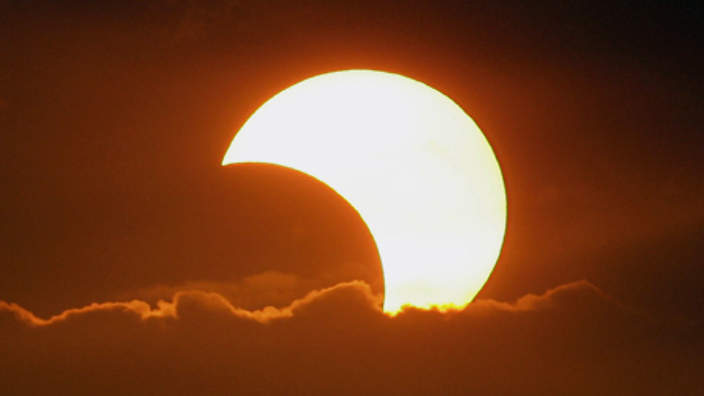
If you look up at the sky and see this, you are witnessing a....

a)

solar eclipse

b)

total eclipse

c)

lunar eclipse

d)

jupiter

51.

If you are looking up at the sky and see this, you are looking at a....

a)

solar eclipse

b)

total eclipse

c)

lunar eclipse

d)

jupiter

52.

Which of the following is not true about a total solar eclipse?

a)

It can be viewed once a year from every spot on earth

b)

It is dangerous to look at without the proper device

c)

When it happens, the moon blocks all of the sun except the corona

d)

You must be within the moon's umbra to see it

53.

In order to have an eclipse, the Moon, Sun and Earth have to be?

a)

Below each other

b)

Above each other

c)

In alignment

54.

This image is an example of

a)

Lunar Eclipse

b)

Full Moon

c)

New Moon

d)

Solar Eclipse

55.

During a lunar eclipse, what color does the moon appear?

a)

Black

b)

Red-orange

c)

Yellow-green

d)

White

56.
Which of the following best describes the tilt of the earth when it is summer in the southern hemisphere?
a)
The northern hemisphere is tilted toward the sun
b)
The northern hemisphere is tilted away from the sun
c)
The norther hemisphere is tilted neither toward or away from the sun
d)
Why are you talking about the northern hemisphere when you asked about the southern hemisphere?
57.
The earth is a tilted planet.  What is the degree of tilt?
a)
Approximately 25 degrees
b)
Exactly 25 degrees
c)
23.5 degrees
d)
90 degrees with respect to the sun
58.
What does the earth's tilt cause?
a)
The seasons
b)
Day and Night
c)
Tsunamis
d)
Earthquakes
59.
What is the shape of the earth's orbit around the sun?
a)
Circular
b)
Elliptical (slightly oval)
c)
Square to rectangular
d)
Variable and changes with the seasons (no particular shape)
60.
What effect does the tilt of the earth have?
a)
It changes the angle that the sun strikes the earth in different land areas
b)
It causes the earth to be farther away from the sun at different times of the year
c)
When the earth is tilted away from the sun we have night
d)
When the earth is tilted away from the sun we have day
61.
What season is it in the Southern Hemisphere when it is fall in the Northern Hemisphere?
a)
winter
b)
spring
c)
summer
d)
fall
62.
Why does the area around the equator stay the same temperature all year?
a)
The equator rotates slower than the poles.
b)
The equator remains the same distance from the sun.
c)
The equator always receives direct sunlight.
d)
The equator has 18 hour days.
63.
One rotation of Earth is equal to
a)
a day.
b)
a year.
64.
What would seasons be like if Earth's axis were straight up and down?
a)
Seasons would be the same.
b)
Seasons would be more extreme.
c)
There would be no seasons.
65.
Where on Earth can you experience entire days of darkness?
a)
The equator
b)
The poles
c)
The Tropic of Cancer
d)
The Tropic of Capricorn
66.

Where is most of Earth’s water located?

a)

glaciers

b)

lakes

c)

oceans

d)

rivers

67.

What is groundwater?

a)

water that fills space between rocks of Earth

b)

water found within a lake or pond

c)

water that is evaporated from the surface of Earth

d)

water that is found in the ocean

68.

Water can exist on Earth as...

a)

solid ice

b)

liquid water

c)

the gas water vapor

d)

All of above

69.

What are the two kinds of water that exist on Earth?

a)

Freshwater

b)

Saltwater

c)

Sugarwater

d)

Bluewater

70.

Freshwater makes up how much of the Earth's water supply?

a)

97%

b)

75%

c)

25%

d)

3%

71.

Saltwater makes up how much of the Earth's water supply?

a)

97%

b)

75%

c)

25%

d)

3%

72.

Oceans are

a)

Freshwater

b)

Saltwater

73.

Rivers are

a)

Freshwater

b)

Saltwater

74.

Salinity is the amount of salt in a body of water.

a)

True

b)

False

75.

Where is most of Earth's freshwater found?

a)

in the ground

b)

in the atmosphere

c)

in lakes and rivers

d)

in glaciers and icecaps

76.
Why do we need to conserve water?
a)
It is an unlimited resource. 
b)
It is a limited resource. 
c)
There is a lot of water. 
d)
There is no need to conserve water.
77.
Why is clean water important?
a)
All life on Earth depends on clean water to live and grow.
b)
We need clean water for recreational activities.
c)
We need bodies of water for transportation
d)
We need water to regulate the temperature on Earth.
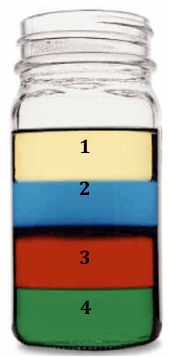
78.
Put the liquids in order from most dense to least dense?
a)
4, 3, 2, 1
b)
1, 2, 3, 4
c)
3, 4, 2, 1, 
d)
4, 3, 1, 2
79.

______ causes deep ocean currents

a)

The Coriolis Effect

b)

gravity

c)

wind

d)

density differences

80.

______ causes surface currents.

a)

The Coriolis Effect

b)

gravity

c)

density differences

d)

wind

81.

Decreasing ocean temperature causes the density of the water to ______.

a)

decrease

b)

increase

c)

stay the same

d)

fluctuate

82.
Warm ocean currents generally come from
a)
The North Pole
b)
The South Pole
c)
The Equator
d)
Both A and B
83.
Cold ocean currents generally come from
a)
The North Pole 
b)
The South Pole
c)
The Equator
d)
Either Pole
84.
Where does the intial source of energy come from that creates winds and thus surface currents?
a)
The moon
b)
The sun
c)
The wind
d)
The rotation of the Earth
85.
The Gulf stream carries _____________ water from the east coast of The United States to the West coast of Europe.
a)
Cold
b)
Warm 
c)
Freezing
d)
Fresh
86.
Ocean currents have an affect on which two things
a)
climate and weather
b)
temperature and density
c)
land and sea
d)
equator and poles
87.
Why are surface currents at the surface of the ocean?
a)
colder temperature
b)
colder temperature & more salinty
c)
warmer temperature & less salinty
d)
less salinty
88.
 As the temperature of ocean water changes from 10 to 30 degrees C, how does the density change?
a)
The water becomes more dense
b)
The water becomes less dense
c)
 The density does not change 
d)
 It is impossible to predict
89.
As Density  increases
a)
Temperature decreases
b)
Temperature increases
90.
Temperature  increases
a)
Density increases
b)
Density decreases
91.
As salinity  increases
a)
Density increases
b)
Density decreases
92.
Ocean depth  increases & Salinity  increases then
a)
Temperature decreases because cold water is more dense and sinks
b)
Temperature increases because cold water is more dense and sinks
93.
When an object or substance is cooler, its particles move slower and are closer together True Or False
a)
True
b)
False
94.
When an object or substance is warmer, its particles move faster and get further apart (Tip for remembering: they are warmer and want to get cooler by moving away from one another)  True or False
a)
True
b)
False
95.
True or False Salinity increases as ocean depth increases.
a)
True
b)
False
96.
At which latitudes are the highest surface salinities located? See graph the Atlantic or the Pacific
a)
About 20o N and S latitude
b)
About 30o N and S latitude
97.
Which ocean, the Atlantic or the Pacific, has higher average surface salinities?
a)
Pacific
b)
Atlantic
98.
Briefly describe the overall relationship between temperature and density.
a)
Lower temperature water has higher density, warmer water has lower density
b)
Lower temperature water has lower density, warmer water has higher density
99.

What is a high tide?

a)

Sea pulled TOWARD the moon where Earth is CLOSEST to the moon

b)

Sea pulled AWAY from the moon where Earth is FARTHEST to the moon

c)

Sea pulled AWAY from the moon where Earth is CLOSEST to the moon

100.
Which body has the greater effect on Earth's tides?
a)
Sun
b)
Saturn
c)
Moon 
d)
Venus
101.

Wha type of tide would this arrangement of earth-moon-sun create?

a)

full moon tide

b)

new moon tide

c)

neap tide

d)

spring tide

102.
Tides are caused by
a)
strong winds that blow over ocean waters.
b)
the interaction of Earth, the moon and the sun.
c)
the shifting of the plates on the ocean floor.
d)
variations in the salinity of ocean water
103.
What causes tides?
a)
gravity
b)
wind
c)
spring
d)
neap
104.
How many low tides and high tides happen in a day?
a)
1 low tide, 1 high tide
b)
4 low tides, 4 high tides
c)
3 low tides, 3 high tides
d)
2 low tides, 2 high tides
105.
Snow, sleet, hail, and rain are all examples of  ________________. 
a)
evaporation
b)
condensation
c)
accumulation
d)
precipitation
106.
What is it called when WATER is FORMED from an LIQUID to a WATER VAPOR Oor an [GAS]?
a)
EVAPORATION
b)
PRECIPITATION
c)
TRANSPIRATION
107.
What is it called when plants give off water vapor as a waste product?
a)
condensation
b)
evaporation
c)
sublimation
d)
transpiration
108.
When water _________, dew forms.
a)
Melts
b)
Evaporates
c)
Condenses
d)
Precipitates
109.
What is A?
a)
Evaporation
b)
Condensation
c)
Precipitation
d)
Runoff
110.
What is B?
a)
Evaporation
b)
Condensation
c)
Precipitation
d)
Runoff
111.
What is precipitation?
a)
The part of the water cycle when the sun heats up water, turning it from a liquid into water vapor or steam. It rises from the ground into the air.
b)
The part of the water cycle when the water vapor in the air gets cold. The water turns back into a liquid and forms clouds.
c)
The part of the water cycle when clouds get heavy and can no longer hold the liquid water. This causes the water to fall from the sky to the earth as rain, snow, sleet, or hail.
112.
What is condensation?
a)
The part of the water cycle when the sun heats up water, turning it from a liquid into water vapor or steam. It rises from the ground into the air.
b)
The part of the water cycle when the water vapor in the air gets cold. The water turns back into a liquid and forms clouds.
c)
The part of the water cycle when clouds get heavy and can no longer hold the liquid water. This causes the water to fall from the sky to the earth as rain, snow, sleet, or hail.
113.
What is evaporation?
a)
The part of the water cycle when the sun heats up water, turning it from a liquid into water vapor or steam. It rises from the ground into the air.
b)
The part of the water cycle when the water vapor in the air gets cold. The water turns back into a liquid and forms clouds.
c)
The part of the water cycle when clouds get heavy and can no longer hold the liquid water. This causes the water to fall from the sky to the earth as rain, snow, sleet, or hail.
114.
What is water that flows in rivers and streams into the oceans and lakes?
a)
evaporating
b)
condensing
c)
precipitating
d)
runoff
115.
On which kind of day would you expect the most evaporation from the surface of a pond?
a)
cold, rainy
b)
cold, sunny
c)
warm, rainy
d)
warm, sunny
116.
Which of the following causes all of the water on the planet to change its state (solid, liquid, gas) and move through the water cycle?
a)
amount of plant matter
b)
location of ice caps
c)
size of ocean
d)
temperature
117.
What is water vapor?
a)
Water on the land (geosphere)
b)
Water in the air (atmosphere)
c)
Water in plants
d)
Water in the water (hydrosphere)
118.
What cloud is found at ground level? 
a)
Cirrus
b)
Stratus
c)
Culumlus 
d)
Fog
119.
What is      D?
a)
Evaporation
b)
Condensation
c)
Precipitation
d)
Runoff
120.
What is water vapor doing when it changes to water?
a)
evaporating
b)
condensing
c)
precipitating
d)
runoff
121.
Which of these is not an example of precipitation?
a)
rain
b)
clouds
c)
sleet
d)
snow