wayground logo

Free Printable Worksheets

NEW

Font size

S
M
L
XL
Worksheets

Honors Biology Fall Semester Review

Total questions: 45

Worksheet time: 45mins

Name
Class
Date
1.

The basic unit of a living thing is a ________________.

a)

cell

b)

cytoplasm

c)

nucleus

d)

cell membrane

2.
The type of variable that you change or manipulate in an experiment.  It is what you are testing.
a)
Independent
b)
Dependent
c)
Control
3.
The type of variable that responds to the experiment and is what you measure to determine if your hypothesis is true.
a)
Independent
b)
Dependent
c)
Control
4.

Groups of similar cells that work together.

a)

cell

b)

tissue

c)

organ

d)

organ system

e)

organism

5.
Which biomolecule is a main source of quick energy?
a)
Nucleic Acid
b)
Protein
c)
Lipid
d)
Carbohydrate
6.
Which biomolecule is found in fats, oils, and waxes and is a source of long-term energy
a)
Proteins
b)
Nucleic Acid
c)
Lipids
d)
Carbohydrate
7.
What is the function of a nucleic acid?
a)
Stores genetic information
b)
Stores energy
c)
Quick source of energy
d)
Builds structures
8.
Which biomolecule is made of nucleotides and contain you DNA?
a)
Carbohydrate
b)
Lipids
c)
Protein
d)
Nucleic Acid
9.

Which biomolecule helps form muscles?

a)

Nucleic Acid

b)

Carbohydrate

c)

Protein

d)

Lipids

10.
Which biomolecule is responsible for insulation and energy storage?
a)
Protein
b)
Nucleic Acid
c)
Lipid
d)
Carbohydrate
11.

Which type of cell DOES NOT have a nucleus?

a)

Prokaryotic

b)

Eukaryotic

12.

Which type of cell HAS a nucleus?

a)

Prokaryotic

b)

Eukaryotic

13.

Which type of cell is found in BACTERIA?

a)

Prokaryotic

b)

Eukaryotic

14.
During the lytic infection by a virus, the host cell is-
a)
destroyed
b)
copied
c)
passed on to the lysogenic cycle
d)
not affected
15.
Which best describes the basic structure of a virus?
a)
nucleic acid strand surrounded by a protein coat
b)
a tail surrounded by a protein coat
c)
a tail surrounded by a carbohydrate coat
d)
nucleic acid strand surrounded by a carbohydrate coat
16.
Which viral life cycle allows viral genetic material to lay dormant while the host cell reproduces?
a)
lytic
b)
mitosis
c)
lysogenic
d)
S phase
17.
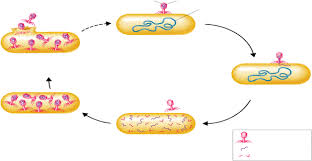
What is shown here?
a)
Lysogenic Cycle
b)
Lytic Cycle
c)
Binary Fission
d)
Conjugation
18.
Provides extra support for the plant cell and gives in shape
a)
chlorophyll
b)
chloroplast
c)
cell wall
d)
vacuole
19.

Why do viruses have projections on the outside?

a)

To send signals to other viruses.

b)

To maintain their structure.

c)

To attach to the host cell.

d)

To reproduce.

20.

How does the circulatory system depend on the respiratory system in order to function?

a)

The respiratory system removes bacteria from the circulatory system.

b)

The respiratory system produces circulatory system cells.

c)

The respiratory system delivers oxygen to the circulatory system.

d)

The respiratory system provides protection to the circulatory system.

21.

This system regulates body functions by secreting hormones?

a)

Endocrine System

b)

Muscular System

c)

Cardiovascular System

d)

Nervous System

22.

Homeostasis for living organisms means...

a)

external environment stays the same when internal changes

b)

water diffuses through membrane by osmosis

c)

concentrations move from high to low

d)

internal environment stays the same when external changes

23.
Identify the phase of mitosis
a)
prophase
b)
metaphase
c)
anaphase
d)
telophase
24.
the uncontrolled division of cells that results in malignant growth 
a)
tissues
b)
cancer
c)
mitosis
d)
anaphase
25.
What phase of mitosis is shown in the picture?
a)
Prophase
b)
Anaphase
c)
Telophase
d)
Metaphase
26.
What phase of mitosis is shown in the picture?
a)
Prophase
b)
Anaphase
c)
Telophase
d)
Metaphase
27.

The picture above represents what happens after mitosis which is

a)

Interphase

b)

Cytokinesis

c)

Metaphase

d)

G1

28.

In which stage of the cell cycle does the DNA replicate?

a)

G1

b)

S

c)

G2

d)

Mitosis

29.
The process where only water is allowed to pass through the cell membrane from a high to low concentration.
a)
meiosis
b)
respiration
c)
diffusion
d)
osmosis
30.
The movement of molecules from an area of high concentration to an area of low concentration.
a)
Osmosis
b)
Respiration
c)
Diffusion
d)
Active Transport
31.

During osmosis

a)

water moves from high to low concentration

b)

large or oddly shaped molecules move across a cell membrane

c)

water moves when energy is used

d)

proteins are built

32.
Molecules diffusing with the concentration gradient through a protein channel is...
a)
Facilitated Diffusion
b)
Simple Diffusion
c)
Active Transport
d)
Osmosis
33.

Passive transport requires

a)

concentration gradients

b)

osmosis

c)

energy

d)

no energy

34.
In what part of the cell does photosynthesis occur?
a)
Nucleus
b)
Chloroplast
c)
Epidermis
d)
Vacuole
35.
Which statement about photosynthesis is correct?
a)
Plants get the energy they need for photosynthesis from water.
b)
Plants get the energy they need for photosynthesis from soil.
c)
Plants get the energy they need for photosynthesis from sunlight.
d)
Plants do not require energy to perform photosynthesis.
36.
Please select who performs cellular respiration: 
a)
Animals 
b)
Both animals and plants 
c)
plants 
37.
Cellular respiration occurs in 
a)
chloroplasts 
b)
mitochondria
c)
golgi aparatus 
d)
thylakoid 
38.
This image is an example of ____________. 
a)
thigmotropism
b)
gravitropism
c)
phototropism
d)
photosynthesis
39.

What is the function of the stems?

a)

anchor plant to the soil

b)

provide support

c)

reproduce

40.

What is the function of the leaves?

a)

anchor plant to the soil

b)

provide support

c)

carry out photosynthesis

41.

what is the function of the roots?

a)

anchor plant

b)

reproduce

c)

photosynthesis

42.

Xylem carries _________ throughout the plant?

a)

nutrients, sugar

b)

water

43.

phloem carries _______ throughout the plant

a)

nutrients, sugar

b)

water

44.
Which of the following is the correct equation for PHOTOSYNTHESIS?
a)
6CO2 + 6H2O --> 6O+ C6H12O6
b)
6CO+ C6H12O6 + 6H2O --> O
c)
6O2 + 6H2O --> 6CO+ C6H12O6
d)
C6H12O6 + 6O2 ---> 6H2O + 6CO2 
45.

DNA replication

a)

makes an exact copy of DNA

b)

makes a different DNA molecule

c)

makes a protein