wayground logo

Free Printable Worksheets

Font size

S
M
L
XL
Worksheets

Fall Final Multiple Choice

Total questions: 100

Worksheet time: 2hrs 58mins

Name
Class
Date
1.

Refraction is when light__________.

a)

Is bounced by an object or material.

b)

changes speed as it travels in different materials which causes bending.

c)

speeds up to over 300,000 km/s

2.
Why can you see most objects?
a)
Light reflects off them
b)
Light is absorbed by them
c)
Light is bent by the object
d)
Light is scattered from the surface of the object
3.
Consider the light ray pictured at left moving from air into a glass slab and then back into air again.  What happens to the speed of the light as it does this?     
a)
Speeds up then slows down
b)
Slows down then speeds up
c)
Stays the same speed
4.
EM waves are always____________
a)
Transverse
b)
Compression
c)
Longitudinal
d)
Seismic
5.
_____ have the longest wavelengths and lowest frequencies of all electromagnetic waves.
a)
microwaves
b)
radio waves
c)
gamma rays
d)
ultraviolet
6.

The shortest wavelength in visible light is______.

a)

violet

b)

red

c)

blue

d)

yellow

7.
_______ carry the greatest amount of energy. 
a)
x-rays
b)
gamma rays
c)
infrared rays
d)
visible light
8.
The higher the frequency the ______ the energy. 
a)
higher
b)
lower
c)
neither, stays the same
9.

When a current flows in a wire, it causes a _____ to be produced.

a)

photon

b)

current

c)

magnetic field

d)

refraction

10.

Light of a single wavelength is incident on a metal. Electrons are released. The frequency of the light is then increased.

Which of the following is true?

a)

More photons cause less electrons to be emitted.

b)

Same number of photons release the same number of electrons.

c)

More photons cause more electrons to be emitted.

d)

Less photons cause less electrons to be emitted.

e)

Less photons cause more electrons to be emitted.

11.

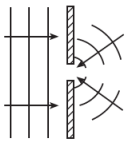
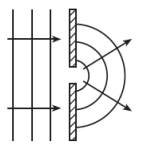
Which diagram best represents the shape and direction of a series of wave fronts after they have passed through a small opening in a barrier?
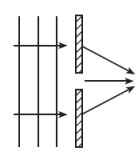
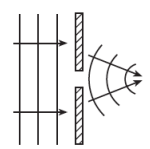
a)
b)
c)
d)
12.

Light of a given wavelength is used to illuminate the surface of a metal. However, no photoelectrons are emitted. In order to cause electrons to be ejected, light of __________ should be used.

a)

lower energy

b)

higher intensity

c)

shorter frequency

d)

higher frequency

13.

What can you change to increase or decrease the speed of a wave?

a)

the wavelength of the wave

b)

the frequency of the wave

c)

the medium that the wave travels through

d)

how fast you vibrate the medium

14.

Which of the following is a true statement about the conservation of energy?

a)

Potential energy is always conserved.

b)

Kinetic energy is always conserved.

c)

Mechanical energy is always conserved.

d)

Total energy is always conserved.

15.

Friction removes energy from a system by…

a)

Destroying it

b)

Converting it into thermal energy

c)

Converting it back into potential energy

d)

Increasing momentum

16.
When a pendulum swings, at which point is potential energy at its greatest?
a)
1
b)
2
c)
3
d)
4
17.
______ is energy stored by things that stretch or compress.
a)
Elastic kinetic energy
b)
Gravitational potential energy
c)
Elastic potential energy
d)
Chemical kinetic energy
18.
Mechanical energy is equal to the sum of Kinetic energy and _________ energy
a)
Thermal
b)
Potential
c)
Electrical
d)
Chemical
19.
Energy can be _____________ or changed from one type to another.
a)
destroyed
b)
transferred
c)
created
d)
ignored
20.
Can energy be destroyed?
a)
no
b)
yes
21.
As the skier goes down the hill, ________ energy increases while _______ energy decreases.
a)
Gravitational; Kinetic
b)
Kinetic; Gravitational
c)
Elastic; Kinetic
d)
Kinetic; Elastic
22.
What kind of energy is in a rock at the edge of a cliff?
a)
Potential
b)
Kinetic
23.
What kind of energy is in a moving skateboard?
a)
Potential
b)
Kinetic
24.

Which of the following energy forms is the sum of kinetic energy and all forms of potential energy?

a)

Total Mechanical Energy

b)

Nonmechanical Energy

c)

Sum Energy

d)

Elastic Potential Energy

25.

What causes this result

a)

Constructive interference

b)

destructive interference

c)

free gift card giveaway

26.

What type of inference is this picture showing?

a)

Constructive

b)

Destructive

c)

Restructive

27.

The amplitude of a particular wave is 4.0 m. The top-to-bottom distance of the disturbance is

a)

4.0 m

b)

8.0 m

c)

0.5 m

d)

2.0 m

28.

Waves are created by a vibration.

a)

True

b)

False

29.
The distance between the same two points on a wave is called _______
a)
amplitude
b)
frequency
c)
wavelength
d)
oscillation
30.
The number of complete oscillations a wave makes each second is the ____ of the wave.
a)
fortitude
b)
amplitude
c)
period
d)
frequency
31.

A wave in which the particles of the medium vibrate parallel to the direction of the wave motion

a)

mechanical wave

b)

surface wave

c)

longitudinal wave

d)

wave

32.

A wave in which the particles of the medium move perpendicularly to the direction the wave is traveling

a)

surface wave

b)

transverse wave

c)

electromagnetic wave

d)

longitudinal wave

33.

Interference is a ____________ phenomenon.

a)

wave

b)

particle

34.

The energy of a photon is directly proportional to its

a)

frequency

b)

wavelength

c)

speed

d)

All photons have the same energy.

35.

_________________ is produced when the crest of one

wave overlaps the crest of another.

a)

Constructive interference

b)

Destructive interference

c)

Refraction

d)

Reflection

36.

______________ is produced when the crest of one wave overlaps the trough of another.

a)

Destructive interference

b)

Constructive interference

c)

Refraction

d)

Reflection

37.

Observation : Bright blue light liberates photoelectrons from

the surface of lithium but red light from the

same intensity does not give off any electrons

at all.

Explanation : The intensity of red light is not sufficient to

liberate photoelectrons

DOES THE EXPLANATION EXPLAIN THE OBSERVATION?

a)

YES

b)

NO

38.

Observation : Bright blue light liberates photoelectrons from

the surface of lithium but red light from the

same intensity does not give off any electrons

at all.

Explanation : Photons of blue light carry more energy than

photons of red light because the frequency of

blue light is higher than the frequency of red

light

DOES THE EXPLANATION EXPLAIN THE OBSERVATION?

a)

YES

b)

NO

39.
The photoelectric effect helps us to understand
a)
the particle nature of light.
b)
diffraction pattern produced as light passes through a single slit.
c)
the wave behavior of light.
d)
spectroscopes.
40.
The photoelectric effect only occurs if the light shining on the metal is:
a)
coherent.
b)
above a minimum intensity.
c)
above a minimum frequency.
d)
above a minimum wavelength.
41.
The wave-particle duality of light describes light as...
a)
a wave only
b)
a particle only
c)
both a wave and a particle
d)
neither a wave nor a particle
42.

Young's double slit experiment relies on the _______ of light, which is a ______ phenomenon.

a)

interference; particle

b)

interference; wave

c)

refraction; particle

d)

refraction; wave

43.

When a light wave enters a medium and slows down, what changes?

a)

The frequency decreases.

b)

The frequency increases.

c)

The wavelength decreases.

d)

The wavelength increases

44.

Which of the following can be ionizing radiation? Mark all that apply.

a)

visible light

b)

microwaves

c)

ultraviolet

d)

x-rays

e)

gamma rays

45.
Particles of light energy are called
a)
beams
b)
photons
c)
thermograms
d)
dots
46.
All electromagnetic waves have the same...
a)
frequency
b)
speed
c)
wavelength
d)
energy
47.

What is the correct order of the EM spectrum from short wavelength to long wavelength?

a)

UV, visible, radio, microwaves

b)

Infrared, microwave, UV, x-rays

c)

UV, visible violet, visible red, infrared

d)

radio, microwave, UV, gamma

48.
What is the correct order of the EM spectrum from low frequency to high frequency?
a)
UV, visible, infrared, microwaves
b)
Infrared, microwave, UV, x-rays
c)
UV, visible violet, visible red, infrared
d)
radio, microwave, UV, gamma
49.
What is the correct order of the EM spectrum from low energy to high energy?
a)
UV, visible, infrared, microwaves
b)
Infrared, microwave, UV, x-rays
c)
UV, visible violet, visible red, infrared
d)
radio, microwave, UV, gamma
50.

As the wavelength of a wave increases, what happens to the frequency if the speed doesn't change?

a)

Increases

b)

Decreases

51.
The time it takes for 50% of the nuclei in a radioactive sample to decay to its stable isotope is called _____.
a)
the daughter product
b)
geologic time
c)
the half-life
d)
the half-time
52.

Scientists use radioactive decay to estimate... (answer all that apply)

a)

how long ago a rock formed

b)

how long ago something was alive

c)

how long something has been alive

d)

time of year, or season

53.

Carbon-14 has a half-life of 5730 years. A bone that originally had 10 grams of Carbon-14 now has about 1.25 grams. How many years have passed?

a)

3 years

b)

5,730 years

c)

11,460 years

d)

17,190 years

54.

What percent of carbon-14 would be left after 11,460 years?

a)

100%

b)

75%

c)

50%

d)

25%

55.

What's the half life of this substance?

a)

1 day

b)

6 days

c)

3 days

d)

9 days

56.

An igneous rock that is newly cooled so has had NO time to age will contain

a)

100% of original parent isotopes

b)

only daughter material, no parent material

c)

an even mix of parent and daughter materials

d)

can't be determined

57.
The type of plate boundary where two plates come together is a .....
a)
Convergent Boundary
b)
Divergent Boundary
c)
Transform Boundary
d)
Plate Boundary
58.
Which of the following causes Earth's tectonic plates to move?
a)
Energy from the Sun
b)
Magnetic Pole Reversal
c)
Convection currents in the mantle
d)
Faults in Mountain Ranges
59.
A divergent boundary occurs when plates ....
a)
Pull apart
b)
Come together
c)
Slide past each other
d)
subducting
60.

Oceanic Trenches are formed by _______ plate boundaries

a)

Convergent

b)

Transform

c)

Plate

d)

Divergent

61.

Very high mountains are created when....

a)

Two continental plates collide

b)

Two oceanic plates pull apart

c)

An Oceanic plate subducts under a Continental Plate

d)

Two continental plates pull apart

62.

Which layer of the Earth has convection currents?

a)

Inner Core

b)

Lithosphere

c)

Mantle

d)

Crust

63.
Which is true about hotter material in the mantle?
a)
more dense, sinks
b)
less dense, sinks
c)
less dense, rises
d)
more dense, rises
64.
A mid-ocean ridge occurs at a ________ plate boundary.
a)
transform
b)
convergent
c)
divergent
65.
What occurs when two plates come together and the denser one is forced under back into the mantle?
a)
reduction
b)
conduction
c)
subduction
d)
convection
66.

The youngest rocks on the seafloor are most likely found...

a)

closest to a mid-ocean ridge

b)

farthest from a mid-ocean ridge

c)

closest to a deep sea trench

67.

What is true about the different types of crust?

a)

Oceanic crust is more dense, but less thick than continental crust.

b)

Oceanic crust is less dense, but less thick than continental crust.

c)

Oceanic crust is more dense and more thick than continental crust.

d)

Oceanic crust is less dense and more thick than continental crust.

68.

What is Pangaea?

a)

The name of a German Scientist

b)

The name of the supercontinent that existed millions of years ago

c)

Another name for continental drift

d)

The name of an ancient fossil

69.

What is the term for an atom with a different number of neutrons?

a)

Earth metal

b)

neutral

c)

isotope

d)

isometric

70.

How many neutrons

does this isotope of

lithium have?

a)

7

b)

3

c)

4

d)

5

71.
Which type of wave arrives first during an earthquake?
a)
Primary (p-wave) waves
b)
Secondary (s-wave) waves
c)
Rayleigh Waves
d)
Love Waves
72.

Earthquakes release these which let us study what the Earth is made out of

a)

Tectonic Plates

b)

Seismic Waves

c)

Plateaus

73.
What is the primary source of energy for the Earth?
a)
Coal
b)
Wind power
c)
Natural gas
d)
The sun
74.

What is the process called in which gasses in Earth's atmosphere trap heat and send it back down to Earth's surface making it 30oC warmer than it would be?

a)

El nino

b)

Greenhouse effect

c)

Reconvectionation

d)

Global warming

75.
How does the amount of greenhouse gases in the atmosphere affect the atmosphere's temperature?
a)
If greenhouse gases in the atmosphere increase, they trap more heat and warm the atmosphere.
b)
If greenhouse gases in the atmosphere increase, they trap less heat and the atmosphere cools.
c)
If greenhouse gases in the atmosphere decrease, they trap more heat and warm the atmosphere. 
76.

The following is an example of what type of feedback loop?

a)

Negative Feedback Loop

b)

Neutral Feedback Loop

c)

Positive Feedback Loop

d)

Global Warming Feedback Loop

77.
Melting ice caps will cause the poles to have a ____________ albedo.
a)
higher
b)
lower
c)
same
78.

Which of the following has the highest albedo?

a)

the oceans

b)

glacial ice

c)

the ground

d)

roads

79.

Energy moves through Earth’s systems in three different ways:

a)

Convection, Concussion and Radiometry

b)

Conduction, Convection and Radiation

c)

Convection, Albedo and Radiation

d)

Radiation, Concussion and Convection

80.

The Mount Pinatubo eruption released nearly 20 million tons of sulfur dioxide, which formed tiny droplets of sulfuric acid that floated high in the atmosphere. How did this affect Earth's energy budget? (check all that apply)

a)

It increased the albedo of the cloud cover.

b)

Temperature increased.

c)

Temperature decreased.

d)

It decreased the albedo of the cloud cover.

e)

It had no affect on the energy budget.

81.

The thermal energy in the interior of the Earth comes from what two main sources?

a)

solar radiation

b)

energy leftover from Earth's formation

c)

radioactive decay

d)

convection of ocean currents

82.
True or false: Heat moves from the cooler object to a warmer object
a)
True
b)
False
83.
If two objects have different temperatures, heat will flow from the warmer object to the cooler one UNTIL ____________
a)
one reaches a temperature of zero
b)
they both have an equal temperature
c)
one runs out of energy
84.
When heat is transferred by the movement of currents within a fluid it is called 
a)
conduction
b)
convection
c)
radiation
85.

The transfer of energy by electromagnetic waves is called

a)

conduction

b)

convection

c)

radiation

86.
A material that conducts heat well is called a(n)
a)
conductor 
b)
insulator 
87.

A material that does not conduct heat well is called a(n)

a)

conductor

b)

insulator

88.

What is a transfer of energy through colliding particles?

a)

Convection

b)

Temperature

c)

Conduction

d)

Radiation

89.
Most metals are bad conductors.
a)
True
b)
False
90.
Which method of energy transfer does not involve movement of matter?
a)
convection
b)
conduction
c)
radiation
d)
None of the above
91.
When you pick up an ice cube, you experience the flow of coldness from the ice cube to your hand.
a)
True
b)
 False
92.
Heat is _________________.
a)
how hot or cold something is.
b)
the sum of all the kinetic and potential energy of the particles in an object.  
c)
the flow of energy from a warmer object to a cooler object.
d)
A measure of the average kinetic energy of all the particles in an object.
93.
As the kinetic energy of the molecules in a substance increases, the temperature of the substance __________.
a)
increases
b)
decreases
94.
What is thermal equilibrium?
a)
When two objects are at rest at the same time.
b)
When two or more objects reach a common temperature.
c)
When two objects have the same specific heat.
95.
Temperature is the same thing as heat.
a)
TRUE
b)
FALSE
96.
A piece of metal will feel colder than a piece of wood at the same temperature. Why?
a)
Metal atoms are moving more slowly, on the average, than wood atoms.
b)
Metals, in general, are good heat conductors.
c)
Metals are colder than wood.
d)
Wood, in general, is a poor insulator.
97.
You are feeling sick, so you place a thermometer under your tongue to check your temperature. The directions on the box tell you to leave the thermometer there for three minutes before you read your temperature. Why should you wait?
a)
It takes some time for the thermometer to reach its activation energy.
b)
It takes some time for the thermometer and your body to reach thermal equilibrium.
c)
It takes some time for the thermometer to raise your body’s internal energy.
d)
It takes some time for the thermometer and your body to attain a state of contact.
98.

What happens when two oceanic plates collide?

a)

The older, denser plate subducts

b)

The older, less dense plate subducts

c)

The younger, denser plate subducts

d)

The younger, less dense plate subducts

99.

You put ice in both an aluminum pan and a paper plate.

a)

The aluminum pan feels colder; the ice melts faster in the aluminum pan.

b)

The aluminum pan feels colder; the ice melts faster in the paper plate.

c)

The aluminum pan feels warmer; the ice melts faster in the aluminum pan.

d)

The aluminum pan feels warmer; the ice melts faster in the paper plate.

100.
As water in a freezer turns into ice,
a)
the water absorbs energy from the air in the freezer.
b)
the water absorbs the coldness from the air in the freezer.
c)
the freezer air absorbs heat from the water.
d)
the water neither absorbs nor releases energy