
 Worksheets
Earth's Interior Review Game
Total questions: 75
Worksheet time: 54mins
Why was Alfred Wegener’s theory of continental drift not at first widely accepted by the scientific community?
He had no evidence to support it
The shape of the continents did not match up
The continents were not moving at that time
He could not explain how the continents move
In his theory of continental drift, Alfred Wegener proposed that ____________.
Earth is expanding in size by 10 meters every year
The continents are floating around on a large ocean
The continents are all moving together and will soon collide
The continent were once joined together in one land mass
The crust and upper mantle of the Earth are together known as the …
Atmosphere
Lithosphere
Hydrosphere
Biosphere
The matching coastlines of Africa and South American help support which theory?
The theory of superposition
The theory of continental drift
The theory of gravity
The theory of evolution
Which of the following features is created when tectonic plates collide?
Sinkholes
Folded Mountains
Mesas
Ozone
Faults and folds are caused by
The heating of Earth
The movement of tectonic plates
The shrinking of Earth
Volcanoes
Alfred Wegener knew that fossils of the prehistoric reptile Mesosaurus existed in South America and Africa. This evidence supported his idea that…
South America and Africa were never connected
South America and Africa were once covered by ice for 5 billion years
Reptiles originated near the equator
South America and Africa were once connected
The fossil plant Glossopteris has been found in Africa, Australia, India, South America, and Antarctica. This evidence helps support the idea that….
The continents have moved
The continents have always been in the same locations they are now
The continents were once all covered by ice
Plants can travel across oceans
Where are most volcanoes and Earthquakes located?
Along the edges of tectonic plates, in zones like The Ring of Fire
In the middle of tectonic plates
In the middle of continents by lakes
In tropic zones, like the Ring of Ice

The satellite photograph shows a region of California. Observe the straight line above the highway. It has formed due to being along a transform boundary.
What kind of geologic feature is this line?
Fault
Mountain
Fold
Sinkhole
Which of the following is NOT considered evidence for plate tectonics?
The coastlines of South America and Africa seem to match up
Meteorites hit the planet and create craters
The sea floor is separating (spreading) along mid-ocean ridges
Earthquakes and volcanoes occur along specific zone
Which of the following features is found along divergent plate boundaries?
Folded mountains
Ocean trenches
Fault lines
Mid-Ocean Ridge
The process by which plate tectonic plates move apart at mid-ocean ridges is called…
Sea floor spreading
Subduction
Reverse faulting
Isostatic rebound
The movement of tectonic plates is believed to be caused by…
The rotation of Earth
Earth’s magnetic field
Convection currents in the mantle
The gravitational pull of the moon
Certain seismic waves will not pass through liquids. Therefore, these waves do not travel through the Earth’s…
Crust
Outer Core
Mantle
Inner Core
Folded mountains are common found at what type of plate boundary?
Divergent
Transform
Convergent
Inactive
Rift valleys often occur along what type of plate boundary?
Divergent
Convergent
Transform
Inactive
Ocean trenches & Island Arcs are often found at what type of plate boundaries?
Divergent
Convergent
Transform
Inactive
About how long did it take for South America and Africa to move apart to their current positions?
One hundred years
One thousand years
Millions of years
3 billion years
At transform boundaries, tectonic plates...
move apart
collide
slide past each other
do not move
At convergent boundaries, the tectonic plates…
move apart
collide
slide past each other
do not move
Which order of Earth’s layers is correct for least dense to most dense?
Crust, Mantle, Outer Core, Inner Core
Inner Core, Outer Core, Mantle, Crust
Mantle, Crust, Inner Core, Outer Core
Crust, Inner Core, Mantle, Outer Core
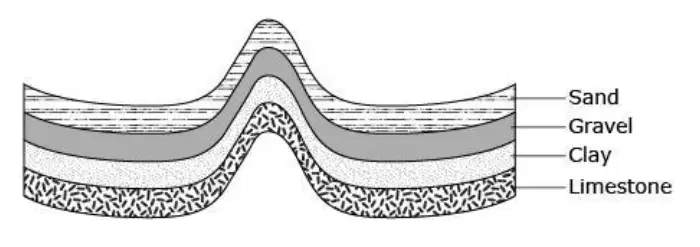
According to the law of superposition, which statement correctly describes the diagram?
The sand layer is older than all other layers
Different types of rock formed at the same time
The limestone layer is older than all other layers
The formation of the layers does not match their age
Identify the statement that is true about relative dating.
Radioactive elements help give clues about how old rocks are
The exact age of a rock can be determined by identifying radioactive elements and measuring their rates of decay
You can determine the exact age of rocks by looking at ice within rocks
The sequence of rock layers can help us determine how old rocks are as compared to one another
Which statement correctly compares techniques used to determine rock ages?
Radioactive dating includes absolute age; The law of superposition indicates relative age
Core rock samples indicate absolute age; Radioactive dating indicates relative age
The law of superposition indicates absolute age; Core rock samples indicate relative age
Position of fossils in rock determine absolute age; Core rock samples indicate relative age
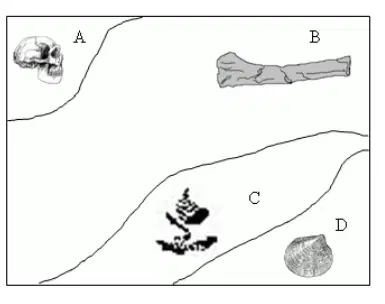
According to the sedimentary rock layers shown below, which statement is true?
Fossil B is younger than A, but older than C
Fossil A is oldest
Fossil C is younger than D, but older than B
Fossil D is the youngest
At divergent boundaries, tectonic plates…
move apart
slide past each other
collide
do not move
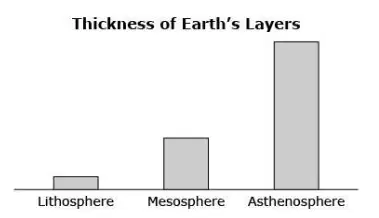
A student draws the follow diagram to compare the thickness of some of Earth’s interior layers. What’s wrong with the diagram?
The bar describing the lithosphere is too short
All the bars should be about the same height
The mesosphere is not one of Earth’s interior layers
The asthenosphere and the mesosphere labels are switched
Scientists believe that a supercontinent existed 240 million years ago. This supercontinent was called…
Continental Drift
Convergent Continent
Pangea
America
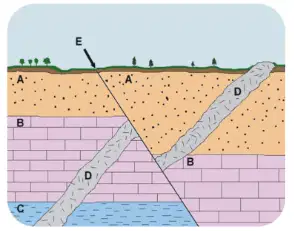
Using the diagram and knowing what you know about cross-cutting, which statement is true?
Layer A formed first
Layer D is younger than C
Layer C is the youngest
Layer E is the oldest
Which layer of the Earth is the thinnest?
Crust
Mantle
Outer core
Inner core

A diagram of Earth's layers is provided. Which letter in the diagram identifies the layer scientists believe to be in a liquid state?
Location A
Location B
Location C
Location D
Oceans and other bodies of water are found on which layer of Earth?
Outer core
Crust
Mantle
Inner core
Which of the following best describes Earth's asthenosphere?
Liquid rock that can reach the surface
Solid rock that is broken into plates
Dense molten rock that moves the crust
Metal rock at the center of the Earth
Which layer of Earth is broken up into giant moving plates?
Asthnosphere
Lithosphere
Inner core
Outer core

Which Layer of the Earth is the most dense, and is also solid?
Inner Core
Outer Core
Mantle
Crust
Which Layer of the Earth has convection currents?
Inner Core
Outer Core
Mantle
Crust
Which Layer of the Earth is made of molten (melted) Nickel and Iron?
Inner Core
Outer Core
Mantle
Crust
Which layer of the Earth is the largest layer?
Inner Core
Outer Core
Mantle
Crust

What are the two types of Earth's Crust?
Oceanic and Continental
water and land
ocean and dessert
crust and mantle
Oceanic crust is more dense than continental crust?
true
false
Pressure ______________________ as you go deeper into the Earth.
increases
decreases
goes up or down depending on the layer
stays the same
Density ______________________ as you go deeper into the Earth.
increases
decreases
goes up or down depending on the layer
stays the same

Which layer is composed mostly of iron?
Z
Y
V
X
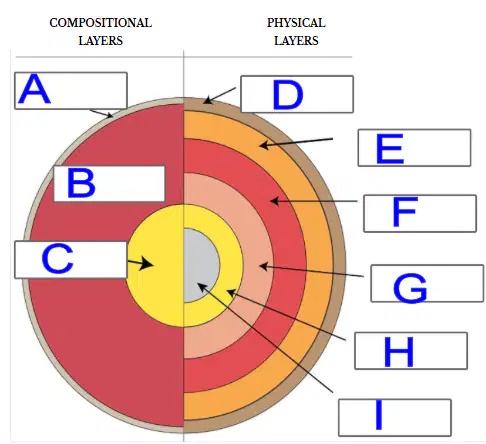
Use the diagram to identify what the name of layer [B] is.
Crust
Mantle
Core
Use the diagram to identify what the name of layer [A] is.
Crust
Core
Asthenosphere
Use the diagram to identify what the name of layer [C] is.
Crust
Core
Asthenosphere
Use the diagram to identify what the name of layer [D] is.
Mantle
Lithosphere
Asthenosphere
Use the diagram to identify what the name of layer [E] is.
Mantle
Lithosphere
Asthenosphere
Based on the law of superposition, where would the oldest rocks be found.
at the bottom
at the top
second from the bottom
second from the top

Which letter matches with the OLDEST layer of rock?
W
X
Y
Z
What kind of dating is used to compare the age of a rock to those around it?
Radiometric
Relative


Which principle states that sediments spread out flat, in all directions, until they either thin out or run into a barrier.
Principle of superposition
Principle of original horizontality
Principle of lateral continuity

As you travel deeper DOWN into the Grand Canyon, the rocks get _____.
younger
older
prettier
nicer

boundary between two tectonic plates that are moving away from each other
convergent boundary
divergent boundary
transform boundary
Ring of Fire

a tectonic plate boundary where two plates collide, come together, or crash into each other
divergent boundary
transform boundary
convergent boundary
continental drift (Pangea)
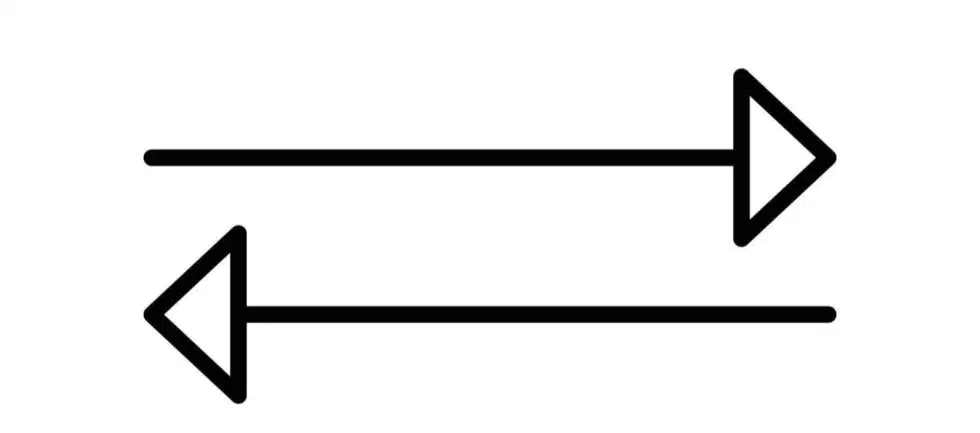
a plate boundary where two plates move past each other in opposite directions
transform boundary
seafloor spreading
convergent boundary
divergent boundary
Both P and S waves travel through solids.
True
False
P waves travel faster than S waves
True
False
Only P waves travel through the Mantle
True
False
Only P waves travel through the core.
True
False
Only P waves travel through liquids.
True
False
These waves can travel through the core...
P waves only
S waves only
P and S waves
Neither P nor S waves
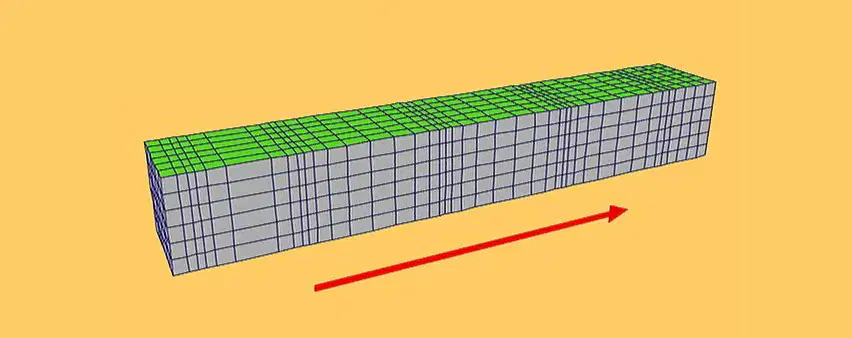
Which wave moves in this direction?
P-waves
S-waves
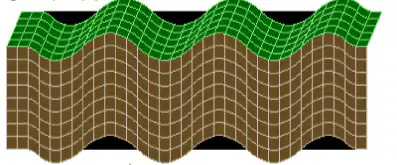
Which wave moves in this direction?
P-waves
S-waves
Tectonic plates move _________, a few _________ each year
quickly; yards (yd)
quickly; feet (ft)
slowly; miles (mi)
slowly; centimeters (cm)
Which TWO phenomenon's cause seismic waves?
hurricanes
earthquakes
volcanoes
tsunamis
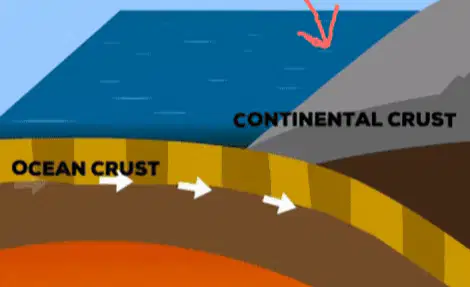
the process by which oceanic crust sinks beneath a deep-ocean trench and back into the mantle at a convergent plate boundary.
subduction
fault
plate tectonics
boundary
the place where two tectonic plates meet
fault
African plate
boundary
Eurasian plates

Mid Ocean ridges are formed by ___________________________ plate boundaries
Convergent
Divergent
Transform
A subduction zone is formed...

