Wayground logo

Free Printable Worksheets

Font size

S
M
L
XL
Worksheets

Physical Science Pre-assessment Spring 2020

Total questions: 60

Worksheet time: 3600secs

Name
Class
Date
1.
The speed and direction of a moving object.
a)
acceleration
b)
net force
c)
velocity
d)
maximum speed
2.
Substances with atoms that are all alike.
a)
element
b)
compound
c)
isotope
d)
ion
3.
A substance in which the atoms of two or more elements are combined in a fixed proportion.
a)
element
b)
isotope
c)
compound
d)
ion
4.
Possible explanation for a problem using what is known and what is observe.
a)
theory
b)
idea
c)
observation 
d)
hypothesis
5.
Tendency of an object to resist any change in motion.
a)
accleration
b)
velocity
c)
inerita
d)
net force
6.
The measure of the amount of matter in an object 
a)
Mass
b)
Weight
c)
Work
d)
Kinetic 
7.
A substance that gets dissolved in a solution
a)
Solute
b)
Solvent 
c)
Friction
d)
Density 
8.
__________ is stored energy. 
a)
Potential
b)
Kinetic
c)
None of the above 
d)
All of the above 
9.
The __________ contains the protons and neutrons of an atom, and is most of the mass of an atom
a)
Nucleus
b)
Atomic Number
c)
Atomic Mass
d)
Electrons
10.
Columns on the periodic table are known as ---
a)
Periods
b)
Groups/Families
c)
Rows
d)
Elements
11.
A combination of two or more substances that can be easily separated in some physical way.
a)
solution
b)
matter
c)
heat energy
d)
mixture
12.
properties of matter that can be observed, measured, or changed without changing the matter itself. 
a)
physical properties
b)
density
density
c)
magnetism
d)
insulator
13.
The amount of space that a substance or object takes up.
a)
mass
b)
insulator
c)
density
d)
volume
14.
Which is an example of a heterogeneous mixture? 
a)
Vegetable soup
b)
salad
c)
pizza 
d)
all of the above
15.
Gasoline being flammable is an example of a
a)
chemical property
b)
physical property
c)
phase change
d)
none of the above 
16.
Color, shape, taste, and density are examples of ______________properties
a)
Chemical 
b)
Physical
c)
Heterogeneous
d)
Homogeneous
17.
Which phase change has a definite shape and volume?
a)
Solid
b)
Liquid
c)
Gas
d)
Plasma
18.
Which phase of matter has no definite shape or volume?
a)
Solid
b)
Liquid
c)
Gas
d)
Plasma
19.
An electron has a ____________ charge.
a)
Positive
b)
Negative 
c)
Neutral
d)
Not enough info.
20.
A proton has a ___________ charge
a)
Positive
b)
Negative
c)
Neutral
d)
Not enough info
21.
What does Newton's First law of motion state?
a)
For every action there is an equal and opposite reaction
b)
Force=mass x acceleration
c)
The Law of inertia, an object in motion will remain in motion until acted upon by an outside force.
d)
Energy cannot be created or destroyed, but only transferred. 
22.
What does Newton's second law of motion state?
a)
For every action there is an equal and opposite reaction. 
b)
Force = mass x acceleration
c)
The Law of inertia, an object in motion will remain in motion until acted upon by an outside force.
d)
Energy cannot be created or destroyed, but only transferred. 
23.
What does Newton's third law of motion state?
a)
For every action there is an equal and opposite reaction
b)
Force = mass x acceleration
c)
The law of inertia, an object in motion will remain in motion until acted upon by an outside force
d)
Energy cannot be created or destroyed, but only transferred 
24.
Which is not a state of matter?
a)
Solid
b)
Gas
c)
Temperature
d)
Plasma
25.
What are examples of colloids?
a)
Milk and fog
b)
Corn syrup and honey
c)
Sugar and water
d)
Muddy water and nuts
26.
Describe melting.
a)
When liquid turns to solid
b)
When solid turns to liquid
c)
When liquid at the surface turns to gas
d)
When gas turns to liquid
27.
What is a state of matter where the molecules are moving very fast and freely? *
a)
gas
b)
liquid
c)
solid
d)
mass
28.
What is matter where the molecules are vibrating very slowly? 
a)
gas
b)
liquid
c)
solid
d)
mass
29.
A mixture in which one substance is dissolved in another
a)
chemical reaction
b)
solution
c)
solvent
30.
Matter can be created during a chemical reaction.
a)
true
b)
false
31.
A mixture of 2 or more metals.
a)
alloy
b)
isotope
c)
radical
32.
What is the symbol for carbon
a)
C
b)
Ca
c)
Fe
d)
Co
33.
What is the net force?
a)
17 N Right
b)
3 N Right
c)
3 N Left
d)
17 N Left
34.
You know that 12 inches = 1 foot.  Convert 60 inches to feet.
a)
720 feet
b)
5 feet
c)
5 inches
d)
72 feet
35.
You know 1000 mg = 1 g.  Convert 2.5 grams into milligrams.
a)
25 mg
b)
25,000 mg
c)
250 mg
d)
2500 mg
36.
Which variable is held constant when using Boyle's Law?
a)
Temperature
b)
Pressure
c)
Volume
d)
number of moles
37.
What is the correct temperature on the Kelvin scale equal to 30oC?
a)
303K
b)
243K
c)
313K
d)
253K
38.
Which gas law uses a term defined as one mole of a material with a volume of one liter at STP
a)
ideal gas law
b)
combined gas law
c)
Dalton's law of partial pressure
d)
none of the above
39.
How many significant figures: 153.0 mL
a)
1
b)
2
c)
3
d)
4
40.
How many significant figures: 0.012 km
a)
1
b)
2
c)
3
d)
4
41.
Is this equation balanced?
a)
yes
b)
no
c)
Not enough information
d)
Left side is balanced
42.
Fill in the blanks with coefficient:
PCl5+_ H2O→_ HCl+H3PO4
a)
4, 5
b)
1, 6
c)
3, 8
d)
2,2
43.
Where is the strongest attraction force of the magnet?
a)
at the poles
b)
in the middle
c)
above the magnet
d)
below the magnet
44.
Which of the following is true about a bar magnet?
a)
Its magnetic field is strongest near its center.
b)
It is surrounded by a magnetic field.
c)
The north pole is stronger than the south pole.
d)
The south pole is stronger than the north pole.
45.
Which two metals will be attracted by a magnet?
a)
iron and steel
b)
gold and silver
c)
aluminum and lead
d)
copper and cobalt
46.
What is this tool to get volume?
a)
triple beam balance
b)
ruler
c)
thermometer
d)
graduate cylinder
47.
What is this tool to get mass?
a)
triple beam balance
b)
ruler
c)
thermometer
d)
graduate cylinder
48.
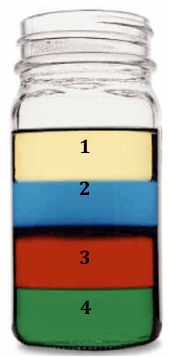
Put the liquids in order from most dense to least dense?
a)
4, 3, 2, 1
b)
1, 2, 3, 4
c)
3, 4, 2, 1, 
d)
4, 3, 1, 2
49.

A nuclear reaction involves what two parts of the atom?

a)

electrons and protons

b)

protons and neutrons

c)

neutrons and electrons

d)

nucleus and protons

50.

The process where one neutron hits a nuclei, which causes it to split releasing more neutrons which hit more nuclei causing more more neutrons to be released which hit more nuclei and so for and so on is called what?

a)

fusion

b)

hydrogen bomb

c)

chain reaction

51.

The splitting of a nucleus into smaller, lighter nuclei is called what?

a)

fusion

b)

fission

c)

hydrogen bomb

52.

Which process leads to a more stable nucleus because it ADDS on to it?

a)

fission

b)

fusion

c)

atomic bomb

d)

endothermic reactions

53.
What does this graph represent?
a)
Constant Speed
b)
Acceleration
c)
Deacceleration
d)
Not moving
54.
What is speed?
a)
how far you go
b)
how much distance is covered over a period of time
c)
how fast you accelerate
d)
the change in the location of a object
55.
According to the graph how far does the person travel in the first 5 seconds?
a)
2 m
b)
10 m
c)
0 m
d)
5 m
56.
What is the name of Mg(OH)2?
a)
Magnesium Hydride
b)
Magnesium Dihydride
c)
Magnesium Dihydroxide
d)
Magnesium Hydroxide
57.
Distance and direction of an object's change in position from a starting point
a)
displacement
b)
distance
c)
motion
d)
reference point
58.
Scott travels north 5 miles and then goes west 3 miles before coming straight back south 2 miles. What is his distance?
a)
10
b)
7
c)
8
d)
6
59.

Electromagnetic waves vary in

a)

the speed they travel in a vacuum.

b)

wavelength and frequency.

c)

the way they reflect.

d)

the orientation of their electric and magnetic fields.

60.

Light acts like

a)

a wave.

b)

a particle.

c)

Both a wave and a particle

d)

neither a wave nor a particle.