wayground logo

Free Printable Worksheets

Font size

S
M
L
XL
Worksheets

Full on review

Total questions: 105

Worksheet time: 9hrs 45mins

Name
Class
Date
1.
Adding or subtracting neutrons (charge = 0, mass = 1) makes the element change into an...
a)
ion
b)
mixture
c)
isotope
d)
neutral atom
2.
The atomic number is equal to _.
a)
the number of protons and electrons
b)
the number of neutrons only
c)
the total number of protons and neutrons
d)
the number of protons neutrons and electrons
3.
What is the charge on a lithium atom that looses 1 electron?
a)
+1
b)
0
c)
-1
d)
-2
4.
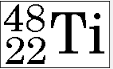
Is the element shown in this image an ion, isotope or normal atom?
a)
atom
b)
isotope
c)
cation (+ ion)
d)
anion (- ion)
5.
The atomic mass is equal to _.
a)
the number of protons only
b)
the number of neutrons only
c)
the total number of protons and neutrons
d)
the number of protons, neutrons, and electrons.
6.
How many protons does this isotope of titanium have? Hint titanium has an atomic number of 22.
a)
48
b)
22
c)
26
d)
70
7.
What element is this?  What is the mass number of this atom?
a)
sodium, 23
b)
magnesium, 23
c)
magnesium, 12
d)
sodium, 11
8.
What is the atomic number of Fe? (click to see image)
a)
26
b)
55.845
c)
56
d)
None of these
9.
How many neutrons does B (Boron) contain?
a)
5
b)
11
c)
6
d)
10.811
10.
For an electron to change from ground state to an excited stated it must...
a)
Absorb energy
b)
Release energy
11.
Which drawing represents the process by which an absorption line is formed?
a)
A
b)
B
c)
C
d)
D
12.
The ground state is the highest energy state of an atom.
a)
True
b)
False
13.
How do we solve for number of neutrons?
a)
Mass + Atomic Number= Neutrons
b)
Mass x Atomic Number = Neutrons
c)
Mass - Atomic Number = Neutrons
d)
Mass + Number of Protons = Neutron
14.
A positive ion is called a...
a)
Posion
b)
Anion
c)
Cation
d)
Proton
15.
An electron has what kind of charge?
a)
no charge
b)
positive 
c)
negative
d)
it depends
16.
a proton has what charge?
a)
positive
b)
negative
c)
no charge
d)
it depends
17.
Atoms that gain electrons become...
a)
negatively charged
b)
positively charged
c)
remain neutrally charged
d)
21
18.
if METALS are more likely to LOSE electrons, they will form ...
a)
anions
b)
neutral atoms
c)
positive ions
d)
negative ions
19.
If an aluminum atom has 13 protons (+) and 10 electrons (-), what is it's charge?
a)
Al3+
b)
Al13+
c)
Al10+
d)
Al10-
20.
How many valence electrons does Lithium have?
a)
1
b)
2
c)
3
d)
4
21.
How many valence electrons does magnesium have?
a)
1
b)
2
c)
12
d)
24
22.
How many valence electrons does Neon have?
a)
18
b)
8
c)
10
d)
2
23.
Which group is very nonreactive?
a)
Noble Gases
b)
Halogens
c)
Alkali Metals
d)
Transition Metals
24.
Ionic bonds occur between...
a)
A metal and a nonmetal
b)
Two metals
c)
Two nonmetals
d)
Two gases
25.
What bond involves the sharing of electrons?
a)
Ionic
b)
Transitive
c)
Covalent
26.
What types of elements are involved in a covalent bond?
a)
A nonmetal and a metal
b)
Two nonmetals
c)
Gases Only
d)
Metalloids Only
27.
What would the correct chemical formula be for Magnesium + Chlorine?
a)
MgCl
b)
MgCl2
c)
Mg2Cl
d)
2MgCl
28.
What is the name of Ca3N2?
a)
calcium nitrogen
b)
carbon nitrogen
c)
calcium nitride
d)
carbon nitrate
29.

Formula for lead (II) chloride

a)

PbCl2

b)

Pb2Cl

c)

Pb2Cl3

d)

Pb3Cl2

30.

Name for PBr2

a)

phosphorus bromide

b)

phosphorus dibromide

c)

phosphorus dibromine

d)

phosphorus bromine

31.

Formula for Cobalt (II) bromide

a)

CoBr

b)

Co2Br2

c)

Co2Br

d)

CoBr2

32.

Formula for sulfur dioxide

a)

S2O

b)

SO2

c)

S2O2

d)

(SO)2

33.

Name for CO

a)

carbon monoxide

b)

carbon oxide

c)

monocarbon oxide

d)

carbide monoxide

34.
As you move down a group, atomic radius increases because - 
a)
you add more and more neutrons
b)
you add more and more protons
c)
you add more and more shells (energy levels)
d)
you add more atomic mass
35.
Electronegativity is...
a)
the ability of an atom to attract/ accept electrons
b)
the ability of an atom to lose electrons
c)
the energy required to remove an electron from a specific atom
d)
how easy it is to make friends. 
36.
Which has the greater Electronegativity: 
N or C?
a)
C
b)
N
37.

Which of these is the weakest intermolecular force?

a)

Dipole-dipole

b)

Hydrogen bonding

c)

London dispersion forces

38.

Which intermolecular force do all molecules have?

a)

Dipole-dipole

b)

Hydrogen bonding

c)

London dispersion forces

39.

Which intermolecular force requires hydrogen and one of the following: nitrogen, oxygen, fluorine?

a)

Dipole-dipole

b)

Hydrogen bonding

c)

London dispersion forces

40.

Which intermolecular force is characterized by partially oppositely charged ions?

a)

Dipole-dipole

b)

Hydrogen bonding

c)

London dispersion forces

41.

Which of the following is an intramolecular force?

a)

hydrogen bonding

b)

covalent bonding

42.
Where are the non-metallic elements found in the periodic table?
a)
In the middle
b)
In the top rows
c)
On the left-hand side
d)
On the right-hand side
43.
If you have a material that can conduct electricity well it is probably a...
a)
Metalloid
b)
Matter
c)
Non-metal
d)
Metal
44.
Metals are ductile, meaning they can be drawn into wire
a)
True
b)
False
c)
Never
45.

Which elements are found on the left to middle of The Periodic Table?

a)

Metals

b)

Nonmetals

c)

Metalloids

d)

Candles

46.
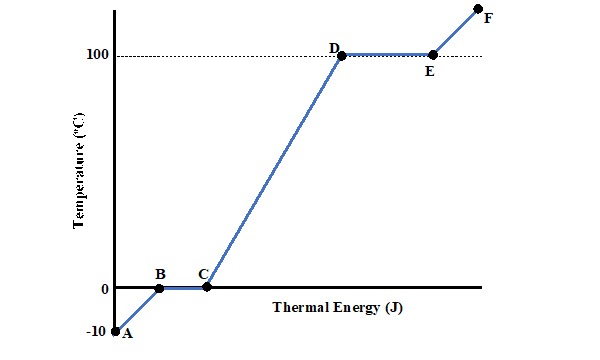
What line segment represents only the solid state?
a)
A-B
b)
B-C
c)
C-D
d)
D-E
47.

Between which two points is Heat of Fusion?

a)

A <----> B

b)

B <----> C

c)

C <----> D

d)

D <----> E

e)

E <----> F

48.
What change occurs from E to C?
a)
sublimation
b)
freezing
c)
melting
d)
boiling
49.

Convert 235 cm to mm

a)

0.235 mm

b)

2350 mm

c)

23.5 mm

d)

2.35 mm

50.

If the specific heat of water is 4.18 J/g∙°C, how much heat is required to increase the temperature of 1.2 kg of water from 23 °C to 39 °C? (show your work)

a)

-80,256 J

b)

80.256 J

c)

80,256 J

d)

-80.256 J

51.

What does "ΔT" mean?

a)

A change in health

b)

A change in heat

c)

A change in height

d)

A change in temperature

52.
For the formula:
 Q= m c ∆T
The  units for specific heat are:
a)
g /J C
b)
°C/g J
c)
kJ/g
d)
J/g°C
53.
What is the correct temperature on the Kelvin scale equal to 30oC?
a)
303K
b)
243K
c)
313K
d)
253K
54.
If 6L of gas at 293K is compressed to 4L, what is the new temperature? 
a)
195K
b)
439.5K
c)
0.082K
d)
12.2K
55.
A gas at 928 kpa, 129 C occupies a volume of 569 L. Calculate the volume at 319 kpa and 32 C.
a)
410.61 L
b)
418.18 L
c)
1255 L
d)
1400 L
56.
If a balloon is cooled what will happen to the volume?
a)
Volume will increase
b)
Volume will decrease
c)
Volume will not change
57.
At higher temperatures...
a)
particles in an object have less energy
b)
particles in an object move faster
c)
a gas contracts
58.
What do you call a pig that knows Karate
a)
Piggly
b)
Porkchop
c)
Babe
d)
Porky
59.
What is a reactant?
a)
a volatile chemical
b)
a dangerous substance
c)
the substances you start with in a chemical reaction
d)
the substances that are formed by a chemical reaction 
60.

Balance the following:

____ Fe + ____ Cl2 → ____ FeCl3

a)
1,1,2
b)
1,3,1
c)
2,2,3
d)
2,3,2
61.

Which type of reaction is:

2 H3AsO4 → As2O5 + 3 H2O

a)
Synthesis
b)
Decomposition
c)
Single Displacement
d)
Combustion
62.

Which type of reaction is:

C7H16 + 10 O2 → 7 CO2 + 8 H2O

a)
Synthesis
b)
Decomposition
c)
Single Displacement
d)
Combustion
63.
This pictures simulates what type of reaction?
a)
Synthesis
b)
Decomposition
c)
Single Replacement
d)
Double Replacement
64.
What is the Law of Conservation of mass?
a)
Mass is created in a chemical reaction
b)
Mass is created in a physical change
c)
New chemicals formed from a chemical reaction have a larger overall mass than the original reactants
d)
Mass is never created or destroyed
65.

How many oxygen atoms are in this chemical formula?

a)

6 oxygen atoms

b)

2 oxygen atoms

c)

3 oxygen atoms

d)

4 oxygen atoms

66.
This substance speeds up the rate of a chemical reaction without being consumed or changed.
a)
intermediate
b)
catalyst
c)
reactant
d)
product
67.
If the pressure exerted by a gas at 25 degrees C in a volume of 0.044 L is 3.81 atm, how many moles of gas are present?
a)
.002766 mole
b)
.0069 mol
c)
2.766 mol
d)
9.887 mol
68.
Products will form faster if____________
a)
the particle size of the reactants are larger.
b)
temperature is decreased.
c)
concentration of the reactants are increased.
d)
the reaction is not stirred.
69.
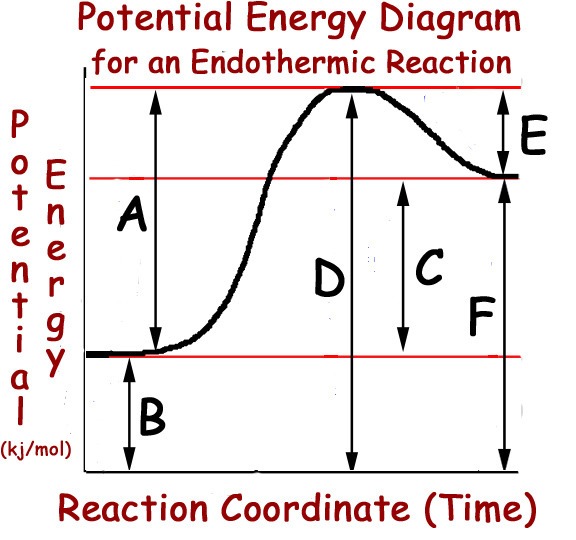
What letter represents ΔH?
a)
A
b)
B
c)
C
d)
D
70.
For the reaction...
SO2 + O2  <=>  SO3
If the concentration of SOis increased, the equilibrium position of the reaction will shift ___________.
a)
to the left
b)
to the right
c)
to the left and right 
d)
neither left nor right
71.
For the reaction...
SO2 + O2 <=>  SO3
If the equilibrium position shifts to the right, the concentration of O2 will ___________.
a)
increase
b)
decrease
c)
remain the same
d)
double
72.
When the rate of the forward reaction is equal to the rate of backward reaction, the system is said to be in
a)
Chemical Equilibrium
b)
Chemical Balance
c)
Chemical Constant
d)
Chemical Reaction
73.
What is the activation energy?
a)
the quantity of heat absorbed in a reaction
b)
the minimum energy needed to begin a reaction
c)
the energy given off after reactants collide.
d)
both the energy and frequeny of collisions in increased
the energy difference between reactants and products
74.

Stronger acids have a pH closer to...

a)

7

b)

0

c)

14

d)

9

75.

A pH level of 7 indicates

a)

acid

b)

base

c)

neutral

d)

none of the following

76.
A solution with a pH of 8.6 would be...
a)
Acid
b)
Base
c)
Neutral
d)
Acid and Base
77.

You test a solution with pH paper, and the paper turns blue. The solution is ______.

a)

neutral

b)

an acid

c)

a base

d)

an acid & a base

78.
Based on the solubility chart, which of the listed salts is the most soluble at 40°C?
a)
KCl
b)
KClO3
c)
KNO3
d)
Pb(NO3)2
79.
Which of the following would NOT be a way to speed up the rate of solubility of rock salt?
a)
stir it
b)
heat the water
c)
crush the salt
d)
cool the water
80.

Water has a neutral because

a)

it has more H+ ions than OH-

b)

it has more OH- ions than H+

c)

it does not produce any ions

d)

it has an equal amount of H+ and OH- in solution

81.
If the [H+] of a solution is 1 x 10⁻² mol/L the pH is
a)
2
b)
12
c)
-2
d)
1
82.
If the pH of a solution is 5.6 the pOH is
a)
6.5
b)
12.4
c)
8.4
d)
5.6
83.
If the [OH-] of a solution is 2.7 x 10⁻⁴ mol/L the pOH of the solution is
a)
10.44
b)
3.56
c)
1.00
d)
-4.43
84.
if the [H+] of a solution is 8.4 x 10⁻³ mol/L the pOH of the solution will be
a)
2.08
b)
11.92
c)
1.02
d)
12.98
85.

What is the solubility of KNO3 at 50 degrees Celsius?

a)

36 g/100 g water

b)

58 g/ 100 g water

c)

100 g / 100 g water

d)

84 g/ 100 g water

86.

What ion found in a solution would make it acidic?

a)

H+

b)

OH-

c)

NH3-

d)

ClO3-

87.
What is the molar mass of NaCl?
a)
58.45g/mol
b)
28g/mol
c)
12g/mol
d)
6.02 x 10²³
88.
Which has more molecules?
a)
1 mole H2O
b)
1 mole Al(OH)3
c)
1 mole NaCl
d)
There are all the same
89.
Where do you look to calculate the molar mass?
a)
avogadros number
b)
periodic table 
90.
Find the percent composition of N2S2.
a)
N: 69.6%  S: 30.4%
b)
N:36% S: 75.6%
c)
N: 96.6% S: 3.4%
d)
N: 30.4% S: 69.6%
91.
How many moles are there in 12.7g of CaF2?
a)
0.20 mol
b)
1,000.76 mol
c)
6.14 mol
d)
0.16 mol
92.
How many moles of (NH4)2O are present in 74.9 g?
a)
3,907.0  moles
b)
1.44 moles
c)
8.67x10²³moles
d)
0.79 moles
93.
How many molecules are present in 25 g of NaBr?
a)
102.96 molecules
b)
0.24 molecules
c)
1.45x10²³ molecules
d)
2.34 x 10²⁰molecules
94.

Mole to mole ratio

a)

6.02 x 10^23

b)

the mass in grams of a mole of a substance

c)

the number before a formula in a balanced equation

d)

comparing moles of substances

95.
H2+Cl2-->2HCl
How many moles of Cl2 is needed to react with 3 moles of H2?
a)
5
b)
2
c)
3
d)
6
96.
6CO2 + 6H2O --> C6H12O6 + 6O2 
What is the total number of moles of CO2 needed to make 2 moles of C6H12O6?
a)
2.5
b)
6
c)
12
d)
15
97.

2 C2H6 + 7 O2 → 4 CO2 + 6 H2O

Ethane (C2H6) combusts in the above reaction. What is the mole ratio of ethane to oxygen gas?

a)
b)
c)
d)
98.

2 C2H6 + 7 O2 → 4 CO2 + 6 H2O

New problem: If 16 moles of carbon dioxide are formed by this reaction, how many moles of water were also produced?

a)

4 mol H2O

b)

6 mol H2O

c)

24 mol H2O

d)

96 mol H2O

e)

384 mol H2O

99.
How would you write 564,000,000 in scientific notation?
a)
5.64 x 10⁻⁷
b)
5.64 x 10⁶
c)
5.64 x 10⁸
d)
56.4 x 10⁷
100.
When writing a number in scientific notation, the first number must be greater than 1, but less than 10.
a)
False
b)
True
101.
When your exponent is negative, you move your decimal....
a)
to the right
b)
to the left
c)
to both sides
d)
nowhere.... the decimal goes nowhere
102.
ANY number raised to a power of 0 will be....
a)
10
b)
itself
c)
1
d)
0
103.
Which of the following is correct scientific notation?
a)
20.35 x 10⁴
b)
.2035 x 104
c)
2035 4
d)
2.035 x10⁴
104.
Express the following in scientific notation:
.000457
a)
457 x 106
b)
457 x 10-6
c)
4.57 x10⁴
d)
4.57 x 10⁻⁴
105.

If you see 1.1E4 on your calculator it means.

a)

1.14

b)

11,000

c)

1,100

d)

11140