Wayground logo

Free Printable Worksheets

Font size

S
M
L
XL
Worksheets

Protein Synthesis

Total questions: 75

Worksheet time: 38mins

Name
Class
Date
1.

Which of the following are differences in the structure between RNA and DNA

a)

DNA uses deoxyribose sugar, RNA uses sugar ribose

b)

DNA pairs Adenine with Uracil, RNA pairs Adenine with Thymine

c)

DNA is a double helix, RNA is a single helix

d)

DNA pairs Adenine with Thymine, RNA pairs Adenine with Uracil

2.

Which organelle is the location where protein is made?

a)

Ribosome

b)

Nucleus

c)

Cytoplasm

d)

Nucleotide

3.

During transcription, this type of ribonucleic acid is responsible for copying the DNA and brining it out of the nucleus.

a)

tRNA

b)

mRNA

c)

rRNA

d)

dRNA

4.

When these bond together, they form a protein

a)

Amino Acids

b)

Peptide Bonds

c)

Ribose

d)

Nucleotides

5.

These building blocks consist of a sugar, phosphate, and nitrogen base.

a)

Ribose

b)

Nucleotide

c)

Gene

d)

Protein

6.

A string of nucleotides that contain the information to make a specific protein

a)

Ribose

b)

Amino Acids

c)

tRNA

d)

Gene

7.

During translation, this type of ribonucleic acid is responsible for delivering amino acids to help make a protein.

a)

mRNA

b)

rRNA

c)

tRNA

d)

dRNA

8.

How many amino acids are found on one tRNA?

a)

20

b)

4

c)

1

d)

3

9.

Which of the following is the complementary mRNA sequence to this DNA strand: AACTGAA

a)

UUGACUU

b)

TTGACTT

c)

AACTGAA

d)

AACUGAA

10.

Which of the following is the tRNA that will be used to decode to this DNA strand: AACTGA

a)

AAC and TGA

b)

TTG and ACT

c)

UUG and ACU

d)

AAC and UGA

11.
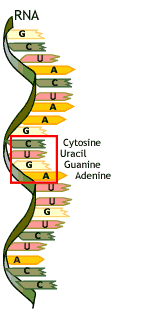
In RNA, Uracil pairs with ______. 
a)
cytosine
b)
adenine
c)
guanine
d)
thymine
12.
The process to go from DNA to mRNA is _______
a)
translation
b)
transcription
c)
replication
13.
The process to go from mRNA to a protein is called ____
a)
transcription
b)
rRNA
c)
replication
d)
translation
14.
DNA holds the code for
a)
lipids
b)
carbohydrates
c)
protein
d)
sugar
15.
The main function of tRNA is to...
a)
carry a message that, when translated, forms proteins
b)
form a portion of ribosomes
c)
string together complementary RNA and DNA strands
d)
bring amino acids from the cytoplasm to the ribosomes
16.
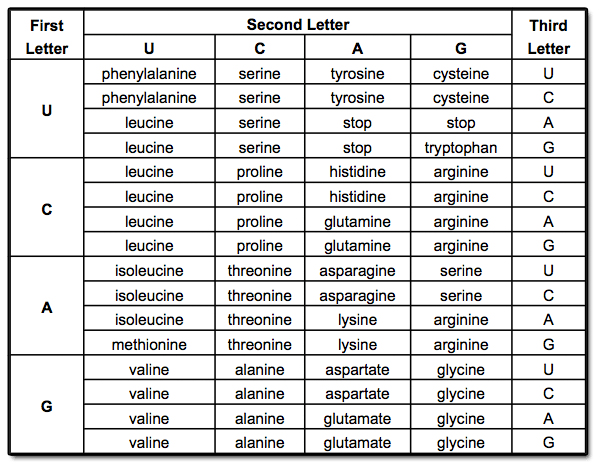
What amino acid is represented by the codon UUA?
a)
Phenylalanine
b)
Tyrosine
c)
Leucine
d)
Stop codon
17.
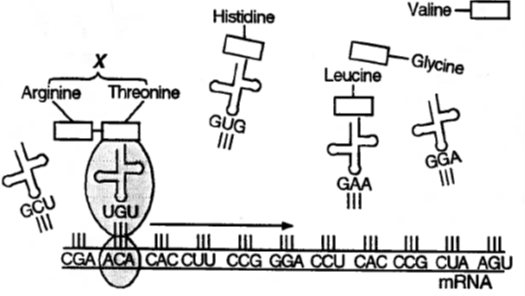
What process is going on in this photo? 
a)
Transcription 
b)
Translation 
c)
Replication 
d)
All the above 
18.
Translation is the process where
a)
mRNA is created in the Nucleus
b)
mRNA is decoded to form a protein 
c)
glucose molecules are made
d)
is where lipids are synthesised
19.
Does the order of amino acids in a protein matter?
a)
YES!
b)
NO!
20.
This is the triplet of bases on the end of a tRNA molecule
a)
Anticodon
b)
Codon
c)
Protein
21.
The function of ______ is to combine with proteins to form ribosomes.
a)
rRNA
b)
tRNA
c)
mRNA
d)
DNA
22.
How many amino acids are coded for by this sequence of nucleotides:
ATG GGA ACT CCA
a)
4
b)
2
c)
6
d)
12
23.
What is the three base sequence of mRNA that codes for a single amino acid?
a)
Anticodon
b)
Codon
c)
Protein
24.
Which of these nitrogenous bases is NOT in RNA?
a)
Uracil
b)
Thymine
c)
Cytosine
d)
Guanine
25.
Which is the mRNA molecule that would be transcribed from this DNA template:
TGGCAAGTACGT
a)
ACCGTTCATGCA
b)
UGGCAAGUACGU
c)
UCCGUUCUUGCU
d)
ACCGUUCAUGCA
26.

How do you know when to begin translating a strand of mRNA?

a)

look for AUG

b)

start at the beginning

c)

look for ATG

d)

when Ms. H tells me to

27.

How do you know when to STOP translating a strand of mRNA?

a)

look for STOP on the decoder

b)

stop at the end of the strand

c)

you don't

d)

when Ms. H tells me to

28.

The important enzyme related with transcription is;

a)

gyrase

b)

DNA polymerase

c)

RNA polymerase

d)

ligase

29.
Transcription is a process that in eukaryotic cells takes place in the:
a)
Nucleus
b)
Cytoplasm
c)
Golgi Apparatus
d)
Rough E.R.
30.
Transcription begins at sequences called
a)
Start Codons
b)
Promoters
c)
Origins
d)
Introns
31.
RNA contains which bases?
a)
adenine, guanine, uracil, cytosine
b)
thymine, guanine, cytosine, uracil
c)
thymine, uracil, cytosine, guanines
d)
adenine, uracil, guanine, thymine
32.

If you have a DNA triplet: GTA, what will the mRNA codon be?

a)

GTA

b)

CAU

c)

CUA

d)

GAU

33.

On the rough draft version of mRNA, what is spliced together to make the mature mRNA?

a)

introns

b)

exons

c)

Poly-A tail

d)

G- cap

34.

The function of the rough ER is to:

a)

Produce and folding lipids

b)

Produce and folding proteins

c)

Produce and folding carbohydrates

d)

Produce and folding Nucleic acids

35.

The function of the Golgi apparatus is to

a)

Sort, package and modify macromolecules produced by the cell.

b)

Produce proteins

c)

Produce lipids

d)

Produce RNA

36.

The function of the smooth ER is to:

a)

Make proteins

b)

Make lipids

c)

Make carbohydrates

d)

Make nucleic acids

37.
What organelle is labeled with "D"?
a)
Mitochondria
b)
Golgi Apparatus
c)
Nucleus
d)
Endoplasmic Reticulum
38.
What is the function of the ribosomes?
a)
Transport proteins
b)
Make proteins
c)
Package and ship proteins
d)
Store water, food, and wastes
39.
What is the function of the Endoplasmic Reticulum (ER)?
a)
Package and ship proteins
b)
Transport proteins
c)
Create energy for the cell
d)
Remove waste
40.

An organelle that transports and packages large molecules like complex carbohydrates, lipids and proteins.

Sometimes called golgi body or golgi complex.

a)

Ribosome

b)

Golgi Reticulum

c)

Endoplasmic Apparatus

d)

Golgi Apparatus

41.
What organelle is associated with the production of proteins?
a)
nucleus
b)
ribosome
c)
mitochondria
d)
cell membrane
42.

What types of cells would have a lot of smooth ER?

a)

lung cells

b)

liver cells

c)

heart cells

d)

skin cells

43.
Why is the order of amino acids so important?
a)
The order of amino acids dictates what shape the protein will fold into.
b)
It is not important. The protein folding chamber will force the protein to fold into the correct shape.
44.

This organelle is crucial for the translation process:

a)

Mitochondria

b)

Ribosome

c)

Gogli Apparatus

d)

Vacuole

45.

There are _______ amino acids?

a)

18

b)

26

c)

20

d)

3

46.

The start codon is _______:

a)

AUG

b)

GGG

c)

UCG

d)

AAU

47.

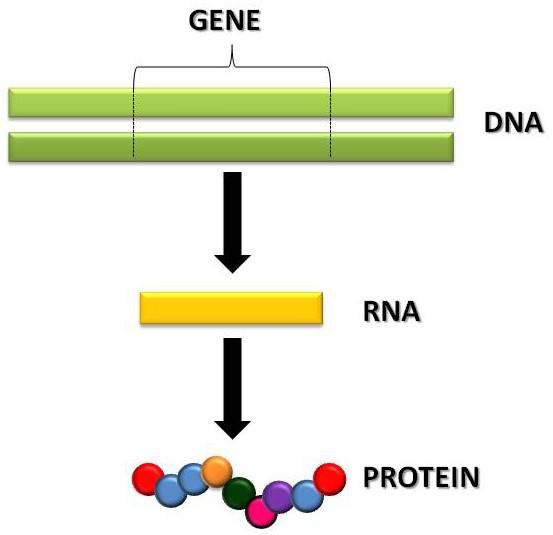
Which answer models central dogma?

a)

DNA to protein to RNA

b)

RNA to DNA to protein

c)

DNA to RNA to protein

d)

protein to RNA to DNA

48.

What is the result of transcription?

a)

The synthesis of RNA from protein

b)

The synthesis of protein from RNA

c)

The synthesis of protein from DNA

d)

The synthesis of RNA from DNA

49.

What is the result of translation?

a)

The synthesis of RNA from protein

b)

The synthesis of protein from RNA

c)

The synthesis of protein from DNA

d)

The synthesis of RNA from DNA

50.

At which organelle does translation occur?

a)

Nucleus

b)

Ribosome

c)

Mitochondria

d)

Golgi apparatus

51.

What is the role of RNA polymerase?

a)

To synthesize DNA

b)

To synthesize RNA

c)

To synthesize amino acids

d)

To synthesize protein

52.

Anticodons are complementary to...

a)

codons

b)

amino acids

c)

nucleotides

d)

nitrogenous bases

53.

Can more than one codon code for the same type of amino acid?

a)

yes

b)

no

54.

When reading the codon chart, which molecule do you reference?

a)

DNA

b)

mRNA

c)

tRNA

d)

rRNA

55.

How many codons are required for one amino acid?

a)

1

b)

2

c)

3

d)

4

56.

How many codons are required for three amino acids?

a)

1

b)

2

c)

3

d)

4

57.

The ______________ transports the amino acids to the ribosome.

a)

mRNA

b)

tRNA

c)

rRNA

d)

Golgi Apparatus

58.
What is the name given to part of a DNA molecule that codes for a protein?
a)
Glucose
b)
Chromosome
c)
Gene
d)
Phosphate
59.
Which of the following statements regarding mRNA is correct?
a)
Exons are included in the protein sequence, while introns are left out
b)
Introns are included in the protein sequence, while exons are left out
c)
Exons and Introns can both be included or left out depending on the protein
d)
Exons and Introns are both part of the mRNA sequence, but only exons are part of the rRNA and tRNA
60.
How can a person's muscle cells have the same exact DNA sequences as their nerve cells even though the look and perform completely different?
a)
The two different cells become mutated
b)
The proteins expressed in each cell are different
c)
They actually have different DNA in the two types of cells.
d)
The genome of the different cells changes
61.

The monomers units of DNA and RNA are

a)

amino acids

b)

monosaccharides

c)

nucleotides

d)

fatty acids

62.

Which of the following sequences best describes the flow of information that takes place when a gene directs the synthesis of a cellular component?

a)

RNA-DNA-RNA-PROTEIN

b)

DNA-RNA-PROTEIN

c)

PROTEIN-RNA-DNA

d)

DNA-AMINO ACID-RNA-PROTEIN

63.

The info carried by DNA is in

a)

an amino acid sequence

b)

the sugars and phosphates that form the backbone

c)

the order of bases in the molecule

d)

the total number of nucleotides

64.
How can a person's muscle cells have the same exact DNA sequences as their nerve cells even though the look and perform completely different?
a)
The two different cells become mutated
b)
The proteins expressed in each cell are different
c)
They actually have different DNA in the two types of cells.
d)
The genome of the different cells changes
65.
How is the information in a DNA molecule expressed in an organism?
a)
through plasmids
b)
through RNA polymerase
c)
through recombinant DNA
d)
through proteins
66.
Which of the following best explains the term gene expression?
a)
the production of proteins based on the genetic information in DNA
b)
the suppression of RNA polymerase
c)
the suppression of protein production
d)
the production of lipids based on the genetic information in DNA
67.
The lac operon genes only become expressed if:
a)
lactose binds to the repressor
b)
glucose binds to the repressor
c)
lactose binds to the operator
d)
the repressor binds to the operator
68.
If an mRNA molecule has introns and exons in it, where is it?
a)
At a ribosome
b)
In the nucleus
c)
In a prokaryotic cell
d)
could be in the nucleus or the ribosome
69.

Which reason explains why nerve cells function differently than muscle cells?

a)

In nerve cells all the genes are expressed.

b)

In muscle cells all the genes are expressed.

c)

In both kinds of cells the same genes are expressed.

d)

In both kinds of cells different genes are expressed.

70.

What are the names of the 2 parts of protein synthesis?

a)

Elongation

Termination

b)

Initiation

Elongation

c)

Codon

Anticodon

d)

Transcription

Translation

71.

Name the 3 types of RNA

a)

mRNA

dRNA

rRNA

b)

mRNA

tRNA

rRNA

c)

mRNA

tRNA

cRNA

d)

mRNA

dRNA

tRNA

72.

One codon codes to make how many amino acids?

a)

64

b)

1

c)

12

d)

3

73.

Which of the following statements regarding mRNA is correct?

a)

Exons are included in the protein sequence, while introns are left out

b)

Introns are included in the protein sequence, while exons are left out

c)

Exons and Introns can both be included or left out depending on the protein

d)

Exons and Introns are both part of the mRNA sequence, but only exons are part of the rRNA and tRNA

74.

CRISPR-Cas9 is a technology that allows scientists to change a cell's DNA at a precise location.

a)

TRUE

b)

FALSE

75.

New treatment for sickle cell anemia involves using gene switches to turn off fetal hemoglobin.

a)

TRUE

b)

FALSE