wayground logo

Free Printable Worksheets

NEW

Font size

S
M
L
XL
Worksheets

First Semester Review

Total questions: 55

Worksheet time: 1hrs 14mins

Name
Class
Date
1.
Which side of a chemical equation is the reactant side?
a)
Left (before the yields sign)
b)
Right (after the yields sign)
2.

Which side of a chemical equation is the product side?

a)

Left (before the yields sign)

b)

Right (after the yields sign)

3.
A(n) _________ is an ion with a positive (+) charge.
a)
anion
b)
cation
c)
ion
d)
solute
4.
When an atom loses an electron, it becomes a:
a)
positive ion
b)
negative ion
c)
neutral ion
d)
neutral atom
5.

What is the charge of a chlorine ion?

a)

-1

b)

1

c)

+2

d)

+1

6.

This is a correct dot diagram for carbon (C)

a)

true

b)

false

7.

According to the octet rule most elements need _______ valence electrons.

a)

2

b)

8

c)

6

d)

18

8.

What is the goal of the Lewis Dot Structure?

a)

To determine the electron position.

b)

To show the element's valence electrons & bonding capabilities.

c)

To find the atomic mass of an element.

d)

To search for the number of electrons in an individual atom.

9.

The innermost energy level has a maximum of how many electrons?

a)

1

b)

2

c)

6

d)

8

10.
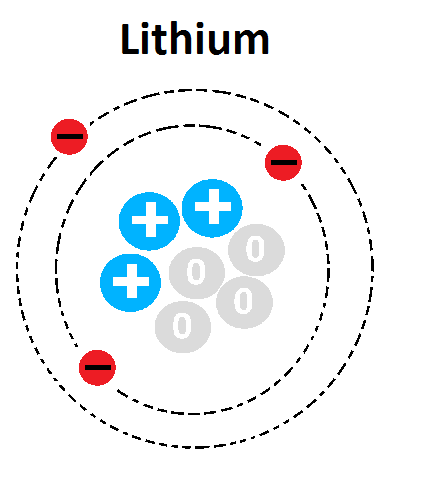
What group does this element belong to?
a)
Group 1: Alkali metals
b)
Group 18: Noble Gases
c)
Group 2: Alkaline-Earth Metals
d)
Group 17: Halogens
11.
What is the atomic number of this atom?
a)
2
b)
4
c)
6
d)
none of the above
12.
What is the mass number of this atom?
a)
1
b)
3
c)
4
d)
7
13.
How many neutrons does oxygen have?
a)
16
b)
15.99
c)
8
d)
Doesn't contain any neutrons
14.
What is the formula to solve for the neutron?
a)
Mass + Atomic Number= Neutrons
b)
Mass x Atomic Number = Neutrons
c)
Mass - Atomic Number = Neutrons
d)
Mass + Number of Protons = Neutron
15.
Magnesium bromide is an ionic compound with the chemical formula MgBr₂.  What does the "2" tell you?
a)
There are 2 bromide ions for every magnesium ion
b)
Bromide has a 2- charge
c)
Bromide has a 2+ charge
d)
There are 2 magnesium ions to every bromide ion
16.

What does the number 15.999 represent on the image shown?

a)

atomic mass

b)

atomic number

c)

mass number

d)

element symbol

17.

A(n) _________ is an ion with a negative (-) charge.

a)

anion

b)

cation

c)

ion

d)

onion

18.
Which problem is balanced?
(Check ALL answers)
a)
PbO2 + 2H2
b)
SO2 + H20 --> H2SO4
c)
2Na + 2H2O --> 2NaOH + H2
19.
Balance this chemical reaction......?  
__H2O2 ---->  __H2O + O2
a)
2H2O2  //  2H2O
b)
1H2O2  //  2H2O
c)
2H2O2  //  1H2O
d)
H2O2  //  2H2O
20.

__ Al + __ FeO → Al2O2 + __ Fe

a)

1, 1, 2

b)

2,1,2

c)

2, 2, 2

d)

2,4,2

21.

Electrons are _________.

a)

Positive

b)

Negative

c)

Neutral

22.

Protons are _________.

a)

Positive

b)

Negative

c)

Neutral

23.

Neutrons are ________.

a)

Positive

b)

Negative

c)

Neutral

24.

These are subatomic particles:

a)

protons, neutrons, electrons

b)

only neutrons

c)

only electrons

d)

ions, atoms

25.

Valence electrons are:

a)

Electrons in the innermost energy level

b)

All electrons

c)

The electrons in the outermost energy level

26.

What is atomic mass?

a)

The sum of protons and neutrons

b)

The weight of protons

c)

The number of protons

d)

The sum of protons and electrons

27.

In "2KCl" the 2 means there are:

a)

2 molecules of KCl

b)

2 atoms of KCl

c)

2 grams of KCl

d)

2 energy levels of KCl

28.
Pizza
a)
Heterogeneous
b)
Homogeneous
29.
Sugar water
a)
Heterogeneous
b)
Homogeneous
30.
Which of the following tells you that a chemical change may have occurred?
a)
Change Shape
b)
Melting
c)
Vaporizing
d)
Change in color
31.
Is wood burning a physical or chemical change?
a)
Physical 
b)
Chemical
32.
Is making orange juice a physical or chemical change?
a)
Physical 
b)
Chemical
33.
Is copper tarnishing a physical or chemical change?
a)
Physical 
b)
Chemical
34.
The Law of Conservation of Mass tells us matter can't  ______________.
a)
change color
b)
change state of matter
c)
be created or destroyed
d)
change temperature
35.
Which of the following is a sign that a chemical reaction has occurred?
a)
change in shape
b)
melting
c)
formation of a gas
d)
dissolving
36.
An object with which of the following densities will float on water?
a)
0.7 g/cm3
b)
1.2 g/cm3
c)
3.5 g/cm3
d)
11.4 g/cm3
37.
Why do ice cubes float in a  glass of water?
a)
the ice cubes are more dense than the water
b)
the water is more dense than the ice cubes
c)
the water is more dense than the glass
d)
the ice is more dense than the glass
38.
Why do elements in the same column of the periodic table have similar reactivity?
a)
Their electron shells are full.
b)
Their electron shells are empty
c)
They have the same number of valence electrons.
d)
The have different numbers of valence electrons
39.
Why are noble gases generally unreactive?
a)
They have empty shells
b)
They are explosive
c)
They have a full valence shell
d)
They combine with water
40.
What is water?
a)
element
b)
compound
c)
mixture
41.
How many atoms of carbon (C) are in C6H12O6?
a)
3
b)
6
c)
12
d)
24
42.
Element or compound?
H2O
a)
element
b)
compound
43.
Which of the following is a compound?
a)
Co
b)
O2
c)
C
d)
CO2
44.
Which is the correct formula for:
 three hydrogen (H)
one sulfur (S)
four oxygen (O)
a)
H3SO4
b)
HSO4
c)
H4S3O
d)
H2O
45.
The blue numbers in the image below represent ________
a)
I don't know, and don't want to try
b)
coefficients
c)
subscripts
d)
none of the answers are correct
46.
How many atoms are there TOTAL in:
H2SO4
a)
6
b)
5
c)
7
d)
3
47.

An atom has an atomic number of 15 and a mass number of 31. How many protons are there in the atom?

a)

15

b)

31

c)

16

d)

47

48.
What carries no charge 
a)
Neutrons
b)
Electrons
c)
Protons
49.
The noble gases have how many valence electrons?
a)
1
b)
2
c)
7
d)
8
50.
The blue atoms are called 
a)
metals
b)
nonmetals
c)
metalloids
d)
noble gases
51.
The atoms along the staircase are called 
a)
metals
b)
nonmetals
c)
metalloids
d)
noble gases
52.
Which is the smallest?
a)
electron
b)
proton
c)
atom
d)
neutron 
53.
An atom has 5 protons and 7 neutrons. What is the mass number of the atom?
a)
5
b)
7
c)
2
d)
12
54.
How many elements are in C6H12O6?
a)
1
b)
2
c)
3
d)
4
55.
Calcium is most like which of the following?
a)
Barium
b)
Potassium
c)
Cesium
d)
Nitrogen