wayground logo

Free Printable Worksheets

Font size

S
M
L
XL
Worksheets

PSP Semester Review

Total questions: 133

Worksheet time: 3hrs 13mins

Name
Class
Date
1.
What type of energy is in this picture?
a)
Kinetic
b)
Potential
c)
Electromagnetic
2.
When plants convert the sun's energy into food, which type of energy does the sun energy become?
a)
kinetic
b)
chemical
c)
thermal
3.
What form of energy?
a)
Thermal
b)
Electrical
c)
Mechanical
d)
Radiant
4.
the ability to do work
a)
energy
b)
Matter
c)
photons
d)
potential energy
5.
Stored energy that results from the position or shape of an object is called...
a)
Thermal
b)
Potential
c)
Kinetic
d)
Gravitational
6.
At what position does the rock have the greatest kinetic energy?
a)
A
b)
B
c)
D
d)
E
7.
Energy of motion is which type of energy?
a)
Potential
b)
Kinetic
c)
Sound
d)
Gravitational
8.
A battery converts what type of energy to another?
a)
sound to kinetic
b)
light to heat
c)
mechanical to electrical
d)
chemical to electrical
9.
Wind turbines and windmills convert what energy to another?
a)
Kinetic to electric
b)
Gravitational potential to electric
c)
Mechanical to potential
d)
Thermal to sound
10.
Work is:
a)
A transfer of energy by a force to move and object
b)
Something you get paid for
c)
Something you take home
d)
Makes you sweat
11.
On a roller coaster, where is maximum potential energy?
a)
At the bottom of a big hill
b)
When going around a corner
c)
When going upside down
d)
At the top of a big hill
12.
The formula for work is:
a)
d = r x t
b)
p = m x v
c)
f = m x a
d)
w = d x f
13.
According to which law of energy, energy can't be created or destroyed?
a)
First law of motion
b)
The law of tacos
c)
Laws of Energy
d)
law of conservation of energy
14.
The faster an object moves, the ________ kinetic energy it has. 
a)
more
b)
less
c)
none of the above
d)
all of the above 
15.
__________ is stored energy. 
a)
Potential
b)
Kinetic
c)
None of the above 
d)
All of the above 
16.
Gravitational potential energy depends on the ________ and ________ of the object. 
a)
Height and mass
b)
Friction and movement
c)
Mass and Movement
d)
Height and Friction 
17.
Energy stored in the height of an object is called ___________ potential energy.
a)
Elastic
b)
Chemical
c)
Gravitational
d)
Nuclear
18.
A flat sloping surface that connects lower and higher elevations. It makes raising objects easier.  
a)
wedge
b)
screw
c)
lever
d)
inclined plane 
19.
An inclined plane wrapped around a rod forms this simple machine 
a)
lever
b)
pulley
c)
screw
d)
wedge 
20.
An axe is an example of a
a)
pulley
b)
inclined plane
c)
screw
d)
wedge 
21.
A device that has two or more simple machines working together 
a)
fulcrum 
b)
pulley
c)
compound (complex) machine 
d)
motor 
22.
A seesaw is an example of a  
a)
wedge
b)
lever 
c)
inclined plane 
d)
pulley 
23.
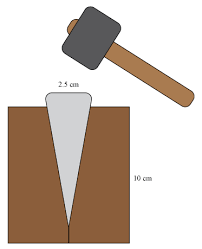
This device
a)
wedge
b)
lever
c)
incline plane
d)
wheel and axle
24.
The fixed point on the lever is called 
a)
load
b)
resistance
c)
bar
d)
fulcrum
25.
The device used to raise a flag up a flag pole is an example of a 
a)
wheel and axle 
b)
lever
c)
inclined plane 
d)
pulley 
26.
Which of the following does a simple machine do?
a)
allows the users to apply less force over a longer distance
b)
reduce the amount of force needed to do work
c)
change the direction of the applied force
d)
all of the above
27.
Which is an example of someone using a simple machine to do work?
a)
a boy runs across a football field
b)
a banker counts money
c)
a mother pushes a stroller up a ramp
d)
a girl eats a sandwich
28.
Name this simple machine.
a)
Lever
b)
Wedge
c)
Pulley
d)
Inclined Plane
29.
How does a pulley make work easier? 
a)
It changes the direction of the input force.
b)
It changes the distance over which the input force is applied.
c)
It changes the amount of the input force applied 
d)
It changes direction and increases the effect of your input force
30.
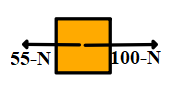
What is the net force?
a)
20 N 
b)
0 N 
c)
400 N 
d)
40 N 
31.
What is the unit to MEASURE force?
a)
Kilogram
b)
Meter
c)
Pascal
d)
Newton
32.
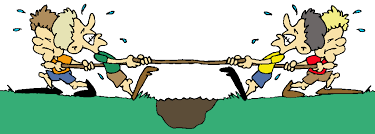
If these teams are pulling with the same amount of force what will happen?
a)
The boy in blue will win.
b)
They will not move at all.
c)
The boy in red will win.
d)
Both will fall down.
33.
Balanced or unbalanced?
a)
balanced
b)
unbalanced
34.

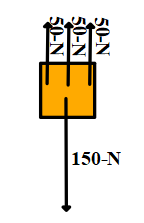
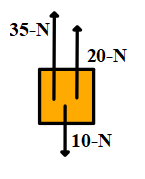
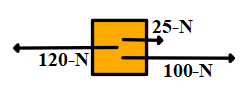
The free body diagram of four boxes are shown below. Which box is in equilibrium?
a)
b)
c)
d)
35.

______________ is a push or pull.

a)

evidence

b)

diagram

c)

force

d)

gravity

36.

______________ is the pull between Earth and other objects, which acts even without touching.

a)

magnet

b)

exert

c)

gravity

d)

repel

37.
An object is _____ if its position changes relative to another object.
a)
in motion
b)
at reset
c)
a frame of refence
d)
magical
38.
In each of the following cases, determine where the car has no acceleration ?
a)
A car shortly after a stoplight turns green.
b)
A car approaching a red light
c)
A car with the cruise control set at 80 km/h
d)
A car moving down a ramp
39.
A person’s body is thrown outward as a car rounds a curve on a highway.
a)
Newton's 1st Law
b)
Newton's 2nd Law
c)
Newton's 3rd Law
d)
None of them
40.
Rockets are launched into space using jet propulsion where exhaust accelerates out from the rocket and the rocket accelerates in an opposite direction.
a)
Newton's 1st Law
b)
Newton's 2nd Law
c)
Newton's 3rd Law
d)
None of them
41.
A magician pulls a tablecloth out from under dishes and glasses on a table without disturbing them.
a)
Newton's 1st Law
b)
Newton's 2nd Law
c)
Newton's 3rd Law
d)
None of them
42.
A picture is hanging on a wall and does not move.
a)
Newton's 1st Law
b)
Newton's 2nd Law
c)
Newton's 3rd Law
d)
None of them
43.
Pushing a child on a swing is easier than pushing an adult on the same swing, because the adult has more inertia.
a)
Newton's 1st Law
b)
Newton's 2nd Law
c)
Newton's 3rd Law
d)
None of them
44.
Acceleration is produced when a force acts on a mass. The greater the mass (of the object being accelerated) the greater the amount of force needed (to accelerate the object).
a)
Newton's 1st Law
b)
Newton's 2nd Law
c)
Newton's 3rd Law
d)
None of them
45.
A soccer ball accelerates more than a bowling ball when thrown with the same force.
a)
Newton's 1st Law
b)
Newton's 2nd Law
c)
Newton's 3rd Law
d)
None of them
46.
The swimmer moves her hand down and to the left and her body goes forward to the right.
a)
Newton's 1st Law
b)
Newton's 2nd Law
c)
Newton's 3rd Law
47.

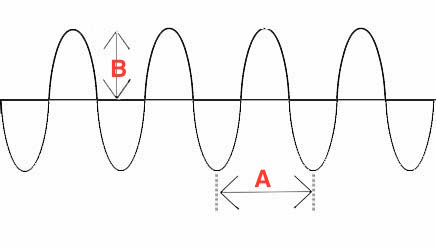
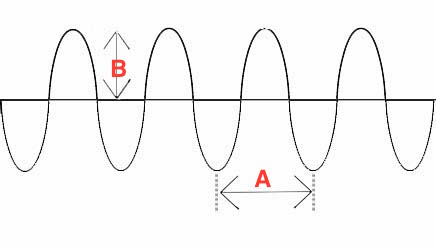
What property of this wave is represented by the letter "A"

a)

amplitude

b)

crest

c)

trough

d)

wavelength

48.
What property of the wave is represented by the letter "B"?
a)
amplitude
b)
crest
c)
trough
d)
wavelength
49.
The number of wavelengths that pass a point each per second is:
a)
frequency
b)
period
c)
longitudinal 
d)
transverse wave 
50.
The type of waves that require medium to pass:
a)
Mechanical Waves
b)
Electromagnetic Waves
51.
When the frequency of a wave increases, what happens to the wavelength?
a)
The wavelength is not directly affected by the frequency of a wave.
b)
The wavelength increases.
c)
The wavelength decreases.
d)
More specific information is needed to form a conclusion about the wavelength.
52.
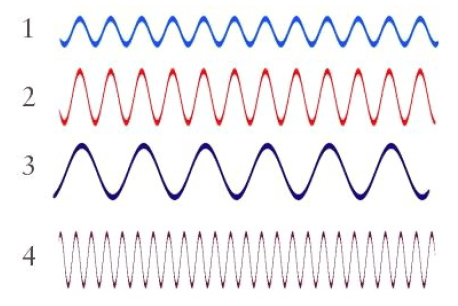
Which wave in the diagram has the greatest frequency?
a)
1
b)
2
c)
3
d)
4
53.
Which of the following can sound travel through?
a)
solid
b)
liquid
c)
gas
d)
all of the above
54.
When a wave bends as it passes through at an angle from one medium to another.(example: pencil in a glass of water-)
a)
medium
b)
refraction
c)
reflection
d)
interference
55.
When a wave strikes and object and bounces off. (example echo)
a)
medium
b)
refraction
c)
reflection
d)
interference
56.
A wave carries...?
a)
energy only
b)
matter only
c)
energy and matter
d)
neither
57.
In a longitudinal wave, the particles move...?
a)
back and forth
b)
up and down
c)
not at all
d)
at a 90 degree angle
58.
The units for frequency are measured in _____________.
a)
hertz
b)
seconds
c)
m/s
d)
grams
59.

When light shines through a prism it creates ________________

a)

visible light

b)

infrared radiation

c)

ultraviolet rays

d)

electromagnetic wave

60.

Rarefactions are...

a)

were waves are farthest apart

b)

were waves are closest together

c)

associated with transverse waves

d)

found near the crest of a wave

61.

Rarefactions are...

a)

were waves are farthest apart

b)

were waves are closest together

c)

associated with transverse waves

d)

found near the crest of a wave

62.
What does refract mean?
a)
To shrink
b)
To bend
c)
To widen
d)
To enlarge
63.

Some materials like carpet and curtains can hold the energy transported by sound waves which reduces the loudness of the sound. What is happening to the sound waves?

a)

absorption

b)

compression

c)

reflection

d)

refraction

64.

What property of light is occurring in this picture?

a)

diffraction

b)

refraction

c)

reflection

d)

scattering

65.

What property of light is being shown here?

a)

diffraction

b)

refraction

c)

reflection

d)

scattering

66.
Max went scuba diving with his family. He heard the sound of dolphins, birds, and the boat motor as he swam underwater. What property of sound enabled Max to hear noises underwater?
a)
Sound has pitch.
b)
Sound has volume.
c)
Sound travels through liquids.
d)
Sound travels through solids.
67.

How are sound and light similar?

a)

They are both forms of energy.

b)

They both travel as transverse waves.

c)

They both have matter.

d)

They both have pitch and frequency.

68.

Why do you see a reflection in the mirror?

a)

Most light rays are taken in by the surface of the mirror.

b)

Most light rays pass through the surface of the mirror.

c)

Most light rays are destroyed by the surface of the mirror.

d)

Most light rays bounce off the surface of the mirror.

69.

Kyle is wearing a blue shirt. Why does the shirt appear blue?

a)

The shirt reflects all of the light rays that strike it

b)

The shirt absorbs all of the blue light rays that strike it.

c)

The shirt reflects all of the light rays that strike it except blue.

d)

The shirt absorbs all of the light rays that strike it except blue.

70.
What kind of wave is pictured below?
a)
compressional wave
b)
transverse wave
c)
sound wave
d)
mechanical wave
71.

If a wave has a wavelength of 50.0 m and a frequency of 25.0 Hz, what is its velocity?

a)

2 m/s

b)

150 m/s

c)

250 m/s

d)

1250 m/s

72.
Which of the following types of waves needs a medium to travel through?
a)
Electromagnetic
b)
Radiowave
c)
Microwave
d)
Sound wave
73.

If a wave is traveling at 260. m/s and has a wavelength of 0.800 m/s, what is its frequency?

a)

208 Hz

b)

325 Hz

c)

430 Hz

d)

160 Hz

74.
The speed of a wave is also known as its _________.
a)
Frequency
b)
Amplitude
c)
Velocity
d)
Period
75.
If a wave is traveling at 45 m/s and has a frequency 5 Hz, what is its wavelength?
a)
225 m
b)
9 m
c)
0.11 m
d)
4.8 m
76.
What type of wave vibrates at right angles to the direction it travels?
a)
Transverse wave
b)
Longitudinal wave
c)
Compression wave
d)
Sound wave
77.

What do we call the part of a longitudinal wave that is when the waves are squeezed together?

a)

compression

b)

rarefaction

c)

crest

d)

trough

78.

What is the unit of speed?

a)

m

b)

s

c)

Hz

d)

m/s

79.
What is the unit of frequency?
a)
m
b)
s
c)
Hz
d)
m/s
80.
High frequency waves have _________ wavelengths.
a)
varying
b)
long
c)
the same
d)
short
81.
A distance vs. time graph shows an object's
a)
frame of reference
b)
speed
c)
acceleration
d)
favorite food
82.
Velocity is both ____ and _____. 
a)
speed , direction 
b)
direction, mass
c)
volume, density 
d)
direction, magnitude 
83.
Which of the following is a unit for acceleration?
a)
km/s
b)
m/s2
c)
mi/hr
d)
ft
84.
A change in velocity over time is known as:
a)
acceleration
b)
constant speed
c)
average speed
d)
displacement
85.
What is happening to the velocity?
a)
Constant
b)
Decreasing
c)
Increasing
d)
Zero
86.
Mass has units of ____
a)
kg
b)
m
c)
N
d)
m/s
87.
Weight is a 
a)
a unit
b)
a force
c)
a mass
d)
a length
88.
Which has more momentum: a car stopped at a red light or a bike moving at 15 mph?
a)
car
b)
bike
c)
they are equal
d)
cannot determine using the info provided
89.
The impulse is ______ the change in momentum
a)
Greater than
b)
Equal to
c)
less than
d)
always double
90.
When the speed of an object is doubled, its momentum
a)
remains unchanged in accord with the conservation of momentum.
b)
doubles
c)
quadruples
d)
decreases
91.
In any collision (crash) the ______ is ALWAYS constant
a)
Total Momentum
b)
total speed
c)
total Velocity
d)
Energy
92.
The purpose of crumble zones on a car is to
a)
decrease time of impact.
b)
increase force of impact.
c)
increase the time of impact.
d)
decrease the impulse during impact.
93.
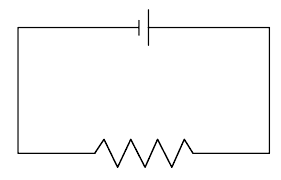
This circuit has a 24 volt battery and the resistor is 8 ohms. How many amps are running through the circuit?
a)
3 Amps
b)
192 Amps
c)
2 Amps
d)
4 Amps
94.
What size resistor would produce a 3 Amp current flow with a 12 Volt battery
a)
1 Ohm
b)
3 Ohms
c)
4 Ohms
d)
12 Ohms
95.
If the battery produced 12.6 Volts and what would be the current flow be for a 6 Ohm resistor
a)
2.1 Amps
b)
2.4 Amps
c)
1.71 Amps
d)
15 Amps
96.
What is current measured in?
a)
Ω (Ohms)
b)
V (Volts)
c)
A (Amps)
d)
W (Watts)
97.
What is resistance measured in?
a)
Ω (Ohms)
b)
V (Volts)
c)
A (Amps)
d)
W (Watts)
98.
What is Resistance?
a)
The flow of electrons
b)
Electric potential difference
c)
A battery
d)
The ability to reduce the flow of electrons
99.
What types of charges attract?
a)
Positive and Positive
b)
Positive and Neutral
c)
Negative and Neutral
d)
Positive and Negative
100.
What is the Voltage of a circuit that has a resistance of 5 Ω and a current of 2 A?
a)
25 V
b)
10 V
c)
2.5 V
d)
0.4 V
101.

Voltage divided by Resistance

(V / R)

a)

Current

b)

Power

c)

Ohms

d)

Watts

102.
Current times Resistance equals
 (I X R)
a)
Power
b)
Voltage
c)
Amperage
d)
Ohm
103.

Voltage divided by Current

(V / I)

a)

Current

b)

Power

c)

Resistance

d)

Watts

104.
What is the power of a 10V bulb with 5A through it?
a)
2W
b)
2V
c)
50W
d)
50A
105.
What is the power of a 20V bulb with 5A through it?
a)
100W
b)
100V
c)
6.3W
d)
6.3A
106.
This is an example of a _______ circuit
a)
open
b)
series
c)
parallel
d)
square
107.
This is an example of a ______ circuit
a)
Series
b)
Parallel
c)
Open
d)
Dihexihedral
108.
What 'flows' in a wire?
a)
Protons
b)
Neutrons
c)
Atoms
d)
Electrons
109.
In a parallel circuit if one of the light bulbs burns out the rest _________.
a)
stop the flow of electricity
b)
 can still light up
c)
 will go out
d)
of the light bulbs burn out also
110.

What is the resistance through a 20V bulb with a power of 100W?

a)

20 Ω

b)

4 Ω

c)

2000 Ω

d)

5 Ω

111.
What is the unit of measurement for Power?
a)
Joules
b)
Newtons
c)
Watts
d)
Meters
112.
The rate at which energy is converted from one form to another
a)
power
b)
voltage
c)
current
d)
none
113.
A kilowatt is
a)
1000 Amps
b)
1000 watts
c)
1000 volts
d)
none
114.
The current in an appliance is 3 A and the voltage difference is 120 V. How much power is being supplied to the appliance?
a)
10000 v
b)
220 v
c)
420 v
d)
360 v
115.
How does flipping a switch turn a light on?
a)
It steps up the voltage
b)
It generates an electromagnetic field
c)
 It opens a circuit
d)
 It closes a circuit 
116.
How many Volts would we need to produce a current of 8 Amps through a 6 Ohm resistor?
a)
1.33 volts
b)
24 volts
c)
0.75
d)
48 volts
117.
Ms Jo Jo rubbed two balloons with a piece of wool. What will happen when the balloons are brought near each other?
a)
The balloons will repel each other.
b)
The balloons will attract each other.
c)
The balloons will become positively (+) charged.
d)
The balloons will pop.
118.
What types of charges attract?
a)
Positive and Positive
b)
Positive and Neutral
c)
Negative and Neutral
d)
Positive and Negative
119.
Electric charges that are alike _______ each other.
a)
Attract
b)
Repel
120.
What charge does an electron have?
a)
negative (-)
b)
positive (+)
c)
neutral or no charge (0)
121.
What kind of circuit is this?
a)
series
b)
parallel
122.
What kind of circuit is this?
a)
Series
b)
Consecutive
c)
Parallel
d)
Training
123.
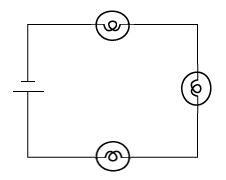
The picture shows an electrical circuit. This circuit is a series circuit because: 
a)
It has 3 light bulbs.
b)
The same current flows through all three light bulbs.
c)
It uses a single battery.
d)
The electrical current has more than one path to flow through
124.
What is a switch's function in a circuit?
a)
to make the current hotter or colder
b)
turn on and off the flow of current
c)
the pathway that current flows
d)
to add more power to the circuit
125.
water is a______?
a)
conductor
b)
insulator
126.
A material in which electrons are not able to move easily 
a)
Circuit 
b)
Insulator 
c)
Resistance 
d)
Conductor
127.
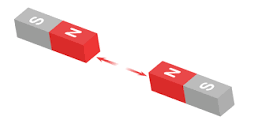
What will happen when these magnets are brought close together?
a)
They will attract each other.
b)
They will repel each other.
c)
Both magnets will turn to the left
d)
Both magnets will turn to the right
128.
Where is the force of attraction the strongest on a magnet?
a)
at the poles
b)
in the middle
c)
above the magnet
d)
below the magnet
129.
Earth acts like a giant magnet because its center is made up MOSTLY of
a)
granite
b)
limestone
c)
iron
d)
nickel
130.
How does an electromagnet work?
a)
You push a magnet into an electrical socket
b)
Wrap wire around a nail and touch it to a magnet
c)
Run electrical current through a coil of wire
d)
push an iron nail into an electrical socket
131.
The force of magnetism is stronger when magnets are ________________
a)
cold
b)
round
c)
closer together
d)
farther apart
132.
The type of current where charges flow in one direction
a)
Direct Current
b)
Alternating Current
c)
Electron Flow
d)
Voltage
133.
The type of current where charges shake back and forth in a circuit
a)
Alternating Current
b)
Direct Current
c)
Voltage 
d)
Switchback Current