
NEW
Font size
S
M
L
XL
 Worksheets
Mid-term Exam 2022
Total questions: 49
Worksheet time: 1hrs 19mins
Name
Class
Date
1.

Type of mixture that has the SAME COMPOSITION in every part.
a)
Homogenous
b)
Heterogeneous
2.

Type of mixture that DOESN'T HAVE the same composition in every part.
a)
Homogeneous
b)
Heterogeneous
3.
A mixture made of parts that separate upon standing is what type of mixture?
a)
suspension
b)
solution
c)
alloy
d)
colloid
4.
Darla put some sugar in a pitcher of iced tea.
Why is Darla stirring the iced tea?
Why is Darla stirring the iced tea?
a)
Stirring makes the iced tea colder
b)
Stirring makes the sugar dissolve more quickly
c)
Stirring keeps the sugar from forming into larger pieces
d)
D - The sugar will not dissolve unless she stirs the iced tea
5.
Combination of two or more pure substances that are not chemically combined
a)
compound
b)
atom
c)
mixture
d)
element
6.

Which of these is a heterogeneous mixture?
a)
Milk
b)
Juice
c)
Trail mix
d)
Smoothie
7.
Water can dissolve many things so it is called the .....
a)
wonderful water
b)
cohesion
c)
liquid
d)
universal solvent
8.
The substances listed on the right side of a chemical equation are the
a)
Yields
b)
Reactants
c)
Products
d)
Precipitates
9.
CaCO3 represents a chemical
a)
Symbol
b)
Formula
c)
Subscript
d)
Reaction
10.
The substances listed on the left side of a chemical equation are the
a)
Products
b)
Coefficients
c)
Precipitates
d)
Reactants
11.
A molecule is smaller than an atom.
a)
True
b)
False
12.
How many elements are in C6H12O6?
a)
1
b)
2
c)
3
d)
4
13.
The coefficient in 3H2O is
a)
6
b)
5
c)
2
d)
3
14.
How many atoms of carbon (C) are in C6H12O6?
a)
3
b)
6
c)
12
d)
24
15.
The core of an atom where most of the mass of an atom exists; contains protons and neutrons
a)
nucleus
b)
electron shell
c)
proton
d)
electron
16.
A negatively charged subatomic particle that exists in various energy levels outside the nucleus of an atom
a)
neutron
b)
electron
c)
proton
d)
subatomic particle
17.
The chart scientists use to organize and classify all the known elements
a)
elements chart
b)
the chart
c)
Periodic Table of the Elements
d)
Period table
18.
An electron that resides in the outermost shell, or principal quantum level, of an atom
a)
periodic trend
b)
electron shell
c)
ionic radius
d)
valence electron
19.
Vertical columns of elements (families) on the periodic table with similar valence electron configurations and similar properties
a)
groups
b)
periods
c)
quadrants
d)
rows
20.
This subatomic particle always identifies the identity (name) of the element
a)
Neutron
b)
Electron
c)
Proton
d)
amu
21.
The chart that shows the arrangement of elements in order by their atomic number
a)
Electron Cloud
b)
Periodic Table
c)
amu
d)
Atomic Mass
22.
The sum of the protons and neutrons in the nucleus of an atom
a)
Atomic Number
b)
Compound
c)
Electrons
d)
Mass Number (also called Atomic Mass)
23.
The vertical columns on the periodic table #1-18
a)
Groups
b)
Periods
c)
Subatomic Particles
d)
Rows
24.
A "pure" substance that cannot be separated or broken down into simpler substances
a)
Compound
b)
Mixture
c)
Period
d)
Element
25.
Most of these elements are gases and are located on the right side of the periodic table
a)
Metalloids
b)
Compounds
c)
Nonmetals
d)
Metals
26.
A substance composed of two or more elements chemically bonded together. Examples are H2O and CO2.
a)
Element
b)
Compound
c)
Electron Cloud
d)
Metalloid
27.
The horizontal rows on the periodic table #1-7.
a)
Periods
b)
Element
c)
Atomic Number
d)
Group
28.
These elements are found along the zig-zag line on the periodic table.
a)
Metal
b)
Group
c)
Metalloid
d)
Nonmetal
29.
This number is the top number in the box on the periodic table and ALWAYS equals the number of protons
a)
Neutrons
b)
Atomic Mass Number
c)
Group
d)
Atomic Number
30.
Density
a)
Physical Property
b)
Chemical Property
31.
Flammability (burns)
a)
Physical Property
b)
Chemical Property
32.
Reacts with acid
a)
Physical Property
b)
Chemical Property
33.
Sour taste
a)
Physical Property
b)
Chemical Property
34.
Melting point
a)
Physical Property
b)
Chemical Property
35.
A student removes a loaf of bread hot from the oven. The student cuts a slice off the loaf and spreads butter on it.
a)
Physical Change
b)
Chemical Change
36.
In baking biscuits and other quick breads, the baking powder reacts to release carbon dioxide bubbles. The carbon dioxide bubbles cause the dough to rise.
a)
Physical Change
b)
Chemical Change
37.
In a fireworks show, the fireworks explode giving off heat and light.
a)
Physical Change
b)
Chemical Change
38.
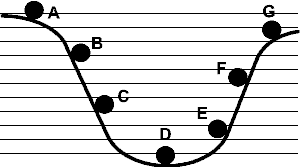
Which point has the most potential energy?
a)
G
b)
f
c)
b
d)
a
39.
When you stretch a rubber band, you are storing __________ energy.
a)
kinetic
b)
potential
c)
none of the above
d)
all of the above
40.
Can energy be destroyed
a)
no
b)
yes
41.
Energy can be _____________ or changed from one type to another.
a)
destroyed
b)
transferred
c)
created
d)
ignored
42.
Which are chemical changes
a)
Iron rusting
b)
Glass breaking
c)
Clothing ripping
d)
Hair cut
43.
How many atoms of carbon (C) are in C6H12O6?
a)
3
b)
6
c)
12
d)
24
44.
Element or compound?
H2O
H2O
a)
element
b)
compound
45.

The blue numbers in the image below represent ________
a)
I don't know, and don't want to try
b)
coefficients
c)
subscripts
d)
none of the answers are correct
46.
How many atoms are there TOTAL in:
H2SO4
H2SO4
a)
6
b)
5
c)
7
d)
3
47.

The blue atoms are called
a)
metals
b)
nonmetals
c)
metalloids
d)
noble gases
48.
What is the name of the group that never reacts--ever ever they are stable with a full outermost ring!!!
a)
noble gases
b)
transition
c)
halogens
d)
borons
49.
Which is the smallest?
a)
electron
b)
proton
c)
atom
d)
neutron
Reset

