Wayground logo

Free Printable Worksheets

Font size

S
M
L
XL
Worksheets

MP2 Earth Science Test LIFT

Total questions: 90

Worksheet time: 1hrs 27mins

Name
Class
Date
1.
When mixing chemicals students should always wear
a)
hair bows
b)
goggles
c)
flip flops
2.
The FIRST thing a student should do in a science investigation is -
a)
read the steps of the investigation
b)
clean off the table
c)
get out safety equipment
3.
What does this symbol mean?
a)
fire safety 
b)
eye protection safety 
c)
animal safety 
d)
extreme temperatures 
4.
Broken glass should never be placed in the trash can because...
a)
Its feelings might get hurt.
b)
It could ignite into a terrible fire.
c)
It could slice through the garbage bag and cause injury to someone.
d)
It could melt on contact with the garbage.
5.
What is the SI unit for length?
a)
meter
b)
liter
c)
mass
d)
second
6.
How do you calculate density?
a)
mass divided by volume
b)
volume divided by mass
c)
mass times volume
d)
very carefully
7.
What is the volume of the battery?
a)
17 cm3
b)
5 cm3
c)
22 cm3
d)
24 ml
8.
Which box has a higher density?  
a)
Box A
b)
Box B
c)
cannot be determined
d)
they are the same
9.
Calculate the density of the cube.
a)
.33 g/cm3
b)
.4 g/cm3
c)
.6 g/cm3
d)
.5 g/cm3
10.

A florist wants to see if Product X will extend the life of cut flowers so that they last longer. What is the dependent variable?

a)

The life of the flowers

b)

Product X

11.

Orchids were studied to determine if the amount of humidity affected the flowering of these plants. Which of these was the independent variable in this study?

a)

Amount of humidity

b)

Amount of water

c)

Flower

12.
What is the relationship between the independent variable and the dependent variable?
a)
As time increase, distance decreases
b)
As time increases, distance increases
c)
As time decreases, distance decreases
d)
As time decreases, distance increases
13.

Location D is located at which coordinates?

a)

30oN, 90oW

b)

90oN, 30oW

c)

10oN, 40oW

d)

30oN, 90oE

14.

Which point is located at 30oS, 30oE?

a)

K

b)

D

c)

E

d)

G

15.
What is the name of the line at 0 degrees longitude?
a)
Equator
b)
Prime Meridian
c)
International Date Line
d)
Arctic Circle
16.
What is this object known as?
a)
Map symbol
b)
Map key
c)
Map scale
d)
Compass rose
17.
What is the elevation of point B?
a)
800 ft
b)
850 ft
c)
900 ft
d)
1000 ft
18.

In which direction is Mill River flowing?

a)

Southeast

b)

Southwest

c)

Northeast

d)

Northwest

19.
The distance from D to E is...
a)
A little over 2 km
b)
A little over 3 km
c)
A little over 4 km
d)
A little over 5 km
20.
What is the elevation of A?
a)
10 meters
b)
20 meters
c)
40 meters
d)
120 meters
21.
What feature is formed at B?
a)
river
b)
rift valley
c)
sink hole
d)
mountain
22.
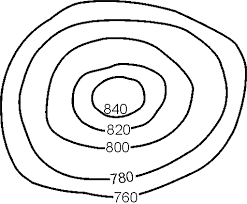
Determine the contour interval:
a)
5 m
b)
10 m
c)
15 m
d)
20 m
23.
What do contour lines that are farther apart represent?
a)
waterfall
b)
steep area
c)
gentle slope
d)
river
24.
What does GPS stand for?
a)
Global Positioning System
b)
Global Positioning Satellites
c)
Global Positioning Software
d)
Global Phone System
25.
The Geometric Principle to locate an item using radius of circles
a)
Triangulation
b)
Tangent
c)
Using a compass
d)
I don't know but can I still get the points? :D
26.
The way in which a mineral's surface reflects light.
a)
Cleavage
b)
Fracture
c)
Density
d)
Luster
27.
The tendency of a mineral to break along smooth, flat surfaces.
a)
Cleavage
b)
Fracture
c)
Hardness
d)
Streak
28.
The color of a mineral's powder form.
a)
Streak
b)
Hardness
c)
Magnetism
d)
Luster
29.

A mineral can be scratched by gypsum and quartz.

What is the hardness range?


a)

1-2

b)

2-7

c)

2-10

d)

7-10

30.

Minerals have a definite chemical composition.

a)

TRUE

b)

FALSE

31.
This mineral has a cubic shape
a)
halite
b)
pyrite
c)
quartz
d)
sulfur
32.

What is the softest mineral?

a)

sulfur

b)

calcite

c)

talc

d)

corundum

33.
This mineral is used to make glass
a)
quartz
b)
calcite
c)
hematite
d)
graphite
34.

This yellow mineral is used in cleaning products

a)

pyrite

b)

gold

c)

sulfur

d)

galena

35.
This rock was formed when magma cooled very slowly inside the Earth. What specific type of rock is it?
a)
Intrusive Igneous Rock
b)
Extrusive Igneous Rock
c)
Foliated Metamorphic Rock
d)
Clastic Sedimentary Rock
36.
This rock formed when lava cooled very quickly on Earth's surface. What specific type of rock is it?
a)
Extrusive Igneous Rock
b)
Intrusive Igneous Rock
c)
Non-Foliated Metamorphic Rock
d)
Biochemical Sedimentary Rock
37.
When you watch a volcano erupt molten rock, you are seeing _____
a)
Lava
b)
Magma
c)
Mineral Crystals
d)
Igneous Rocks
38.
What are the 3 major types of rocks?
a)
Igneous, Metamorphic, Sedimentary
b)
Metamorphic, Igneous, Cementation
c)
Brown, Red, Gray
d)
Streak, Hardness, Breakage
39.
What process is used to form sedimentary rocks?
a)
Lava cools and hardens to form a rock.
b)
Weathering, Erosion, Deposition, Compaction, Cementation
c)
Extreme heat and pressure from inside the Earth turn rocks into new rocks.
d)
Magma trapped under the Earth's surface cools and solidifies.
40.
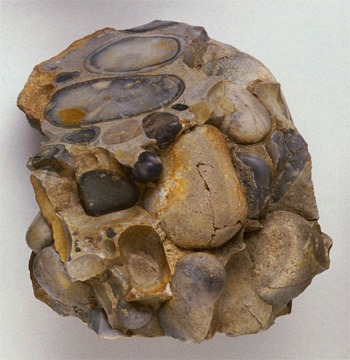
This rock was formed by smaller pieces of rock that settled at the bottom of a lake millions of years ago. What type of rock is this?
a)
Sedimentary
b)
Igneous
c)
Metamorphic
41.
The process when rocks break into smaller pieces due to exposure to natural elements is called
a)
erosion
b)
weathering
c)
sediments
d)
deposition
42.
The movement of weathered material (sediment) is called?
a)
weathering
b)
erosion
c)
deposition
d)
cementation
43.
Which type of rock is formed from INTENSE heat and pressure?
a)
igneous
b)
sedimentary
c)
metamorphic
44.
Is the following metamorphic rock foliated or non-foliated?
a)
Foliated
b)
Non-foliated
c)
Neither
45.

Volcanoes with steep sides made of layers of ash is called......

a)

Cinder Cone

b)

Shield Volcano

c)

Composite Volcano

46.

A common mafic lava flow?

a)

Blocky

b)

A'a

c)

Pahoehoe

d)

Lahar

47.
What type of volcano is this? It has been created with layers of both lava and pyroclastic materials. 
a)
Shield
b)
Cinder cone
c)
Composite
48.
The rock shown is DIORITE. We can tell that it is an ______________ igneous rock that cooled slowly underground because it has large, visible crystals.
a)
extrusive
b)
intrusive
49.
The rock shown is scoria.  We can tell that it is an ______________ igneous rock that quickly on the surface of the ground because we can still see the holes where bubbles of gas were trapped while the rock cooled rapidly
a)
extrusive
b)
intrusive
50.
Small, solid pieces of materials from rocks or living things
a)
sediment
b)
clastic rock
c)
organic rock
d)
deposition
51.
Fossils are only found in sedimentary rocks.
a)
True
b)
False
52.
What is mechanical weathering?
a)
Process through which rocks are physically broken into smaller pieces.
b)
Rocks are broken down through chemical changes.
c)
Rocks are worn away from acid in plant roots.
d)
Rocks broken down by machinery.
53.
Which layer of sedimentary rock is the oldest?
a)
A
b)
B
c)
D
d)
F
54.

Which layer is OLDER? Fault E or Intrusion D?

a)

Fault E

b)

Intrusion D

55.
Which is the most accurate form of absolute dating?
a)
radiometric dating
b)
erosion rate
c)
deposition rate
d)
index fossils
56.

How much Carbon-14 would a foosil that is 6,000 yrs old?

a)

about 40%

b)

about 50%

c)

about 60%

d)

about 70%

57.

A fossil emitting 90% carbon-14, would be __________ yrs old.

a)

1,000

b)

2,000

c)

3,000

d)

4,000

58.
According to the law of superposition, the oldest fossils are found 
a)
At the top of the rock layers
b)
Near the bottom of the rock layers
c)
In the middle of the rock layers
d)
Somewhat near the surface
59.
Which parts of an organism are more likely to fossilize?
a)
the soft parts - skin, muscle
b)
the hard parts - bones, shells, stems
c)
all parts can become fossilized easily because the organism becomes buried by sediments
60.
_______________ are fossils in which minerals replace all or part of an organism.
a)
carbon films
b)
trace fossils
c)
petrified fossils
d)
amber
61.
A dinosaur track, a trail, and burrow are all examples of
a)
casts
b)
molds
c)
trace fossils
d)
preserved remains
62.
Decayed organic matter is...
a)
Hummus
b)
Humus
c)
Himalayas
d)
Hummers
63.
In which answer choice are the soil particles arranged in order from LARGEST to SMALLEST?
a)
Silt, sand, clay
b)
Silt, clay, sand
c)
Clay, silt, sand
d)
Sand, silt, clay
64.
Which of the following is NOT one of the three layers of soil?
a)
topsoil
b)
undersoil
c)
subsoil
d)
bedrock
65.
If you have 50% clay, 10% silt, and 40% sand, what type of soil do you have?
a)
silty clay
b)
clay loam
c)
clay
d)
sand
66.
Bobby observed that a metal trash can was covered with rust.  What type of weathering caused the rust on the trash can?
a)
Mechanical weathering 
b)
Wind weathering
c)
Chemical weathering
d)
Erosion weathering
67.
A student hiking in a rock area on a mountain notices that wide, deep cracks have formed in some of the large rocks. Some of the cracks are so large that the rocks have broken apart. Which process most likely caused these rocks to crack and creak? 
a)
Erosion by wind
b)
Water freezing and thawing
c)
Erosion by fast-moving
d)
Sediments being deposited.
68.
Which of the following is the most important agent of chemical weathering to form this cave?
a)
Water - It can carry acid and dissolve rock
b)
Erosion - Moves the rocks from one place to another
c)
Wind - It displaces rocks
d)
Exfoliation - New cracks give chemical reactions the chance to operate
69.

Rock formations hanging from a roof are called ________.

a)

stalactites

b)

stalagmites

c)

troglodytes

d)

minerals

70.
Karst topography includes underground caverns. Where in VA would this landscape be found?
a)
Piedmont 
b)
Coastal Plain
c)
Valley and Ridge
d)
Blue Ridge
71.

What type of rock is common in the cavernous region and is the rock needed to create Karst topography because it can be dissolved by the weak acid of Carbon Dioxide dissolved in water

a)

Sandstone

b)

Granite

c)

Basalt

d)

Limestone

72.
A depression or hole formed when the roof of a cave collapses
a)
Cavern
b)
Cave
c)
Sinkhole
d)
Bedrock
73.
What is the name of this Metamorphic Rock?
a)
Marble
b)
Schist
c)
Slate
d)
Anthracite
74.
What is the name of this Metamorphic Rock?
a)
Schist
b)
Slate
c)
Gneiss
d)
Marble
75.
How do metamorphic rocks form? 
a)
Heat and Pressure
b)
Compaction & Cementation
c)
Cooling of Magma
d)
Sediments & Glue
76.
__________ metamorphism occurs when magma heats the surrounding rock and changes it.
a)
Regional
b)
Forced
c)
Igneotrophic
d)
Contact
77.
What is the fossil fuel found in the Appalachian Plateau Province?
a)
Coal
b)
Oil
c)
Natural Gas
d)
Uranium
78.
Which of the provinces below has Igneous and Metamorphic Rocks
a)
Coastal Plain
b)
Piedmont
c)
Appalachian Plateau
d)
Valley & Ridge 
79.
What is the oldest province?
a)
Coastal Plain
b)
Piedmont
c)
Blue Ridge
d)
Appalachian Plateau
80.
Which province is known for its "rolling hills?"
a)
Piedmont
b)
Blue Ridge
c)
Valley & Ridge
d)
Appalachian Plateau
81.
In the figure, "H" is ___________?
a)
an intrusion
b)
a splitting spike
c)
a contusion
d)
an inclusion
82.
What is the order geologic time scales are divided (largest to smallest):
a)
Epoch, Period, Era, Eon
b)
Era, Epoch, Eon, Period
c)
Period, Eon, Epoch, Era
d)
Eon, Era, Period, Epoch
83.
In what order do these appear in the geologic record (oldest to youngest)?
a)
Bacteria, fish, birds, humans
b)
Bacteria, birds, fish, humans
c)
Humans, birds, fish, bacteria
d)
Humans, fish, birds, bacteria
84.
Earth's geologic history is divided into units based on:
a)
Radiocarbon dating
b)
Absolute dating
c)
Seismic information
d)
Fossil informaiton
85.
Absolute dating measures _________________.
a)
the radioactive decay of material
b)
the depth of the fossil relative to sea level
c)
climate CO2  concentration
d)
the movement of tectonic plates
86.
This region is best known for its valuable resources like kyanite and high quality slate: 
a)
Piedmont 
b)
Appalachian Plateau 
c)
Coastal Plain 
d)
Blue Ridge 
87.
Has the youngest sedimentary rocks in Virginia-sand gravel, shells and clay.
Minerals-titanium
Oil and natural gas offshore
a)
Coastal
b)
Piedmont
c)
Blue Ridge
d)
Valley and Ridge
88.

How do extrusive igneous rocks differ from intrusive igneous rocks?

a)

Extrusive rocks are larger in size.

b)

Intrusive rocks break down quicker.

c)

Extrusive rocks are arranged in layers.

d)

Intrusive rocks have larger crystals.

89.

In which location would you most likely find an igneous rock?

a)
b)
c)
d)
90.

Place the following events in sequence: A) Mineral grains are formed; B) A volcano erupts; C) Lava begins cooling

a)

A, B, C

b)

B, A, C

c)

B, C ,A

d)

C, A, B