wayground logo

Free Printable Worksheets

Font size

S
M
L
XL
Worksheets

Physical Science Semester 1 Review

Total questions: 61

Worksheet time: 45mins

Name
Class
Date
1.
In an experiment, what is the variable that you change directly?
a)
dependent variable
b)
independent variable
c)
artificial variable
d)
official variable
2.
What is the final step of the scientific method?
a)
Ask a question
b)
Form a hypothesis
c)
Gather information
d)
Draw conclusions
3.
2200 m = ________km
a)
220
b)
22
c)
2.2
d)
200
4.
4 km = ______ m
a)
400
b)
4000
c)
4444
d)
0.004
5.
If a runner runs around a 400 m track THREE times and ends up where she started, what DISTANCE has she run?
a)
0 m
b)
400 m
c)
800 m
d)
1200 m
6.
If a jogger runs around a 400 m track TWO times and ends up where he started, what is his DISPLACEMENT?
a)
0 m
b)
400 m
c)
800 m
d)
1200 m
7.
If a plane travels 48,000 m in 80 s, how fast is it going?
a)
3840000 m/s
b)
600 m/s
c)
80 m/s
d)
60 m/s
8.
How long will it take a Pony Express rider to travel 24,000 m if he is traveling at a speed of 12 m/s?
a)
48,000 s
b)
4,800 m
c)
200 s
d)
2,000 s
9.

A driver slows down from 45 m/s to 20 m/s in 5 s. What is his acceleration?

a)

5 m/s^2

b)

-5 m/s^2

c)

25 m/s

d)

-25 m/s^2

10.
This is the force on an object due to gravity.
a)
force applied
b)
force normal
c)
force weight
d)
force friction
11.
This is the force that is exerted by the surface an object is resting on.
a)
force applied
b)
force normal
c)
force weight
d)
force friction
12.
What force is needed to accelerate a rocket at 60 m/s^2 if the rocket has a  mass of 20,000 kg?
a)
3,000 N
b)
3,000 kg
c)
120,000 N
d)
333 N
13.
Which of Newton’s laws states that for every action, there is an equal and opposite reaction?
a)
First Law
b)
Second Law
c)
Third Law
d)
None of these
14.
This law says that an object in motion will remain in motion and an object will remain at rest unless acted upon by an outside net force.
a)
Newton's First Law of Motion
b)
Newton's Second Law of Motion
c)
Newton's Third Law of Motion
d)
None of these
15.
Which of Newton's Laws states that force, mass, and acceleration are related by the formula F=ma?
a)
First Law
b)
Second Law
c)
Third Law
d)
None of these
16.
When an object is in free fall above earth’s surface, what is it’s acceleration?
a)
9.8 m/s
b)
8.9 m/s2
c)
9.8 m/s2
d)
16 m/s
17.

Which state of matter has the least amount of thermal energy?

a)

solid

b)

liquid

c)

gas

d)

plasma

18.
Heat from the sun travels to Earth by _____.
a)
conduction
b)
convection
c)
insulation
d)
radiation
19.

Heat moves by ______ when it travels from one solid to another solid through physical contact.

a)

radiation

b)

convection

c)

thermal energy

d)

conduction

20.

When graphing experiment data, the y-axis shows the:

a)

independent variable

b)

dependent variable

c)

control variable

d)

relationship

21.
Temperature is the average amount of _____.
a)
chemical energy
b)
kinetic energy
c)
thermometer energy
d)
potential energy
22.
What is the correct temperature on the Kelvin scale equal to 30oC?
a)
303K
b)
243K
c)
313K
d)
253K
23.

The absolute coldest anything can get.

In Celsius it's -273.15 degrees. Or 0 degrees Kelvin.

a)

Absolute cold

b)

Kelvin

c)

Absolute zero

d)

I don't know

24.
The slower molecules move, 
a)
the higher the temperature
b)
the less temperature
c)
the same temperature
d)
I don't know
25.

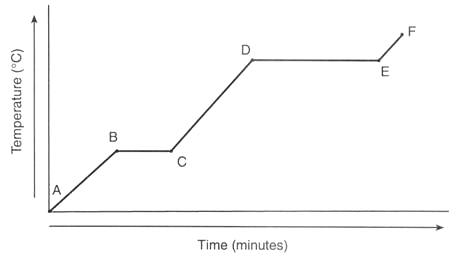
Are the particles moving faster or slower as time goes on?

a)

Faster

b)

Slower

26.

What state/phase is the object likely from points A to B?

a)

Solid

b)

Liquid

c)

Gas

d)

Plasma

27.

Where on the graph are phase changes taking place?

a)

1

b)

2

c)

3

d)

4

e)

5

28.

Phase change going from a Solid to a Gas...

a)

Deposition

b)

Sublimation

c)

Condensation

d)

Recombination

29.

Phase change going from a Liquid to a Gas...

a)

Vaporization

b)

Deposition

c)

Condensation

d)

Melting

30.

What is happening to the particles in the substance between points A and B?

a)

Melting

b)

Freezing

c)

Speeding Up

d)

Slowing Down

31.

Phase change going from a Gas to a Liquid...

a)

Sublimation

b)

Deposition

c)

Ionization

d)

Condensation

32.
Heat is the transfer of ___________ energy?
a)
kinetic
b)
sound
c)
mechanical
d)
thermal
33.
What is the unit for force?
a)
Inertia
b)
Mass
c)
Weight
d)
Newton
34.
How does the kinetic energy of a car traveling at 16 m/s compare with the kinetic energy of the same car traveling at 8 m/s?
a)
it is 2 times greater
b)
it is .5 times greater
c)
it is 4 times greater
d)
it is 8 times greater
35.
To calculate net force, when forces are acting in the same direction, the forces are ...
a)
added 
b)
subtracted 
c)
multiplied 
d)
divided 
36.
You push on a tree with 20 N of force. If the tree doesn't move, the tree is pushing back on you with _____of force.
a)
20N 
b)
40N 
c)
10N 
d)
70N
37.
If there is a big mass, it would need a stronger force to accelerate it.  Which law does this describe?
a)
Newton's 1st Law
b)
Newton's 2nd Law
c)
Newton's 3rd Law
38.
What is the overall force acting on an object after all forces are combined.
a)
Sliding Friction
b)
Inertia
c)
Weight
d)
Net Force
39.

If mass increases and the force remains constant the acceleration

a)

increases.

b)

decreases.

c)

does not change.

40.

When a car is on cruise control on the highway, traveling at a constant speed

a)

the forces acting on the car are balanced.

b)

the forces acting on the car are unbalanced.

c)

the frictional force is greater than the applied force.

d)

the applied force is greater than the frictional force.

41.

What has more kinetic energy, an elephant standing still or a mouse moving at 5 m/s?

a)

the elephant

b)

the mouse

c)

they both have the same amount

d)

not enough information

42.

The greater the mass of an object,

a)

the easier the object starts moving.

b)

the greater its inertia.

c)

the more balanced it is.

d)

the more space it takes up.

43.

According to the law of conservation of momentum, when two objects collide in the absence of outside forces,

a)

velocity decreases

b)

velocity increases

c)

the objects have the same total momentum before and after they collide.

d)

the objects have more momentum after they collide than they did before.

44.

The momentum of an object is in the same direction as its

a)

force.

b)

velocity.

c)

acceleration.

d)

inertia.

45.

Two balls with the same mass are going in opposite directions and collide in an elastic collision. Ball A has a momentum 12 kg m/s to the left and ball B has a momentum of 10 kg m/s to the right when they collide. After the collision ball A travels with a momentum of 10 kg m/s to the right. What is the momentum of ball B after the collision?

a)

22 kg m/s left

b)

2 kg m/s left

c)

12 m/s left

d)

10 kg m/s left

46.

The total mechanical energy of a steel beam as it falls off a crane is 1000 J. At some point while it is falling the gravitational potential energy of the beam is 750 J, its kinetic energy

a)

is also 750 J

b)

is 125 J

c)

is 250 J

d)

is 1750 J

47.
Kinetic energy ___ as an object's speed increases.
a)
increases
b)
decreases
c)
stays the same
d)
is destroyed
48.
Energy stored in a big boulder at the top of the hill is an example of ___ energy.
a)
potential
b)
electrical
c)
radiant
d)
thermal
49.
Food is a form of ____ energy. 
a)
solar
b)
geothermal
c)
nuclear
d)
chemical 
50.
When a baseball falls from its highest point, the energy is changing from_____.
a)
kinetic to potential
b)
potential to kinetic
c)
thermal to kinetic
d)
chemical to potential
51.
What does this graph represent?
a)
Constant Speed
b)
Acceleration
c)
Deacceleration
d)
Not moving
52.
According to the graph how far does the person travel in the first 5 seconds?
a)
2 m
b)
10 m
c)
0 m
d)
5 m
53.
Which graph shows the object standing still?
a)
A
b)
B
c)
C
d)
D
54.
Why does a car accelerate as it round a corner at a constant speed?
a)
Its direction changes
b)
It doesn't
c)
It slows down
d)
Its speeds up  
55.
The slope of a position vs time graph represents the:
a)
speed
b)
acceleration
c)
distance
d)
time
56.
The slope on a speed vs time graph represents the:
a)
speed
b)
acceleration
c)
distance
d)
time
57.
Why does weight change on different planets while mass doesn't?
a)
Weight is what makes something up
b)
Weight does not change
c)
Weight and mass are the same thing
d)
Weight is a force affected by gravity
58.
Which of the following would require no work to do:
a)
Carrying a backpack down the hall
b)
Lifting a book
c)
Throwing a basketball
d)
Running up stairs
59.

A brick has a mass of 2 kg and is thrown with a velocity of 5 m/s to the right. What is the momentum of the brick?

a)

10 kg m/s to the right

b)

10 kg m/s to the left

c)

2.5 kg m/s to the right

d)

2.5 kg m/s to the left

60.

Amir has a mass of 70 kg and climbs a 5 m ladder. How much work did he do?

a)

14 J

b)

0.07 J

c)

350 J

d)

3430 J

61.

Amir does 3430 J of work climbing a ladder. If it took him 12 seconds, how much was his power output?

a)

41,160 W

b)

286 W

c)

0.003 W

d)

500 W