Wayground logo

Free Printable Worksheets

Font size

S
M
L
XL
Worksheets

BIOCHEMISTRY TEST

Total questions: 104

Worksheet time: 2hrs 20mins

Name
Class
Date
1.

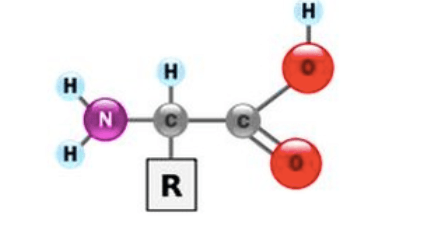
Chains of amino acids are

a)

proteins

b)

nucleic acids

c)

carbohydrates

d)

lipids

2.

A ___________________ is an organic molecule used as the body's primary source of energy.

a)

protein

b)

nucleic acid

c)

carbohydrate

d)

lipid

3.

Which biomolecule builds muscle tissue?

a)

protein

b)

nucleic acid

c)

carbohydrate

d)

lipid

4.

What is the difference between a plant cell and an animal cell?

a)

Plant cell has a cell membrane and chloroplasts

b)

planet cell has a cell wall and chloroplasts

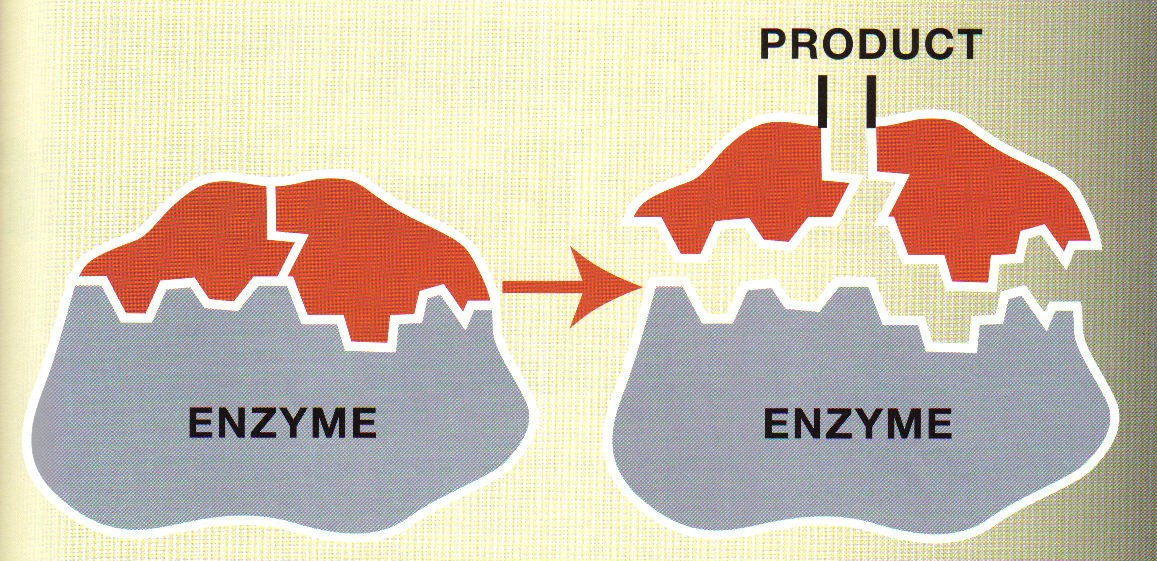
c)

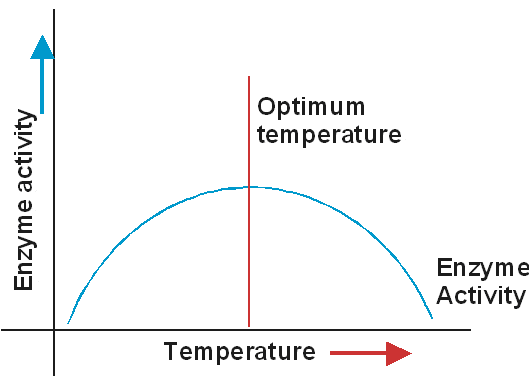
animal cell has a cell membrane and a cell wall

d)

animal cell has a cell wall and chloroplasts
5.
Which monomer is paired with the correct biomolecule?
a)
Monosaccharide = Carbohyrate
b)
Nucleotide = Protein
c)
Glycerol and Fatty Acid = Nucleic Acid
d)
Amino Acid = Lipid
6.
Which monomer is paired with the correct biomolecule?
a)
Amino Acid = Protein
b)
Monosaccharide = Lipid
c)
Glycerol and Fatty Acid = Carbohydrate
d)
Monosaccharide = Nucleic Acid
7.
How does Dehydration Synthesis work in making large biomolecules?
a)
It uses a water molecule, breaking bonds and creating two smaller molecules
b)
It removes a water molecule, creating a bond between two smaller molecules.
c)
It creates a double bond between two carbon atoms
d)
It links monosaccharides together to make polysaccharides.
8.
How does Hydrolysis work with biomolecules? 
a)
It uses a water molecule, breaking bonds and creating two smaller molecules
b)
It links monosaccharides together to make polysaccharides.
c)
It removes a water molecule, creating a bond between two smaller molecules.
d)
It creates a double bond between two carbon atoms
9.
This molecule is a nucleic acid. It is used by the Mitochondria for cellular energy.
a)
RNA
b)
DNA
c)
ATP
d)
Protein
10.
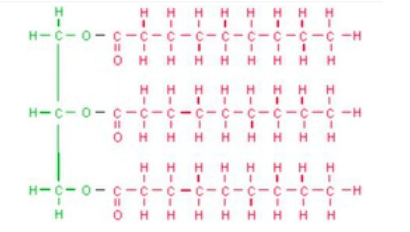
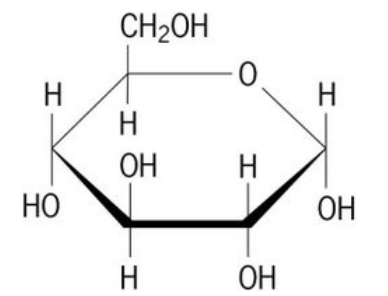
Which biomolecule is this a picture of?
a)
Protein
b)
Nucleic Acid
c)
Lipid
d)
Carbohydrate
11.
Which biomolecule is this a picture of?
a)
Protein
b)
Nucleic Acid
c)
Lipid
d)
Carbohydrate
12.
Which biomolecule is this a picture of?
a)
Protein
b)
Nucleic Acid
c)
Lipid
d)
Carbohydrate
13.
The 3 categories of carbohydrates are:
a)
Monosaccharide, disaccharide, polysaccharide
b)
glucose, fructose, galatose
c)
starch, cellulose, chitin
d)
There are no categories of carbohydrates
14.

Which of the following shows the correct monomer to polymer for CARBOHYDRATES.

a)

Amino Acid: Enzyme

b)

Glucose: Starch

c)

Nucleotide: DNA

d)

Fatty acid tail: triglyceride

15.
The monomer of a protein is called...
a)
an amino acid
b)
a monosaccharide
c)
a fatty acid
d)
a nucleotide
16.
The monomer of a carbohydrate is called...
a)
a monosaccharide
b)
a fatty acid
c)
an amino acid
d)
a nucleotide
17.
Monomers combine to form ________ through the process of ________.
a)
polymers; hydrolysis
b)
polymers; dehydration synthesis
c)
monomers; hydrolysis
d)
monomers; dehydration synthesis
18.
monosaccharides combine to form....
a)
carbhoydrates
b)
lipids
c)
proteins
d)
nucleic acids
19.

Which of the following macromolecules contains more energy per molecule?

a)

Carbohydrates

b)

Lipids

20.
Enzymes are...
a)
nucleic acids
b)
proteins
c)
lipids
d)
carbohydrates
21.
Which category of nutrients do the calories in Mountain Dew come from?  
a)
Fats
b)
Carbohydrates
c)
Proteins
d)
Nucleic Acids
22.
Which types of fat is good for you and how can you identify it?  
a)
Unsaturated fat; mostly comes from plants and is liquid at room temp.
b)
saturated fat; an animal fat (butter, lard, etc.); solid at room temp.
c)
Trans fats; man made; usually solid at room temp
d)
All fats are terrible!
23.
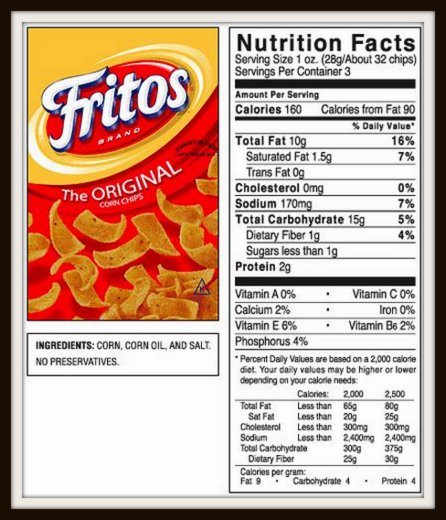
How many grams of total fat?
a)
10 g
b)
160 g
c)
15 g
d)
1.5 g
24.
Based on the food label, if I eat 9 potato chips, how many grams of protein would I be getting? 
a)
2 g
b)
4 g
c)
6 g
d)
8 g
25.
Based on the label, if I ate 32 chips, how much cholesterol would I consume 
a)
0
b)
10
c)
50
d)
120
26.
How much Total Fat is in two servings of these potato chips?
a)
8 g
b)
16 g
c)
0 mg 
d)
720 mg 
27.
Based on the food label, if I eat 9 potato chips, how many grams of protein would I be getting? 
a)
2 g
b)
4 g
c)
6 g
d)
8 g
28.
Carbohydrates are our body's initial energy source.  Which of the following foods are a good source of carbohydrates?
a)
Steak
b)
Potatoes
c)
Butter
d)
Fish
29.

If there are 4 calories per gram of protein, how many calories are from protein in this granola bar?

a)

2

b)

4

c)

8

d)

6

30.

What is the serving size for the pretzels?

a)

8 pretzels

b)

10 pretzels

c)

28 Pretzels

d)

5 pretzels

31.

If a The percent daily value is based upon...

a)

a 2, 000 calorie diet

b)

a 1,000 calorie diet

c)

2,500 calories diet

d)

3,000 calorie Diet

32.

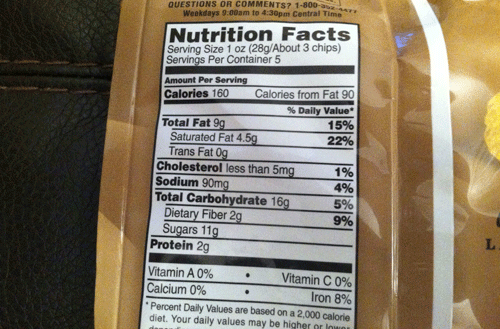
Sun chips contain how many calories from fat?

a)

54

b)

24

c)

32

d)

72

33.

What is the Percent daily value if a food is "low" in a nutrient?

a)

below 5%

b)

below 10%

c)

below 20%

d)

below 30%

34.

What is the Percent daily value if a food is "High" in a nutrient?

a)

above 5%

b)

above 10%

c)

above 20%

d)

above 30%

35.

What is a food allergen found in the Sun Chips?

a)

Soy

b)

Wheat

c)

Egg

d)

Milk

36.

The granola bar contains the most of which ingredient?

a)

Coconut

b)

Chocolate Chips

c)

Honey

d)

Crisp Rice

37.
The process of removing water in order to form a bond between monomers is called....
a)
Dehydration Synthesis
b)
Hydrolysis
38.
The process of adding water in order to break bonds within a polymer....
a)
Dehydration Synthesis
b)
Hydrolysis
39.
The following figure is illustrating
a)
Dehydration Synthesis
b)
Hydrolysis
40.
The following figure is illustrating
a)
Dehydration Synthesis
b)
Hydrolysis
41.
The following figure is illustrating
a)
Dehydration Synthesis
b)
Hydrolysis
42.
The following figure is illustrating
a)
Dehydration Synthesis
b)
Hydrolysis
43.
Is the following chemical reaction illustrating dehydration synthesis or hydrolysis?
Starch + Water -------> Glucose
a)
Dehydration Synthesis
b)
Hydrolysis
44.
The monomer of a lipid is called...
a)
a nucleotide
b)
a monosaccharide
c)
an amino acid
d)
a fatty acid
45.
The monomer of a protein is called...
a)
an amino acid
b)
a monosaccharide
c)
a fatty acid
d)
a nucleotide
46.
The monomer of a carbohydrate is called...
a)
a monosaccharide
b)
a fatty acid
c)
an amino acid
d)
a nucleotide
47.
Fatty acids and glycerol form the polymer....
a)
carbohydrates
b)
lipids
c)
proteins
d)
nucleic acids
48.
Is C2H12O3 an organic or Inorganic Compound?
a)
Inorganic
b)
Organic
49.
a)
organic
b)
inorganic
50.
The area that the substrate fits into on the enzyme is called the:
a)
Active Site
b)
Allosteric Site
c)
DiSulphide Bridge
d)
β-Pleated Sheet
51.
At high temperatures enzyme activity declines because of:
a)
Denaturation
b)
Decreased Kinetic Motion
c)
Increased H-Bonding
d)
Dissociation of Ionic Compounds
52.
What is the purpose  of an enzyme?
a)
give permission for the reaction
b)
raise activation energy
c)
speed up reactions
d)
control how many reactions occur
53.
What is the name for the mechanism of enzyme activity?
a)
Lock and key
b)
jigsaw puzzle
c)
hammer and nail
d)
two hands pattern
54.
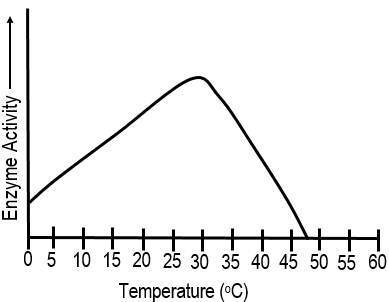
Based on the graph, what temperature does this enzyme work best? 
a)
15 C
b)
40 C
c)
30 C
d)
47 C
55.
What happens when enzymes are heated to a high temperature?
a)
The enzymes die.
b)
The shapes of the enzyme are altered or denatured
c)
The enzymes' amino acid sequence changes.
d)
The enzymes remain the same
56.

The diagram represents one way an enzyme can be inhibited.


Which statement explains the effect of an inhibitor on an enzyme?

a)

A substrate will be able to bond with the enzyme.

b)

The enzyme will likely be attacked by immune cells.

c)

The enzyme will be unable to produce more enzymes.

d)

A substrate will be unable to attach to the enzyme.

57.
What is structure A?
a)
Substrate
b)
Active site
c)
Enzyme
d)
Products
58.
What is structure D?
a)
Substrate
b)
Active site
c)
Enzyme
d)
Products
59.
What is structure C?
a)
Substrate
b)
Active site
c)
Enzyme
d)
Products
60.
What is structure E, F, G?
a)
Substrate
b)
Active site
c)
Enzyme
d)
Products
61.
What is a substance called if it speeds up a chemical reaction?
a)
reusable
b)
catalyst
c)
specific
d)
fragile
62.
Which of the following conclusions can be drawn from this graph?
a)
The optimum pH of the enzyme is 6.6.
b)
The optimum pH of the enzyme is 5.8
c)
The enzyme’s activity increases as pH increases 5.0 to 9.0
d)
The enzyme’s activity is greater around pH of 8.0 .
63.
The "lock and key hypothesis" attempts to explain the mechanism of?
a)
Vacuole formation
b)
Pinocytosis
c)
Sharing of electrons
d)
Enzyme specificity 
64.
Which chemical is classified as an enzyme?
a)
Galactose
b)
Lipid
c)
Protease
d)
Manganese dioxide
65.

Which biomolecule is made of nucleotides and contain your DNA?

a)

Carbohydrate

b)

Lipids

c)

Protein

d)

Nucleic Acid

66.
Which biomolecule contains pastas and breads?
a)
Lipid
b)
Protein
c)
Nucleic Acid
d)
Carbohydrate
67.
Which biomolecule helps form muscles?
a)
Nucleic Acid
b)
Carbohydrate
c)
Protein
d)
Lipids
68.
Which biomolecule is made of amino acids?
a)
Nucleic Acid
b)
Carbohydrate
c)
Protein
d)
Lipid
69.
Which biomolecule contains fats, oils, and waxes?
a)
Proteins
b)
Nucleic Acid
c)
Lipids
d)
Carbohydrate
70.
Which biomolecule is your main source of energy?
a)
Nucleic Acid
b)
Protein
c)
Lipid
d)
Carbohydrate
71.
Building blocks of polymers.
a)
monomer
b)
polypeptide
c)
monosaccharide
d)
glycerol
72.
Which foods are high in protein?
a)
Meats, cheeses, milk, eggs
b)
Breads, pasta, grains
c)
Butter, oil, lard
d)
Apples, Bananas, Grapes
73.
Lipids are made of
a)
monosaccharides
b)
amino acids
c)
glycerol and 3 fatty acids
d)
nucleotides
74.
Nucleotides are monomer for
a)
Nucleic Acids
b)
Proteins
c)
Carbohydrates
d)
Lipids
75.
Once a new product leaves an enzyme, the enzyme is unchanged and ready for the next substrate.  What is this called?
a)
reusable
b)
catalyst
c)
specific
d)
fragile
76.

Which statement about photosynthesis is correct?

a)

Plants get the energy they need for photosynthesis from water.

b)

Plants get the energy they need for photosynthesis from soil.

c)

Plants get the energy they need for photosynthesis from sunlight.

d)

Plants do not require energy to perform photosynthesis.

77.

What reactants (raw materials) go into photosynthesis? Choose all that apply!!

a)

Carbon dioxide

b)

Oxygen

c)

Water

d)

Sunlight

78.
Which of the following structure is where cellular respiration occurs in the cell?
a)
nucleus
b)
cytoplasm
c)
mitochondria
d)
vacuoles
79.

This means that oxygen is needed

a)

anaerobic

b)

aerobic

80.

What process occurs when light energy is captured in chloroplasts and converted into sugar?

a)

Photosynthesis

b)

Cellular Respiration

c)

Mitosis

d)

Lactic Acid Fermentation

81.
In which organelle (part of the cell) does photosynthesis take place?
a)
mitochondria
b)
chloroplast
c)
nucleus
d)
cell membrane
82.

Why do you know that this is cellular respiration?

a)

Oxygen is created

b)

ATP is created

c)

Rain is created

d)

Photosynthesis

83.

What product (result) of photosynthesis is missing from the diagram?

a)

Sugar

b)

ATP

c)

Oxygen

d)

Chlorophyll

84.

Where did the energy contained in sugar ultimately come from?

a)

Cellular Respiration

b)

Sunlight

c)

ATP

d)

Green Light

85.

What does this picture equation represent?

a)

Global Warming

b)

Cellular Respiration

c)

Lactic Acid Fermentation

d)

Photosynthesis

86.

In Cellular Respiration, cells use energy available in food to create what energy-rich compound?

a)

ATP

b)

ADP

c)

glucose

d)

water

87.

Which of the following organisms perform cellular respiration?

a)

A

b)

D

c)

B and C

d)

All of these

88.

Does photosynthesis most commonly occur in heterotrophs or autotrophs?

a)

Heterotrophs

b)

Autotrophs

89.

Which of the following would most affect the rate of photosynthesis?

a)

Amount of carbon dioxide in the atmosphere

b)

amount of water in the soil

c)

amount of sunlight

d)

All of the above

90.

The process that produces glucose using sunlight, water and carbon dioxide is:

a)

cellular respiration

b)

Krebs Cycle

c)

Osmosis

d)

Photosynthesis

91.
The main source of energy for all life comes from ____.
a)
the Earth
b)
the moon
c)
the sun
d)
the food we eat/make
92.
The reactants of photosynthesis are
a)
sugar and water.
b)
sugar and oxygen.
c)
carbon dioxide and water.
d)
carbon dioxide and oxygen.
93.
What are the products of photosynthesis?
a)
Carbon dioxide and water
b)
Carbon dioxide and oxygen
c)
Glucose and oxygen
d)
Glucose and water
94.
Which of the following is the correct equation for PHOTOSYNTHESIS?
a)
6CO2 + 6H2O --> 6O2 + C6H12O6
b)
6CO2 + C6H12O6 + 6H2O --> O2 
c)
6O2 + 6H2O --> 6CO2 + C6H12O6
d)
C6H12O6 + 6O2 ---> 6H2O + 6CO2 
95.
What is the purpose of photosynthesis?
a)
make glucose
b)
make ATP
c)
make light
d)
release carbon dioxide
96.
What is the gas we breathe out that plants use for photosynthesis?
a)
sulfur
b)
carbon dioxide
c)
oxygen
d)
hydrogen
97.
In which organelle (part of the cell) does photosynthesis take place?
a)
mitochondria
b)
chloroplast
c)
nucleus
d)
cell membrane
98.
Carbon dioxide and oxygen both enter and leave the leaf at the 
a)
pore
b)
spongy measophyll
c)
guard cells
d)
stomata
99.
What is the correct equation for cellular respiration?
a)
6O2 + C6H12O6 -> 6CO2 + 6H2O + Energy
b)
6O2 + C6H12O6 + Energy -> 6CO2 + 6H2O
c)
6CO2 + 6H2O -> 6O2 + C6H12O6 + Energy
d)
6CO2 + 6H2O + Energy -> 6O2 + C6H12O6
100.
What process is the foundation (base) of all food webs?
a)
Cellular respiration
b)
Photosynthesis
c)
Ventilation
d)
Mitosis
101.
What does the chemical formula C6H12O6 represent?
a)
Oxygen
b)
Carbon dioxide
c)
Hydroxide
d)
Glucose
102.

Plants, algea, and some bacteria have the ability to make their own food by capturing energy from the sun. These types of organisms are:

a)

Autotrophs

b)

Heterotrophs

c)

Saprotrophs

d)

Mesotrophs

103.

All chemical reactions that occur in an organism can be defined as the organisms:

a)

Catabolism

b)

Anabolism

c)

Metabolism

d)

Trophism

104.

Organisms that must eat to get energy are categorized as:

a)

Autotrophs

b)

Heterotrophs