
 Worksheets
Fission
Total questions: 60
Worksheet time: 2hrs 37mins
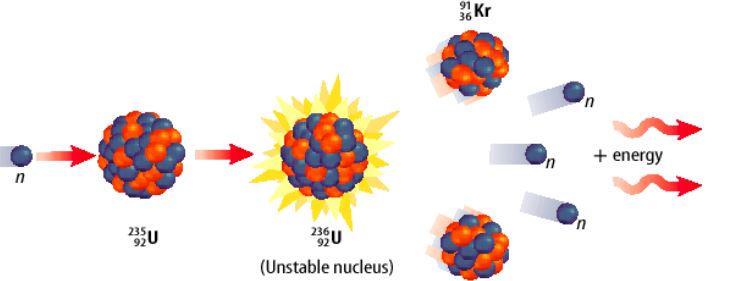
Is radioactive decay 'spontaneous' ?
yes
no
sometimes
Is radioactive decay 'random' ?
yes
no
sometimes
Which best describes what happens during radioactive decay?
the emission of radioactivity
the build up of radioactivity
the splitting of radioactivity
the expansion of radioactivity
During radioactive decay, the element can change?
true
false
During radioactive decay ....?
another element might be made
another element is always made
another element is never made


In the early twentieth century the apparatus shown in the diagram was used to investigate atomic structure. When He2+ particles were fired at a thin sheet of gold, most of the particles were detected at point P. What conclusion can be drawn from the detection of He2+ particles at point P?
Gold atoms contain electrons.
Gold atoms contain protons.
Gold atoms contain neutrons.
Gold atoms are mainly empty space.

When He2+ particles were fired at a thin sheet of gold, about 1 in 8000 of the particles were detected at point Q. What conclusion can be drawn from the detection of He2+ particles at point Q?
Gold atoms have a small, positive nucleus.
Gold atoms have electrons in orbitals.
Gold consists of ions in a sea of delocalised electrons.
Gold atoms have more protons than He2+ particles.
Which of these correctly shows the numbers of sub-atomic particles in a 41K+ ion?
Number of electrons: 19, Number of protons: 19, Number of neutrons: 20
Number of electrons: 18, Number of protons: 20, Number of neutrons: 21
Number of electrons: 18, Number of protons: 19, Number of neutrons: 22
Number of electrons: 19, Number of protons: 18, Number of neutrons: 23
Which of these correctly shows the numbers of sub-atomic particles in a 21Na+ ion?
Number of electrons: 11, Number of protons: 11, Number of neutrons: 10
Number of electrons: 10, Number of protons: 12, Number of neutrons: 9
Number of electrons: 10, Number of protons: 11, Number of neutrons: 10
Number of electrons: 11, Number of protons: 10, Number of neutrons: 11
Which of these correctly shows the numbers of sub-atomic particles in a 42Ca2+ ion?
Number of electrons: 20, Number of protons: 20, Number of neutrons: 22
Number of electrons: 18, Number of protons: 21, Number of neutrons: 21
Number of electrons: 18, Number of protons: 20, Number of neutrons: 22
Number of electrons: 20, Number of protons: 19, Number of neutrons: 23

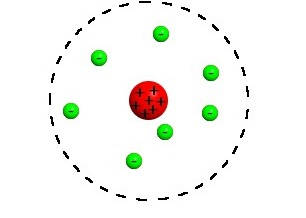
Which model of the atom is denoted as the "plum pudding" model?
A
B
C
D
E



An atom in which the number of protons is greater than the number of neutrons is:
234U
6Li
3He
2H
Which of these atoms has the smallest number of neutrons?
3H
4He
5He
4Li

Americium-241 (24195Am) is an isotope of americium. Which of the isotopes given in the table below is not an isotope of americium?
A
B
C

The graph shows how the number of americium-241 nuclei in a sample changes with time. How many years does it take for the number of americium-241 nuclei to decrease from 10,000 to 5,000?
430 years
500 years
400 years
800 years
A householder is worried about the radiation emitted by the granite worktop in his kitchen. 1 kg of granite has an activity of 1250 Bq. The kitchen worktop has a mass of 180 kg. Calculate the activity of the kitchen worktop in Bq.
225,000 Bq
6.94 Bq
0.144 Bq
25,000 Bq
A teacher used a Geiger-Muller tube and counter to measure the number of counts in 2 minutes for a radioactive rock. The counter recorded 980 counts in two minutes. The background radiation count rate was 0.25 counts per second. Calculate the count rate for the rock.
7.92 per second
8.16 per second
490 per second
489.75 per second

In an experiment, a teacher put a 2 mm thick lead sheet in front of a radioactive source. She used a detector and counter to measure the radiation passing through the lead sheet in one minute. She then put different numbers of lead sheets, each 2 mm thick, in front of the radioactive source and measured the radiation passing through in one minute. The readings taken by the teacher are plotted in the graph. How does the amount of radiation transmitted by the lead change as the total thickness of the lead is increased?
it increases
it decreases
it stays constant
An atom that loses an electron is called an _____________________and has an overall _________________________ charge.
ion ; positive
ion ; negative
isotope ; positive
ion ; neutral
Carbon-14 and carbon-12 are two of the isotopes of carbon. The nucleus of a carbon-12 atom has the same number of ________________ as the nucleus of a carbon-14 atom.
protons
neutrons
electrons
State the number of neutrons in an atom of iodine-135 (13553I)
78
82
131
53
The graph shows how the number of americium-241 nuclei in a sample changes with time. What is the half-life of americium-241?
430 years
500 years
400 years
800 years
The half-life of As-81 is 33s. How long does it take for a 100g sample of As-81 to decay to 6.25g?
33 seconds
66 seconds
2.2 minutes
5.5 minutes
How old is a bone if it presently contains 0.3125g of carbon-14 and it was estimated to originally contain 80g? The half-life of carbon-14 is 5730 years.
5730 years old
11460 years old
45840 years old
22920 years old
Sodium-25 was to be used in an experiment, but it took 3 minutes to get the sodium from the reactor to the laboratory. If 5 mg of sodium-25 was removed from the reactor, how many mg of sodium-25 would be available to use in the laboratory? The half-life of Na-25 is 60 seconds.
5 mg
0.625 mg
2.5 mg
1.25 mg

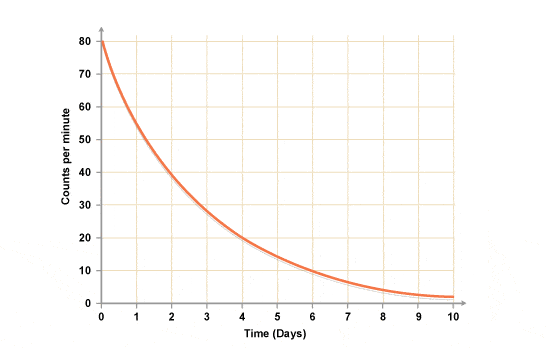
Use the graph to determine the half-life of the radioactive sample. The x-axis label is time in seconds
1 minute
20 seconds
40 seconds
80 seconds
State the likely count rate after 180 seconds
20 counts per minute
10 counts per minute
5 counts per minute
2 counts per minute

The graph shows how the count rate from a sample of technetium-99 changes with time. State the half-life of technetium-99.
6 hours
4 hours
12 hours
18 hours
The graph shows how the count rate from a sample of technetium-99 changes with time. What would the count rate be after 24 hours?
9.38 counts per minute
75 counts per minute
37.5 counts per minute
18.75 counts per minute

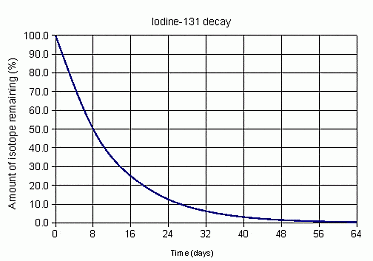
The graph shows how the count rate of a sample of iodine-131 changed over 24 days. What is the half-life of iodine-131?
8 days
4 days
16 days
24 days
U‐238 has a half‐life of 4.46 billion years. How much U‐238 was present initially if 2 grams remains after 13.38 billion years?
0.5 g
1 g
8 g
4 g
What two things are nuclear radiation used for in hospitals? (Select both)
Exploration of internal organs
Control or destruction of unwanted tissue
Type of radiation
Half-life of source
What factors need to be considered when assessing the risk of using radiation?
Exploration of internal organs
Control or destruction of unwanted tissue
Type of radiation
Half-life of source
What does ionising radiation do when it hits living tissue ?
causes mutations
shrinks cells
enlarges cells
freezes cells
dissolves cells

