wayground logo

Free Printable Worksheets

Font size

S
M
L
XL
Worksheets

Protein Synthesis

Total questions: 76

Worksheet time: 25mins

Name
Class
Date
1.

Which of the following are differences in the structure between RNA and DNA

a)

DNA uses deoxyribose sugar, RNA uses sugar ribose

b)

DNA pairs Adenine with Uracil, RNA pairs Adenine with Thymine

c)

DNA is a double helix, RNA is a single helix

d)

DNA pairs Adenine with Thymine, RNA pairs Adenine with Uracil

2.

Which organelle is the location where protein is made?

a)

Ribosome

b)

Nucleus

c)

Cytoplasm

d)

Nucleotide

3.

Insertion, deletion, and substitution are all examples of a change in a genetic sequence which is also referred to as (a)

a)

Gene

b)

Amino Acid

c)

Ribose

d)

Mutation

4.

During transcription, this type of ribonucleic acid is responsible for copying the DNA and brining it out of the nucleus.

a)

tRNA

b)

mRNA

c)

rRNA

d)

dRNA

5.

When these bond together, they form a protein

a)

Amino Acids

b)

Peptide Bonds

c)

Ribose

d)

Nucleotides

6.

These building blocks consist of a sugar, phosphate, and nitrogen base.

a)

Ribose

b)

Nucleotide

c)

Gene

d)

Protein

7.

A string of nucleotides that contain the information to make a specific protein

a)

Ribose

b)

Amino Acids

c)

tRNA

d)

Gene

8.

During translation, this type of ribonucleic acid is responsible for delivering amino acids to help make a protein.

a)

mRNA

b)

rRNA

c)

tRNA

d)

dRNA

9.

There are a total of ____ different amino acids

a)

20

b)

1

c)

4

d)

unlimited

10.

mRNA occurs during this process

a)

Translation

b)

Transcription

c)

Replication

d)

Delivery

11.

How many amino acids are found on one tRNA?

a)

20

b)

4

c)

1

d)

3

12.

Which of the following is the complementary mRNA sequence to this DNA strand: AACTGAA

a)

UUGACUU

b)

TTGACTT

c)

AACTGAA

d)

AACUGAA

13.
The function of _____ is to transport amino acids in the cytoplasm to the ribosome.
a)
rRNA
b)
tRNA
c)
mRNA
d)
DNA
14.
The process of going from DNA to mRNA is called
a)
Transcription
b)
Translation
c)
Transportation
d)
Transient
15.
This is the triplet of bases on the end of a tRNA molecule
a)
Anticodon
b)
Codon
c)
Protein
16.
The process where DNA is transcribed to mRNA happens in what part of the cell?
a)
Nucleus
b)
Mitochondria
c)
Cytoplasm
d)
Endoplasmic Reticulum
17.
The function of ______ is to combine with proteins to form ribosomes.
a)
rRNA
b)
tRNA
c)
mRNA
d)
DNA
18.
The process where mRNA is read and made into an amino acid chain.
a)
Transcription
b)
Translation
c)
Transportation
d)
Transient
19.
How many amino acids are coded for by this sequence of nucleotides:
ATG GGA ACT CCA
a)
4
b)
2
c)
6
d)
12
20.
In proteins, the amino acid order is determined by 
a)
nitrogenous bases in RNA
b)
random placement
c)
nitrogenous bases in DNA
d)
there is no order
21.
What is the three base sequence of mRNA that codes for a single amino acid?
a)
Anticodon
b)
Codon
c)
Protein
22.
This molecule carries genetic information from the nucleus to the ribosomes in the cytoplasm.
a)
rRNA
b)
tRNA
c)
mRNA
d)
DNA
23.
The process where mRNA is translated into amino acids happens in what part of the cell?
a)
Nucleus
b)
Mitochondria
c)
Cytoplasm
d)
Endoplasmic Reticulum
24.
Which of these nitrogenous bases is NOT in RNA?
a)
Uracil
b)
Thymine
c)
Cytosine
d)
Guanine
25.
In RNA, Uracil pairs with ______. 
a)
cytosine
b)
adenine
c)
guanine
d)
thymine
26.
The process to go from mRNA to a protein is called ____
a)
transcription
b)
rRNA
c)
replication
d)
translation
27.
The process to go from DNA to mRNA is _______
a)
translation
b)
transcription
c)
replication
28.
DNA holds the code for
a)
lipids
b)
carbohydrates
c)
protein
d)
sugar
29.
The main function of tRNA is to...
a)
carry a message that, when translated, forms proteins
b)
form a portion of ribosomes
c)
string together complementary RNA and DNA strands
d)
bring amino acids from the cytoplasm to the ribosomes
30.
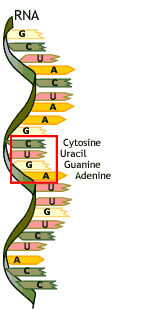
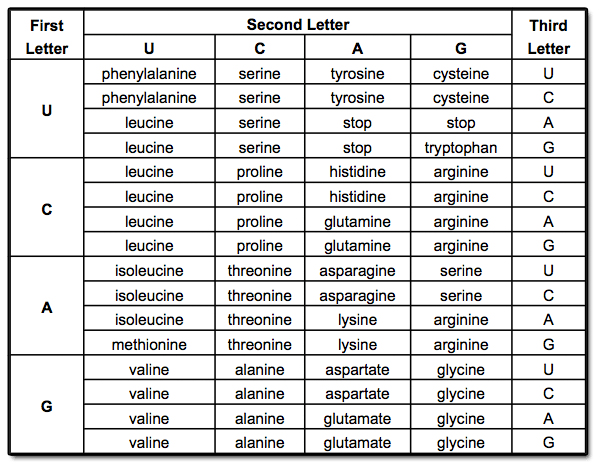
What amino acid is represented by the codon UUA?
a)
Phenylalanine
b)
Tyrosine
c)
Leucine
d)
Stop codon
31.
What process is going on in this photo? 
a)
Transcription 
b)
Translation 
c)
Replication 
d)
All the above 
32.
Which component of DNA determines the traits of an organism? 
a)
Nitrogen Bases
b)
Sugar-Phosphate Backbone
c)
Hydrogen bonds
33.

What is the location in the cell for translation?

a)

nucleus

b)

mitochondria in cytoplasm

c)

ribosome in cytoplasm

d)

chloroplast in cytoplasm

34.
What is the location in the cell for transcription?
a)
nucleus
b)
cytoplasm
c)
ribosome
d)
mitochondria
35.
Translation is the process where
a)
mRNA is created in the Nucleus
b)
mRNA is decoded to form a protein 
c)
glucose molecules are made
d)
is where lipids are synthesised
36.
Does the order of amino acids in a protein matter?
a)
YES!
b)
NO!
37.

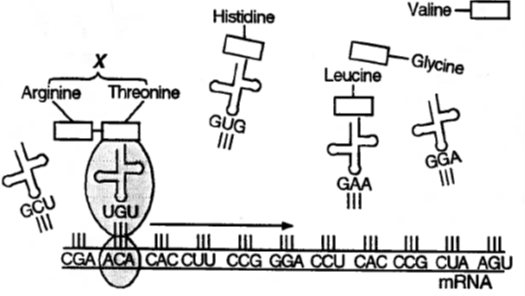
What process is happening in the diagram?

a)

transcription

b)

translation

c)

dna replication

d)

mitosis

38.

In what process is mRNA synthesized?

a)

Transcription

b)

Translation

c)

DNA Replication

d)

Mitosis

39.

Where does TRANSCRIPTION occur?

a)

Nucleus

b)

Ribosome

c)

Cytoplasm

d)

Mitochondria

40.

Why must transcription occur where DNA can be found?

a)

because DNA can't leave

b)

because ribosomes are in the nucleus

c)

because DNA polymerase is found there

d)

because helicase unzips the DNA

41.

Which of the following is a codon?

a)
b)

ATG

c)

AUG

d)

AUT

42.

How many codons equals 1 amino acid?

a)

1

b)

2

c)

3

d)

4

43.

How many nucleotides equal 1 amino acid?

a)

1

b)

2

c)

3

d)

4

44.

On which molecule can an anticodon be found?

a)

mRNA

b)

DNA

c)

tRNA

d)

rRNA

45.

Where is the anticodon located?

a)

at the top of the molecule it's found on

b)

at the bottom of the molecule it's found on

c)

on the right of the molecule it's found on

d)

on the left of the molecule it's found on

46.

What is the purpose for anti-codons?

a)

to ensure the correct amino acid is dropped off

b)

to match the strand of DNA

c)

to decode a sequence of 4 nucleotides into an amino acid

d)

to make me hate biology

47.

A polypeptide is a sequence of ____________________ held together by a ______________ bond.

a)

amino acids; peptide

b)

fatty acids; ionic

c)

proteins; hydrogen

d)

fatty acids; covalent

48.

Which two thing are found on a molecule of tRNA?

a)

amino acids; anticodons

b)

amino acids; codons

c)

ribose sugar; proteins

d)

deoxyribose sugar; codons

49.

How do you know when to begin translating a strand of mRNA?

a)

look for AUG

b)

start at the beginning

c)

look for ATG

d)

when Ms. H tells me to

50.

How do you know when to STOP translating a strand of mRNA?

a)

look for STOP on the decoder

b)

stop at the end of the strand

c)

you don't

d)

when Ms. H tells me to

51.

TRANSCRIBE this DNA sequence: TACGTTACT

a)

AUGCAAUGA

b)

ATGCAATGA

c)

AUGGATUGA

d)

TACGTTACT

52.

TRANSLATE this RNA sequence: AUGCAAUGA

a)

Met-Glu-Stop

b)

Met-His-Stop

c)

Thr-Glu-Stop

d)

Thr-Pro-Stop

53.

A DNA nucleotide may be made up of a phosphate group, along with

a)

deoxyribose sugar and uracil

b)

ribose sugar and cytosine

c)

deoxyribose sugar and thymine

d)

ribose sugar and adenine

54.

Which of the following units are repeatedly joined together to form a strand of DNA? (This is the MONOMER of DNA.)

a)

amino acids

b)

nucleotides

c)

fatty acids

d)

polysaccharides

55.

The important enzyme related with transcription is;

a)

gyrase

b)

DNA polymerase

c)

RNA polymerase

d)

ligase

56.
Which of the following is the template for the production of RNA within a cell?
a)
DNA
b)
protein
c)
ATO
d)
carbohydrate
57.
which process is shown?
a)
diffusion
b)
repiration
c)
recombination
d)
translation
58.
When an extra base is inserted into the DNA sequence of a gene, the protein doesn't work. Which explains why?
a)
the base increases rate of translation
b)
the base causes DNA to be transcribed in opposite direction
c)
the inserted base causes the codons in the sequence to be incorrect for the desired protein
d)
the base signals enzymes to translate DNA rather than RNA
59.
What molecules do both DNA and RNA contain?
a)
uracil
b)
nucleotides
c)
thymine
d)
deoxyribose
60.
Which of the following best describes how DNA and RNA are similar?
a)
they both contain A and T
b)
They both have a double helix
c)
They are both composed of 5 different nucleotides
d)
they both have C and G
61.
One human disease is caused by a change in one codon in a gene from GAA to GUA. The disease is a result of 
a)
a mutation
b)
crossing-over
c)
a meiosis error
d)
polyploidy
62.
What is the relationship between a protein, the cell, and DNA?
a)
DNA is produced by protein which is produced in the cell
b)
Protein is composed of DNA which is produced in the cell
c)
DNA controls the production of protein in the cell
d)
A cell is composed of DNA and protein
63.
Genetic info flows in one direction. Which best represents this flow?
a)
DNA-protein-RNA
b)
Protein-RNA-DNA
c)
RNA-protein-DNA
d)
DNA-RNA-protein
64.
Which process?
a)
mutation
b)
transcription
c)
respiration
d)
translation
65.
An RNA polymer is composed of subunits known as
a)
polysaccharides
b)
ribose molecules
c)
nucleotides
d)
uracil molecules
66.
RNA is read in sections called:
a)
Triplets
b)
Genes
c)
Codons
d)
Genes
67.
Transcription is a process that in eukaryotic cells takes place in the:
a)
Nucleus
b)
Cytoplasm
c)
Golgi Apparatus
d)
Rough E.R.
68.
RNA polymerase creates RNA in the _________ direction
a)
5' to 3'
b)
3' to 5'
69.
Translation is a process in eurkaryotic cells takes place in the:
a)
Cytoplasm
b)
Nucleus
c)
Nucleolus
d)
Golgi Bodies
70.
When the Ribosome reaches ________________ the process of translation stops
a)
Stop Codon
b)
Okazaki Fragment
c)
Terminator
d)
taq Polymerase
71.
Translation is a process that produces
a)
mRNA
b)
Protein
c)
Polypeptide Chains
d)
tRNA
72.
RNA contains which bases?
a)
adenine, guanine, uracil, cytosine
b)
thymine, guanine, cytosine, uracil
c)
thymine, uracil, cytosine, guanines
d)
adenine, uracil, guanine, thymine
73.

Exons are the part of the mRNA that are removed from the final copy.

a)

True

b)

False

74.

Exons are the part of the mRNA that are spliced back together for the final copy.

a)

True

b)

False

75.

Introns are the part of the mRNA that are spliced back together for the final copy.

a)

True

b)

False

76.

Introns are the part of the mRNA that are removed from the final copy.

a)

True

b)

False