wayground logo

Free Printable Worksheets

NEW

Font size

S
M
L
XL
Worksheets

AKS 9 Intro

Total questions: 50

Worksheet time: 53mins

Name
Class
Date
1.
What does biodiversity mean?
a)
Only one species in an area.
b)
The different amount of species in an area
c)
All abiotic life
d)
Nitrogen fixation
2.
Structures or behaviors that help an
organism survive in its surroundings
a)
adaptations
b)
inherited traits
c)
learned behaviors
d)
structural behaviors
3.
New organisms that come from parent
organisms
a)
adaptations
b)
offspring
c)
behaviors
d)
function
4.
Characteristics of an organism
a)
adaptations
b)
traits
c)
functions
d)
instincts
5.
Characteristics that are passed from
parents to their offspring
a)
broken leg
b)
structures
c)
behaviors
d)
inherited traits
6.

Which of the following is a true statement about the members of a species?

a)

they must live in the same geographic area

b)

they must be able to breed with one another

c)

they must be able to move under their own power

d)

they must be extinct at the present time

7.

What do we call a group of individuals that can reproduce successfully in nature?

a)

species

b)

order

c)

speciation

d)

mom and dad

8.
What is the term for a feature that allows an organism to survive in its environment?
a)
adaptation
b)
variation
c)
homologous structure
d)
vestigial structure
9.
Individuals that are well adapted to their environment will survive and produce
a)
better traits
b)
stronger genes
c)
more offspring
d)
fewer mutations
10.
All the individuals of a species that live in a particular area are called a 
a)
group
b)
population
c)
variation
d)
fossil
11.
A biological ____________ is a group of interbreeding populations that is reproductively isolated from other groups.
a)
species
b)
family
c)
phylogeny
d)
hybrid
12.
______________ is the process by which populations change in response to their environment.
a)
natural selection
b)
adaptation
c)
reproductive isolation
d)
divergence
13.
__________ enable an organism to survive in its environment.
a)
adaptations
b)
natural selections
c)
divergence
d)
extinctions
14.
Which terms best describe heterotrophs?
a)
Plants; producers
b)
Animals; producers
c)
Plants; consumers
d)
Animals; consumers
15.
What is another name to describe a heterotroph?
a)
Consumer
b)
Producer
16.
How can animals and fungi best be classified?
a)
Autotroph
b)
Heterotroph
17.

BUNNY

a)

AUTOTROPH

b)

HETEROTROPH

c)

AUTOPHOTOTROPH

d)

NONE OF THE ABOVE

18.
Organisms that cannot make their own food and must obtain energy from external sources are called
a)
autotrophs
b)
heterotrophs
c)
thylakoids
d)
plants
19.
Structures that are inherited from a common ancestor are homologous.
a)
True
b)
False
20.
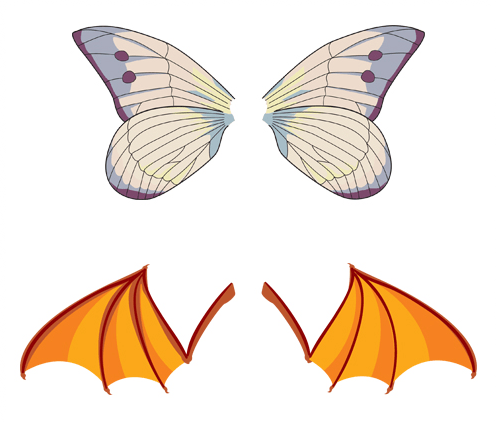
Bird wings and butterfly wings are an example of
a)
Homologous structure
b)
Analogous structure
c)
Mimicry
d)
Camoflague
21.
Analogous structures show common ancestry.
a)
True
b)
False
22.
Shark fins and dolphin fins are examples of analogous structures.
a)
True
b)
False
23.
Individuals with favorable traits survive, reproduce, and pass their traits onto their offspring. This is called
a)
Mutation
b)
Adaptation
c)
Evolution
d)
Natural Selection
24.
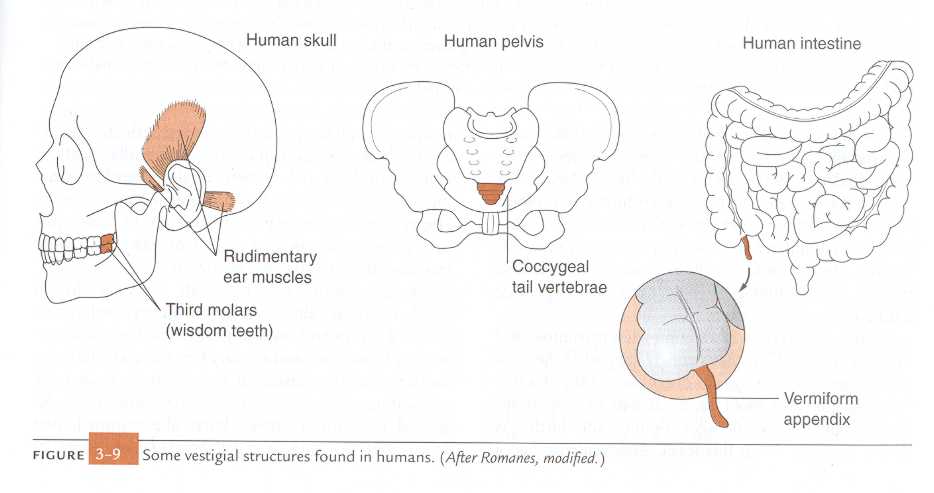
If an organism has a vestigial structure, that structure likely once had a function in a(n)
a)
close relative
b)
early ancestor
c)
unrelated organism
d)
embryological stage
25.
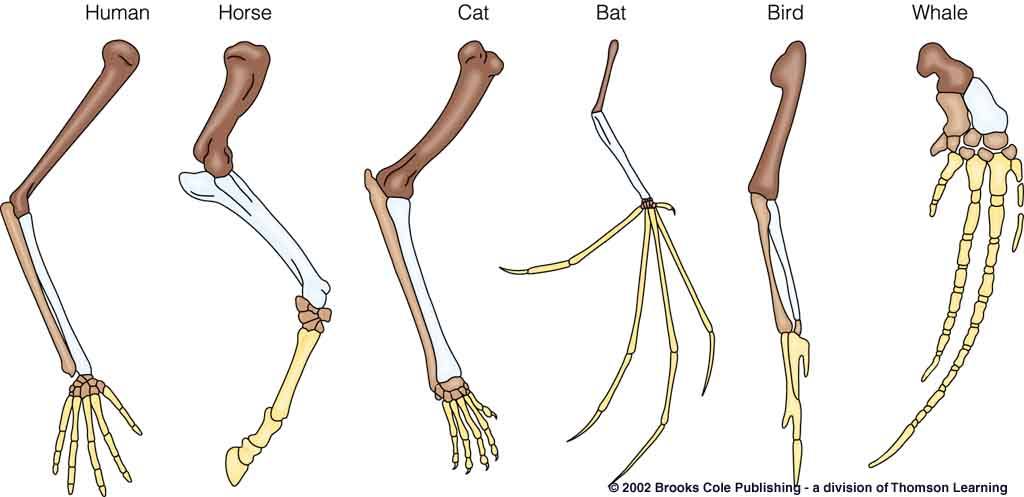
Some organisms that share a common ancestor have features that have different functions, but similar structures.  These are known as
a)
vestigial structures
b)
analogous structures
c)
homologous structures
d)
fossil structures
26.
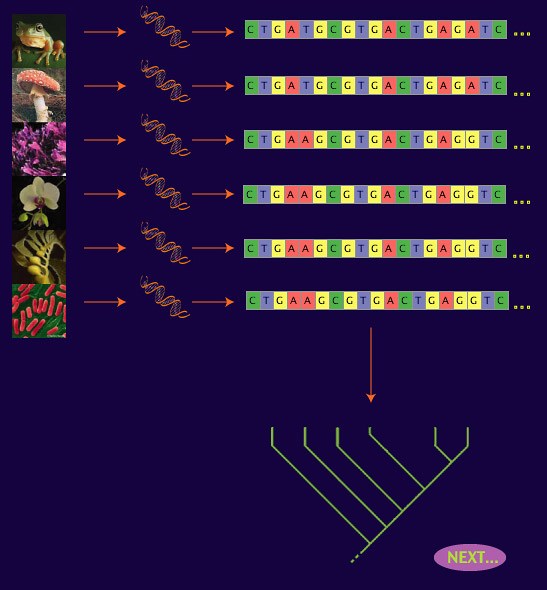
Two organisms that are closely related would have
a)
very similar DNA sequence
b)
exactly the same DNA sequences
c)
no proteins in common
d)
completely different DNA sequence
27.
Mutations are important because they bring about
a)
death of the organism in which they develop
b)
genetic variation needed for a population to evolve
c)
benefits for the individual, not for the population
d)
Hardey-Weinberg equilibrium within a population
28.
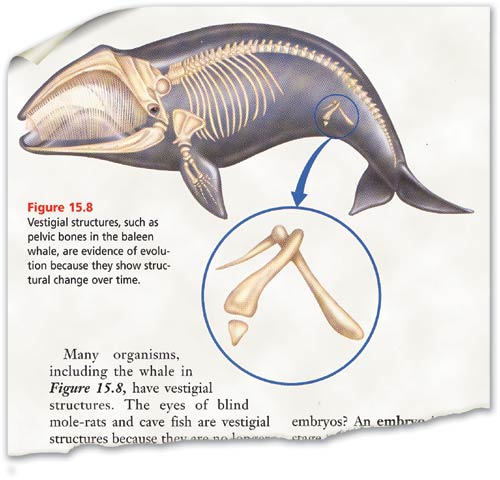
The hind leg bones in a whale are examples of
a)
homologous structures
b)
analogous structures
c)
fossils
d)
vestigal structures
29.
How would you describe this evolution?
a)
Homologous structure
b)
Analogous structure
c)
Structural adaption
d)
Functional adaption
30.
The structures shown are_________
a)
homologous
b)
heterologous
c)
analogous
d)
vestigial
31.
What is a species?
a)
A group of organisms that can mate with each other and produce fertile offspring. 
b)
A group of organisms that genetically are very different from each other. 
c)
A group of organisms that can mate and produce offspring even if those offspring are infertile.
d)
Indivual organisms that live in the same environment. 
32.

An inheritable trait that gives a survival advantage to the organism

a)

speciation

b)

adaption

c)

rapid speciation

d)

derived character

33.
Which statement best describes the process of evolution?
a)
Populations can survive in different locations on earth
b)
Environmental conditions limit the number of species on Earth
c)
Populations grow when resources are abundant
d)
The traits of a species can change over time
34.
Which of the following ideas is supported by Darwin’s observation of local variation among tortoises in the Galápagos Islands? 
a)
artificial selection
b)
adaptation
c)
acquired characteristics
d)
tendency towards perfection
35.
Charles Darwin’s observation that finches of different species on the Galápagos Islands have many similar physical characteristics supports the hypothesis that these finches 
 
a)
have the ability to interbreed.
b)
acquired traits through use and disuse.
c)
all eat the same type of food.
d)
descended from a common ancestor.
36.
Lamarck’s ideas about evolution include the concept that differences among the traits of organisms arise as a result of
a)
continual increases in population size.
b)
the actions of organisms as they use or fail to use body structures.
c)
an unchanging local environment.
d)
the natural variations already present within the population of organisms.
37.
According to Darwin’s theory of natural selection, individuals who survive are the ones best adapted for their environment. Their survival is due to the 
a)
possession of adaptations developed through use.
b)
 possession of inherited adaptations that maximize fitness.
c)
lack of competition within the species.
d)
choices made by plant and animal breeders.
38.
Which statement is part of Darwin’s theory of evolution by natural selection? 
a)
More offspring are produced than can possibly survive.
b)
The organisms that are the fittest are always largest and strongest. 
c)
The number of offspring is not related to fitness.
d)
Acquired characteristics that are inherited are the cause of evolution.
39.
Charles Darwin called the ability of an organism to survive and reproduce in its specific environment 
a)
diversity.
b)
evolution
c)
adaptation. 
d)
 fitness.
40.
Organisms with the most beneficial traits will survive.  This is commonly known as
a)
theory of evolution.
b)
variations.
c)
survival of the fittest.
d)
ecosystems.
41.
This scientist developed the theory of evolution as he studied the finches.
a)
Charles Darwin
b)
Isaac Newton
c)
Albert Einstein
d)
Marie Curie
42.
Do organisms "decide" to evolve and change?
a)
Yes, they know they need to change to survive 
b)
No, they change because of natural selection
43.
Genetic drift is change in the allele frequency of a population due to...
a)
random chance
b)
natural selection
c)
non-random mating (sexual selection)
d)
artificial selection
44.
Some organisms that share a common ancestor have features that have different functions, but similar structures.  These are known as
a)
vestigial structures
b)
analogous structures
c)
homologous structures
d)
fossil structures
45.
Mutations are important because they bring about
a)
death of the organism in which they develop
b)
genetic variation needed for a population to evolve
c)
benefits for the individual, not for the population
d)
Hardey-Weinberg equilibrium within a population
46.
The term for the formation of new and distinct species over the course of evolution is...
a)
speciation
b)
biological species concept
c)
reproductive barrier
d)
natural selection
47.
In natural selection, the selective agent is the
a)
humans
b)
mutations
c)
breeders
d)
environment
48.
When every organism of a species has died.
a)
Evolution
b)
Natural Selection
c)
Extinction
d)
Artificial Selection
49.

Evolutionary change on a small scale

a)

macroevolution

b)

microevolution

c)

coevolution

d)

parallel evolution

50.

Evolutionary change on a large scale; Principle of common descent

a)

macroevolution

b)

microevolution

c)

coevolution

d)

parallel evolution