wayground logo

Free Printable Worksheets

Font size

S
M
L
XL
Worksheets

Unit 1 Scientific Method and Skills Review

Total questions: 55

Worksheet time: 1hrs 12mins

Name
Class
Date
1.

A scientist is conducting research on mealworms. Which of the following pieces of equipment should be used by the scientist to determine the mass of each mealworm?

a)

triple beam balance

b)

ruler

c)

graduated cylinder

d)

beaker

2.
What is NOT an example of qualitative data?
a)
the average high daily temperature for the month of july
b)
the names of chemicals found in breakfast cereal
c)
the zip codes in which each high school student resides
d)
types of shoes worn by pedestrians on a city street 
3.
A hypothesis is-
a)
a possible explanation of an observation that can be tested
b)
a proven statement
c)
a conclusive statement
d)
a definite answer to a possible problem
4.
How does the control group differ from an experimental group in a scientific experiment?
a)
the control group does not contain the experimental data, whereas the experimental group does
b)
the control group does not contain the experimental variable, whereas the experimental group does not
c)
the control group is not tested or measured
d)
the control group contains more than one experimental variable
5.
The variable that is measured in the experiment is-
a)
the dependent variable
b)
the independent variable
c)
the control variable
d)
the hypothetical variable
6.
The main reason that diagrams, tables and graphs of data are used by scientists is to-
a)
organize data
b)
verify the conclusion
c)
test a hypothesis
d)
create an experiment
7.
Which of the following must be done for the results of an experiment to be considered valid?
a)
the experiment must be repeated numerous times and the same results are obtained
b)
the results must be published in a national journal
c)
the results must be shown in a graph
d)
the results must be only quantitative
8.
When heating a solution in a test tube, a student should-
a)
wear safety goggles
b)
look in the opening of the test tube
c)
hold the test tube at its opening with at least two fingers
d)
keep the test tube closed with a rubber stopper
9.
Wyatt should follow all of the safety procedures when heating a test tube EXCEPT-
a)
point the opening directly at their lab partner
b)
heat it along its length in order to distribute the heat evenly
c)
point the opening away from themselves and others
d)
use a test tube holder so they do not burn their fingers
10.

What would NOT be considered a source of valid scientific information?

a)

wikipedia or snapchat

b)

scientific journal

c)

science textbook

d)

a technical report

11.
A hypothesis is a statement that-
a)
can be tested
b)
is almost always true
c)
is almost always false
d)
is the same as a theory
12.

What scientific instrument is used to measure liquid volume?

a)

Graduated cylinder

b)

Meter stick

c)

Triple beam balance

d)

Tricorder

13.

In a science experiment, ______________ is when you gather background information about the problem you're trying to solve.

a)

Research

b)

Drawing conclusions

c)

Stating a hypothesis

d)

Analyzing data

14.

What is the metric unit for measuring mass?

a)

Grams

b)

Meters

c)

Liters

d)

Pounds

15.

What is the metric unit for measuring volume?

a)

Liters

b)

Meters

c)

Grams

d)

Gallons

16.
This is the last step in the scientific method
a)
Draw a conclusion
b)
Record your data as results
c)
Share what you have learned with others
d)
Collaborate with others
17.

What is an observation?

a)

A scientific statement based on ideas

b)

Using your senses to notice what is going on around you

c)

To be unaware of your surroundings

d)

The question that you want an answer to.

18.
A series of steps used by scientists to solve a problem or answer a question. 
a)
scientific method
b)
recipe
c)
data collection
d)
metric system
19.
Which is NOT a step in the scientific method?
a)
Make observation
b)
Form a theory
c)
Collect data
d)
Form a hypothesis
20.
A hypothesis is simply a prediction that has not yet been _.
a)
proven or disproven
b)
made into a theory
c)
results calculated
d)
written about
21.
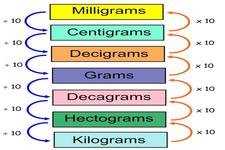
what is the correct units for decagrams?
a)
dg
b)
cg
c)
mg
d)
dag
22.
What is the base unit for temperature in in the metric system?
a)
meters
b)
degrees Celsius
c)
degrees Fahrenheit
d)
centimeters
23.

The SI unit for time is the __________.

a)

meter

b)

kilogram

c)

liter

d)

second

e)

Newton

24.

Convert 8,562 cm to km.

a)

0.08562 km

b)

8,562,000 km

c)

8.562 km

d)

85,620 km

25.
What is this tool called?
a)
Beaker
b)
Flask
c)
Graduated Cylinder
d)
Measuring Cup
26.
Compare:
15,000 g ____ 15 kg
a)
<
b)
>
c)
=
27.

Keaton has 10 meters 32 centimeters of fishing line. If he release 3 meters 89 centimeters of fishing line. How much is left on his reel?

a)

543 cm

b)

743 cm

c)

643 cm

d)

683 cm

e)

765 cm

28.

If you do not understand a direction or part of a lab procedure, you should

a)

figure it out on your own as you go

b)

ask your teacher

c)

guess

d)

write a pros and cons list

29.
You are heating a piece of glass and now want to pick it up. You should 
a)
pour cold water on it
b)
use tongs
c)
pick up the end that looks cooler
d)
use a rag or paper towels
30.
Long hair in the laboratory must be 
a)
A. cut short. 
b)
B. held away from the experiment with one hand.
c)
 C. always neatly groomed.
d)
D. tied back or kept entirely out of the way with a hair band, hairpins, or other confining device.
31.
a)

evaporation

b)

watch glass

c)

mortar and pestle

d)

funnel

32.
a)

wire gauze

b)

Bunsen burner

c)

thermometer

d)

utility clamp

33.
a)

beaker

b)

graduated cylinder

c)

Erlenmeyer flask

d)

test tube

34.
There are 16 red marbles in the bag.
a)
Qualitative
b)
Quantitative
c)
Both
d)
Neither
35.
What words would be most appropriate to see if a student was describing the QUALITATIVE properties of a metal? 
a)
 melts at 1,500 degrees F
b)
density of 1.75 pounds per cubic inch
c)
reflective shine
d)
15.3% copper
36.
What words would be most appropriate to see if a student was describing the QUANTITATIVE properties of an organism? 
a)
grey skin
b)
big ears
c)
2 1/2 tons
d)
mammal
37.
What words would be most appropriate to see if a student was describing the QUALITATIVE properties of an organism? 
a)
rough skin
b)
fourteen pounds
c)
twice as many teeth
d)
16 inches long
38.
Which of these statements is NOT an observation about this picture?
a)
There is a red candle on the window sill.
b)
The moon is full.
c)
It is Christmas time.
d)
There's snow on the tree.
39.
Which of the following is NOT an inference about the man in this picture:
a)
The man hates his purple shirt.
b)
The man has a purple shirt.
c)
The man is having a bad day.
d)
This man is upset because he's hungry
40.

Scenario: You are shopping at Rouse's. You hear glass breaking, a person cursing, and the sharp smell of pickle juice coming from the next aisle.

Which of these is/are observations?

a)

You hear glass breaking

b)

You hear a person cursing

c)

You smell pickle juice

d)

All of these are observations

41.

Scenario: You are shopping at Rouse's. You hear glass breaking, a person cursing, and the sharp smell of pickle juice coming from the next aisle.

Based on the scenario, what do you infer (inference)?

a)

The pickle jar was slippery.

b)

Someone dropped a jar of pickles.

c)

All of these are inferences.

d)

That person is having a bad day.

42.
We measure temperature in degrees...
a)
Fahrenheit
b)
Celsius
c)
Both
d)
Nothing
43.
Convert: -194 C to F:
a)
-317.2 F
b)
338.5 K
c)
- 273 C
d)
0 K
44.
Convert: 0 K to C
a)
-273 C
b)
-273 K
c)
273 C
d)
273 K
45.
Convert: 253 C to K:
a)
526 K
b)
625 K
c)
0 K
d)
186 K
46.

What is the boiling point of water on the Kelvin scale?

a)

100 K

b)

212 K

c)

273.15 K

d)

373.15 K

47.

Jason ran 325 meters farther than Kim ran. Kim ran 4.2 kilometers. How many meters did Jason run?

a)

4,200 m

b)

4,525 m

c)

3,875 m

d)

3,250 m

48.

Parents are making 2 batches of punch for the school's Spring Fair. The recipe calls for only one batch calls for 1 liter of orange juice, 550 milliliters of lemon juice, 2.6 liters of soda water, and two 750 milliliters bottles of apple cider. How many LITERS of punch will she make?

a)

11.3 L

b)

5.65 L

c)

4.9 L

d)

9.8 L

49.

Your family wants to frame your drawing from the art show. The rectanguar drawing has a length of 43.5 centimeters and width of 934 millimeters. How many centimeters of wood framing you will need.

a)

488.75 cm

b)

105.68 cm

c)

977.5 cm

d)

273.8 cm

50.
Which unit is the largest? 
a)
b)
km
c)
cm
d)
dm
51.
Which of these contains steps in the right order?
a)
Ask a question, state your hypothesis, research, experiment, analyze, make a conclusion
b)
State your hypothesis, ask a question, research, experiment, analyze, make a conclusion
c)
Ask a question, research, state your hypothesis, experiment, analyze, make a conclusion
d)
State your hypothesis, ask a question, research, make a conclusion, experiment, analyze
52.

Mr. Wiltshire grew bacteria from the mouth on special plates in the laboratory. He placed drops of different mouthwashes on bacteria on each plate. Which is the independent variable?

a)

the bacteria

b)

the mouthwash

c)

the special plates

d)

the air in the room

53.

This part of the experiment serves as a basis of comparison, it does not get the experiment and it is the one variable being tested has been omitted.

a)

experimental group

b)

control group

c)

data

d)

variables

54.
A student wants to test the effects of type of exercise on heart rate.  What is the dependent variable?
a)
heart rate
b)
type of exercise
c)
amount of exercise
d)
time of day exercise occurs
55.
An experiment is performed on plants to see how different liquids affect plant growth. Each plant in the experiment is given a different liquid; water, apple juice, or milk. Each plant has the same amount of soil, sunlight, and listens to the same music. In this investigation, the independent variable is ...
a)
The type of plant
b)
The amount of sunlight
c)
The type of music
d)
The type of liquid