wayground logo

Free Printable Worksheets

Font size

S
M
L
XL
Worksheets

Revision Quiz

Total questions: 72

Worksheet time: 1hrs 5mins

Name
Class
Date
1.
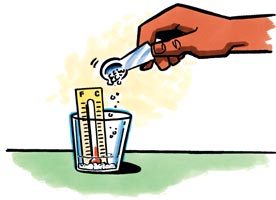
In an exothermic reaction, heat is ...
a)
taken in or absorbed
b)
given out or released
2.
In an endothermic reaction, heat is ...
a)
taken in or absorbed
b)
given out or released 
3.
Is photosynthesis an exothermic or endothermic reaction?
a)
Endothermic
b)
Exothermic
c)
Neither
4.
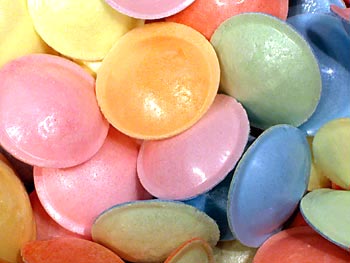
Have you ever eaten sherbet sweets candy? They fizz in your mouth and your tongue feels cold. Why do you think that is?
a)
It is an exothermic reaction
b)
It is an endothermic reaction
c)
It is made of ice
d)
It is dissolving your mouth
5.
What environmental element assists rusting?
a)
nitrogen
b)
carbon
c)
oxygen
d)
hydrogen
6.
What element rusts?
a)
carbon
b)
iron
c)
manganese
d)
potassium
7.
Solids have a __________ volume and ___________ shape.
a)
Definite, Definite
b)
Definite, Indefinite
c)
Indefinite, Definite
d)
Indefinite, Indefinite
8.
What is the state of the substance at point A?
a)
Liquid
b)
Solid
c)
Gas
d)
Plasma
9.
What phase change is happening at point D?
a)
Vaporization
b)
Sublimation
c)
Freezing
d)
Melting
10.
The change from solid to a gas is called ________________.
a)
Sublimation
b)
Freezing
c)
Evaporation
d)
Condensation
11.
Number 2 represents a ________
a)
solid
b)
liquid
c)
gas
d)
plasma
12.
Particles in a _________ take the shape of the container.
a)
solid
b)
liquid
c)
gas
d)
plasma
13.
What am I? I have a fixed mass, a fixed volume, I cannot be squashed and I have a shape that changes to fit the bottom of my container?
a)
solid
b)
liquid
c)
gas
d)
plasma
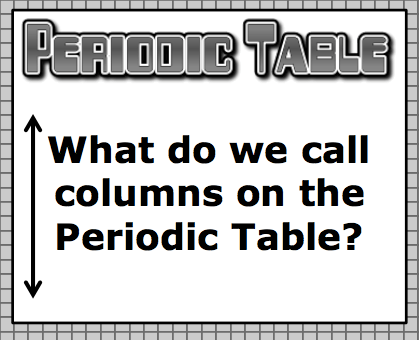
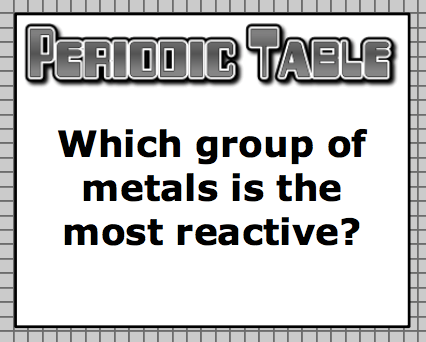
14.
a)
Periods
b)
Groups
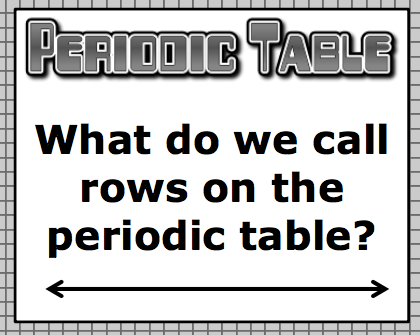
15.
a)
Periods
b)
Groups
16.
a)
Group 1
b)
Group 17
c)
Group 18
d)
Group 2
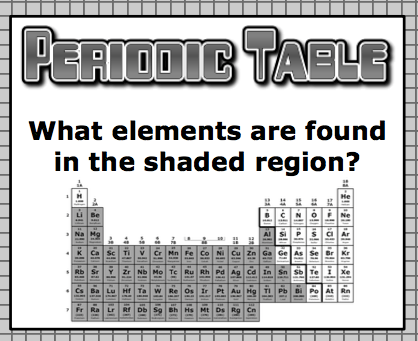
17.
a)
Metals
b)
Nonmetals
c)
Metalloids
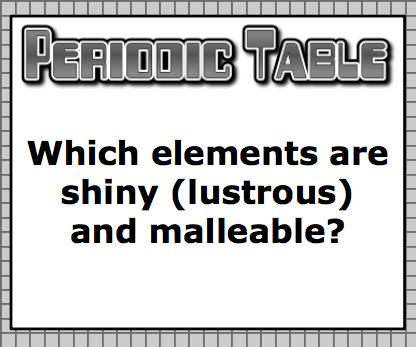
18.
a)
Metals
b)
Nonmetals
c)
Metalloids
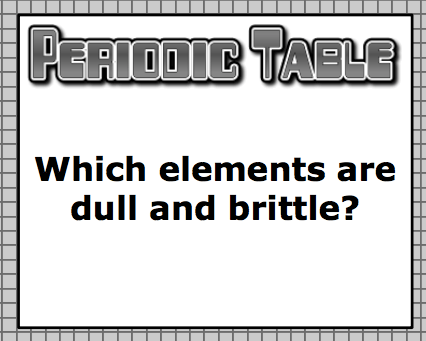
19.
a)
Metals
b)
Nonmetals
c)
Metalloids
20.
What type of bond forms when 2 or more electrons are SHARED?
a)
Covalent bond
b)
Incomplete bond
c)
Ionic bond
d)
Metallic bond
21.
What type of bond forms between two or more atoms that are charged (+/-)?
a)
Covalent bond
b)
Incomplete bond
c)
Ionic bond
d)
Metallic bond
22.
Which of the following is an example of an IONIC COMPOUND?
a)
NaCl
b)
H2O
c)
CO2
d)
NO
23.
Which of the following is an example of a COVALENT COMPOUND?
a)
H2S
b)
KI
c)
CaCl2
d)
MgO
24.
What charge does a bromine (Br) ion have?
a)
-1
b)
-2
c)
-3
d)
-4
25.
What charge does a potassium (K) ion have?
a)
+1
b)
-1
c)
+2 
d)
-2
26.
Name that Ion
Li+
a)
copper (III)
b)
lithium
c)
ladmium
d)
iodine
27.
Which category of elements have the property of being malleable and ductile?
a)
gases
b)
metals
c)
metalloids
d)
nonmetals
28.
Which term means "can be shaped?"
a)
malleable 
b)
ductile 
c)
hard 
d)
soft
29.
Alloys include a "sea" of free moving _______. 
a)
electrons
b)
atoms 
c)
molecules 
d)
protons 
30.
How does a positively charged ion form?
a)
An atom loses an electron
b)
An atom gains an electron
c)
An atom gains a proton
d)
An ionic compound dissolves
31.
Outer shell electrons are called
a)
outer electrons
b)
valence electrons
c)
negatives
32.
What do metals conduct?
a)
heat
b)
electricity
c)
both
d)
neither
33.

How many grams of carbon dioxide are present in a sample containing 80.0 moles of CO2?

a)

0.550 grams

b)

3520 grams

c)

44.0 grams

d)

1.82 grams

34.

What is the formula mass of the covalent compound silicon dioxide (SiO2)?

a)

7193.6 g/mol

b)

30.0 g/mol

c)

44.1 g/mol

d)

60.1 g/mol

35.

Sodium metal (Na) is very reactive and can replace hydrogen in water. This reaction is very exothermic. In fact, so much heat is released that the hydrogen gas given off from the reaction actually ignites. Because of safety hazards surrounding this substance, sodium is usually only handled by teachers. If a teacher decides to use 3.0 grams of sodium meal in a demonstration, how many atoms of sodium does she plan on using?

a)

7.85 x 10²²

b)

2.17 x 10⁻²⁵

c)

1.15 x 10⁻²²

d)

4.15 x 1025

36.

A large glass bottle congtains 20. grams of ammonia (NH3). Approximately how lmany molecules of ammonia are contained within this bottle?

a)

2.0 x 10⁻²⁴

b)

7.1 x 10²³

c)

1.2 x 1025

d)

2.0 x 1026

37.
What is the molar mass of sodium?
a)
11
b)
23
c)
45.98
d)
3
38.
The mass of one mole of substance is called...
a)
molecular mass
b)
mole constant
c)
molar mass
d)
atomic weight
39.
The molar mass of an element is equal to its...
a)
Atomic mass
b)
Atomic number
c)
Oxidation number
d)
Valence electrons
40.
What is the molar mass of fluorine gas?
(beware!)
a)
18.998 g/mol
b)
38 g/mol
c)
9 g/mol
d)
18 g/mol
41.
What is the mass of one mole of aluminum?
a)
27 g
b)
13 g
c)
54 g
d)
14 g
42.
What is the molar mass of CO2?
a)
12
b)
16
c)
32
d)
44
43.
How many particles are in a mole?
a)
602
b)
602 million
c)
602 moles
d)
6.02 x 10²³
44.
The substances listed on the right side of a chemical equation are the
a)
Yields
b)
Reactants
c)
Products
d)
Precipitates
45.
The substances listed on the left side of a chemical equation are the
a)
Products
b)
Coefficients
c)
Precipitates
d)
Reactants
46.
In chemical reactions, what does the principle of conservation of mass mean?
a)
Matter is not created or destroyed.
b)
The total mass of the reactants is greater than the total mass of the products.
c)
The total mass of the reactants is less than the total mass of the products.
d)
Matter is not changed.
47.
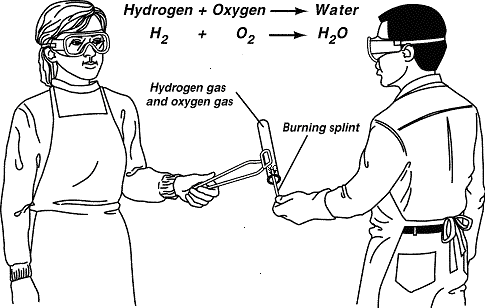
Identify the reactant(s) and product(s) of the reaction.
a)
All three are reactants and none are products.
b)
Hydrogen and water are the reactants, and oxygen is the product.
c)
Water and oxygen are the reactants, and hydrogen is the product.
d)
Hydrogen and oxygen are the reactants, and water is the product.
48.
A molecule is smaller than an atom.
a)
True
b)
False
49.
How many Oxygen (O) atoms are in 2C2HO8Cl2
a)
2
b)
16
c)
8
d)
5
50.
How many Hydrogen (H) atoms are in NH3O5
a)
3
b)
4
c)
5
d)
1
51.
A molecule is________
a)
a glob of gelatinous goo
b)
smaller than an atom
c)
filled with raisons
d)
more than one atom bonded together
52.
What is the  chemical formula for Glucose?
a)
GLc
b)
C6H1206
c)
G12H2C6
d)
Glucose
53.
How many elements are in C6H12O6?
a)
1
b)
2
c)
3
d)
4
54.
How many molecules of Carbon are in the following formula? 3C2H6
a)
3
b)
6
c)
12
d)
18
55.
Which problem is balanced?
a)
PbO2 + 2H2--> H2SO4
b)
SO2 + H20 --> H2SO4
c)
2Na + 2H2O --> 2NaOH + H2
d)
2Na + 2H2O --> 2NaOH + H
56.
Balance this equation
_Zn+_HCl-->_ZnCl+_H2
a)
1,1,2,1
b)
1,1,1,2
c)
1,2,1,1
d)
2,1,1,1
57.
Balance this equation.
_Mg + _Cl--> _MgCl2
a)
1, 2,1
b)
already balanced
c)
2,1,1
d)
1,1,2
58.
How many atoms of aluminum are on each side of the following equation: 4Al + 3O--> 2AlO3
a)
2
b)
6
c)
1
d)
4
59.
Balance this equation,            
Al2O3 --> Al + O2 
a)
Cannot be balanced
b)
2Al2O3 --> 2Al+3O2 
c)
2Al2O3--> 4Al+3O2 
d)
3Al2O3--> 2Al+O2 
60.
Which of the following has the most number of O?
a)
2Mg3(PO4)2
b)
4AlPO4
c)
3Al(NO3)3
d)
15KOH
61.
N2 + H2 = NH4
a)
Balanced
b)
Unbalanced
62.

List four factors that affects the rate of a reaction

a)

temperature

b)

concentration

c)

surface area

d)

volume

e)

catalysts

63.

A temperature increase causes the particles ......

a)

to slow down

b)

move faster

c)

collide higher

d)

in the right order

64.

How does a catalyst work in speeding up a reaction?

a)

By lowering the activation energy or reaction

b)

by giving them more energy

c)

by making them more available

65.
The following graph shows two different reaction pathways for the same overall reaction at the same temperature. Which pathway is slower and why?
a)
Red, because the activation energy is larger
b)
Blue, because the activation energy is lower
c)
both reaction progress at the same rate
66.
What does NOT happen when the temperature is increased?
a)
Particles collide more often
b)
Particles collide with more energy
c)
Particles move faster
d)
More particles collide in the correct orientation
67.

Why does a higher concentration increase the rate of reaction?

a)

it increases the amount of reactants

b)

it lowers the activation energy

c)

it increases the energy of particle collisions

d)

it increases the frequency of particle collisions

68.

Why does a higher temperature increase the rate of a reaction?

a)

it increases both the frequency and energy of particle collisions

b)

it only increases the frequency of particle collisions

c)

it only increases the energy of particle collisions

d)

it reduces the activation energy of the reaction

69.

The ______________is required to break the bonds of the reactants.

a)

Carbonic energy

b)

Activation energy

c)

Plutonic energy

d)

Energi Gaib

70.
Why don't all collisions between particles cause a reaction?
a)
the particles also need to collide with a catalyst
b)
not all the particles collide with enough energy
c)
not all the particles collide at a high enough temperature
d)
the particles need to collide with each other twice
71.
What method can NOT be used to collect gas?
a)
Using a gas syringe
b)
Collecting it in a measuring cylinder under water
c)
Measuring the change in mass
d)
Seeing how quickly the solution goes cloudy
72.
What is the rate of reaction?
a)
How fast a reaction is 
b)
How big a reaction is
c)
How loud a reaction is
d)
How much gas a reaction produces