wayground logo

Free Printable Worksheets

NEW

Font size

S
M
L
XL
Worksheets

Modern Genetics

Total questions: 61

Worksheet time: 48mins

Name
Class
Date
1.
The different forms of a gene are called
________________________.
a)
traits
b)
Kelly and Wilder
c)
allele
d)
Chromosomes
2.
What is the genotype of a pea plant that's homozygous for height?
a)
tt
b)
Tt
c)
TT
d)
tall
3.
Where is all the genetic information in a cell?
a)
Nucleus
b)
Nucleotides
c)
Chromosomes
d)
Cytoplasm
4.

What are the four bases of DNA?

a)

ATGC

b)

ATDC

c)

GCAS

d)

DNAB

5.

What is the function of the X and Y chromosomes?

a)

Eye colour

b)

Hair colour

c)

Height

d)

Sex

6.
How many chromosomes are there in most of your body's cells?
a)
23
b)
46
c)
12
d)
48
7.
How many chromosomes are in sex cells of humans? 
a)
12
b)
46
c)
23
d)
18
8.
A ______________ is a person who has one normal or dominant allele for a trait and a recessive or abnormal allele for a trait.
a)
codominant
b)
disorder
c)
carrier
d)
pedigree
9.
Besides genetics, what can alter or change a gene? (HINT: Height is an example.)
a)
cancer
b)
environment
c)
doctors
d)
television
10.
What is the genotype for a male? 
a)
Tt
b)
GG
c)
XX
d)
XY
11.
What is the genotype for an egg cell 
a)
Tt
b)
GG
c)
XX
d)
XY
12.
What disease is a genetic disorder that results in abnormally shaped blood cells?
a)
Sickle Cell
b)
Hemophilia 
c)
Cystic Fibrosis
d)
Down Syndrome
13.
What can affect a person's height? 
a)
Genetics 
b)
Environmental factors 
c)
Parents
d)
Genetics and environmental factors
14.
If a trait, like colorblindness, is a sex-linked trait, who is more likely to get the disorder?
a)
Females
b)
Males
c)
Females and males equally
d)
No one is likely to get the disorder
15.
What is a form of selective breeding that crosses genetically different individuals in an attempt to keep the best traits of both?
a)
Inbreeding
b)
Cloning
c)
Replication
d)
Hybridiztion
16.
What form of selective breeding crosses parents with the same or similar sets of alleles? 
a)
Inbreeding
b)
Replication
c)
Hybridization
d)
Cloning
17.
Sex-linked genes are mostly found on which chromosome? 
a)
XX
b)
XY
c)
Y only
d)
X only
18.
Cloning results in two organisms that are 
a)
genetically different
b)
genetically identical
c)
does not result in any organism
d)
genetically similar, but not identical
19.
What is commonly used to track the occurance of a particular trait in a family? 
a)
Punnett squares
b)
Karyotypes
c)
Family trees
d)
Pedigrees
20.
A person that has hemophilia
a)
will die
b)
bleeds easily
c)
has too much mucus built up in their bodies
d)
is colorblind
21.
What disorder occurs when chromosomes fail to separate properly during meiosis?
a)
Sickle Cell
b)
Cystic Fibrosis
c)
Hemophilia
d)
Down Syndrome
22.
A recessive allele on the X chromosome will always produce the trait in a male. 
a)
True
b)
False
23.
Except for identical twins, all people have different DNA.
a)
True
b)
False
24.
What symbol do geneticists use to represent a male on a pedigree? 
a)
Circle
b)
Square
c)
Star
d)
Triangle
25.
______________ is controlled by one gene with many alleles.
a)
Widow's peak
b)
Tongue roller
c)
Attached earlobes
d)
Blood type
26.
What is an example of a sex-linked trait?
a)
A- Autism
b)
B- Cancer
c)
C- Hemophilia
d)
D- Hair Color
27.
What did the first/original Human Genome Project do?
a)
A- Sequenced the entire human genome and found we had 20,000 genes that coded for proteins
b)
B- Allowed doctors to be more aware about diseases
c)
C- Created a new resource for life sciences and world wide conservations
d)
D- All of the above
28.
A man with AB blood married a women with  A blood. What blood type could their child possibly have?
a)
Type A
b)
Type B
c)
Type AB
d)
all of the above
29.
Which disease or disorder causes people to have abnormal hemoglobin?
a)
Cystic Fibrosis
b)
Albinism
c)
Sickle-cell Disease
d)
Down Syndrome
30.
Which disease or disorder is the result of having an extra chromosome?
a)
Cystic Fibrosis
b)
Down Syndrome
c)
Colorblindness
d)
Sickle-cell Disease
31.
What are the two ways that genetic disorders can be inherited?
a)
Through blood transfusions and meiosis.
b)
Mutations in DNA and changes in structure or number of chromosomes.
c)
Missing chromosomes or premature egg splitting.
d)
Unhealthy environments and heredity.
32.
A doctor may use a _________ to examine the chromosomes in a cell.
a)
x-ray
b)
blood test
c)
karyotype
d)
hemoglobin
33.
Which genetic disorder or disease is a sex-linked trait and carried on the X chromosome?
a)
Cystic Fibrosis
b)
Sickle-cell Disease
c)
Hemophilia
d)
Down Syndrome
34.
a)
Not affected Female
b)
Not affected Male
c)
Affected Male
d)
Affected Female
35.
a)
Not Affected Male
b)
Not Affected Female
c)
Affected Male
d)
Affected Female
36.
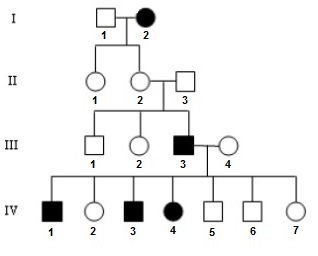
In the second generation-how many people are carriers of the trait?
a)
2
b)
3
c)
5
d)
6
37.
A couple that have a family history of a genetic disorder might wish to receive advice from a ___________.
a)
mutated allele
b)
genetic counsellor
c)
family dentist
d)
brother or sister
38.
What is the gender of the individual whose karyotype is seen in the image?
a)
Male
b)
Female
39.
What is the chromosomal condition of the individual whose karyotype is seen in the image?
a)
Trisomy 21 (Down's Syndrome)
b)
Trisomy 13 (Patau Syndrome)
c)
Trisomy 18 (Edward's Syndrome)
d)
XXY Sex Chromosomes (Klinefelter's Syndrome)
40.
Which of the following is true of your sex chromosomes?
a)
I have two Y chromosomes.
b)
I have at least one X chromosomes.
c)
They aren't developed until I turn 13.
d)
They are afraid of one another.
41.
How many generations are shown in this pedigree?
a)
1
b)
2
c)
3
d)
4
42.
How many kids did the mother and father from the first generation have?
a)
2
b)
4
c)
5
d)
6
43.
This pedigree represents the inheritance of hemophilia in this family. How many of the females have the hemophilia trait?
a)
8
b)
5
c)
2
d)
3
44.
What do half colored symbols represent?
a)
The individual is a carrier (heterozygous).
b)
The individual expresses the trait.
c)
The individual has both recessive alleles.
d)
The individual has both dominant alleles.
45.
Is this trait (the shaded individuals) dominant or recessive?
a)
dominant
b)
recessive
46.
Which gender can be carriers of colorblindness and not have it?
a)
Just males
b)
Just females
c)
Both genders
47.
The purpose of selective breeding is to 
a)
Get bigger animals
b)
get smaller animals
c)
create animals with desirable traits
d)
create animals with bad traits
48.
All of the following statements are reasons for selective breeding except:
a)
To produce offspring with desirable characteristics
b)
Farmers increase their profit by improving crops
c)
To improve the quality of food products
d)
To increase migration patterns
49.
Where humans have bred organisms together based on traits we like.
a)
Evolution
b)
Natural Selection
c)
Extinction 
d)
Artificial Selection
50.

Which of the following could be used as a vector for a human gene?

a)

Bacterial Plasmid

b)

Bacteria

c)

A mitochondria

d)

mRNA

51.

In which ways can genetic engineering can improve crops

a)

Make them pest or drought resistant

b)

Make them more nutritious

c)

Make them larger

d)

All answers are correct

52.

A circular piece of DNA, found in bacteria, is called:

a)

A plasmid

b)

mRNA

c)

Ribosome

d)

Nucleotide

53.

Humans with genetic diseases can have a gene inserted into their body using a virus. This is called:

a)

Gene therapy

b)

Cloning

c)

DNA fingerprinting

54.
Corn and rice are two of these most genetically modified crops in the US.
a)
true
b)
false
55.
Correcting mistakes in DNA is _______
a)
Gene therapy
b)
Gene modification
c)
Selective breeding
d)
animal husbandry
56.
Messing with DNA by doing things like putting genes from one organism into another is _____.
a)
Gene modification
b)
gene therapy
c)
Selective breeding
d)
Animal husbandry
57.
Why aren't more scientists using gene modification?
a)
Because they are poor
b)
Because they are lazy
c)
Because of ethics and morality
d)
Because of how long it takes
58.

Which is NOT one of the three ways of producing organisms with desired traits?

a)

Selective Breeding

b)

Human Genome Project

c)

Genetic engineering

d)

Cloning

59.

A group of disorders that affects hemoglobin, the molecule in red blood cells that delivers oxygen to cells throughout the body.

a)

Sickle Cell Disease

b)

Hemophilia

c)

HIV

d)

Cystic Fibrosis

60.

When you look at the cells of individuals with sickle cell anemia, what do you expect to see?

a)

C-shaped cells

b)

S-shaped cells

c)

Disk-Shaped Cells

d)

Globular shaped cells

e)

Sick cells

61.
The main goal of the Human Genome Project (HGP) was to:
a)
Identify the unique parts of each person's DNA.
b)
Identify genes responsible for human diseases.
c)
Identify genes responsible for human behavior.
d)
Determine the entire sequence of human DNA.