wayground logo

Free Printable Worksheets

Font size

S
M
L
XL
Worksheets

Lesson 1 - 3 Review

Total questions: 82

Worksheet time: 1hrs 21mins

Name
Class
Date
1.
What is the difference between mass and weight?
a)
Mass is the total matter in an object, and weight is the downward pull of an object.
b)
Mass is the downward pull of gravity on an object, and weight is the total matter making up an object.
c)
Mass is Batnan, Weight is Spider-Cam
d)
I don't know 😭
2.
Iron + oxygen = rust is an example of a ___________.
a)
physical property/change
b)
chemical property/change
c)
mass
d)
volume
3.
One hot summer, you remember you left a cup of water outside. A few weeks later, you saw that the cup was empty and you remember the cup having water. What happened to the water?
a)
It evaporated
b)
It underwent deposition
c)
It melted
4.
Which statement about atoms is true?
a)
They are all the same
b)
All substances are made of just one kind
c)
You can see them with your eyes
d)
They are too small to be seen with an ordinary microscope
5.
A watermelon has more matter than a grape, so it has more
a)
mass
b)
eat
c)
solid
d)
greater
6.
Water in its solid form is _____________.
a)
a vapor
b)
ice
c)
a liquid
d)
boiling
7.
Which physical property is measured in liters?
a)
color
b)
length
c)
mass
d)
volume
8.
Which liquid has the greatest density?
a)
lamp oil
b)
karo syrup
c)
water
d)
honey
9.
What form of matter has a definite shape?
a)
Solid
b)
Liquid
c)
Gas
d)
Square
10.
This state of matter does not have a definite size or shape.
a)
Gas
b)
Liquid
c)
Solid
d)
Milk
11.
Which is not a property of matter?
a)
Shape
b)
Mass
c)
Liquid
d)
Volume
12.
Name the three states of matter:
a)
crystalline, amorphous, solid
b)
solid, liquid, gas
c)
energy, matter, mass
d)
solid, fluid, liquid
13.

When you see steam or fog, which state of matter is it?

a)

solid

b)

liquid

c)

gas

14.
What is an example of gas?
a)
crayons
b)
paper
c)
soda
d)
air
15.
Which state of matter has particles that are tightly packed?
a)
liquid
b)
gas
c)
solid
16.
Matter is anything that takes up space
a)
True
b)
False
17.
The amount of space something takes up
a)
density
b)
volume
c)
mass
d)
matter
18.
__________ are the building blocks of life.
a)
solids
b)
gases
c)
atoms
d)
nutrients
19.
Helium is a ____________.
a)
liquid
b)
solid
c)
gas
20.
I am the smallest whole particle of matter. 
a)
atom
b)
compound
c)
molecule
d)
mixture
21.
Blue Color
a)
Physical Property
b)
Chemical Property
22.
Density
a)
Physical Property
b)
Chemical Property
23.
Flammability (burns)
a)
Physical Property
b)
Chemical Property
24.
Solubility (dissolves)
a)
Physical Proeprty
b)
Chemical Property
25.
Reacts with acid
a)
Physical Property
b)
Chemical Property
26.
Supports combustion
a)
Physical Property
b)
Chemical Property
27.
Sour taste
a)
Physical Property
b)
Chemical Property
28.
Melting point
a)
Physical Property
b)
Chemical Property
29.
Reacts with water
a)
Physical Property
b)
Chemical Property
30.
Hardness
a)
Physical Property
b)
Chemical Property
31.
A student removes a loaf of bread hot from the oven. The student cuts a slice off the loaf and spreads butter on it. 
a)
Physical Change
b)
Chemical Change
32.
Your friend decides to toast a piece of bread, but leaves it in the toaster too long. The bread is black and the kitchen if full of smoke. 
a)
Physical Change
b)
Chemical Change
33.
You blow dry your wet hair. 
a)
Physical Change
b)
Chemical Change
34.
In baking biscuits and other quick breads, the baking powder reacts to release carbon dioxide bubbles. The carbon dioxide bubbles cause the dough to rise. 
a)
Physical Change
b)
Chemical Change
35.
A straight piece of wire is coiled to form a spring. 
a)
Physical Change
b)
Chemical Change
36.
Food color is dropped into water to give it color. 
a)
Physical Change
b)
Chemical Change
37.
In a fireworks show, the fireworks explode giving off heat and light. 
a)
Physical Change
b)
Chemical Change
38.
Chewing food to break it down into smaller particles represents a _________ change, but the changing of starch into sugars by enzymes in the digestive system represents a ___________change. 
a)
Chemical then Physical 
b)
Physical then Chemical
c)
Both Physical
d)
Both Chemical
39.
Dissolving a solid into a liquid is a ___.
a)
physical change
b)
chemical change
40.
A characteristic that can be observed without changing the composition of a substance is a ___.
a)
chemical property
b)
physical property
c)
melting point
d)
chemical change
41.
Physical or Chemical change:
milk sours
a)
physical change
b)
chemical change
42.
Physical or Chemical change:
a bicycle changes color as it rusts
a)
physical change
b)
chemical change
43.
Substances that exist before the reaction
a)
products
b)
subscripts
c)
reactants
d)
coefficients
44.
___ change - results in a change in a substance's composition.
a)
formation
b)
physical
c)
chemical
d)
conservation
45.
Rotting bananas?
a)
Physical Change
b)
Chemical Change
46.
What is this tool to get volume?
a)
triple beam balance
b)
ruler
c)
thermometer
d)
graduate cylinder
47.
True or False:  The density of a specific type of material never changes.  
a)
True
b)
False
48.
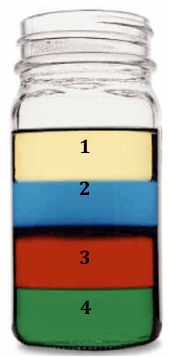
Put the liquids in order from most dense to least dense?
a)
4, 3, 2, 1
b)
1, 2, 3, 4
c)
3, 4, 2, 1, 
d)
4, 3, 1, 2
49.
Why does ice float?
a)
Liquid water is less dense than solid water.
b)
Solid water is less dense than liquid water.
c)
Gaseous water is less dense than solid water.
d)
Liquid water is less dense than gaseous water.
50.
What do we know about the density of lamp oil, rubbing alcohol, and vegetable oil?  
a)
The density is greater than 1.0 g/mL
b)
The density is less than 1.0 g/mL
c)
The density is equal to 1.0 g/mL
d)
The density can not be determined
51.
In general what is the most dense form of matter?
a)
solid
b)
liquid
c)
gas
d)
plasmas
52.
If an object has a density of .6 g/cm^3 and you put it into water, will it sink or float?  
a)
sink
b)
float
53.
If an object has a density of 3.6 g/cm^3 and you put it into water, will it sink or float?  
a)
sink
b)
float
54.
What is the formula for density?
a)
density = mass x volume
b)
density = mass / volume
c)
density = mass + volume
d)
density = mass - volume
55.
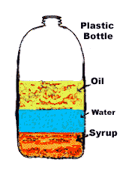
Which liquid is the least dense?
a)
oil
b)
water
c)
syrup 
d)
plastic bottle
56.
Jack has a rock. The rock has a mass of 14 g and a volume of 2 cm3. What is the density of the rock?
a)
7 mL
b)
7 g/cm3
c)
28 g/cm3
d)
1/7 g/cm3
57.
Frank has an eraser. It has a mass of 4 g, and a volume of 2 cm3. What is its density?
a)
8 g/cm3
b)
2 g/cm3
c)
1/2 g/cm3
d)
24 g/cm3
58.
Frank has a liquid. It has a mass of 6 g and a volume of 9 mL. What is its density?
a)
3 g/mL
b)
.66 g/mL
c)
1.33 g/mL
d)
54 g/mL
59.
Calculate the density of the cube.
a)
2 g/cm3
b)
4 g/cm3
c)
6 g/cm3
d)
8 g/cm3
60.
If this substance takes up 6 ml of space, what is its mass?
a)
 6 ml
b)
6 grams
c)
0 grams
d)
4 grams 
61.
Jack has a rock. The rock has a mass of 14g and a volume of 2cm3. What is the density of the rock?
a)
7 mL
b)
7 g/cm3
c)
28 g/cm3
d)
1/7 g/cm3
62.
Which units of measurement are used for volume?
a)
grams
b)
centimeters
c)
grams/milliliter
d)
milliliter
63.
I have two objects with the same volume but different masses.  Which object will be more dense?
a)
The object with less weight.
b)
The object with more weight.
c)
The object with more mass.
d)
The object with less mass.
64.
An empty beaker has a mass of 60 grams.  When mercury is added to the beaker, it has a mass of 200 grams. What is the mass of the mercury?
a)
140 grams
b)
200 grams
c)
140 mL
d)
260 g
65.
What is the volume of 150 grams of lead if it has a density of 11.3 g/cm3?
a)
13.3 g
b)
13.3 cm3
c)
.075 g
d)
1695 cm3
66.
Archimedes used density to discover if the crown of gold was real because
a)
Substances have their own unique densities
b)
Substances can change densities depending on their size
c)
Substances can change densities depending on their mass
d)
Substances can change densities depending on their volume
67.
This pumice has a mass of 35.4 grams.  Water the same size as this pumice has a mass of 41.2 grams.  Will it sink or float?
a)
sink
b)
float
c)
same
68.
An experiment is being done to determine how light affects the growth of small zinnia plants. One plant is placed in full sunlight, the second in a shaded area, the third in an unlit closet. What is the independent variable in the experiment?
a)
the amount of light
b)
the type of plants
c)
the type of soil
d)
the length of the experiment
69.
True or False - Experiments should have many independent variables.
a)
TRUE
b)
FALSE
70.
This variable in an experiment is the one being deliberately changed by the scientist. 
a)
dependent variable
b)
independent variable
c)
data
d)
control group
71.
In a controlled experiment, how many variables can be worked with at a time? 
a)
one
b)
none
c)
two or more
d)
how ever many makes sense.
72.
The part of the experiment that remains the same for the control and experimental group.
a)
constants
b)
control
c)
independent
d)
dependent
73.
Mr. S. sets up an experiment to see how the mass of a ball affects the distance it rolls off a ramp.  Identify the independent variable.
a)
distance traveled by the ball
b)
height of the ramp
c)
mass of the ball
d)
weight of the ball
74.

The variable that is measured.

a)

Controlled Variable

b)

Dependent Variable

c)

Independent Variable

75.

The factors that stay the same or are constant throughout the experiment.

a)

Controlled Variable

b)

Dependent Variable

c)

Independent Variable

76.

Why is it important to have only one independent variable and to control the other variables when performing science experiments?

a)

So you can tell which factor is causing the change in the experiment.

b)

It does not matter, you can have as many independent variables as you want.

77.
On a graph, which axis shows the dependent variable?
a)
x-axis
b)
y-axis
c)
neither
d)
it changes
78.
On a graph, which axis shows the independent variable?
a)
x-axis
b)
y-axis
c)
neither
d)
it changes
79.

Asher is planning an experiment to find out how the height from which he drops a ball affects how high the ball bounces. The dependent variable is the _____.

a)

Diameter of the ball

b)

Force acting on the ball

c)

Height that the ball bounces

d)

Height from which the ball is dropped

80.

The graph shows the distance traveled by Ms. Luce's family on a road trip. They will travel 25 miles each hour. Which statement is true about the situation?

a)

the independent variable is distance

b)

the independent variable is d=25 t

c)

the dependent variable is time

d)

the dependent variable is distance

81.
The graph shows the cost of mailing a package based on its weight.  Which statement is true about the situation?
a)
The dependent variable is total cost
b)
The dependent variable is weight
c)
The independent variable is total cost
d)
The independent variable is cost of a package
82.
Identify the dependent variable:
A study was done to find if different tire treads affect the braking distance of a car.

a)
The car
b)
The distance the car took to brake 
c)
The different tire treads
d)
The drive