wayground logo

Free Printable Worksheets

Font size

S
M
L
XL
Worksheets

Darwin's EVOLUTION Practice Test

Total questions: 55

Worksheet time: 43mins

Name
Class
Date
1.

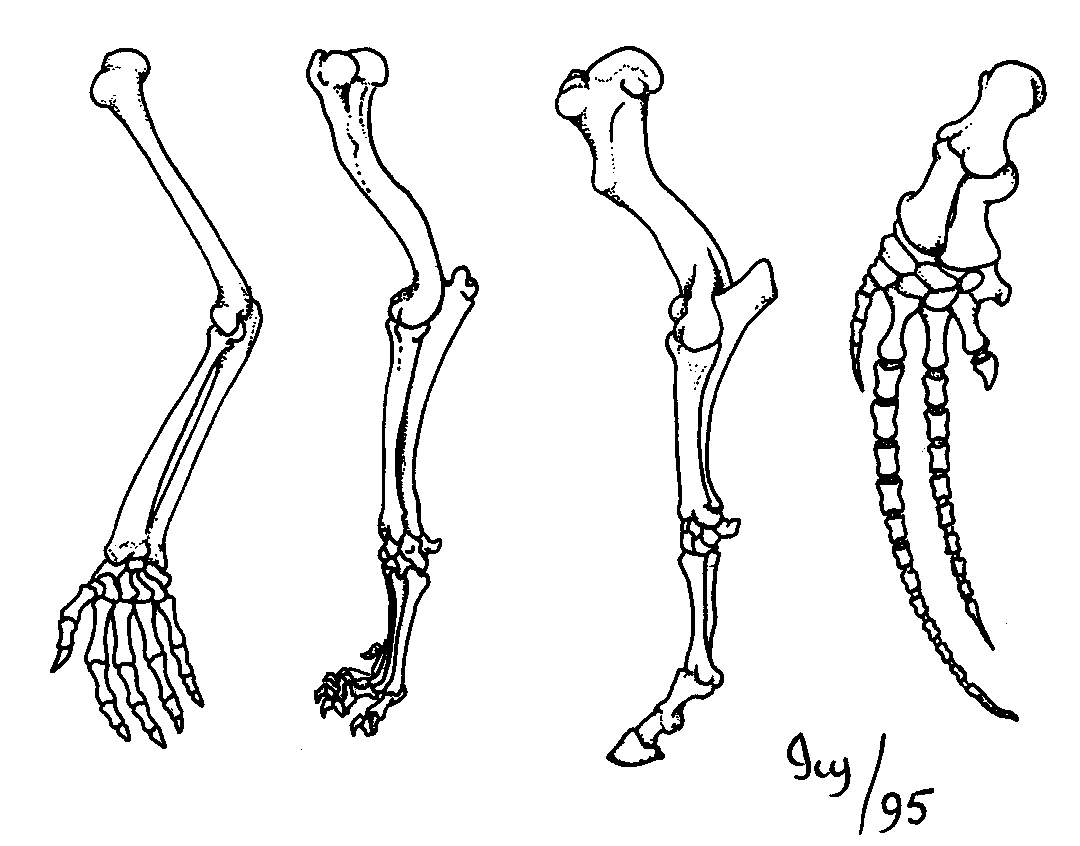
This illustration is a good example of which evidence for evolution?

a)

analogous structures

b)

homologous structures

c)

vestigial structures

d)

none of the above

2.
What is the process of which humans breed organisms for certain traits?
a)
artificial selection
b)
descent without modification
c)
inheritance of acquired characteristics
d)
natural selection
3.

Vertebrate embryos passing through similar stages of development is evidence for

a)

use and disuse

b)

homologous structures

c)

common ancestry

d)

acquired characteristics

4.
Individuals that are well adapted to their environment will survive and produce
a)
better traits
b)
stronger genes
c)
more offspring
d)
fewer mutations
5.
All the individuals of a species that live in a particular area are called a 
a)
group
b)
population
c)
variation
d)
fossil
6.
A biological ____________ is a group of interbreeding populations that is reproductively isolated from other groups.
a)
species
b)
family
c)
phylogeny
d)
hybrid
7.

The system for classifying organisms called binomial nomenclature was developed by ___________

a)

Linneaus

b)

Mayr

c)

Darwin

d)

Lamarck

8.

__________ characters are similar characteristics that have evolved separately in two unrelated organisms. (Ex. Sharks and Dolphins).

a)

analogous

b)

homologous

c)

cladistic

d)

phylogenic

9.
______________ is the process by which populations change in response to their environment.
a)
natural selection
b)
adaptation
c)
reproductive isolation
d)
divergence
10.
Mutations are important because they bring about
a)
death of the organism in which they develop
b)
genetic variation needed for a population to evolve
c)
benefits for the individual, not for the population
d)
Hardey-Weinberg equilibrium within a population
11.

Extinction can occur because of which of the following?

a)

Certain traits are favored over certain other traits.

b)

Increased competition with other species

c)

New predators within the environment

d)

Loss of habitat and/or catastrophes

12.
Finches on the Galapagos Islands had different beaks in order to help them do what?
a)
Build nests
b)
Fight off predators
c)
Collect food sources
d)
Compete with rivals
13.
This scientist came up with the idea of natural selection.
a)
Jean Baptiste Lamarck
b)
Gregor Mendel
c)
Charles Darwin
d)
Thomas Malthus
14.
A remnant or trace of an organism from the past is called a _______.
a)
Ancestor
b)
Skeleton
c)
Fossil
d)
Imprints
15.
Inherited trait that helps an organism survive is a(n) __________.
a)
Fossil
b)
Adaptation
c)
Ancestor
d)
Natural selection
16.

Jennifer is a tall, 11 year old drummer. She has a scar on her right cheek. She is good at swimming. Which of her traits did Jennifer most diffidently inherit?

a)

height

b)

the scar

c)

ability to swim

d)

ability to play drums

17.
According to the diagram, which organism is older?
a)
ammonite
b)
coral
c)
gastropod
d)
trilobite
18.
Structures with the same parts have different functions; suggests that organisms share a common ancestry
a)
vestigial structures
b)
homologous structures
c)
adaptive radiation
d)
fossil
19.
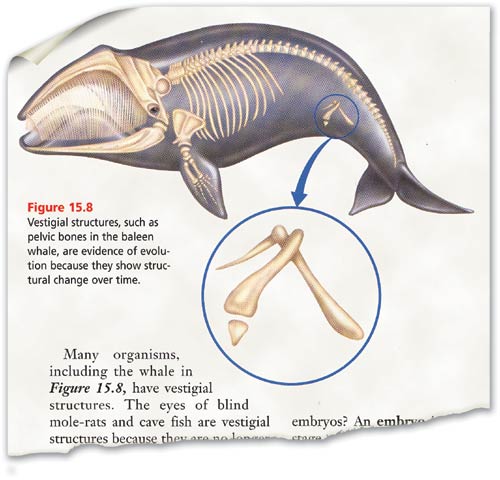
Which of the following is an example of a vestigial structure?
a)
the wings of a red-tailed hawk
b)
the hind limbs of a house cat
c)
the fins of sharks
d)
the tailbone of a human
20.
The diagram shows fossils in different rock layers. Which of these statements about the age of these fossils is most likely correct?
a)
Fossil A and C are the same age
b)
Fossil B is older than fossil C
c)
Fossils A is older than fossil B
d)
Fossil D is older than fossil C
21.
If species A and B have very similar genes and proteins, what is probably TRUE?
a)
species A and B share a relatively recent common ancestor
b)
species A evolved independently of species B for a long period
c)
species A is younger than species B
d)
species A is older than species B
22.
The ability of an organism to survive and reproduce in its specific environment 
a)
diversity.
b)
evolution
c)
adaptation
d)
 fitness
23.
Why are advantageous traits more likely to be passed onto offspring?
a)
Because they are more likely to survive and reproduce.
b)
Because they come from dominant alleles.
c)
Because they come from recessive alleles.
d)
Because the trait is an acquired phenotype.
24.
Farmers breed cows to produce high amounts of milk. This is an example of...
a)
Natural Selection 
b)
Variations in a species 
c)
Selective Breeding 
d)
inbreeding
25.
In natural selection, the selective agent is the
a)
humans
b)
mutations
c)
breeders
d)
environment
26.

What did Charles Darwin observe in finch populations of the Galapagos Islands off the coast of South America?

a)

different species on different islands

b)

all species on one of the islands

c)

identical species on all the islands

d)

the same species as North America

27.
Natural selection results in change over time by acting on traits that are
a)
heritable
b)
new
c)
mutated 
d)
better than the best
28.

Most of the species found in fossil form are _______________.

a)

Current

b)

Extinct

29.
Some organisms that share a common ancestor have features that have different functions, but similar structures.  These are known as
a)
vestigial structures
b)
analogous structures
c)
homologous structures
d)
fossil structures
30.

The gradual change in species over time is...

a)

Evolution

b)

Nucleotide

c)

Adaptation

d)

Natural Selection

31.
What is another name for natural selection?
a)
survival of the smartest
b)
survival of the fastest
c)
survival of the biggest
d)
survival of the fittest
32.
What is the study of organisms at the early stages of development?
a)
DNA studies
b)
embryology 
c)
extinction
d)
fossil record
33.
The fossil record provides evidence that 
a)
Fossils cannot be dated.
b)
All species were formed during Earth’s formation and have changed little since then.
c)
The fossilized species have no connection to today’s species.
d)
Older species gave rise to more-recent species.
34.
Which of the following statements gives the most likely explanation for the presence of two very similar species of squirrels living on opposite sides of the Grand Canyon?
a)
One squirrel traveled across the canyon and started a new population on the other side.
b)
One squirrel traveled across the canyon and interbred with a different population on the other side.
c)
Members of one single squirrel species were geographically separated by the formation of the canyon.
d)
Members of two different squirrel species migrated from two different places to opposite sides of the canyon. 
35.
The Asian shore crab invaded parts of the eastern coast of the United States about 15 years ago. The Asian shore crab preys on blue mussels. In the time since the Asian shore crab arrived, the average shell thickness of the blue mussel population has increased. Which of the following is the most likely reason that this increase in shell thickness has occurred? 
a)
Blue mussels with thick shells attract more crabs that mussels without thick shells.
b)
Blue mussels with thick shells grow in larger colonies than mussels without thick shells.
c)
Blue mussels with thick shells catch more food per day than mussels without thick shells.
d)
Blue mussels with thick shells survive and reproduce more successfully than mussels without thick shells.
36.
Structures with no function that are remnants of an organism’s evolutionary past are
a)
Not visible organisms.
b)
Vestigial
c)
Young in origin
d)
Useful to the organism
37.
Comparing human hemoglobin of chimpanzees, horses, kangaroos, and chickens, reveal that humans have the fewest amino acid differences with 
a)
Kangaroos
b)
Horses
c)
chickens
d)
chimpanzees
38.

Who was the naturalist that traveled the world to study plants and animals?

a)

Carolus Linnaeus

b)

Charles Darwin

c)

Jean-Baptiste Lamarck

d)

George Buffon

39.
Which term refers to the process by which individuals that are better suited to the environment survive and reproduce therefore passing down their genes to their offspring? 
a)
Evolution 
b)
Variation 
c)
Adaptation
d)
Natural Selection 
40.
The struggle for existence against other members of an organisms species is
a)
Competition
b)
Natural Selection
c)
gene flow
d)
genetic drift
41.

In Darwin's theory of evolution, he uses his idea of _________________ to explain evolution.

a)

Decent with Modification

b)

Genetic Drift

c)

Reproductive Isolation

d)

Use and Disuse

42.
Genetic variation can arise from a random change in the DNA of a gene.  The change is called a(n)
a)
mutation
b)
gene flow
c)
gene pool
d)
allele
43.

What most likely caused the finches on the Galapagos Islands to have beaks that were different from the finches on the mainland?

a)

There were different types of predators on the island.

b)

There were different types of food available on the island.

c)

The finches had no water to drink.

d)

The finches on the mainland could not fly high enough.

44.

When looking at two birds of the same species, you notice that one has darker feathers than the other one. You also notice that one has a beak that is just a little longer. These slight differences within members of the same species are called.....

a)

Fossils

b)

Extinction

c)

Meiosis

d)

Variations

45.

Who proposed the "Use and Disuse" Theory?

a)

Malthus

b)

Lamarck

c)

Darwin

d)

Linnaeus

46.

Small changes that occur in a species or population over a few years is described as:

a)

Macroevolution

b)

Convergent evolution

c)

Microevolution

d)

Divergent Evolution

47.

Large changes in a species over long periods of time resulting in significant change is referred to as:

a)

Macroevolution

b)

Convergent Evolution

c)

Microevolution

d)

Divergent Evolution

48.

A single species giving rise to several other, different species over long periods of time is known as:

a)

Macroevolution

b)

Convergent Evolution

c)

Microevolution

d)

Divergent Evolution

49.

Several different species evolving into very similar species, due to natural selection is known as:

a)

Macroevolution

b)

Convergent Evolution

c)

Microevolution

d)

Divergent Evolution.

50.

What characteristic did Darwin observe about the finches on the Galapagos Islands?

a)

Their feathers

b)

Genotypes

c)

Their beaks

d)

Their body sizes

51.

What is this an example of?

a)

homologous structures

b)

variation

c)

vestigial structures

d)

speciation

52.

Which of the following is an example of natural selection?

a)

Bald Eagles are hunted until near extinction, population recovers.

b)

Small group of iguanas floats to an island, starts a new population.

c)

Red fox pups are more likely to survive in a snowy environment if they are born white.

d)

Farmer chooses seeds from largest apples to plant next year. This results in larger apples from year to year.

53.
Which rock layer in the diagram seems to be the oldest?
a)
F
b)
E
c)
B
d)
A
54.

Scientists have found that the elephant shrew and the elephant share more DNA sequences than does the elephant shrew with a rodent. This evidence for evolution suggests to scientists that the elephant shrew and elephant

a)

are the same organism.

b)

may share a common ancestor

c)

have different ancestors

d)

are the same organism.

55.

A single population of species evolving into several different species is an example of what type of Evolution?

a)

Convergent

b)

Divergent

c)

Natural Selection

d)

Decent with Modification