
 Worksheets
Unit 2: Code.org
Total questions: 82
Worksheet time: 57mins
the art of creating a program
program
debugging
paramenter
programming
the action of doing something over and over again
for loop
while loop
bug
loop
finding and fixing problems in an algorithm or program
bug
conditionals
variable
debugging
part of a program that does not work correctly
bug
variable
debugging
try
an algorithm that has been coded into something that can be run be a machine
parsnip
parameter
program
conditionals
Infinite loops are also called _________ loops.
endless
forever
never ending
George wanted to make a robot that prepared him a bowl of ice cream every day when he got home from work.He noticed that the robot made the same motion over and over again. He decided to loop that behavior in his program. What part of Computational Thinking was she using?
Abstraction
Decomposition
Algorithm
Pattern Matching
Remembering methods for solving previous problems.
Decomposition
Algorithm
Abstraction
Pattern Matching
Mr. Hillegonds wanted to help a student get to the 6th grade wing. He gave him step by step instructions to help him get to the 6th grade wing. What part of Computational Thinking was he using?
Abstraction
Decomposition
Algorithm
Pattern Matching
Identify the strategy: While running errands, Jane remembered the fastest way to Meijer.
Decomposition
Algorithm
Abstraction
Pattern Matching
Identify the strategy: Tim decides to break is homework into several pieces.
Decomposition
Algorithm
Abstraction
Pattern Matching
Define ALGORITHM
Breaking a task into smaller tasks.
Looking for similarities and trends.
A sequence of instructions.
Deciding what computer to use.
Define PATTERN RECOGNITION.
A sequence of instructions.
Looking for similarities and trends.
Breaking a task into smaller tasks.
Focusing on what is important and ignoring what is unnecessary.
Define DECOMPOSITION
Breaking a task into smaller tasks.
Looking for similarities and trends.
A sequence of instructions.
Focusing on what is important and ignoring what is unnecessary.

Can this code be written better?
Yes, by using loops (repeat blocks)
No, this is the best way to right this code
Why is decomposition important for your life?
It can help you solve complex problems by breaking the problem into easier chunks
It can help you simplify problems by looking for repeated steps
It can help you simplify complex ideas
It can help you with step by step sets of instructions
Why is Pattern Matching important to Computer Science?
It helps us solve problems that have repeated actions
It helps us write loops
It helps us write algorithms in fewer steps by looping repeated steps.
All of these

What happens if the space bar is pressed?
The computer says you win
The score is set to zero
The Score is changed by 1

Which of the values for "Best Time" and "Time" cause the whole statement to be true?
Best Time = 5 and Time = 14
Best Time = 5 and Time = 7
Best Time = 5 and Time = 4

What will happen if the space bar is not being pressed?
the sprite will turn left
the sprite will turn right
nothing
What will happen if the space bar is being pressed?
the sprite will turn left
the sprite will turn right
nothing
What type of statement is this?
If-then
If-then-else
While Loop
A type of selection that has two options
Boolean
If-then
Flowchart
If-then-else
Else-if
A type of selection that has one option or can be skipped.
Boolean
If-then
Flowchart
If-then-else
Else-if

Which condition gets the sprite to put the pen down?
space key pressed?
up arrow pressed?
3<4
mouse down?
Is 25 < 32 ?
True
False
Not Sure
Is 4 < 5
True
False
Not sure
Is 4 > 5
True
False
Not sure
Infinite loops are also called _________ loops.
endless
forever
never ending
George wanted to make a robot that prepared him a bowl of ice cream every day when he got home from work.He noticed that the robot made the same motion over and over again. He decided to loop that behavior in his program. What part of Computational Thinking was she using?
Abstraction
Decomposition
Algorithm
Pattern Matching
What is the purpose of Computational Thinking?
To confuse us
To help us solve only Computer Science problems
To help us with out homework
To help us solve any problem that we are faced with
Breaking a problem down into multiple pieces to make it easier to understand.
Decomposition
Algorithm
Abstraction
Pattern Matching
a placeholder for a piece of information that can change
variable
for loop
define
parameter

True or False:
True
False

True or False:
True
False

True or False
True
False

True or False
True
False

Challenge: True or False
True
False
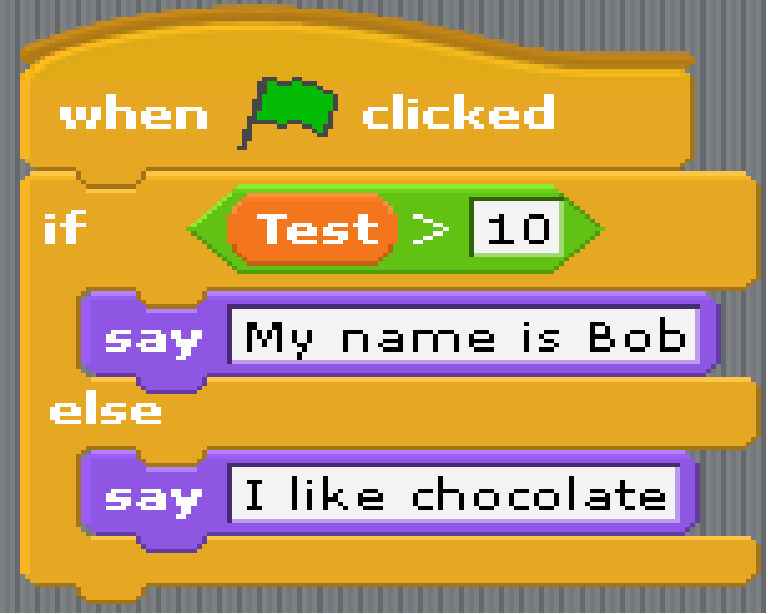
What would the Sprite say if the Test is set to 10?
My name is Bob
I like Chocolate
Hello
I do not know
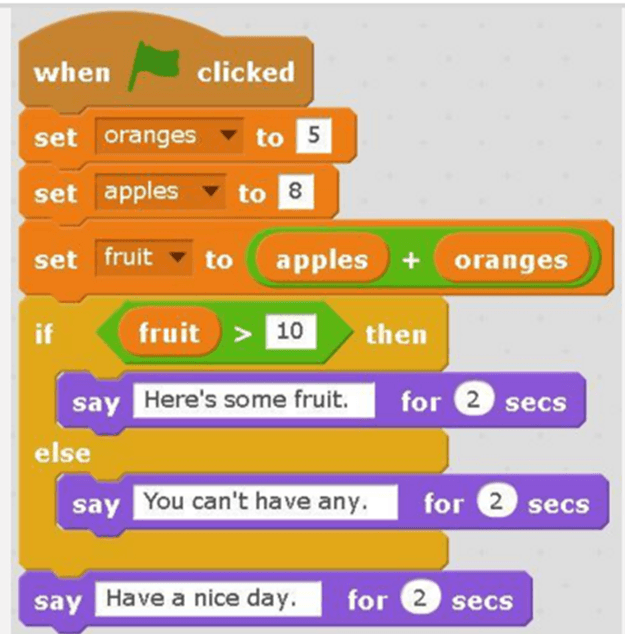
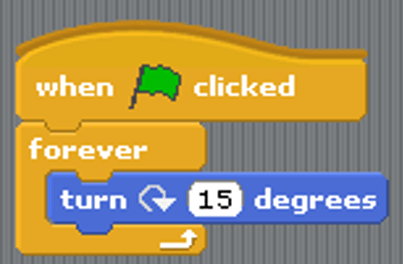
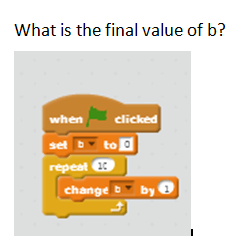
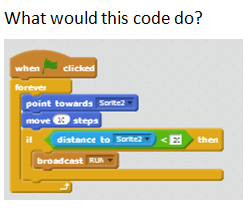

True or False
True
False

True or False
True
False

True or False
True
False

What will the sprite do?
Turn right
Turn left

Do the variables' values effect the if-then-else statement?
Yes
No

How many degrees will the sprite turn each iteration?
10
57
30
0
Variables have a name and a _______
Value
Number
Word
Duck
Which is not a valid value for a Boolean?
true
false
yes
None of these are correct.
What programming concept means following steps in order?
Iteration
Sequence
Selection
What type of language is Scratch?
Procedural
Iterative
Block
Functional
Which word below describes iteration?
Order
Steps
Loop
Decision
Which of the words below describe selection?
Order
Steps
Loop
Decision
What is a character in Scratch called?
Bat
Cat
Sprite
Crab
What is the default Sprite when you open Scratch?
Cat
Dog
Bat
Crab
What group of blocks controls movement of the Sprite?
Control
Sensing
Motion
Look
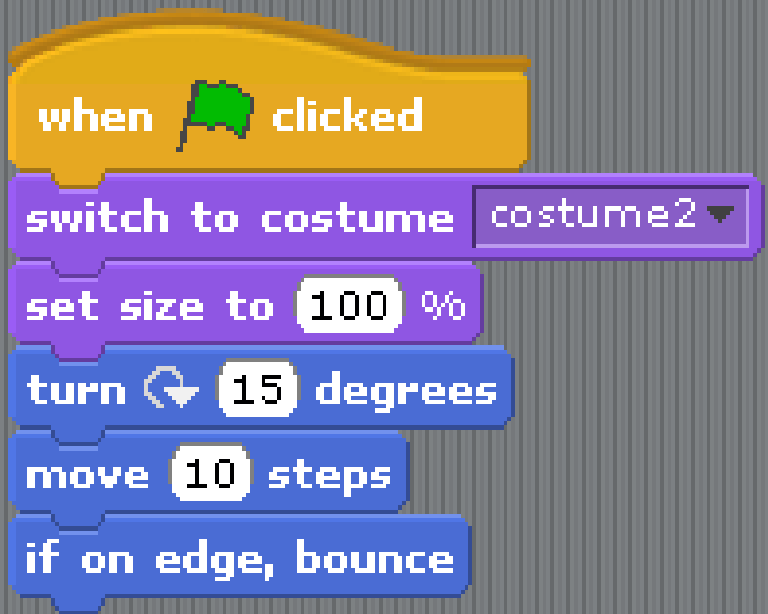
What it this code an example of?
Iteration
Selection
Sequence
Repetition


you can NOT change the back drop of the stage .
true
false
what are the two axis in scratch
x and y
n and t
j and w
k and somethig

what will the sprite do ?
does it move ?
walk
move
when the green flag is clicked the sprite will move ten steps forword
what is scratch?
a programming language
some application
an educational application


