
 Worksheets
IB Economics HL-Oligopoly
Total questions: 71
Worksheet time: 1hrs 13mins

A
B
C
D

A
B
C
D

A
B
C
D

A
B
C
D

A
B
C
D

A
B
C
D

A
B
C
D

A
B
C
D

A
B
C
D

A
B
C
D

A
B
C
D

A
B
C
D

A
B
C
D

A
B
C
D

A
B
C
D

A
B
C
D

Equilibrium price for the oligopolist is at
0e
0f
0g
0h

The price charged by the profit-maximising oligopolist would be
0a
0b
0c
0d

The per unit profit made by the profit-maximising oligopolist is
ab
bc
cd
ac

Price rigidity is shown by the range of marginal costs
ab
bc
cd
ac
What characteristics does Oligolopy
Firms producing almost or all output
Large capital requirements or other factors limit the numbers of firms
Firms producing little or no output
Large capital requirements or other factors help make it easy to make more firms
None of these
Would McDonalds be in the Oligopoly Industry
yes
no
Would Aircraft companies be in the oligopoly industry
Yes
No
Would Aircraft companies be in the oligopoly industry
Yes
No
Markets like automobiles, cell phones, cable TV, and internet providers are examples of which market structure?
Monopoly
Oligopoly
Perfect competition
Monopolistic competition
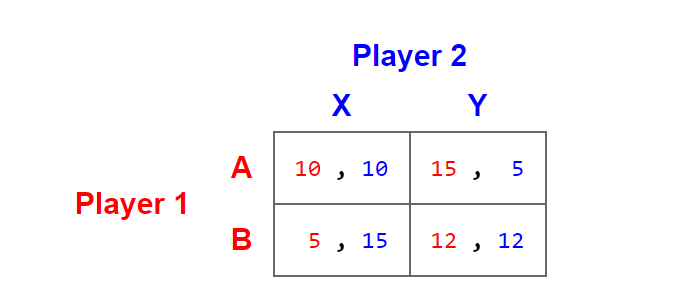
Oligopoly is a market structure characterized by:
independence in decision making
regulated natural monopolies
substantial diseconomies of scale
a large number of small firms
strategic behavior between rival firms
Oligopoly is a market structure that is characterized by a _____ number of ______ firms that produce _____ products.
large; relatively small, independent; identical
small; independent; identical or differentiated
large; relatively small, independent; differentiated
small; independent; differentiated
small; interdependent; identical or differentiated
An extreme case of oligopoly in which firms collude to raise joint profits is known as a:
duopoly
cartel
dominant producer
price war
price leadership
When firms openly agree on price, output, and other decisions aimed at achieving monopoly profits, those firms are practicing
overt collusion
tacit collusion
price leadership
price-taking behavior
price discrimination
The cartel model of oligopoly predicts that
all firms in the industry act in unison to set monopoly price
each producer acts independently of others
firms follow the low-price firm in the industry
differences in cost of production discourage individual firms from cheating
the markup on marginal cost should be the same for all firms
Collusion, price leadership, and price wars are usually observed in which of the following market structures?
Perfect Competition
Monopolistic Competition
Oligopoly
Monopoly
Natural Monopoly
One of the assumptions underlying the kinked demand curve is that oligopolists
Sell to consumers who are less sensitive to price increases than price decreases
Expect their rivals to match any reduction in price
Leave their prices unchanged if a competitor reduces his price
Increase their prices in response to an increase in the price charged by a competitor
What would facilitate collusion between firms in an oligopolistic industry
An increase in the number of firms
large fluctuations in demand
rapid changes in technology
a standardised product
Some of the firms in an industry agree to set the same price. What would threaten the continuation of the agreement?
homogeneity of the product
the inclusion of the dominant firm in the industry
differences in cost structures between firms
significant barriers to enter into the industry
Which of these is not a feature of an oligopolistic market?
Firms acting as price makers
Extensive price competition
The number of firms is usually small
Firms are interdependent

The diagram shows the cost and revenue curves of an oligopolist. In the initial situation, AC1 is its average cost curve, MC1 is its marginal cost curve and the firm is in equilibrium at output OQ and price OP.
The cost of labour rises, so that AC2 and MC2 become the relevant cost curves.
What should the firm do to maximise profit in this new situation?
Leave both price and output unchanged
Leave price unchanged and increased output
Raise price and leave output unchanged
Raise price and reduce output

what is an oligopoly
a market is shared by a small number of producers or sellers.
market is controlled by 1 producer
a large company that has or attempts to gain monopolistic control of a market
the next monopoly game
Game theory is used to explain
why firms price discriminate
how monopolies evolve into oligopolies
strategic behavior of firms in oligopoly
profit maximization in monopoly
price leadership of monopolistic competition
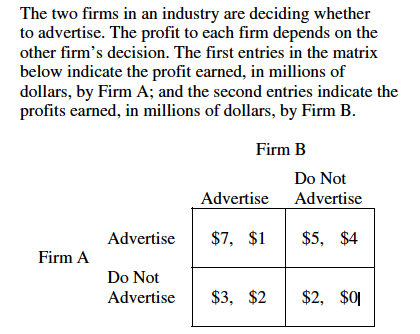
Based on the payoff matrix, which of the following is correct?
Firm A always gets a smaller share of the industry profits.
Firm A’s dominant strategy is to advertise.
Firm B’s dominant strategy is not to advertise.
The dominant strategy for both firms is not to advertise.
Neither firm has a dominant strategy.
One difference between oligopolies and monopolistically competitive markets is that
there is no deadweight loss in monopolistically competitive markets, but there is in oligopolies
the products sold in monopolistically competitive markets are identical
oligopolies have fewer barriers to entry
firms maximize profits in monopolistically competitive markets but not in oligopolies
there are fewer firms in oligopolistic markets than in monopolistically competitive ones
The concentration ratio measures the
Number of plants owned by an oligopoly.
Percentage of total profits made by a firm in a specific market.
Proportion of total output produced by the four largest producers in a specific market.
Relative size of a firm compared to other industries.
The goal of a company in an oligopoly industry is to
Increase market share and profits.
Obtain the highest price possible.
Always follow rivals if they raise price.
Be the market leader in innovation.
A kinked demand curve indicates that rival oligopolists match all
Increased advertising.
Advertising reductions.
Price increases.
Price reductions.
The study of how decisions are made when strategic interaction between firms exists is known as
Game theory.
Contestable market theory.
Market power theory.
Predatory pricing theory.
A model of Game Theory of oligopoly is known as the:
a) Prisoner's Dilemma
b) Monopoly Cell
c) Jailhouse Sentence
d) Jury Box
In which of the following markets is an oligopoly most likely to occur?
A the market for petrol
B the market for tea
C the market for apples
D the market for haircuts
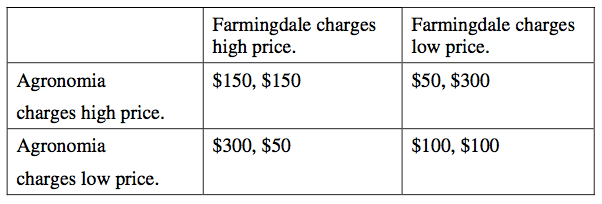
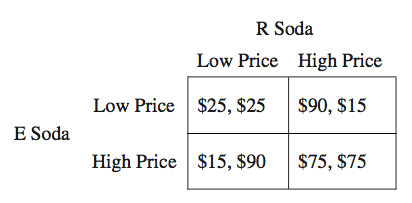
the soft-drink industry. The companies cannot cooperate. Each firm can follow a high-price strategy or a low-price strategy for pricing its product. In the payoff, the first entry in each cell shows the profits to E Soda and the second entry shows the profits to R Soda. It can be concluded that:
Game theory is used to explain
why firms price discriminate
how monopolies evolve into oligopolies
strategic behavior of firms in oligopoly
profit maximization in monopoly
price leadership of monopolistic competition
Game theory reveals that
each player looks after what is best for the industry.
firms in an oligopoly are not interdependent.
firms in an oligopoly choose their actions without regard for what other firms might do.
the equilibrium might not be the best solution for the parties involved.
if all firms in an oligopoly take the action that maximizes their profit, then the equilibrium will have the largest combined profit of all the firms.
In this market, 2-24 firms control the market, products can be slightly differentiated, there are high barriers to entry, & lots of control over price
Monopoly
Oligopoly
Perfect Competition
Cartel
"Oil Princes" in Saudi Arabia are examples of...
monopoly
oligopoly
monopolistic competition
perfect competition
If a firm can change market prices by altering its output, then it
Has market power.
Faces a flat demand curve.
Is a price taker.
Engages in marginal cost pricing
The only market structure in which there is significant interdependence among firms with regard to their pricing and output decisions is
Monopolistic competition.
Monopoly.
Oligopoly.
Perfect competition.
Product differentiation refers to
Features that make one product appear different from competing products in the same market.
Different prices for the same product in a certain market.
The selling of identical products in different markets.
The charging of different prices for the same product in different markets.

