Wayground logo

Free Printable Worksheets

Font size

S
M
L
XL
Worksheets

Static & Current Electricity

Total questions: 100

Worksheet time: 3hrs 31mins

Name
Class
Date
1.
If an object has the same number of positive and negative charges, its electrical charge is...
a)
positive
b)
negative
c)
neutral or no charge
d)
opposite
2.
True or False
A positively charged object has lost electrons
a)
True
b)
False
3.
True or False
A negatively charged object has lost protons
a)
True
b)
False
4.
Materials that tightly hold on to their electrons are considered 
a)
Good conductors
b)
Good insulators
c)
Good anti-static agents
d)
Useful for storing charge
5.
Materials that easily loose or accept electrons are considered
a)
Good conductors
b)
Good insulators
c)
Good anti-static agents
d)
Good for storing charge
6.
Which one of these objects is a good insulator
a)
Copper wire
b)
Glass
c)
Aluminum 
d)
Gold
7.
What is the major difference between static electricity and current electricity?
a)
Current electricity involves a continuous flow of neutrons; static electricity is a sudden transfer of protons
b)
Current electricity can be deadly; static electricity is almost always safe
c)
In current electricity, there's a single transfer of electrons; in static electricity, there's a steady flow of electrons
d)
Current electricity involves a flow of electrons; static electricity involves a single transfer of electrons
8.
Charge separation in clouds is one way
a)
that freezing rain occurs
b)
that lightning occurs
c)
that low pressure system occurs
d)
that a tornado occurs
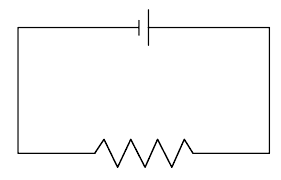
9.
Which term is not a method for charging an object with static electricity
a)
Alternating Current
b)
Induction
c)
Conduction
d)
Friction
10.
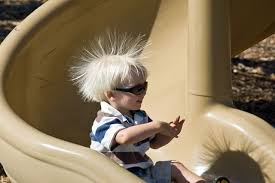
What method of static charging is shown in this picture
a)
Polarization
b)
Friction
c)
Induction
d)
Conduction
11.
Ms Jo Jo rubbed two balloons with a piece of wool. What will happen when the balloons are brought near each other?
a)
The balloons will repel each other.
b)
The balloons will attract each other.
c)
The balloons will become positively (+) charged.
d)
The balloons will pop.
12.
If a substance has a higher number of electrons than protons on its surface, what type of charge does it have?
a)
A positive charge.
b)
A negative charge.
c)
A neutral charge
d)
No charge at all
13.
What happens when you touch a metal doorknob after rubbing your shoes on the carpet?
a)
The doorknob sends a burst of electric current into your body
b)
Millions of electrons go from your finger into the doorknob
c)
The doorknob sends millions of electrons into your finger
d)
our finger becomes negatively charged
14.
Lightning is _____.
a)
a buildup of neutrons
b)
harmless
c)
a high-voltage electric current
d)
a large discharge of static electricity
15.
An object becomes charged when the atoms in the object gain or lose
a)
electrons
b)
protons
c)
neutrons
d)
all of the above
16.

Bending water with a charged balloon is an example of what phenomenon?

a)

friction

b)

polarization

c)

conduction

d)

induction

17.

The difference between attraction and repulsion is that to attract is to pull something closer and repel is to push something away.

a)

True

b)

False

18.

the positively charged particle in an atom, never leaves the nucleus, determines the element

a)

proton

b)

neutron

c)

electron

19.

During a lab a balloon was rubbed with a wooly fabric. This is an example of which type of charging?

a)

conduction

b)

friction

c)

induction

d)

polarization

e)

grounding

20.

the negatively charged particle in an atom, moves freely, can be released, shared, or “stolen” from an atom

a)

proton

b)

neutron

c)

electron

21.

Lightning occurs because ___.

a)

the negative charges at the bottom of clouds are attracted to the positive charges on the ground.

b)

the positive charges at the bottom of clouds are attracted to the negative charges on the ground.

c)

the positive and negative charges inside clouds are attracted to each other

d)

All of these reasons are correct.

22.
When distance increases, electrostatic force ____________; we call this relationship ____________ proportional
a)
decreases;directly
b)
decreases;inversely
c)
increases;inversely
d)
increases;directly
23.
What variable do "Newtons" represent?
a)
Electrostatic Charge
b)
Force
c)
Distance
d)
Mass
24.

What happens to the force between two charged objects when you double the distance between them?

a)

becomes 2X greater

b)

becomes 1/2 as large

c)

becomes 4X greater

d)

becomes 1/4 as large

25.

If the value of each of the charges doubles, what happens to the force?

a)

Quadruples

b)

Doubles

c)

Stays the same

d)

Reduced by half

26.
When distance increases, electrostatic force ____________; we call this relationship ____________ proportional
a)
decreases;directly
b)
decreases;inversely
c)
increases;inversely
d)
increases;directly
27.
What variable do Coulombs represent?
a)
Electrostatic Charge
b)
Force
c)
Distance
d)
Mass
28.

The graph shows the relationship between the force of interaction and the magnitude(size) of charge. What type of relationship is this?

a)

Direct

b)

Indirect

c)

Inverse

d)

Reverse

29.

Recap:

Coulomb’s law states that the force between two charged objects will __________ when the magnitude of the object’s charge increases.

Coulomb’s law also states that the force between two charged objects will __________ when the distance between objects increases.

a)

increase; increase

b)

increase; decrease

c)

decrease; increase

d)

decrease; decrease

30.
Which of these substances conducts electricity the best?
a)
wood
b)
brick
c)
copper
d)
plastic
31.
The plastic covering is there to:
a)
Provide a conductor for electrical energy to flow.
b)
Provide an insulator so that electrical energy will not pass outside of the wires.
c)
Provide a conductor so that electrical energy can NOT flow.
d)
Provide an insulator so that electrical energy can flow.
32.

The image shows two charged particles with a force of 2.4 N. What would you predict the force of interaction would be when the magnitude of charge on q2 doubles?

a)

9.6 N

b)

4.8 N

c)

1.2 N

d)

.6 N

33.

The image shows two charged particles with a force of 2.4 N. What would you predict the force of interaction would be when the distance doubles?

a)

4.8 N

b)

1.2 N

c)

.6 N

d)

.3 N

34.
The Electric Force is strongest when charges are...
a)
close together
b)
far apart
c)
the electric force is constant everywhere
35.
Calculate the force exerted between two charged objects separated by a distance of 0.6 m. One object has a charge of -5 C and the other has a charge of +2.0 C.
a)
-1.5E-11 N
b)
2.5E-11 N
c)
-2.5E11 N
d)
-7.5E-10 N
36.
During a physics lab, a plastic strip was rubbed with cotton and became positively charged. The correct explanation for why the plastic strip becomes positively charged is that ...
a)
the plastic strip acquired extra protons from the cotton.
b)
the plastic strip acquired extra protons from the charging process 
c)
protons were created as the result of the charging process
d)
the plastic strip lost electrons to the cotton during the charging process 
37.

The figure shows a neutral glass rod and a positively charged metal sphere.


Which of the following best describes the movement of charges as this glass rod touches the sphere?

a)

Positive charges move from the sphere to the glass rod.

b)

Negative charges move from the sphere to the glass rod.

c)

Negative charges move from the glass rod to the sphere.

d)

Positive charges move from the glass rod to the sphere.

38.
How many electrons are necessary to produce 1.0 C of negative charge? (e = 1.60 × 10⁻¹⁹ C)
a)
6.3 × 10¹⁸ 
b)
6.3 × 10⁹ 
c)
1.6 × 10¹⁹ 
d)
1.6 × 10⁹ 
39.
In a good insulator, electrons are usually
a)
free to move around
b)
free to move around after an impurity has been added
c)
semi-free to move around
d)
tightly bound in place
40.
What is voltage?
a)
The amount of electric potential energy per one coulomb of charge
b)
The amount of 1 coulomb of charge per unit of potential energy
c)
The number of volts per coulomb
d)
The amount of electric potential energy per volt
41.

The difference in electrical potential energy between two places is called …………...

a)

resistance

b)

friction

c)

induction

d)

voltage

42.
At which point is the electric field the weakest?
a)
A because it is the furthest away
b)
A because the field lines are further apart
c)
C because the field lines are further apart
d)
C  because it is the furthest away
43.
Where does electricity enter and exit the bulb?
a)
1 and 2
b)
2 and 3
c)
3 and 4
d)
4 and 1
44.
Which part of the bulb gives off light? 
a)
1
b)
2
c)
3
d)
4
45.
Lightbulbs use electricity to make light. What else do lightbulbs often give off?
a)
Food energy
b)
Heat Energy
c)
Solar Energy
d)
Wind Energy
46.
One D size battery produces 1.5 volts. How many total votes would 20 D-cell batteries produce?
a)
7.5 volts
b)
30.0 volts
c)
21.5 volts
d)
35.5 volts
47.
In the picture, what powers the circuit?
a)
1
b)
2
c)
3
d)
4
48.
In the picture, which is the receiver (receiving the electricity)?
a)
1
b)
2
c)
3
d)
4
49.
In the hidden circuit box, you saw that #2 and #5 were connected with a piece of wire. Also, #2 and #7 were connected. If you closed the box and used your circuit tester to touch #5 and #7, the bulb would light. 
a)
True
b)
False
50.
Which of these symbols represents a switch? Select the symbol for a switch from the choices provided. 
a)
A
b)
B
c)
C
d)
D
51.
Which diagram shows two bulbs in a series?
a)
1
b)
2
c)
3
d)
4
52.

Which do you expect to have the brightest light?

a)

1

b)

2

c)

3

d)

4

53.
Which circuit diagram matches this picture of a circuit?
a)
A
b)
B
c)
C
d)
D
54.

What is not needed in order to create a working circuit?

a)

battery (power source)

b)

lightbulb

c)

current

d)

closed circuit

55.

What is the voltage of a circuit with 4 ohms of resistance and 3 amps of current?

a)

12 V

b)

21 V

c)

4/3 V

d)

3/4 V

56.

What is the current in a circuit with 6 ohms of resistance and a battery containing 24 Volts?

a)

1/4 A

b)

144 A

c)

4 A

d)

0.4 A

57.

What is the resistance of a lightbulb that experiences 9 Volts and 3 amps of current?

a)

1/3 ohms

b)

3 ohms

c)

27 ohms

d)

9 ohms

58.

If a circuit had 4 D-Cell batteries (each 1.5 V) and a lightbulb with resistance of 2 ohms, what is the current that flows through the circuit?

a)

2 A

b)

3 A

c)

6 A

d)

8 A

59.

What is current?

a)

the amount of push the electrical source supplies to the circuit

b)

how much a given device resists the flow of electric current

c)

flow of electric charge

d)

none of the above

60.

What is resistance?

a)

the amount of push the electrical source supplies to the circuit

b)

how much a given device resists the flow of electric current

c)

flow of electric charge

d)

none of the above

61.
What size resistor would produce a 3 Amp current flow with a 12 Volt battery
a)
1 Ohm
b)
3 Ohms
c)
4 Ohms
d)
12 Ohms
62.
What is current measured in?
a)
Ω (Ohms)
b)
V (Volts)
c)
A (Amps)
d)
W (Watts)
63.
What is resistance measured in?
a)
Ω (Ohms)
b)
V (Volts)
c)
A (Amps)
d)
W (Watts)
64.
What is the Voltage of a circuit that has a resistance of 5 Ω and a current of 2 A?
a)
25 V
b)
10 V
c)
2.5 V
d)
0.4 V
65.
The mathematical relationship among Voltage, Current, and Resistance
a)
Faraday's Law
b)
Tesla's Law
c)
Edison's Law
d)
Ohm's Law
66.
If the Voltage stays the same and Resistance is increased, Current will 
a)
Increase
b)
Decrease
c)
Stay the same
d)
X
67.
How many Volts would we need to produce a current flow of 8 Amps through a 6 Ohm resistor
a)
12 volts
b)
24 volts
c)
1.3333
d)
48 volts
68.
This circuit has a 24 volt battery and the resistor is 8 ohms. How many amps are running through the circuit?
a)
3 Amps
b)
192 Amps
c)
2 Amps
d)
4 Amps
69.
What size resistor would produce a 3 Amp current flow with a 12 Volt battery
a)
1 Ohm
b)
3 Ohms
c)
4 Ohms
d)
12 Ohms
70.
What would the circuit resistance be if a 7.5 Amp draw was present with the engine running and the charging system producing 15 Volts
a)
15 Ohms
b)
4 Ohms
c)
0.3333 Ohms
d)
2 Ohms
71.
Current times Resistance equals
 (I X R)
a)
Power
b)
Voltage
c)
Amperage
d)
Ohm
72.

Voltage divided by Resistance

(V / R)

a)

Current

b)

Power

c)

Ohms

d)

Watts

73.

Voltage divided by Current

(V / I)

a)

Current

b)

Power

c)

Resistance

d)

Watts

74.
If the Voltage is increased and the resistance stays the same, Current will
a)
Increase
b)
Decrease
c)
Stay the same
d)
X
75.
What voltage is needed to cause a 2A current flow through a 10Ω resistor?
a)
5V
b)
0.2V
c)
20V
d)
200V
76.
What voltage is needed to cause a 50A current flow through a 10Ω resistor?
a)
15V
b)
500V
c)
500 kV
d)
0.2V
77.
What resistance is needed to cause a 20A current flow because of a 100V battery?
a)
0.2Ώ
b)
2000Ώ
c)
120Ώ
d)
5Ώ
78.
What word means how much energy is given to / removed from the electrons.
a)
Current
b)
Voltage
c)
Resistance
d)
Power
79.
If the battery produced 12.6 Volts and what would be the current flow be for a 6 Ohm resistor
a)
2.1 Amps
b)
2.4 Amps
c)
1.71 Amps
d)
15 Amps
80.
a)

Battery

b)

Lines

c)

Resistor

d)

bulb

81.
a)

resistor

b)

Ammeter

c)

Voltmeter

d)

Switch

82.
a)

Ampere

b)

Switch

c)

Bulb

d)

Battery

83.
a)

voltage

b)

Voltmeter

c)

Volume

84.
a)

Ammeter

b)

Ampere

c)

And

85.
a)

zig zag

b)

Resistor

c)

Ammeter

86.

What kind of circuit is this?

a)

series

b)

parallel

87.

What type of circuit is show in the image?

a)

Series Circuit

b)

Parallel Circuit

88.

Pick the correct sentence.

a)

This circuit will work because it is a closed circuit.

b)

Energy will freely flow in this circuit.

c)

This circuit will not work because there is no energy source.

d)

This circuit will not work because there is no switch.

89.

A simplified conventional graphical representation of an electrical circuit.

a)

Circuit drawing

b)

Block diagram

c)

Charts

d)

Layout Plan

90.
A circuit that has two or more paths that electricity can follow
a)
parallel circuit
b)
series cirucit
c)
open circuit
d)
closed circuit
91.
If one burned out bulb causes all of the lights to fail in a circuit, what might you conclude?
a)
It is a parallel circuit.
b)
A heavier wire is needed.
c)
It is a series circuit.
d)
More batteries are needed.
92.
A student added another light to an electrical circuit and all the lights became dimmer in the circuit.  What is most likely the cause of the dimmer lights?
a)
The batteries are weak.
b)
The circuit is a parallel circuit.
c)
The light bulbs are hot.
d)
The circuit is a series circuit.
93.

In which of the following circuits will all of the remaining light bulbs go out if bulb 3 burns out?

a)
b)
c)
d)
94.

Irene bought a new house and has decided to rewire it. She wants to be able to turn

some lights off and have the others remain lit. What type of circuits should she use and

why?

a)

She should use parallel circuits because when one light turns off, the other lights remain lit.

b)

She should use series circuits because when one light turns off, the other lights remain lit.

c)

She should use parallel circuits because when one light turns off, the others turn off, too.

d)

She should use series circuits because when one light turns off, the others turn off, too.

95.

An electric current is traveling in a wire. A compass is placed under the wire with the current flowing from north to south. In response, the compass needle will-

a)

rotate because of a magnetic force that acts on the needle

b)

rotate because of an electric force that acts on the needle

c)

not move because moving electric charges do not exert magnetic forces on the needle

d)

not move because moving electric charges do not exert electric forces on the needle

96.

An electric current flows in a wire. What is one result?

a)

a magnetic field is created

b)

any nearby magnetic fields are destroyed

c)

nearby magnets lose their strength

d)

the metal of the wire cannot be affected by magnets

97.

Which of the following is a series circuit?

a)
b)
c)
d)
98.

Which of the following is a simple parallel circuit?

a)
b)
c)
d)
99.

Which switch, when opened, will make the light go out?

a)

Q

b)

R

c)

S

d)

T

100.

Which circuit will not light the bulb?

a)
b)
c)
d)