
 Worksheets
Unit 5.4 Quiz Review -- Rational Functions & their Graphs
Total questions: 50
Worksheet time: 4hrs 10mins
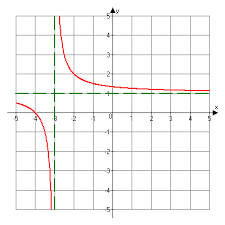
x = -3 ; y = 1
x = 3 ; y = 1
x = -3 ; y = -1
x = 3 ; y = -1

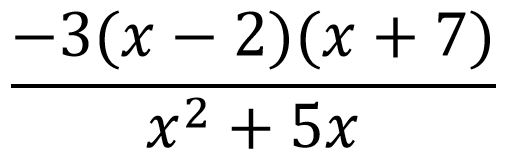
What is/are the vertical asymptote(s)?
There are no vertical asymptotes
x=5
x=-5
x=-1/2


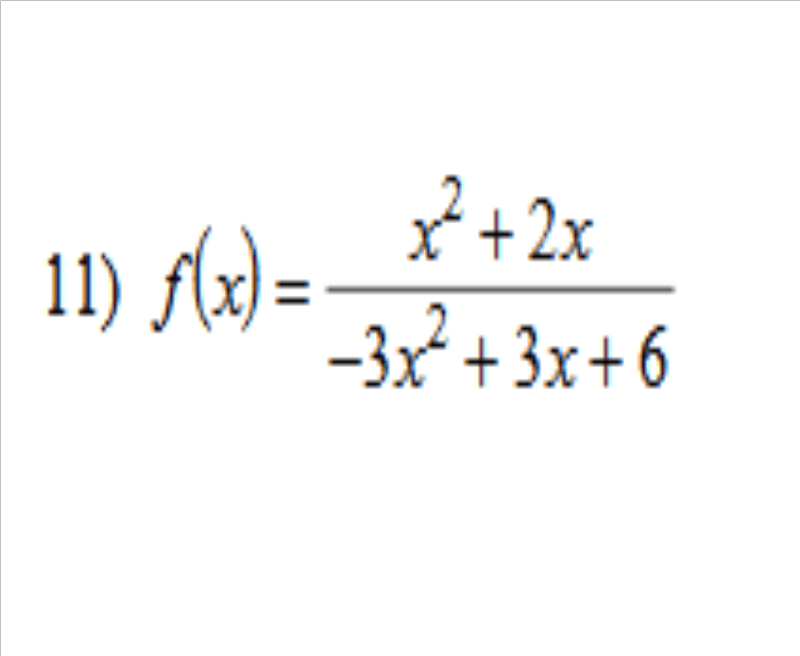
What is the x-coordinate of the hole?
x= 4
x= -4
x= 5
x= -5
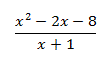
Determine whether the graph of the function has a vertical asymptote or a hole at x = -1.
Vertical Asymptote
at x = -1
Hole
at x = -1
Neither a VA or a hole at x = -1
Has both a VA and a hole at
x = -1
mmm...donuts

What is/are the x-intercepts of this graph?
(-2,0) and (2,0)
(-2,0) only
(3,0) only
(2,0) and (3,0)

(-3, 2)
(-3, 1/2)
(-5, 0)
There is No Hole
What creates a hole in the graph of a rational function?
Crossing the x-axis
An absence of dirt.
Crossing a vertical asymptote.
A factor that cancels out.
Making donuts...mmm

R: All real number y≠ 1
R: All real number y≠ -3
R: All real number y≠ 1
R: All real number y≠ 3
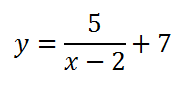

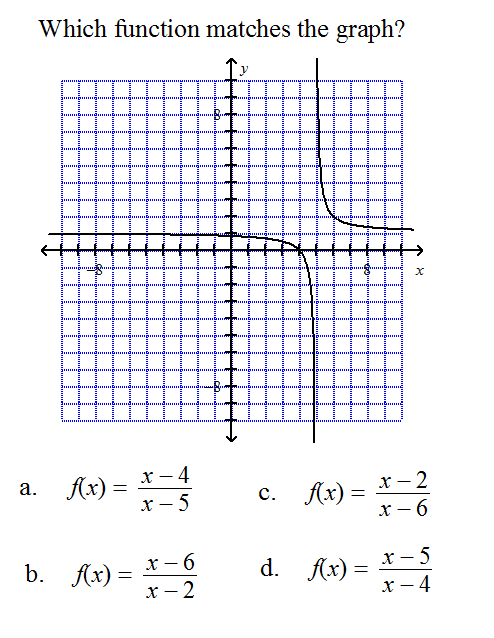
Which function matches this graph?
f(x)=x−24
f(x)=x+24
f(x)=x−2−4
f(x)=x+2−4
What is the end behavior of f(x)=x99+9x as x gets larger and larger?
The value of the expression gets closer and closer to 0.
The value of the expression gets closer and closer to 1.
The value of the expression gets closer and closer to 9.
The value of the expression gets closer and closer to 99.

Which of the following is NOT a vertical asymptote of the following function?
x = 4
x = -4
x = 2
x = -2

What is the domain for the following function?
All real numbers except 2.
All real numbers except -2.
All real numbers except 4.
All real numbers.

What is the range for the following function?
All real numbers.
All real numbers except for -2.
All real numbers except for 2.
All real numbers exceptt for 4.

What is the equation of the horizontal asymptote?
y = 0
y = -2
y = 2
There isn't one

What is the equation of the vertical asymptote?
x = 0
x = 4
x = -1, x = 4
x = -1

What are the coordinates of the hole, if one exists.
(-1, -2)
(-1, ½)
(-1, -½)
there isn't one

What is the domain?
x ≠ 3
x ≠ -1
x ≠ 3, -1
x ≠ 3, 1

Find the x-intercept(s), if one exists.
(1, 0)
(-1, 0)
(1, 0), (-1, 0)
(0, 0), (1, 0)

What are the coordinates of the y-intercept, if one exists.
(0, 0)
(0, 1)
(0, -1)
there isn't one

What is the equation of the slant asymptote?
y = x + 1
y = x + 2
y = x + 3
y = x

What is the equation of the slant asymptote?
y = x - 4
y = 4x - 4
y = 4x + 16
there isn't one

What are the x and y intercepts?
(4, 0) and (0, -4)
(-4, 0) and (0, -4)
(-4, 0) and (0, 4)
(0, 0) and (0, -4)

What is the equation of the graph?


What is the equation of the graph?


Write an equation for the graph.


Which statements are true for the given rational function. Select all that apply.
The horizontal asymptote is at y = 0.
There is a hole at (6, ¾ ).
The vertical asymptote is at x = -2.
The x and y intercepts are at the origin.
The domain is all real numbers except -2.

Write the equation for the graph.
y=x
y=x2
y=x1
y=∣x∣


How do you find the y-intercept?
replace all x-values with 0
replace all y-values with 0
set denominator equal to 0
compare the degrees of the numerator and denominator
How do you find the x-intercept?
replace all x-values with 0
replace the y-value with 0 or make the numerator equal 0
set denominator equal to 0
compare the degrees of the numerator and denominator
How do you determine the Horizontal Asymptote?
replace all x-values with 0
replace the y-value with 0 or make the numerator equal 0
set denominator equal to 0
compare the degrees of the numerator and denominator
When finding the H.A., if the numerator degree is greater than the denominator degree, the answer is...
y = 0
none
y = quotient of LC's
What's an H.A.?
When finding the H.A., if the numerator degree is equal to the denominator degree, the answer is...
y = 0
none
y = quotient of LC's
What's an H.A.?

What's the horizontal asymptote of the function?
y = 0
No horizontal asymptote
y = 1
y = 9

What's the horizontal asymptote of the function?
y = 0
No horizontal asymptote
y = 1/2
y = 1

What's the vertical asymptote of the function?
x = 5
x = 0
x =5 , x = -5
x = 25


What (if any) holes exist?
x=2
x=2 and x=3
x=-3
x=3
Given f(x)=x2+8x+15x2+10x+25 , which feature DOES NOT exist?
VA
HA
Hole
x-intercept

