wayground logo

Free Printable Worksheets

NEW

Font size

S
M
L
XL
Worksheets

Biological molecules

Total questions: 53

Worksheet time: 50mins

Name
Class
Date
1.
What is a biological molecule?
a)
organic molecule found in any organism
b)
any living thing
c)
any nonliving thing
d)
the building block of life
2.
What are the four biological molecules?
a)
proteins, carbohydrates, lipids, nucleic acids
b)
A, T, C, G
c)
water, air, earth, and fire
d)
Joe, Nick, and Kevin Jonas
3.
A biological polymer that stores and transmits genetic information is a ...
a)
nucleic acid
b)
carbohydrate
c)
lipid
d)
protein
4.
A biological polymer that stores and transmits genetic information is a ...
a)
nucleic acid
b)
carbohydrate
c)
lipid
d)
protein
5.
A biological polymer made of amino acid monomers is a 
a)
protein
b)
lipid
c)
carbohydrate
d)
nucleic acid
6.
What group of biological molecules contains DNA and RNA...
a)
Nucleic acids
b)
carbohydrates
c)
proteins
d)
lipids
7.
What is the primary function of carbohydrates in your body?
a)
Speed up chemical reactions.
b)
Give immediate energy.
c)
Help to store energy.
d)
Build cell walls in plants.
8.
A group of organic molecules that includes sugars, starch, and cellulose care called...
a)
proteins
b)
carbohydrates
c)
nucleic acids
d)
lipids
9.
Monomer of nucleic acids; consists of a phosphate group, deoxyribose (sugar), and a nitrogen-base. ATP is an example of this.
a)
steroid
b)
nucleotide
c)
polypeptide
d)
polymer
10.
What are the three components of a genetic molecule?
a)
A phosphate group, pentose sugar, and nitrogenous base
b)
Sucrose, Fructose, and Lactose
c)
A phosphate group, Pentose Sugar, and Oxygen base 
d)
A Carbon Group, Pentose sugar, and Oxygen Base
11.
What are the monomers of a polysaccharides?
a)
Amino Acids
b)
Nucleotides
c)
Triglycerides
d)
Monosaccharides
12.
A large, folded chain of amino acids.
a)
protein
b)
steroid
c)
monosaccharide
d)
enyzme
13.
Building blocks of polymers.
a)
monomer
b)
polypeptide
c)
monosaccharide
d)
glycerol
14.
A series of amino acids linked in a linear fashion
a)
polymer
b)
triglyceride
c)
polypeptide
d)
carbohydrates
15.
Carbohydrates broken down into smaller molecules for what purpose?
a)
to form cell membranes
b)
to form muscle
c)
to transmit genetic information
d)
to provide energy
16.
Which of the following best describes a DNA molecule?
a)
double helix
b)
contains ribose
c)
made of amino acids
d)
contains Uracil
17.
What type of fatty acid is this?
a)
Unsaturated
b)
Saturated
c)
Monounsaturated
18.
The bonds linking amino acids are called
a)
Peptide bonds
b)
Glycosidic bonds
c)
Ester bonds
19.
What two molecules make up a lipid?
a)
glycogen and fatty acids
b)
alpha and beta glucose
c)
glycogen and amino acids
20.
Carbohydrates, proteins and lipids are broken down in reactions called...
a)
Condensation reactions
b)
Hydrolysis Reactions
21.
Carbohydrates, proteins and lipid monomers are joined in reactions called...
a)
Condensation Reactions
b)
Hydrolysis Reactions
22.
The bonds linking amino acids are called
a)
Peptide bonds
b)
Glycosidic bonds
c)
Ester bonds
23.
The bonds linking monosaccharides into polysaccharides are called
a)
Peptide bonds
b)
Glycosidic bonds
c)
Ester bonds
24.
The bonds linking fatty acids to glycerol in triglycerides are called
a)
Peptide bonds
b)
Glycosidic bonds
c)
Ester bonds
25.
This is a section of which molecule?
a)
Amylopectin
b)
Amylose
c)
Cellulose
26.
This is a section of which molecule?
a)
Amylose
b)
Amylopectin
c)
Cellulose
27.
Which branch of the amino acid determines its overall function?
a)
Amino group
b)
Hydrogen atom
c)
Carboxyl Group
d)
R group
28.
What type of fatty acid is this?
a)
Unsaturated
b)
Saturated
c)
Monounsaturated
29.
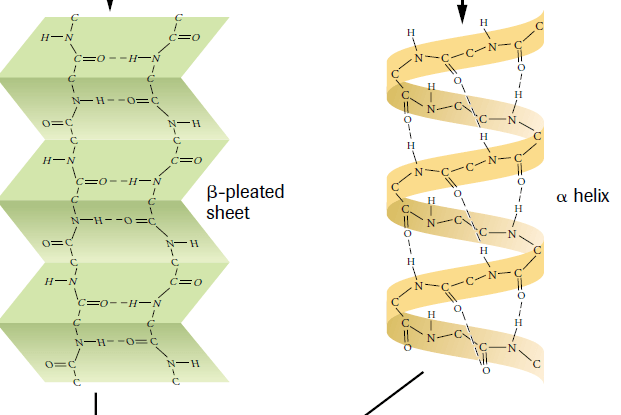
What level of protein structure is this?
a)
Primary
b)
Secondary
c)
Tertiary
d)
Quaternary
30.
Which isomer of glucose is this?
a)
Beta glucose
b)
Alpha glucose
c)
Neither
31.
Which of these is not a disaccharide?
a)
Maltose
b)

Galactose

c)
Sucrose
d)
Lactose
32.
Which type of reaction joins monomers together?
a)
Hydrolysis
b)
Condensation
c)
Glycosidic
d)
Peptide
33.
Which two polysaccharides contains 1,6 glycosidic bonds?
a)
Amylose and Amylopectin
b)
Amylopectin and Glycogen
c)
Cellulose and Glycogen
d)
Glycogen and Amylose
34.
How many fatty acid tails do phospholipids have?
a)
3
b)
1
c)
2
d)
4
35.

The diagram shows the structure of something called a triglyceride. A triglyceride is a

a)

fat

b)

protein

c)

carbohydrate

d)

sugar

36.

If the yellow and blue circles in this diagram represent amino acids, then this whole structure represents

a)

a protein

b)

a fat

c)

a reducing sugar

d)

a simple carbohydrate

e)

None of these

37.

Select the TRUE statement below

a)

Glucose and Lactose are complex carbohydrates

b)

Glucose and Glycogen are simple carbohydrates

c)

Glycogen and Lactose are complex carbohydrates

d)

Glucose and Lactose are simple carbohydrates

38.

Which of the following biological molecules contains the elements carbon, hydrogen and oxygen?


I. carbohydrates

II. proteins

III. fats

a)

I and II only

b)

I and III only

c)

II and III only

d)

I, II and III

39.

What is the function of protein in the body?

a)

cell growth and repair

b)

energy storage

c)

quick energy

d)

pushes food through the digestive system

40.

Which of the following biological molecules has a role in energy storage?

a)

protein

b)

carbohydrate

c)

fat

d)

vitamins

41.

Which of the following molecules is a quick source of energy?

a)

carbohydrate

b)

fat

c)

protein

d)

water

42.

Which carbohydrate strengthens plant cell walls?

a)

glucose

b)

starch

c)

glycogen

d)

cellulose

43.

Which carbohydrate is stored in animal cells?

a)

glycogen

b)

starch

c)

glucose

d)

cellulose

44.

Which of the following biological molecules are made of glucose?


I. cellulose

II. glycogen

III. starch

a)

I and II only

b)

I and III only

c)

II and III only

d)

I, II and III

45.

Which of the following biological molecules contain a type of acid?


I. carbohydrates

II. fats

III. proteins

a)

I and II only

b)

I and III only

c)

II and III only

d)

I, II and III

46.

Which type of biological molecule is shown in the picture?

a)

carbohydrate

b)

fat

c)

protein

d)

vitamin

47.

Which of the following are true for both starch and a protein?


I. They are long chains

II. They contain nitrogen

III. They contain hydrogen

a)

I only

b)

I and II only

c)

I and III only

d)

III only

48.

In humans, if too much glucose is present in the blood, it is taken to the liver.


In the liver these extra glucose molecules are joined together to form a larger carbohydrate.


What is the name of this larger carbohydrate?

a)

starch

b)

cellulose

c)

glycogen

d)

glycerol

49.

Which of the following could make one protein different to another protein?


I. the number of amino acids it contains

II. the sequence of amino acids

III. they contain amino acids

a)

I and II only

b)

I and III only

c)

II and III only

d)

I, II and III

50.

Which of these is not a type of lipid?

a)

Steroid hormone

b)

Glucose

c)

Phospholipid

d)

Triglyceride

51.

Haemoglobin is an example of a...

a)

Carbohydrate

b)

Protein

c)

Lipid

52.

Which of these is a lipid?

a)
b)
c)
d)
53.

The DNA molecule consists of monomers known as

a)

nucleotide

b)

nucleoside

c)

pyrimidine

d)

purine