
 Worksheets
LS-5 Ch5 Changes in Nature
Total questions: 52
Worksheet time: 17hrs 20mins
What does the model of evolution state?
A) Simpler organisms have remained unchanged over millions of years.
B) Simpler organisms have slowly changed through good mutations into new and more complex organisms over millions of years.
C) Complex organisms have evolved into simpler forms over millions of years.
D) Organisms have appeared suddenly without any changes over time.
What is a fossil?
A) A living organism found in the wild.
B) A type of rock formed from lava.
C) The preserved remains of plants and animals.
D) A newly discovered species of plant.
Arjun and Jackson are debating: Why can't science prove the correctness of beliefs about the world's past?
The past is too complex.
The past is no longer observable.
The past is irrelevant.
The past is well-documented.
Imagine you're a detective like Arjun or Grace, solving Earth's mysteries! What does uniformitarianism suggest about Earth's physical processes?
They happen at different rates in the past and present.
They happen at the same rate in the present time as in the past.
They only happened in the past.
They are unpredictable and random.
Hey Isla, Samuel, and Abigail! If you were time travelers exploring the age of Earth, according to uniformitarianism, how old could our planet be?
A few thousand years old.
Only a few million years old.
Millions or billions of years old.
Less than a million years old.
In a thrilling classroom debate, Rohan and Ava are discussing which phrase best describes the idea where only those best suited to their environment thrive. Can you help them out?
Struggle for existence
Survival of the fittest
Law of the jungle
Battle of the best
During a lively science class, Sophia asked, "What exactly is a mutation?"
A planned change in DNA
A random change in DNA
A change in behavior
A change in environment
Maya and Aiden are debating about evolution. Can you help them by answering: What does the modern synthesis model of evolution blend?
Mutation and adaptation
Mutation and natural selection
Natural selection and behavior
Adaptation and environment
Hey science explorers! Evelyn, Aria, and Mia are on a quest to uncover a genetic mystery. What does the fact that all organisms have DNA suggest according to the evolutionist view of genetics?
Cells
Common ancestor
Common designer
Common food
Hey there, curious minds! According to evolutionists, when two species share similar genes, what fascinating connection might they have?
They are unrelated
They are closely related
They have different ancestors
They have the same diet
Imagine you're a scientist like Nora, Arjun, or Maya. What do you think is needed for an organism to evolve in the grand adventure of evolution?
A few mutations
Millions of mutations
No mutations
A single mutation
Hey Zoe, why do you think evolutionists are convinced that the Earth is super old?
Is it because of the ever-changing weather patterns?
Could it be due to the countless years needed for millions of mutations?
Maybe it's because of the massive size of the Earth?
Or is it because of the sheer number of species we have?
Hey science explorers! Rohan and Abigail are on a quest to discover what homologous structures are. Can you help them figure it out?
Features that are unique to one type of organism
Structures that may have different functions (fin; arm; foreleg) but similar design
Structures that no longer have a function
Structures found only in embryos
Hey there, curious minds! Evelyn and Benjamin are having a debate about evolutionary theory. Can you help them out? What are vestigial structures according to evolutionary theory?
Structures that are essential for survival
Structures that are shared by all organisms
Structures that once had a function for a past ancestor, but no longer have a function
Structures that are only found in plants
Grace and Michael are curious about what evolutionists believe embryology reveals about vertebrate animals. Can you help them discover the secret?
They have different ancestors
Their embryos are completely different
They have a common ancestor
They develop in the same environment
Nora and Zoe are on a geology adventure! What is one of the challenges they might face when dating rocks?
It requires certain assumptions.
It is always accurate.
It does not involve any assumptions.
It is based on color.
Hey Aiden and Sophia, can you guess what's missing in the evolutionary record according to the text?
Transitional forms
Complete fossils
Accurate dating methods
Rock samples
During a lively classroom debate, Anika asked, "What does the term 'genetic load' refer to in our DNA discussions?"
The number of species in a population
The accumulated random mutations within the DNA of a population of organisms
The process of natural selection
The fossil record of ancient organisms
Emma and Henry are debating about the impact of random mutations. What do you think happens according to the text?
They add information.
They degrade information.
They have no effect.
They improve information.
In a lively debate, Noah and Mason are pondering: What intriguing question do homologous structures raise?
Do they point to a common ancestor or a common designer?
Do they have no function?
Are they unique to each species?
Are they always beneficial?
In a lively debate, Ava and Lily are discussing biology. Ava claims that vestigial structures are like forgotten relics of evolution. What do you, as a Christian think vestigial structures suggest?
They have no function.
They are always harmful.
They have valid functions.
They are unique to humans.
In a lively classroom debate, Michael and Abigail are discussing: What does the word "kind" in Scripture refer to?
A group of organisms that can evolve into different kinds
A distinct group of organisms that God created to reproduce
A random collection of animals
A type of plant species
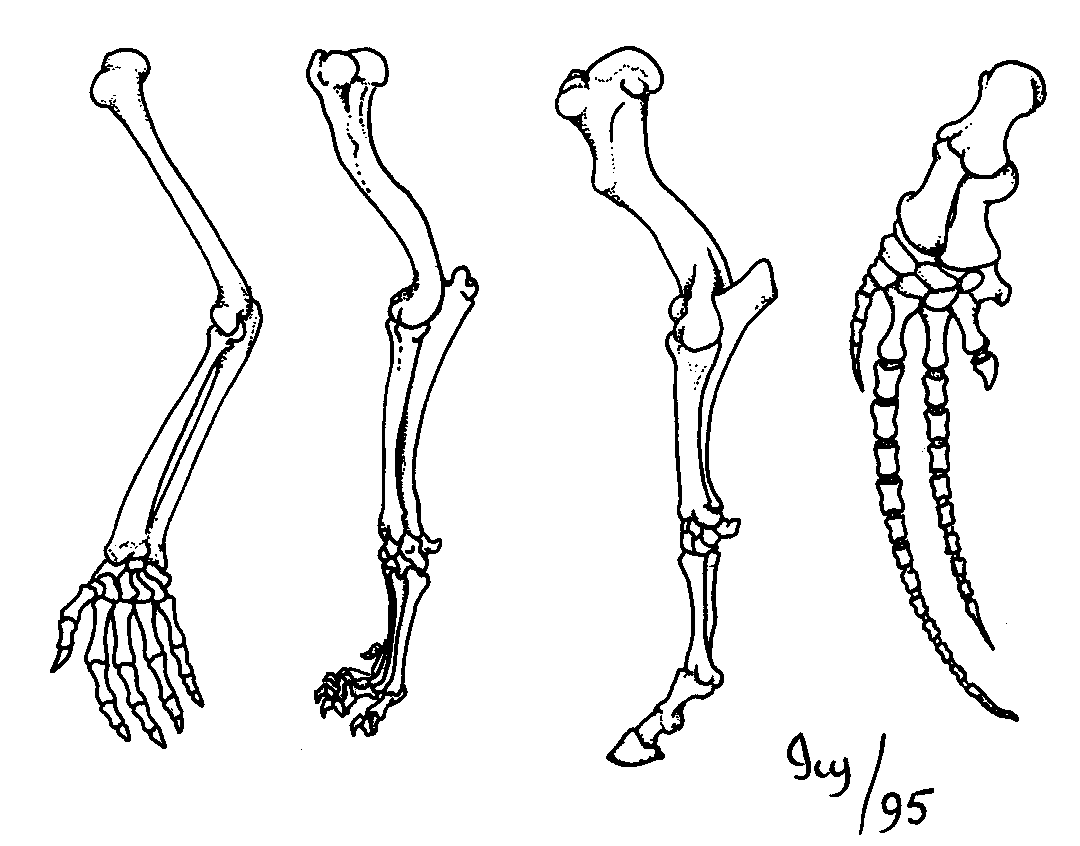
Evelyn and Daniel are exploring the wonders of biology! They discover structures with the same parts but different functions, hinting that organisms might share a common ancestry. What are these intriguing structures called?
vestigial structures
homologous structures
adaptive radiation
fossil
Nora and Aria are exploring the wonders of biology! Can you help them identify an example of a homologous structure ?
human arm and bird wing
rat appendix and human appendix
wing of butterfly and bird wing
During a lively classroom debate, Sophia asked, "What does the Creationism view rely on as its primary source to understand the world we live in?"
Mrs. Mac!
The Holy Bible
the natural world
historical evidence
Imagine you're in a classroom with Priya, Aria, and Aiden. Which theory suggests that an outside force (not necessarily God) crafted the natural world, using scientific study to support its claims?
Intelligent Design Theory
Creationism
Theory of Evolution
Big Bang Theory
Imagine you're in a classroom with Daniel, Evelyn, and Henry. The teacher asks: Which interpretation of the Genesis account suggests that the Heavens and the Earth were created from nothing in six, 24-hour days?
Long day theory
Literal view of creation
Gap theory
Progressive Creationism
Imagine you're on a time-travel adventure with Aria and Elijah! Whose groundbreaking observations of nature led to the theory of natural selection and macro-evolution?
Isaac Newton
Charles Darwin
Rosetta Stone
Aristotle
Hey there, science explorers! Anika and Evelyn are on a fossil hunt adventure. True or False: To form sedimentary fossils, animals need to be buried quickly. What do you think?
True
False
In a lively classroom debate, Benjamin asks, 'What is the biblical view of how organisms were originally created?'
Organisms evolved from simple to complex forms
Organisms were created in an incomplete form and developed over time
Organisms were created fully formed
Organisms were created to evolve into new kinds
In lab 5E, why did we use a random number generator?
Mutations are planned
Mutations are random
Mrs. Mac likes playing with spinners
To pick the right answer
In Lab 5E, the "mutations" made the sentence ______________
a brand new, clear sentence
much better
worse/nonsense
didn't change/stayed the same
The results we got in Lab 5E ___________ the theory of evolution
Proves
Supports
Neither supports nor doesn't support
Doesn't support
Why is variety important in a population? (hint... moths, Wolves, dogs....)
So the population can adapt to changes in their environment and they aren't wiped out by those changes.
because they look cooler
To evolve into new, better creations
Christians don't believe in variety
My friend, Drew, believes in evolution as fact. What is the best way to convince him about creationism?
Laugh at him and call him stupid
Ask him questions about evolution that show how it doesn't make sense and pray for him.
Call his pastor and tell on him
Not say anything, but talk about him behind his back
Why is it important for you to understand the Theory of Evolution?
It's not, who cares!
Because Mrs. Mac said so
Because Mrs. Mac wants us to see how believable and true it is.
Because the bible calls us to always be ready:
1 Peter 3:15 says, "Always be prepared to give an answer to everyone who asks you to give the reason for the hope that you have"
And we can't show how Creationism makes more sense if we don't understand what Evolution actually says.

Mutations are
always good
always bad
usually good
usually bad
Only mutations that happen in the __________ will effect future generations
gametes
body
brain
nose
What do the after-effects of Mt. St. Helens and the formation of Georgia’s “Little Grand Canyon” show about how long it might have taken the Grand Canyon to form?
The Grand Canyon must have taken millions of years to form slowly.
The Grand Canyon could have formed more quickly than people used to think.
The Grand Canyon was fomed by animals digging over time.
The Grand Canyon didn’t really form from erosion.
According to our experiment, AM5E, how did the mutations effect the genetic code?
some of the mutations made the code (sentence) better
Some of the mutations still made a word (codon) but the sentence still didn't make sense
The mutations made more sense (better proteins) than the original sentence
The bad mutations got fixed by good mutations to make the sentence make better proteins
How many transitional forms/fossils have been found?
100's
1000's
Millions
None
If evolution was true, how many transitional forms would you expect there to be?
1 or 2
LOTS
a few
None
What is one assumption that scientists who use evolution-based dating methods make when figuring out how old rocks are?
The Earth has always had the same number of plants and animals.
Radioactive elements decay at varying rates over time.
All rocks are made from the same minerals.
All rocks start with the same amount of radioactive elements at the same time
What is one of the problems with rock dating?
some people prefer classical music
some rocks are too small
volcanoes are always erupting
You have to know where you started to know how far you've come

Embryology is the study of _____.
development
speciation
fossils
similarities in embryos
How do evolutionists believe embryology supports the Theory of Evolution?
It shows that embryos who develop similarly share a common ancestor
It shows that embryos who develop similarly are not related to one another
It shows that organisms have the ability to get larger
How do Christians explain embryology?
It shows that embryos who develop similarly share a common ancestor
It shows that embryos who develop similarly are created by a common designer
It shows that organisms have the ability to get larger
In order for fossils to be created, carcasses must be
buried FAST
buried slowly
exposed for long periods of time
eaten by predators
Christian view point says fossils were created
because of a meteor
a violent volcano
by the flood
by earthquakes

Transitional fossils provide evidence of
no evolution
gradual change
variation
mutations
In the video where they interviewed the students and professors on campus, what VALID examples did they give of macro-evolution?
ducks to geese
bacteria
cats to dogs
NONE

