Font size
 Worksheets
Supply and Demand
Total questions: 33
Worksheet time: 21mins
The regulating force in the marketplace is (a) .
When more firms produce the same product, it means that (a) of that product is produced at a higher quality.
In a free market economy, the (a) does not interfere in the pricing.
As the price of goods or services increases, the quantity demanded decreases, and as the price decreases, the quantity demanded increases.
The Law of Demand
The Law of Supply
Marginal Costs
Equilibrium
As the price of goods increases, the quantity supplied goes up, and as the price decreases, the quantity supplied goes down
The Law of Demand
The Law of Supply
Marginal Costs
Equilibrium
If the price of fresh orange juice rises, consumers might switch to cheaper alternatives, such as frozen juice from concentrate. This is an example of ______.
the substitution effect
the income effect
the money supply
a monopoly
A table showing quantities of goods that would be supplied by one producer at different prices is ________
a supply schedule
a supply curve
price ceiling
productivity

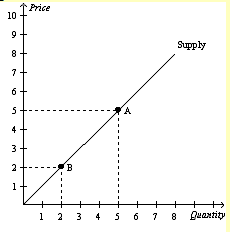
Which scenario caused a change in quantity demanded for gas from point A to point B?
The price of gas increased.
The price of gas fell.
The quality of gas worsened.
The supply of gas increased.

Which scenario caused a change in the quantity supplied from point C to point D?
The price of corn increased.
The demand for corn decreased.
The price of corn decreased.
The demand for corn increased.
When we graph the demand and supply curves on the same plane, they intersect at a point. This is the _________.
the equilibrium point
the supply curve
price fixing
the quota
It is an ideal economic situation.
The quantity of output per unit of input.
The point where there is no shortage or surplus.
The initial costs that businesses incur to establish themselves.
Factors other than the price that influence the demand for or supply of a product.
Standard of Living
Non-price determinants
Trade Deficit
All of these are examples of complimentary goods EXCEPT
soccer cleats and baseball bats
tennis balls and tennis rackets
printers and ink cartridges
cars and gasoline
A decrease in supply shifts the supply curve to the left because it brings (a) goods into the market.


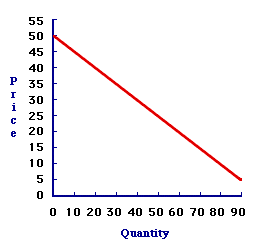
What will happen to the price of soccer balls if more and more boys and girls are learning to play soccer?
The price will increase
The price will decrease
What will happen to the price of teddy bears if puppy dogs become the most popular stuffed toy?
The price will increase
The price will decrease
What will happen to the price of T-Shirts if T-Shirt businesses now use machines that produce twice as many shirts in one hour?
The price will increase
The price will decrease
What will happen to the price of new cars if a weak economy causes people to have lower incomes?
The price will increase
The price will decrease

For the law of supply, as price rises, what happens to quantity supplied?
it goes up
it goes down
it stays the same
it is not effected

For the law of demand, as price rises, what happens to quantity demanded?
it goes up
it goes down
it stays the same
it is not effected

The amount of a good or service that is available to consumers
Supply
Demand
Saver
Spender