wayground logo

Free Printable Worksheets

Font size

S
M
L
XL
Worksheets

Plant Review

Total questions: 75

Worksheet time: 40mins

Name
Class
Date
1.
What is the outside layer of a seed?
a)
Seed Coat 
b)
Cotyledon
c)
Embryo 
d)
Plant Food 
2.
Keeps the plant in the soil
a)
Stem
b)
Flowers
c)
Roots 
d)
Seeds
3.
Carries water and nutrients to and from all the other parts of the plant.
a)
Flowers
b)
Leaves
c)
Stem
d)
Root
4.

Plants take in _________ for photosynthesis.

a)

Oxygen

b)

Carbon Dioxide

c)

Helium

d)

H2O

5.
Plants make their own food by___________.
a)
Going to Kroger.
b)
Photosynthesis.
c)
Eating sunlight.
d)
They don't make food. 
6.
Which is of the following is carried out in the leaves of plant?
a)
absorbing light
b)
producing flowers
c)
making seeds
d)
absorbing food
7.
How would plants survive best around leaf-eating animals?
a)
large fruit
b)
long stems
c)
sharp thorns
d)
colorful flowers
8.
What is the male part of the flower?
a)
Petals
b)
Stamen
c)
Pistil
9.
What is the part of the flower that is brightly colored to attract pollinators?
a)
Petals
b)
Stamen
c)
Pistil
10.
What part of the male part of the flower makes pollen?
a)
Ovary
b)
Anther
c)
Filament
11.
What part of the male part of the flower holds up the anther?
a)
Ovary
b)
Anther
c)
Filament
12.
What part of the female part of the flower gathers pollen?
a)
Stigma
b)
Style
c)
Filament
13.
What part of the female part of the flower is the place that holds the eggs?
a)
Ovary
b)
Style
c)
Filament
14.
What is the male reproductive material of plants?
a)
Seeds
b)
Pollen
c)
Fruit
15.
What part of the flower turns into the fruit?
a)
Sepals
b)
Ovary
c)
Stamen
16.
What organelle in the leaves of plants capture light energy from the sun to complete photosynthesis?
a)
Chloroplasts
b)
Mitochondria
c)
Nucleus
17.
Male reproductive parts of a plant....
a)
Petals and ovary
b)
Ovary and ovule
c)
Anther and filament
d)
Stigma and style
18.
In which part of the flower is pollen found?
a)
Filament
b)
Anther
c)
Ovary
d)
Xylem
19.
How does pollen reach the ovule?
a)
Stigma --> Style
b)
Style --> stigma
c)
Ovary --> stigma
d)
Ovary --> style
20.
After fertilization the ovule will....
a)
Be carried away by a pollinator
b)
Be blown away by the wind
c)
Will grow into a new plant
d)
Develop into a fruit that contains seeds
21.
What is the female part of the plant called?
a)
Stigma
b)
Pistil
c)
Stamen
d)
Style
22.
What part of the flower will turn into a seed?
a)
ovary
b)
anther
c)
ovule
d)
filament
23.
Brightly colored parts of flowers that attract insects.
a)
petals
b)
pistils
c)
stamen
d)
filaments
24.
This is the main support of the plant.
a)
Stem
b)
Root
c)
Vein
d)
Leaf
25.
These convert energy from sunlight into food for the plant through a chemical process called photosynthesis.
a)
Root
b)
Stem
c)
Leaves
d)
Flowers
26.

This is plant tissue that moves nutrients (food) from the leaves to other parts of the plant

a)

Xylem

b)

Phloem

c)

Photosynthesis

d)

DNA

27.

This transports water and minerals upwards from the roots to the stem.

a)

Xylem

b)

Phloem

c)

Photosynthesis

d)

Oxygen

28.
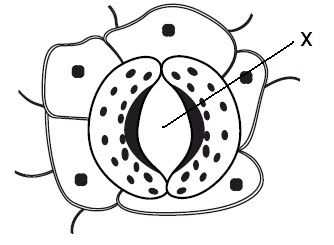
What are the cells that surround the stoma called?
a)
Water cells
b)
Guard cells
c)
Lignin
d)
Bark
29.
Most of the chloroplast cells are found in the
a)
upper epidermis
b)
pallisade mesophyll layer
c)
lower epidermis
d)
stomata
30.

The leaf has a shiny, waxy cuticle around it to

a)

increase the rate of photosynthesis

b)

attract more light

c)

stop water loss

d)

stop carbon dioxide and oxygen gases escaping
31.
The water needed for photosynthesis comes into the leaves through the
a)
upper epidermis
b)
stomata
c)
guard cells
d)
xylem cells
32.
The important gases, carbon dioxide and oxygen, enter and leave the leaf through the
a)
upper epidermis
b)
phloem
c)
stomata
d)
guard cells
33.
Which structures open and close stomata to allow gas exchange but prevent water loss in leaves?
a)
Epidermis
b)
Vascular tissue
c)
Guard cells
d)
Spongy mesophyll
34.

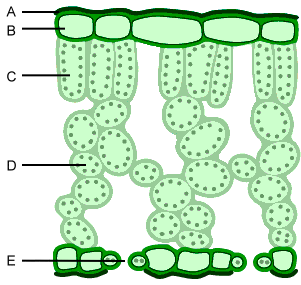
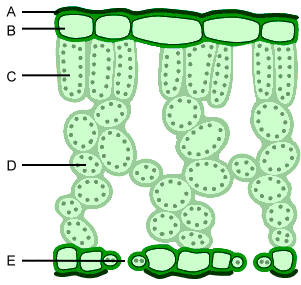
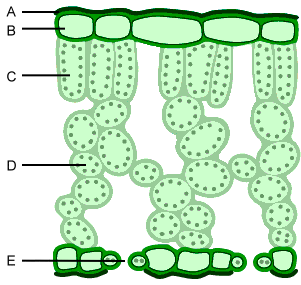
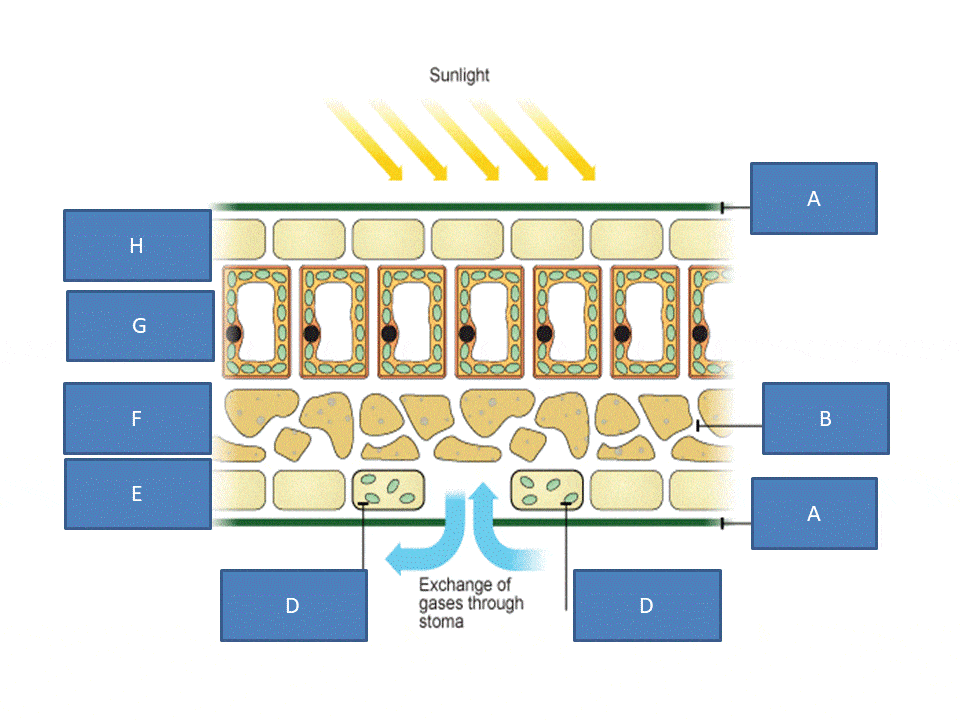
What is the name of the elongated, packed cells (part G) directly under the upper epidermis?

a)

Palisade cells

b)

Guard cell

c)

Spongy layer

d)

Lower epidermis

35.

What is letter "A" pointing to?

a)

cuticle

b)

upper epidermis

c)

lower epidermis

d)

palisade mesophyll

36.

What is letter "D" pointing to?

a)

upper epidermis

b)

palisade mesophyll

c)

spongy mesophyll

d)

bundle sheath

37.

Which of the following is pointing to the "guard cell"?

a)

B

b)

C

c)

D

d)

E

38.

Which number is pointing to the stomata?

a)

6

b)

7

c)

8

d)

9

39.

The outermost layer of CELLS of the leaf is the

a)

cuticle

b)

epidermis

c)

spongy mesophyll

d)

bundle sheath

40.

This layer of cells is where photosynthesis occurs within the leaf; there are air spaces within this layer

a)

spongy mesophyll

b)

palisade mesophyll

c)

chloroplast

d)

upper epidermis

41.

The cell organelle where photosynthesis occurs in plant cells is the

a)

chloroplast

b)

mitochondrion

c)

vacuole

d)

nucleus

42.

Which two layers of the plant contain chloroplasts?

a)

xylem and phloem

b)

upper and lower epidermis

c)

cuticle and upper epidermis

d)

palisade and spongy mesophyll

43.

Which number is pointing to the vein or vascular bundle of the leaf?

a)

2

b)

3

c)

4

d)

7

44.
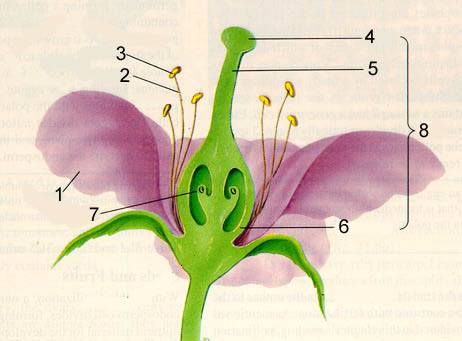
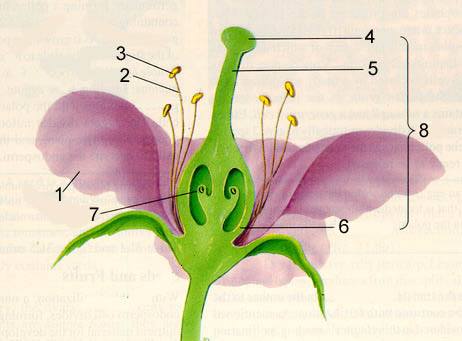
What is #1 pointing to?
a)
ovary
b)
petal
c)
stigma
d)
stamen
45.
What is #8 pointing to?
a)
petal
b)
stamen
c)
pistil
d)
ovary
46.
What is #2 pointing to?
a)
anther
b)
filament
c)
ovary
d)
style
47.
What is #3 pointing to?
a)
stigma
b)
filament
c)
ovary
d)
anther
48.
What is #4 pointing to?
a)
anther
b)
style
c)
stigma
d)
ovary
49.
What is #5 pointing to?
a)
anther
b)
filament
c)
stigma
d)
style
50.
What is #6 pointing to?
a)
stigma
b)
style
c)
ovary
d)
petal
51.
Where is pollen made?
a)
ovary
b)
petal
c)
pistil
d)
anther
52.
What is the sticky part of the flower that catches pollen?
a)
style
b)
stigma
c)
ovary
d)
petal
53.
What part of the flower will turn into a seed?
a)
ovary
b)
anther
c)
ovule
d)
filament
54.
What part of the flower will turn into a fruit?
a)
petal
b)
ovary
c)
ovule
d)
stamen
55.
The filament___________
a)
holds up the anther
b)
protects the petal
c)
is the male part of the flower
d)
catches pollen
56.
The style____________
a)
connects the stigma to the ovary
b)
holds up the anther
c)
smells great
d)
produces pollen grains
57.
The sepal_________
a)
smells good
b)
protects and supports the flower
c)
attracts other animals
d)
produces pollen grains
58.

Which of the following is NOT a function of the roots?

a)

Store carbs

b)

Absorb water and minerals

c)

Anchor plant to the ground

d)

Photosynthesis

59.

What type of root is in this image?

a)

tap root

b)

fibrous root

c)

bulb

60.

What type of roots is in this image?

a)

bulb

b)

tap root

c)

fibrous root

61.

What are the three reactants (things needed) that plants take in to make photosynthesis?

a)

glucose, oxygen and light energy

b)

light energy, carbon dioxide and water

c)

carbon dioxide, oxygen and water

d)

glucose , oxygen and carbon dioxide

62.

What are the two products of photosynthesis? (what comes OUT of photosynthesis)

a)

carbon dioxide and oxygen

b)

water and sugar

c)

light energy and carbon dioxide

d)

glucose (sugar) and oxygen

63.

Plants make their own food through photosynthesis. An organism that is able to make its own food is called a(an) ___________.

a)

hetertroph

b)

autotroph

c)

decomposer

d)

prokaryote

64.

What is the main function of a plant's roots?

a)

make food for the plant

b)

anchor the plant, absorb and store nutrients and water

c)

release excess water

d)

aids in reproduction of the plant

65.

When the male sex cells enter the ovule it is called (when egg and sperm combine)

a)

pollination

b)

fertilization

c)

respiration

d)

photosynthesis

66.

What is the cotyledon of a seed?

a)

baby plant

b)

food for the embryo

c)

protective covering of the seed

d)

where photosynthesis occurs

67.

What is A?

a)

embryo

b)

cotyledon

c)

seed coat

68.

What type of root has many thin roots?

a)

fibrous roots

b)

creeping roots

c)

water roots

69.

What type of root reaches deep into the soil to obtain water and nutrients?

a)

creeping roots

b)

fibrous roots

c)

taproots

70.

Why do plants have flowers?

a)

They are pretty.

b)

They smell good.

c)

They produce seeds.

d)

They are colorful.

71.

This is an example of what type of root?

a)

Green bean

b)

taproot

c)

fibrous

72.

Select ALL functions of the stem.

a)

Transports materials between roots and leaves.

b)

Supports the plant.

c)

Produces pollen.

d)

Some plants store food in it.

e)

Helps prevent landslides.

73.

This is a(n) ________________________ stem.

a)

green

b)

woody

c)

herby

d)

herbaceous

74.

This is a(n) ________________________ stem.

a)

green

b)

woody

c)

herby

d)

herbaceous

75.

Select ALL correct pairings of stem types and their characteristics.

a)

herbaceous >>> thin, soft, flexible

b)

herbaceous >>> thick, hard, rigid

c)

woody >>> thin, soft, flexible

d)

woody >>> thick, hard, rigid