wayground logo

Free Printable Worksheets

NEW

Font size

S
M
L
XL
Worksheets

Renewable Energy

Total questions: 41

Worksheet time: 31mins

Name
Class
Date
1.
Why is solar energy considered renewable energy?
a)
It's cheaper than fossil fuels
b)
The sun's energy would not run out for billions of years
c)
Solar energy recharges batteries
d)
All of them
2.
_____________ power is electricity produced by flowing water.
a)
Solar 
b)
Wind 
c)
Hydroelectric 
d)
water
3.
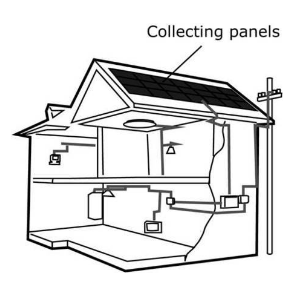
The house illustrated here uses panels on the roof to collect a natural resource and convert it into electricity that can be used.
Which alternative energy source does this house use?
a)
Water
b)
Wind
c)
Solar
d)
Geothermal
4.

which type of renewable energy is currently creating the most electricity generation?

a)

geothermal

b)

hydroelectric

c)

solar

d)

wind

5.

which location would be best for solar energy?

a)

Arizona

b)

Oklahoma

c)

Hawaii

d)

Colorado

6.

Which renewable energy does not require spinning a turbine?

a)

hydroelectric

b)

wind

c)

tidal

d)

photovoltaic cells

7.

A home is built with clear glass panels that allow sunlight to pass through. This is an example of

a)

Active solar

b)

Passive solar

c)

Parabolic collector

d)

Photovoltaic Cells

8.

What is given off as waste in a hydrogen fueled car?

a)

H2

b)

O2

c)

H2O2

d)

H2O

9.

a home is fitted with pumps that pipe water to the roof of the home to be heated by the sun. This is an example of

a)

passive solar

b)

active solar

c)

parabolic collector

d)

photovoltaic cell

10.

which of the following is not a biofuel or a biomass?

a)

wood

b)

ethanol from corn

c)

dung

d)

methane

11.

fuel cells that use a chemical reaction to generate electricity are using

a)

hydrogen gas

b)

methane gas

c)

water

d)

oil

12.
__________ is an energy resource that WILL NOT run out in the next several hundred years.
a)
Renewable Energy Resource
b)
Nonrenewable Energy Resource
13.
Which is not an advantage of Wind energy?
a)
Land can be used for other purposes
b)
Can be quickly built; not too expensive
c)
Long operating life
d)
Danger to birds
14.
How does biomass reduce our carbon footprint by producing less CO2 than fossil fuels?
a)
Plants absorb the same amount of CO2 that is released when it is burned.
b)
Plants remove CO2 from the atmosphere and put it permanently into the ground.
c)
Biomass filters CO2 to make it more environmentally stable.
d)
Biomass doesn't release any CO2 when burned.
15.
Heating and cooling buildings by exchange with shallow groundwater systems is considered a form of ___ energy.  
a)
geothermal
b)
solar
c)
kinetic
d)
potential
16.
Which is NOT a way to conserve energy? 
a)
Using a desktop computer rather than a laptop
b)
Consolidating errands while to make fewer car tips 
c)
Replacing incandescent bulbs with compact fluorescent bulbs
d)
Lowering thermostats during cold months
17.
The poster shown below advertises tours of a power plant.
This power plant produces electricity most likely by using-
a)
fossil fuels
b)
biofuels
c)
solar energy
d)
geothermal energy
18.
Most of the developing countries in the world depend on _______ for their main source of energy.
a)
renewable sources
b)
nuclear
c)
biomass (including wood, manure, etc)
d)
coal
19.
Passive solar design includes all of the following except
a)
large windows on the south side of the house
b)
floor and walls that will store heat in the winter
c)
overhang that blocks the sun in the summer, but allows it inside in the winter
d)
trees that block the sun for the entire year
20.
a downside to relying on biomass as a primary fuel source for a nation is that
a)
it can cause soil erosion, water pollution, and habitat loss
b)
it requires little land use
c)
it produces no pollution
d)
it produces more pollution than coal 
21.
Which of the following is a disadvantage of solar energy?
a)
It can only be used effectively in certain regions and certain times of day
b)
It produces greenhouse gases during use
c)
It is a nonrenewable energy source
d)
It is inexpensive compared to other sources
22.
Nuclear power uses ____ for fuel.
a)
steel
b)
coal
c)
uranium
d)
hydrogen
23.
Nuclear energy uses _____ to turn turbines to power a generator.
a)
wind
b)
water
c)
steam
d)
solar
24.
Splitting a uranium atom is called - 
a)
fission
b)
fusion
25.
What is an advantage  of nuclear energy?
a)
radioactive waste
b)
no pollution
c)
we will never run out
d)
it is the safest way to make energy
26.
All of the following are problems of nuclear energy except ---
a)
storage of radioactive fuel
b)
pollution
c)
security concerns
d)
natural disasters (tsunamis, earthquakes, etc.)
27.

The process where one neutron hits a nuclei, which causes it to split releasing more neutrons which hit more nuclei causing more more neutrons to be released which hit more nuclei and so for and so on is called what?

a)

fusion

b)

hydrogen bomb

c)

chain reaction

28.

The splitting of a nucleus into smaller, lighter nuclei is called what?

a)

fusion

b)

fission

c)

hydrogen bomb

29.

The amount of time it take for 1/2 of any sample to decay is know as its what?

a)

half life

b)

chain reaction

c)

half reaction

d)

U-235

30.

Where, in 1986, did a fission nuclear power plant have an explosion that lead to over 1600 contracting cancer from the resulting radiation?

a)

Chernobyl, Ukraine

b)

3 Mile Island

c)

Anchorage, Alaska

d)

Deep Water Horizon

31.

What type of isotope is used to create electricity for millions of people via fission in nuclear power plants?

a)

U-235

b)

U-238

c)

P-34

d)

Ukrainian

32.
This is an example of...
a)
Fission  reaction
b)
Fusion reaction
c)
Decomposition reaction
d)
Combustion
33.
Which type of power plant is this?
a)
Coal Power Plant
b)
Nuclear Power Plant
c)
Solar Power Plant
d)
Hydroelectric Power Plant
34.

What controls the reaction within a nuclear reactor by absorbing neutrons?

a)

Control Rods

b)

Moderator

c)

Containment building

d)

Reactor Vessel

35.
Three Mile Island differed from Chernobyl and Fukushima because...
a)
It wasn't a complete meltdown
b)
The core melted down
c)
Radiation was released
d)
Many people died
36.

How does a nuclear reactor produce energy?

a)

Atoms, such as uranium, undergo fusion in a reactor. This

generates heat which turns water to steam in a turbine

which generates electricity.

b)

Atoms, such as uranium, undergo fission in a reactor. This

generates heat which turns water to steam in a turbine

which generates electricity.

c)

Atoms, such as uranium, burn in a reactor. This generates

heat which turns water to steam in a turbine which

generates electricity.

d)

We do not currently have the technology to harness nuclear

reactions to generate electricity.

37.
What is one problem with using nuclear fission as an energy source?
a)
finding radioactive elements that have longer half-lives
b)
finding ways of storing radioactive wastes
c)
finding compounds to cool heated water
d)
finding non-radioactive elements for reactors
38.
The Fukushima Daiichi incident happened in Japan in the year
a)
1986
b)
2001
c)
2011
d)
2017
39.

If you begin with 800 grams of carbon, how much will you have after TWO half lives?

a)

200 grams

b)

400 grams

c)

100 grams

d)

50 grams

40.

The most common form of biofuel made from corn and sugar cane is...

a)

motor oil

b)

futonol

c)

ethanol

d)

carbon

41.

This biomass can grow up to 30 times faster than other crops and in almost any kind of water...

a)

lillies

b)

algae

c)

moss

d)

pond scum