wayground logo

Free Printable Worksheets

NEW

Font size

S
M
L
XL
Worksheets

Earth's Layers & Plate Tectonics

Total questions: 75

Worksheet time: 48mins

Name
Class
Date
1.
Order the layers of the Earth from the most dense to the least
a)
crust, mantle, outer core, inner core
b)
inner core, outer core, mantle, crust
c)
crust, mantle, inner core, outer core
d)
inner core, outer core, crust, mantle
2.
Which layer of the Earth is the thickest?
a)
Inner Core
b)
Mantle
c)
Crust
d)
Outer Core
3.
What is a difference between oceanic & continental crust?
a)
Continental is thicker
b)
Oceanic is thicker
c)
Continental is made of basalt
d)
Oceanic is made of granite
4.
What is the driving force behind plate tectonics?
a)
convection currents
b)
magnetic reversal
c)
volcanic eruption
d)
subduction zones
5.
This structure rests on top of the asthenosphere:
a)
Lithosphere
b)
Outer Core
c)
Lower Mantle
d)
Oceanic Crust
6.
The lithosphere is subdivided into:
a)
tectonic plates
b)
continents
c)
islands
d)
poles
7.
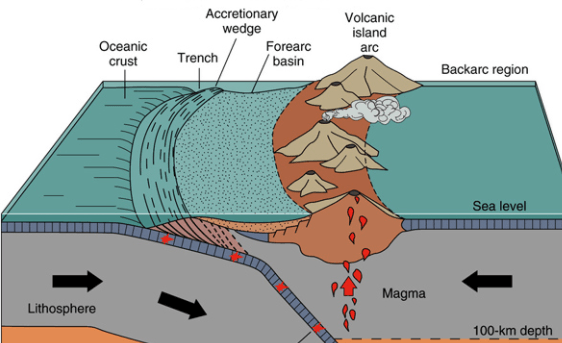
Volcanoes are formed at this type of boundary:
a)

oceanic-oceanic

b)
oceanic-continental
c)
continental-continental
d)
none of the above
8.
How is new crust made?
a)
sea-floor spreading
b)
continental-oceanic
c)
continental-continental
d)
rift valley
9.
Mountain ranges are a result of:
a)
oceanic-oceanic
b)
oceanic-continental
c)
continental-continental
d)
sea-spreading
10.
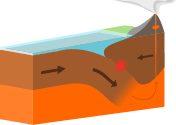
What type of boundary is indicated here at the red dot?
a)
convergent
b)
divergent
c)
transform
d)
none
11.
What travels from the mantle in order to form new crust?
a)
magma
b)
outer core
c)
convection currents
d)
asthenosphere
12.
What are usually common at transform boundaries?
a)
volcanoes
b)
earthquakes
c)
rivers
d)
deserts
13.

Which of the following lists the Earth's layers from innermost to outermost?

a)

Inner Core, Crust, Lithosphere, Asthenosphere

b)

Inner core, Outer Core, Mantle, Crust

c)

Outer Core, Inner Core, Mantle, Crust

14.

What is Pangea?

a)

a fern that lives close to the equator

b)

a large ice sheet

c)

a supercontinent made of the present-day continents

15.

Seafloor spreading is a process that...

a)

Destroys oceanic crust

b)

Occurs at the mid-ocean ridges

c)

Causes continents to plow through the seafloor

16.

What happens at a transform plate boundary?

a)

Plates move away from each other

b)

Plates move toward each other

c)

Plates slide past each other

17.

In divergent plate boundary...

a)

two plates separate

b)

two continental plates collide

c)

two plates slide past one another

18.

What is the theory of plate tectonics?

a)

Earth’s outer layer is made up of large, moving pieces called plates

b)

Cracks in the Earth's crust cause volcanoes

c)

The Earth was created by meteors crashing into each other

19.

When oceanic and continental crust converge, the oceanic plate will dive beneath the continental plate. What best explains the results of this action?

a)

The oceanic crust is moved upward by the radiation of heat

b)

The oceanic crust will melt as it moves deeper in the earth.

c)

The continental crust will form a mountain range.

d)

The two crusts will form an ocean basin

20.

Scientists understand that continents move because of the _________ moves underneath the ________

a)

lithosphere and mantle

b)

convection currents and magentism

c)

asthenosphere and lithosphere

21.

A region, known as the Ring of Fire, follows the border of the Pacific Ocean basin. Why do so many earthquakes and volcanoes occur in this region?

a)

Transform boundaries completely surround this region of the Pacific Ocean

b)

Only powerful convergent plates are located along the Ring of Fire.

c)

Two plates are diverging in the center of the Pacific Ocean basin.

d)

Numerous tectonic plate boundaries are located along the edges of this region.

22.

The movement of Earth's plates results in changes in Earth's surface. Some of these changes occur very quickly, while others may take millions of years. Which of the following is most likely formed from a rapid change?

a)

a mountain range

b)

a mid-ocean ridge

c)

a volcano

d)

a valley

23.

Mountains like the Himalayas in southern Asia form because these plate boundaries collide...

a)

Divergent Plate Boundary

b)

Convergent Plate Boundary

c)

Transform Plate Boundary

24.

Which lists the layers of the earth in the correct order? (from the outside)

a)

Core, Mantle, Asthenosphere

b)

Asthenosphere, Mantle, Core

c)

Mantle, Asthenosphere, Core

d)

Mantle Asthenosphere, Core

25.

What is the coolest layer of the Earth?

a)

inner core

b)

lithosphere

c)

crust

d)

mantle

26.

What is the hottest layer of the Earth?

a)

inner core

b)

lithosphere

c)

crust

d)

mantle

27.

What is formed where 2 CONTINENTAL PLATES COLLIDE?

a)

ocean basin

b)

earthquakes

c)

mountains

d)

volcano

28.

Which is less dense?

a)

Oceanic Crust

b)

Continental crust

29.

Which is more dense?

a)

continental crust

b)

oceanic crust

30.

When a continental plate collides with a oceanic plate which plate is subducted (goes under)?

a)

continental

b)

oceanic

31.

What happens to a plate that is subducted (goes under)?

a)

it melts

b)

it freezes

32.

What landform is likely to be created where one plate is forced under another?

a)

Volcano

b)

Earthquake

c)

Ocean Basin

33.
Which type of wave arrives first during an earthquake?
a)
Primary (p-wave) waves
b)
Secondary (s-wave) waves
c)
Rayleigh Waves
d)
Love Waves
34.
Which type of wave is the most destructive wave?
a)
Primary Wave
b)
Secondary Wave
35.

Main type of seismic waves that can only travel through the surface of the Earth.

a)

seismic waves

b)

surface waves

c)

body waves

d)

primary waves

36.

This is considered as the fastest kind of seismic waves.

a)

Love waves

b)

Body waves

c)

Primary waves

d)

Secondary waves

37.

It can travel through solids only

a)

Love waves

b)

Rayleigh waves

c)

Primary waves

d)

Secondary waves

38.

Primary (P) Waves can pass through...

a)

solids only

b)

liquids only

c)

gases only

d)

solids, liquids, and gases

39.
An instrument that detects and measures earthquakes is a 
a)
seismogram
b)
focus seismic map
c)
focus
d)
seismograph 
40.
What kind of wave travels through the earth?
a)
Seismic Wave
b)
Ocean Wave
c)
Light Wave
41.
Rocks crack and form an earthquake because of
a)
Time of day
b)
Pressure
c)
Kinetic Energy
d)
The Earth's gravity
42.
The outermost solid layer of the Earth is called the
a)
mantle
b)
outer core
c)
inner core
d)
crust
43.
This layer of the Earth is found between the core and the crust.
a)
mantle
b)
outer core
c)
inner core
d)
crust
44.
The layer that lies beneath the mantle and surrounds the inner core. 
a)
mantle
b)
outer core
c)
inner core
d)
crust
45.
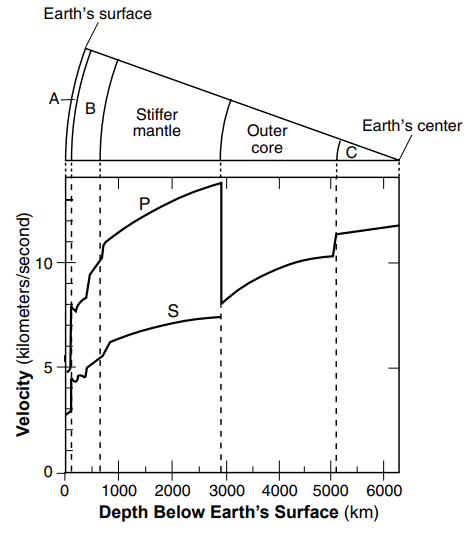
Identify the letter in the diagram.  Identify letter A
a)
Lithosphere
b)
Asthenosphere
c)
Mantle
d)
Outer Core
46.
Identify the letter in the diagram.  Identify letter F
a)
Lithosphere
b)
Asthenosphere
c)
Mantle
d)
Outer Core
47.
Identify the letter in the diagram.  Identify letter B
a)
Crust
b)
Convection Current
c)
Inner Core
d)
Outer Core 
48.
Identify the letter in the diagram.  Identify letter C
a)
Lithosphere
b)
Asthenosphere
c)
Mantle
d)
Inner Core
49.
The driving force of the tectonic plates are convection currents, where can these be found?
a)
inner core
inner core
b)
crust
c)
mantle
d)
outer core
50.
Which is the hottest part of the Earth?
a)
The core
b)
The mantle
c)
The crust
d)
The Asthenosphere
51.

What does pressure do as you go lower into the Earth's layers?

a)

Decreases

b)

Increases

c)

Stays the Same

52.

What does temperature do as you go lower into the Earth's layers?

a)

Decreases

b)

Increases

c)

Stays the Same

53.
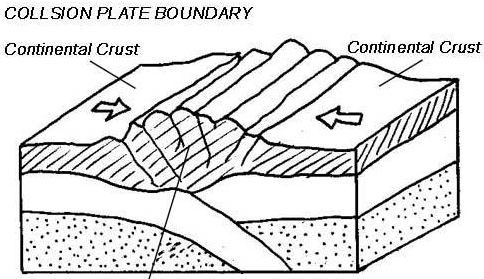
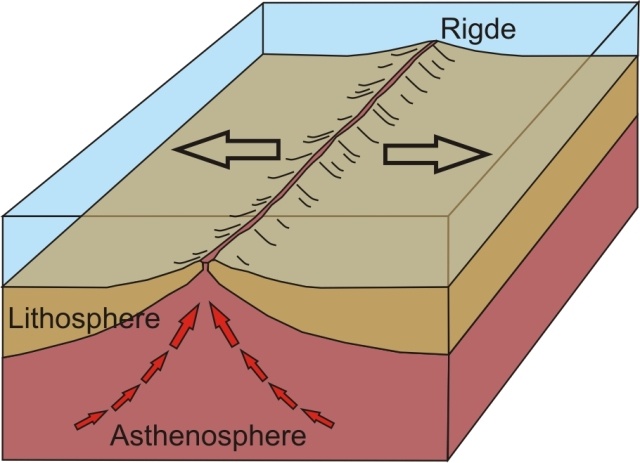
What kind of plate boundary is shown here?
a)
divergent
b)
convergent
c)
transform
d)
subducting
54.
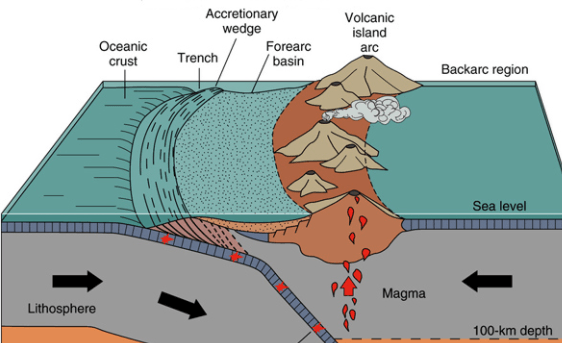
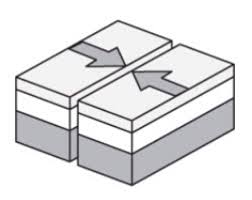
What kind of plate boundary is shown here?
a)
divergent
b)
convergent
c)
transform
d)
submergent
55.
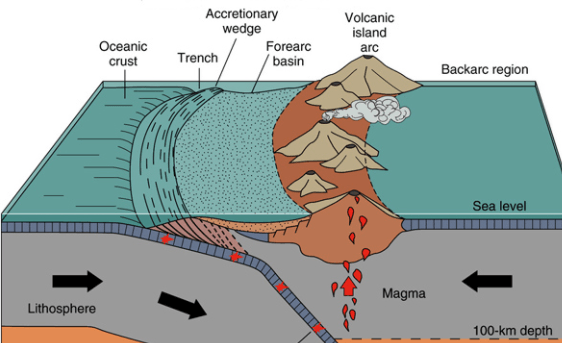
What kind of plate boundary is shown here?
a)
divergent
b)
convergent
c)
transform
d)
strike slip
56.
What geologic feature/event you be most likely to find at a transform boundary?
a)
Earthquakes
b)
Volcanoes
c)
Mountains
d)
Rift Valleys
57.
What geologic feature/event would you most likely to find at a divergent boundary between two pieces of oceanic crust?
a)
Rift Valley
b)
Mid-Ocean Ridge
c)
Island Arc
d)
Flat land
58.
What geologic feature/event would you most likely to find at a divergent boundary between two pieces of continental crust?
a)
Mid-Ocean Ridge
b)
Mountain
c)
Rift Valley
d)
Island Arc
59.
What geologic feature/event would you most likely to find at a convergent boundary between two pieces of continental crust?
a)
Volcano
b)
Mountain
c)
Rift
d)
Island Arc
60.
A subduction zone is formed...
a)
when one tectonic plate sinks below another
b)
at every type of convergent plate boundary
c)
at every type of divergent plate boundary
d)
at transform boundaries
61.
Name the boundary
a)
convergent boundary
b)
divergent boundary
c)
transform boundary
d)
sergent boundary
62.
Name the boundary
a)
convergent boundary
b)
divergent boundary
c)
transform boundary
d)
sergent boundary
63.
In which type of boundary do the plates move away from each other?
a)
convergent
b)
normal
c)
divergent
d)
transform
64.
Plates move towards one another at ______________ boundaries.
a)
divergent
b)
convergent
c)
transform
d)
detergent
65.
What would happen to the convection currents if the heat from the inner core disappeared? 
a)
They would stop. 
b)
They would change directions. 
c)
It would not change. 
d)
They would speed up. 
66.

The area around the pacific plate where boundaries form is called...

a)

death ring

b)

fire zone

c)

ring of fire

d)

zone of fire

67.
Mountains form from ...
a)
plates sliding past one another
b)
collision of plates
c)
plates moving away from each other
68.
Oceanic crust is
a)
Younger and less dense than continental crust
b)
Thinner, younger and more dense than continental crust
c)
Older, thicker and less dense that continental crust
d)
Bigger and younger than continental crust
69.
The volcanoes on the Hawaiian Islands form due to which of the following?
a)
Divergent Boundary
b)
Hot Spot
c)
Subduction Boundary
d)
Transform Boundary
70.
What is Magma when it reaches the surface of Earth?
a)
Lava
b)
Mafic Magma
c)
Felsic Magma
d)
None of these
71.
Some volcanoes in the Ring of Fire were formed near
a)
hot spots.
b)
subduction zones.
c)
divergent boundaries.
d)
normal faults.
72.
What is a volcano?
a)
A mountain that has lava all over it 
b)
A giant hill filled with magma
c)
A long high sea wave 
d)
A hole in the Earth where magma erupts
73.
What is molten rock that has formed deep within the Earth?
a)
Hot Spot
b)
Magma
c)
Lava
d)
Volcano
74.
Volcanoes that are NOT found at plate boundaries occur in the middle of plates in areas called ___________. 
a)
hot spots
b)
mid-ocean ridges
c)
fissure volcanoes
d)
shield volcanoes
75.

Most volcanoes occur at which 2 types of plate boundaries?

a)

convergent w/ subduction and divergent

b)

divergent and transform

c)

divergent and hot spots

d)

convergent w/ subduction and hot spots