Wayground logo

Free Printable Worksheets

Font size

S
M
L
XL
Worksheets

Mock Exam 1

Total questions: 70

Worksheet time: 2hrs 31mins
Name
Class
Date
1.
How many protons, electrons and neutrons does an neutral atom of Calcium have?  Its atomic number is 20 and the mass number is 40.
a)
20 protons, 18 electrons and 40 neutrons
b)
20 protons, 20 electrons and 20 neutrons
c)
40 protons, 40 electrons and 20 neutrons
d)
20 protons, 18 electrons and 20 neutrons
2.
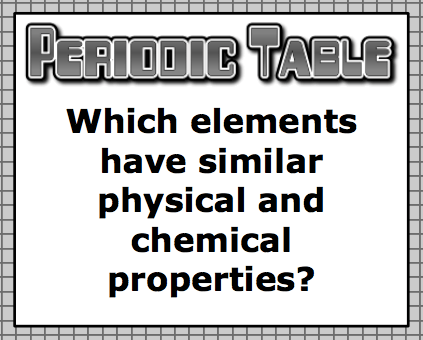
a)
Same group
b)
Same period
3.
Atoms that gain electrons become...
a)
negatively charged
b)
positively charged
c)
remain neutrally charged
d)
21
4.

What two types of atoms make a covalent bond?

a)

2 Nonmetals

b)

1 Nonmetal and 1 Metal

c)

2 Metals

d)

2 Noble Gases

5.

2 or more different elements that are bonded together is called...

a)

A. element

b)

B. compound

c)

C. mixture

d)

D. solution

6.
Define a liquid.
a)
Indefinite shape, indefinite volume
b)
Definite shape, definite volume
c)
Found in stars
d)
Definite volume, indefinite shape
7.

On this temperature scale, there can NEVER be negative numbers

a)

Celsius

b)

Fahrenheit

c)

Kelvin

8.

Which state of matter have the weakest intermolecular forces?

a)

solid

b)

liquid

c)

gas

9.
3. Identify the states of matter where Brownian Motion can occur.
a)
a) Solid, liquid, gas
b)
b) Liquid, gas
c)
c) Solid, gas
d)
d) Solid, liquid
10.

Which two states don't have a fixed shape ?

a)

Gas and liquid

b)

Liquid and solid

c)

Solid and gas

d)

None of the above

11.
How heat is transfered?
a)
From high to low temperature
b)
From low to high
c)
Up to down
d)
Left to right
12.
The lowest possible temperature is
a)
0 F
b)
0 K
c)
0 C
d)
273 K
13.
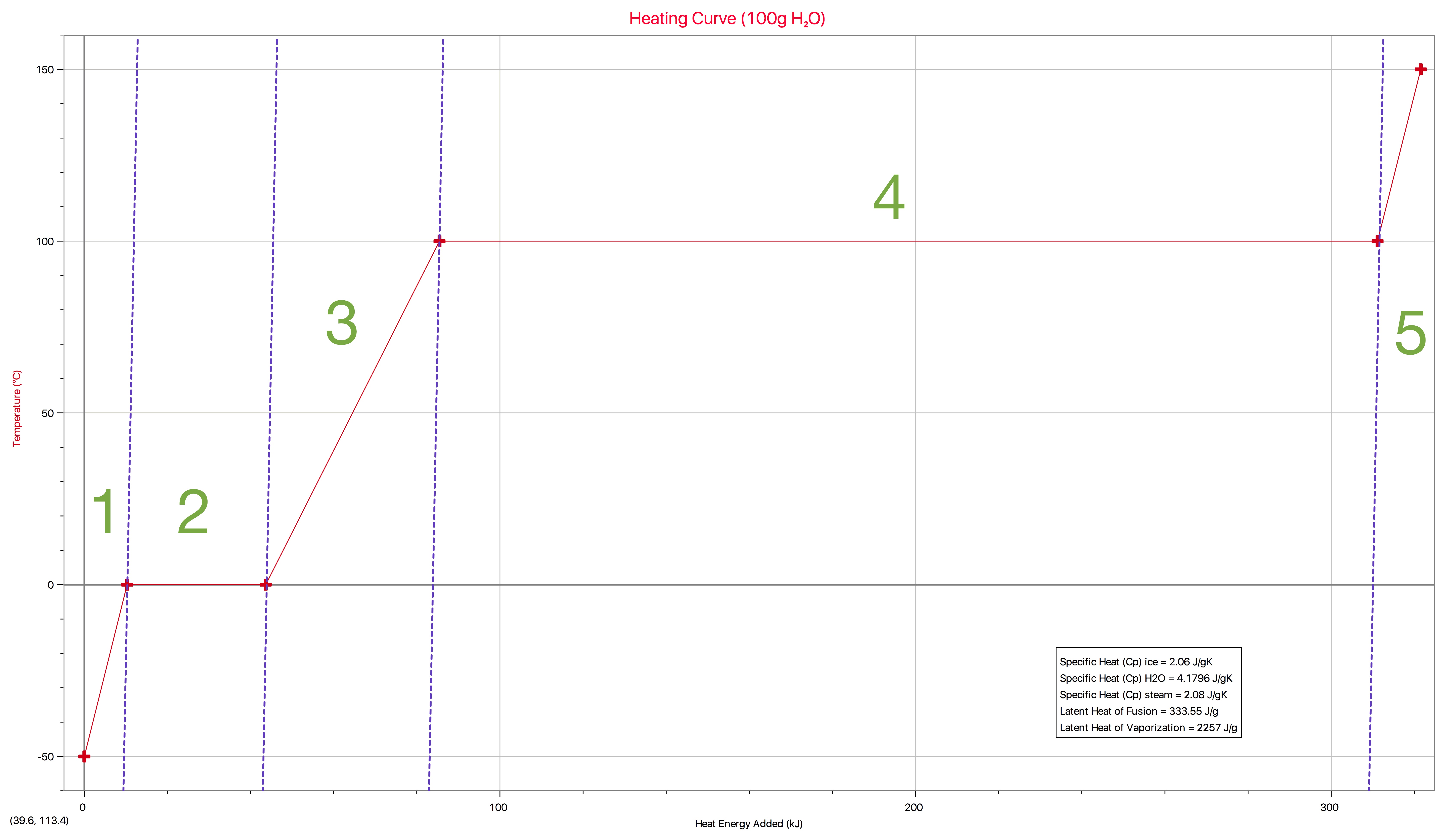
In which region(s) of the graph would we use a latent heat to calculate heat energy?
a)
Region 1, 3, & 5
b)
Region 2 & 4
c)
Region 1 only
d)
Region 1 & 2
14.
In which region(s) of the graph does a phase change occur?
a)
Region 1, 3, & 5
b)
Region 2 & 4
c)
Region 1 only
d)
Region 1 & 2
15.
The type of heat transfer that happens through direct contact of molecules or particles with each other is ___________________.
a)
Convection
b)
Conduction
c)
Radiation
d)
insulation.
16.
What is the formula for Boyle's Law?
a)
P1V1=P2V2
b)
P1V1/P2V2
c)
P1V2=P2V1
d)
P1/V1=P2/V2
17.
There are 40 liters of helium in a balloon at 100 K. If the temperature of the balloon is increased to 200 K, what will the new volume of the balloon be?
a)
80 L
b)
45 L
c)
54 L
d)
45.33 L
18.

What is the net force on an object that is moving with a constant velocity?

a)

Greater than zero

b)

Less than zero

c)

Zero

d)

Can't be determined

19.

A resultant vector is

a)

equal to the sum of one vector.

b)

equal to the sum of two or more vectors.

c)

equal to the difference of one vector.

20.

The process of breaking a vector into its components is called

a)

vector resultant.

b)

vector displacement.

c)

vector coordinates.

d)

vector resolution.

21.
What is the net Moment?
a)
0 Nm
b)
4 Nm (clockwise)
c)
30 Nm (clockwise)
d)
30 Nm (anti-clockwise)
22.

What is the Unit for moment

a)

Nm

b)

N

c)

W

d)

J

23.

What is one way you might increase the stability of an object?

a)

Lower the center of gravity

b)

Raise the center of gravity

c)

Increase the height of the object

d)

Shorten the base of the object

24.

Stress-strain diagram has five stages in the material; select the correct sequence of the stages:

a)

Elastic region - Yielding - Strain hardening - Necking - Fracture

b)

Elastic region - Strain hardening - Yielding - Necking - Fracture

c)

Elastic region - Yielding - Necking - Strain hardening - Fracture

d)

Yielding - Elastic region - Necking - Strain hardening - Fracture

25.

Which symbol represents the "Modulus of Elasticity"?

a)

A

b)

E

c)

ε

d)

d

26.

This is the formula for....

a)

normal stress

b)

axial force

c)

total deformation or elongation

d)

normal strain or unit deformation

27.

what property best describes the ability to be stretched and return to original shape

a)

elasticity

b)

conductor

c)

hardness

d)

brittleness

28.

Parallel forces acting in opposite directions

a)

compression

b)

shear

c)

tension

29.

This is an example of what type of force?

a)

Shear

b)

Torsion

c)

Compression

d)

Tension

e)

Bending

30.

Which of the terms listed describes the following mechanical property of a material?:-


The ability of the material to withstand sudden impact without fracturing.

a)

Stiffness

b)

Toughness

c)

Brittleness

d)

Hardness

31.

Which of the terms listed describes the following mechanical property of a material?:-


The ability of a material to resist deformation under applied force

a)

Stiffness

b)

Elasticity

c)

Ductility

d)

Malleability

32.

Gauge Pressure is positive for pressure ______ atmospheric pressure

a)

above

b)

below

c)

equal

33.

The formula for absolute pressure is

a)

P(abs) = P(gauge) - P(atmospheric)

b)

P(abs) = P(gauge) + P(atmospheric)

c)

P(abs) = P(atmospheric) - P(gauge)

d)

P(abs) = P(gauge) x P(atmospheric)

34.
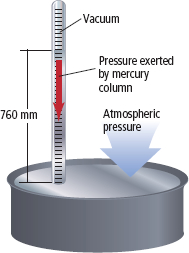
Explain what would happen to the column of mercury in the barometer as shown if the atmospheric pressure fell.
a)
As the pressure falls, the column of mercury will drop lower.
b)
As the pressure falls, the column of mercury will remain unchanged.
c)
As the pressure falls, the column of mercury will rise higher.
d)
As the pressure falls, the density of the mercury will increase.
35.

If a hydraulic system has 10,000 N applied to the input piston and has an area of 0.01 m2, what is the pressure?

a)

105 Pa

b)

103 Pa

c)

104 Pa

d)

106 Pa

36.
Which will result in positive buoyancy?
a)
When the buoyant force is greater than the force of gravity
b)
When the buoyant force is equal to the force of gravity
c)
When the buoyant force is less than the force of gravity
37.

Archimedes' Principle states that...

a)

The buoyant force acting on an object equals the volume of the fluid displaced by the object.

b)

The buoyant force acting on an object equals the weight (force of gravity) of the fluid displaced by the object.

c)

The buoyant force acting on an object will always be equal.

38.
Centripetal acceleration acts  ___________ of the circular path.
a)
towards the center
b)
along the circumference
c)
away from the center
d)
perpendicular to the plane
39.
What is the difference between centripetal and centrifugal forces?
a)
Centripetal is towards center while centrifugal is away from the center.
b)
Centrifugal is towards center while centripetal is away from the center.
c)
Neither of the above is correct
40.
Which of the following depict the velocity of the bowling ball?
a)
A
b)
B
c)
C
d)
D
41.
Calculate the centripetal force required to make a 5 kg ball move 4 m/s in a circle with a radius of 2 m.
a)
10 N
b)
20 N
c)
30 N
d)
40  N
42.
A 20 kg bike accelerates at 10 m/s2.  what was the force?
a)
25 Newtons
b)
20 Newtons
c)
200 Newtons
d)
10 Newtons
43.
The tendency of an object to resist changes in its motion is...
a)
inertia
b)
force
c)
acceleration
d)
velocity
44.

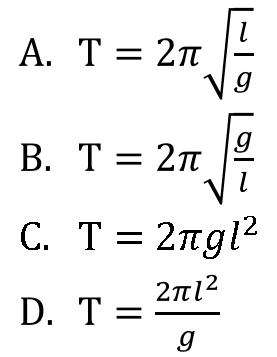
Based on your findings, which equation could best describe the pendulum’s period?

a)

A

b)

B

c)

C

d)

D

45.
What is the frequency of a pendulum that has a period of 10 s?
a)
10 Hz
b)
1/1000 Hz
c)
.1 Hz
46.
In any system in SHM, the restoring force acting on the mass in the system is proportional to
a)
the displacement
b)
the length of the pendulum
c)
the mass
d)
the frequency
47.
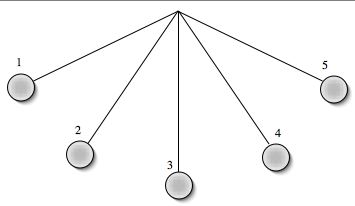
When a pendulum swings, at which point is kinetic energy highest?
a)
1
b)
2
c)
3
d)
4
48.

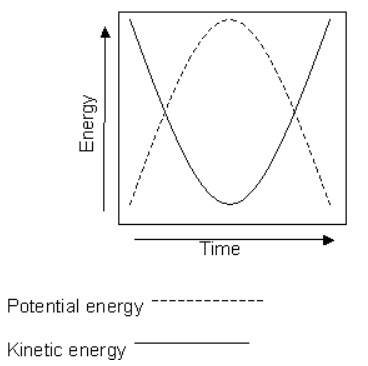
According to this graph, as kinetic energy decreases, potential energy must?

a)

Increase

b)

Decrease

c)

Stay the same

49.
The Law of Conservation of Energy states:
a)
Energy can created or destroyed but not transformed 
b)
Energy cannot be created or destroyed, it can only transformed
c)
Energy can't be created, destroyed or transformed
50.
The unit of power is the...
a)
work
b)
watt
51.
The SI Unit for Work
a)
Newton (N)
b)
Joule (J)
c)
Second (s)
d)
Watt (W)
52.
What is the equation for power?
a)
P = Work/time
b)
P = Force/time
c)
P = time/distance
d)
P = Work * time
53.
The momentum of an object depends upon the object's ___________&_____________.  
a)
size and shape
b)
mass and speed
c)
mass and veloctiy
d)
mass and energy
54.
Momentum is a ____________________ quantity
a)
science
b)
scalar
c)
vector
d)
energy
55.

The impulse is _____the change in momentum

a)

Greater than

b)

Equal to

c)

Less than

d)

Always double

56.

If you push an object with a force of 10 N for 5 seconds , you will change it’s momentum by:

a)

2 N s

b)

50 n s

c)

2 N/s

d)

50 N/s

57.
Friction is a force that acts in an ___________ direction of movement.
a)
similar
b)
opposite
c)
parallel
d)
west
58.
The amount of friction depends on the weight of the objects pressing together.
a)
True
b)
False
59.

A box of weight W is lifted by a force F using a lever as shown below.

What is the mechanical advantage of the lever (MA=Input Distance/Output Distance)?

a)

0.5

b)

2

c)

3

d)

6

60.

the percentage of the input work that is converted to output work

a)

mechanical advantage

b)

efficiency

c)

joule

d)

machine

61.
What is the mechanical advantage of this pulley system?
a)
2
b)
3
c)
4
d)
5
62.
For a lever to be a first class lever the fulcrum needs to be ..
a)
between the load and the effort
b)
on one side and the load and effort on the other side 
c)
on the same side as the load arm. 
63.

Transfers motion between two shafts running parallel to each other. They are characterized by their teeth, which are straight and parallel to the gears axis of rotation.

a)

Spur Gear

b)

Worm Gear

c)

Bevel Gear

d)

Crown Gear

64.

Conically shaped gears that transmit power between shafts that have intersecting axes of rotation.

a)

Spur Gear

b)

Bevel Gear

c)

Rack Gear

d)

Crown Gear

65.

What is relative density or specific gravity of a liquid

a)

density of substance / density of water

b)

density of water / density of substance

c)

density of substance x density of water

66.

The specific gravity of gasoline is 0.72. It is ________ than water.

a)

heavier

b)

lighter

c)

same density

d)

none of the above

67.

As temperature increases viscosity of a liquid _______________.

a)

increases

b)

stays the same

c)

decreases

68.
According to Bernoulli's Principle, wind speed and wind pressure have a _________ relationship
a)
directly proportional
b)
inversely proportional
c)
not enough information
d)
None of the above
69.
The shape of an airplane wing causes the air above the wing to travel slower than the air below the wing.
a)
True
b)
False
70.

With increasing altitude pressure, temperature and density __________

a)

all increases

b)

all decreases

c)

Pressure increases but temperature and density decreases

d)

temperature increases but pressure and density decreases