
 Worksheets
Dynamic & Resilient Ecosystems
Total questions: 48
Worksheet time: 1hrs 15mins
Barnacles are animals that cannot move. In order to get food, they attach to whales and catch any floating plankton in the water. The whale is neither helped nor harmed in the interaction. What type of symbiosis is this?
Mutualism
Commensalism
Parasitism
Amensalism
In the sea, little fish called pilot fish swim closely to sharks. The pilot fish clean the sharks, and the sharks provide protection for the pilot fish. What type of symbiosis is this?
Mutualism
Commensalism
Parasitism
Amensalism
In an ecosystem, there are populations of deer, rabbits, grass, and pine trees. Suddenly, a fire blazes through the area, which kills all of the populations. As the months go on, new species of grass begin to take root. This attracts animals, and eventually the ecosystem is restored.
What type of ecological succession happened?
Primary succession because it started with rocks.
Primary succession because there was soil to begin with, and plants existed before the disaster.
Secondary succession because it started with rocks.
Secondary succession because there was soil to begin with, and plants existed before the disaster.
In Hawaii, there are volcanoes. Before anything was there, the volcanoes erupted which produced volcanic rock. Lichens were the first species to arrive, and they broke down the rock into soil. Eventually, plants began to grow. Now, the islands are functioning at their climax community.
Is this an example of primary or secondary succession?
Primary succession
Secondary succession
In Hawaii, there are volcanoes. Before anything was there, the volcanoes erupted which produced volcanic rock. Lichens were the first species to arrive, and they broke down the rock into soil. Eventually, plants began to grow. Now, the islands are functioning at their climax community.
What is the pioneer species in this example?
Shrubs
Lichens
Trees
Rock

What is this picture describing?
It is describing direct competition between flamingos and ducks.
It is describing natural selection as it follows the disruptive selection pattern.
It is describing the niche of each bird within the tree.
It is describing abiotic factors of the tundra.
What term describes the ability of an organism or ecosystem to adapt after a disturbance?
Tolerance
Resilience
Biodiversity
Niche
The ability to recover from or adjust from or adjust easily to misfortune or change.
Catastrophic
Disruptive
Resilient
Population

A group of animals, plants or other living things that all share common characteristics and that are all classified as alike in some manner.
Population
Species
Ecosystem
Prevalent

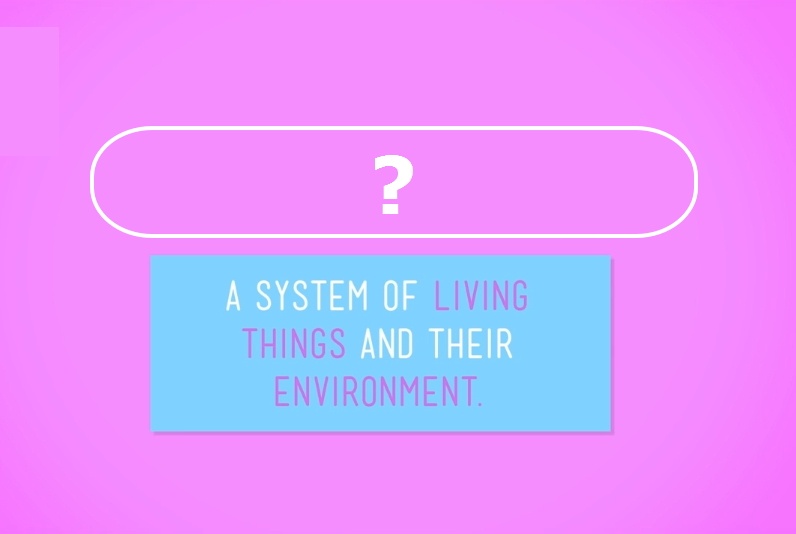
A system that includes all living organisms (biotic factors) in an area as well as its physical environment (abiotic factors or nonliving things) functioning together as a unit.
Population
Catastrophic
Species
Ecosystem

The nonliving parts of an ecosystem.
Biotic
Photosynthesis
Abiotic
Variable

The living things in an ecosystem.
Abiotic
Variable
Control
Biotic

Organisms, like bacteria, insects and worms, that break down waste are called ___
carnivores
herbivores
decomposers

Energy flows through a system of living things in a "what eats what" model called ___
the carbon cycle
a food chain
an energy line

Where do decomposers fit in a food chain?
at the beginning
at the end
any time there's waste

Decomposers break waste down into ___
bacteria and some fungi
nutrients and other chemicals

Which organisms keep waste from piling up in an ecosystem?
decomposers
plants
mice

A habitat is home to a tangle of food chains called ___
a nutrient hub
an energy chain
a food web
The interaction of living and non-living things in a habitat is called ___
a food chain
an ecosystem
a food web

A food chain is a model that shows how energy flows between _____
plants and bugs
living things
bears and monsters

What is the scientific name for the area in which plants and animals live?
a habitat
an ecosystem
a food chain

All of the energy that's in a food chain starts with _____
decomposers
animals
the sun

Food, water, shelter, and space to live are all part of a ___
food chain
habitat
Crash Course video
A community consists of all the organisms in an ecosystem that belong to the same species.
True
False
What is the difference between a population and a community?
A population is made up of all species in an area. A community is made up only of one species.
A population is made up of only one species. A community is made up of all species in an area.
A population is made up of all the species and nonliving things in an area. A community is made up of all species in an area.
The words mean the same thing.
If there are no limiting factors, a population can reach its _____.
competition level
population potential
population density
biotic potential
Mutualism is any close relationship between different species.
True
False
A symbiotic relationship that benefits both species is referred to as commensalism.
True
False
What is the difference between a community and an ecosystem?
An ecosystem consists of living and nonliving things in an area. A community is all the members of one species in the area.
An ecosystem consists of living and nonliving things in an area. A community is all the populations in the area.
An ecosystem consists of nonliving things in an area. A community is all the living things in the area.
An ecosystem consists of all the populations in an area. A community is all the nonliving things in the area.
Which of these is a limiting factor?
food supply
shelter
existence of predators
all of these
In a predator-prey relationship, _____.
the predator hunts the prey for food
the prey hunts the predator for food
the prey keeps the predator population from growing too large
the prey are producers
Succession continues until it reaches a pine forest community.
True
False
Mutualism is any close relationship between different species.
True
False
Samantha plants some flowers in a flower bed and then ignores them. Soon weeds grow and the flowers die. The weeds had been able to get enough resources to survive, while the flowers had not. This is an example of _____.
competition
population size
habitat
community
Some populations have cooperative relationships. This is where _____.
members of the same species compete for resources
members of different species compete for resources
members of the same species work together for survival
members of different species work together for survival


What is an ecosystem?
The area of land where animals live
A community of insects that work together
A community of organisms together with its environment
The section of a terrarium where plants grow
Only living things are made of matter
True
False
Plants make their own food
True
False



