
 Worksheets
APUSH Unit 6: 1865-1898
Total questions: 90
Worksheet time: 2hrs 38mins
What battle ended the Indian Wars? 300 Native Americans killed, including women & children
Sand Creek
Wounded Knee
Dakota War
Black Hills War
Joseph Glidden invented this, which helped close the frontier and settle the Great Plains.
reaper
barbed wire
steel plow
combine
Andrew Carnegie's belief in giving money to libraries, museums and schools to help benefit people who wanted to move up in the social ladder through hard work.
geopolitical
political bosses
Social Darwinism
Gospel of Wealth
In 1890, during the Gilded Age, who wrote about and photographed the horrible living conditions of America's working poor in the book, How the Other Half Lives?
Upton Sinclair
Ida Tarbell
Ida Wells
Jacob Riis
What was the major difference between the first two major Labor Unions, the Knights of Labor and the American Federation of Labor?
The Knights of Labor only allowed skilled workers to join
The Knights of Labor did not allow immigrants to join
The AFL only allowed skilled workers to join
The AFL did not allow immigrants to join
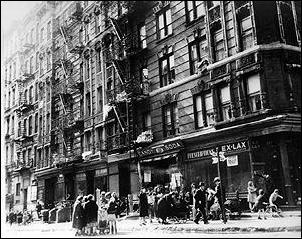
Which of these best describes life in a tenement?
Very crowded
Lots of sickness & disease
No windows, heat, or plumbing
All of these describe tenement life
This is the term for the process of adjusting to the culture and government of the United States.
Assimilation
Nativism
Americanism
MexiCAN
Congressional action taken in 1887 to stop the unfair practices of railroad companies in which large Corporations were given low shipping prices to ship through the railroad while small farmers who had no other shipping options were charged high prices.
Sherman Antitrust Act
Celler-Kefauver Act
Clayton Antitrust Act
Interstate Commerce Act
Who was the most influential African American during this time, encouraging African Americans to GRADUALLY move up in society?
Malcolm X
Booker T. Washington
George Washington Carver
Martin Luther King Jr.
The term Suffrage means:
The right to work in factories
The right to live in America
The right to vote
The right not to vote

The painting "American Progress" by John Gast is an example of
Enlightenment
Annexation
Manifest Destiny
Cession
Who of the following represented the American notion that through hard work, even a poor immigrant could become tremendously successful?
Andrew Carnegie
John D. Rockefeller
Jay Cooke
Thomas Edison
What was the effect of the Transcontinental Railroad?
Became a more efficient form of transportation for settlers and goods.
Created a new trade market between the eastern and western United States boosting the economy.
Polluted the air and the natural environment
All of the above
How did the passage of the Dawes Act impact Native Americans?
It started a series of Indian Wars with massive casualties on the Great Plains
Attempted to assimilate them into mainstream culture by allocating lands to individual Indians and dissolving tribes.
Retention of original tribal territory occurred through a peace treaty with the U.S. Army.
It supported their existing cultural tribal traditions and customs
Why were scabs unpopular with striking workers during the late 1800s?
They were socialists.
They were federal troops.
They were part of management.
They were workers used to break strikes.
Millionaire tycoon who made his riches in the steel industry
Andrew Carnegie
J.D. Rockefeller
J.P. Morgan
Cornelius Vanderbilt
Millionaire tycoon who made his riches in the railroad industry
Andrew Carnegie
J.D. Rockefeller
J.P. Morgan
Cornelius Vanderbilt
Millionaire tycoon who made his riches in the finance industry
Andrew Carnegie
J.D. Rockefeller
J.P. Morgan
Cornelius Vanderbilt
Millionaire tycoon who made his riches in the oil industry
Andrew Carnegie
J.D. Rockefeller
J.P. Morgan
Cornelius Vanderbilt

What is the name of the place that was the gateway for over 12 million immigrants to the U.S. as the United States' busiest immigrant inspection station? It's located in New York.
Hull House
Ellis Island
Pullman House
Staten Island

Technology that made it possible for steel to be produced in an efficient and inexpensive manner?
Steel
Cotton Gin
Steel Maker
Bessemer Process
Eager settlers who claimed the best land in Oklahoma in 1889 after government owned land was opened to be settled by the public.
nomadic
transcontinental
sooners
vaqueros
The US had a "God given right" to take all the land from the Atlantic to the Pacific oceans. This was called......
Lewis and Clark expedition
Erie Canal
Trail of Tears
Manifest Destiny
What was the name of the college that Booker T. Washington started?
The Washington Institute
The University of Alabama
The Tuskegee Institute
The Hampton Institute
When companies that produce a similar product are merged together to form one huge company.
horizontal integration
Taylorism/Scientific Management
Time-Study Analysis
vertical integration
Which Supreme Court decision upheld Jim Crow laws?
Boynton v. Virginia
Dred Scott v. Sandford
Plessy v. Ferguson
Miranda v. Arizona
What was a city government marked by corruption, bribery, and kickbacks (common during the Gilded Age) called?
credit mobilier
corrected democracy
exchequer
political machine
What government territory was opened up to settlement in 1889, causing a "land rush" of 50,000 people?
Kansas
Oklahoma
Nebraska
Missouri
Due to the Triangle Shirtwaist Fire...
the government created laws to help with worker safety.
the government did nothing.
businesses created safer working conditions when the government refused to do so.
businesses continued having poor working conditions.
A system in which businesses operate under minimal government regulation
Time zone
Patent
Mass Production
Laissez Faire
In 1890 the _______________ _____________ _____ was passed by the U.S. government to prevent monopolies from unfair business practices
Better Business Bureau
Savings and Loan Act
Sherman Antitrust Act
A tenement is
when ten people live in an apartment
an expensive high-rise apartment in the 1800s
overcrowded and usually unsafe dwelling in the early 1900s
A business leader who uses dishonest method to get rich?
Shareholder
Labor leader
Entrepreneur
Robber Baron
Henry Ford became famous with his_____________?
Model Z Ford
Ford F-150
KingsFORD charcoal
Assembly Line Process
Job opportunities in cities.
Push Factor during the Gilded Age.
Pull Factor during the Gilded Age.
Religious persecution in Europe (Judaism and Catholicism)
Push Factor during the Gilded Age.
Pull Factor during the Gilded Age.
Reuniting with family in cities.
Push Factor during the Gilded Age.
Pull Factor during the Gilded Age.
Political persecution by a Dictator who punishes you for being in the wrong political party.
Push Factor during the Gilded Age.
Pull Factor during the Gilded Age.
Overcrowding/Economic Depression/Potato famine
Push Factor of the Gilded Age.
Pull Factor of the Gilded Age.
"The American Dream," The opportunity for a fresh start and to make a name for yourself.
Push Factor during the Gilded Age.
Pull Factor during the Gilded Age.
What effect did the mechanization of the American farm in the latter part of the nineteenth century have on the nation?
It brought about a decrease in the nation’s literacy rate
It caused crowded farms and unsanitary conditions
It led to an increase in crop production at a lower cost to consumers making it hard for small family farms to compete with bonanzas.
It increased the acreage of farmland that was unsuitable for farming
Which of the following industries demonstrates the US government's role in targeting and killing Native Americans?
railroad
buffalo hide
coal mining
bakeries
Which act promised citizens who were 21 years of age or heads of households, up to 160 acres if they moved West and cultivated the land for a minimum of 5 years?
Homestead Act
Morrill Land Grant Act
Oklahoma Land Rush
Emancipation Proclamation
The U.S. Supreme Court in the case of Plessy vs Ferguson, established...
Separate but equal.
Separate is not equal.
Chinese Exclusion Act is constitutional.
Voting rights for African American males.
Exodusters who chose to move west in hopes of escaping discrimination and owning land were:
European Immigrants
Asian Immigrants
Mexican Americans
African Americans
Congressional Act enabling President Andrew Jackson to give land east of the Mississippi (Oklahoma) to Native Americans who voluntarily left tribal lands in the Southeast. In addition, Native Americans were promised they'd be able to live on their new land under the protection of the American Government forever.
Indian Removal Act 1830
Civillization ACt
Manifest Destiny Act
Indian Territory Act
What was the name for the governmental forced relocation of the Cherokee Tribe from Georgia to Oklahoma?
The Trail of Tragedy
The Trail of Triumph
The Trail of Tears
The Trail of Trama
City where both lines of the Transcontinental Railroad met to complete construction
Omaha, Nebraska
Sacramento,California
Promontory, Utah
The Transcontinental Railroad reduced the time it took to travel across the United States from 6 months to _______
6 weeks
6 days
3 weeks
3 days
Apache leader who refused to go to live on a reservation, attacked settlers in Arizona and New Mexico and successfully evaded capture for 10 years
Crazy Horse
Sitting Bull
Chief Joseph
Geronimo
Small farms where crops are used to maintain the farmer's family with little surplus to be used for sale or trade.
Bonanza farms
Subsistence farms
Extensive farms
Terrace farms
Government welfare program that helped African American citizens with the transition from slavery to freedom after the abolishment of slavery. Provided education, job training, government jobs, etc.
Freedman's Bureau
Black Codes
Jim Crow Laws
Ku Klux Klan
What did the final destination of all the cattle trails have in common?
All led to highways where cattle would be shipped to the East to be sold
All went through Indian Territory for trade with Native Americans
All led to railroads where cattle would be shipped to the East to be sold
Some went to railroad cities to be sold at auction
Why did the Great Sioux War begin in 1876?
Settlers were making fun of the Sioux
The cattlemen bought up land in the Plains
Gold had been found in the Black Hills
The government were sending children to Christian schools
Who were the two Sioux leaders at the Little Bighorn?
Sitting Bull and Crazy Horse
Red Cloud and Sitting Bull
Crazy Horse and Little Crow
Little Crow and Black Kettle
The significance of the Haymarket Square incident in 1886 was that
union won their demand for an eight hour day
the American socialist movement received a good boost
the use of Pinkerton guards as strikebreakers was outlawed
it led to federal intervention in labor union matters.
Typically fought over water rights or grazing rights to unfenced/unowned land, it could pit competing farmers or ranchers against each other.
Barbed Wire
Forty-Niners
Range Wars
Little Bighorn
In Colorado territory in 1864, U.S army colonel John M. Chivington led a surprise attack on a peaceful Cheyenne settlement along Sand Creek River. The Cheyenne under Chief Black kettle tried to surrender. First he waved the America Flag and the White flag of surrender. Chivington ignored the gestures. The U.S army killed about 200 Cheyenne during the conflict.
Battle of Wounded Knee
Battle of Little Bighorn
United States Civil War
Sand Creek Massacre

