wayground logo

Free Printable Worksheets

Font size

S
M
L
XL
Worksheets

Newton's 2nd & 3rd Law

Total questions: 92

Worksheet time: 2hrs 52mins

Name
Class
Date
1.

What is Newton's 2nd Law?

a)

Every action has an equal and opposite reaction

b)

An object at rest stays at rest, an object in motion stays in motion.

c)

F = ma

d)

Friction

2.

True or False. Acceleration of an object is directly proportional to the net force acting on it

a)

True

b)

False

3.

Your car has a mass of 2500 kg and a force of 5000 N. How fast will it accelerate?

a)

20 m/s2

b)

0.5 m/s2

c)

2 m/s2

d)

120 N

4.

Find how much force the man will need to exert to move the car.

a)

5000 N

b)

50 N

c)

20,000 N

d)

500 N

5.

If the man pushes with an equal amount of force, which object will accelerate more?

a)

Car because it has more mass

b)

Lawnmower because it has less mass

c)

Car because it has less mass

d)

Lawnmower because it has more mass

6.

A 25 kg bike accelerates at 10 m/s2. What was the force?

a)

250 N

b)

2.5 N

c)

25 N

d)

15 N

7.

What unit do we measure force in?

a)

Kilometer/hr

b)

Joules

c)

Seconds

d)

Newtons

8.

What is force?

a)

A push on an object

b)

A pull on an object

c)

A push or pull on an object

9.

If an object was accelerating at 5 m/s2, and a force of 10 newtons was required to accelerate it, what was the object's mass?

a)

50 kg

b)

2 kg

c)

0.5 kg

d)

5 kg

10.

True or False. 800 N = 800 kg ⋅ m/s2

a)

True

b)

False

11.
The larger the mass you have the _____ force you need to change its motion.
a)
more
b)
less
12.
As force applied to a textbook increases, what happens to its acceleration?
a)
Stays the same
b)
Increases
c)
Decreases
d)
Opens
13.
The force of a cart doubles.  What happens to the cart's acceleration?
a)
It doubles
b)
It quadruples 
c)
It halves
d)
It quarters
14.
True or False.  An increase in mass will result in an increase in the acceleration?
a)
True
b)
False
15.
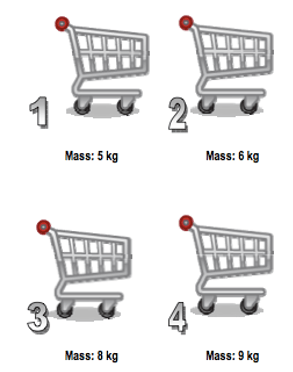
A force of 90N is applied to each cart below, which one will accelerate the fastest?
a)
Cart 1
b)
Cart 2
c)
Cart 3 
d)
Cart 4
16.
A student leaves a pencil on a desk and it stays there until I pick it up. 
a)
Newton's 1st Law
b)
Newton's 2nd Law
c)
Newton's 3rd Law
17.
Two students are in a baseball game. The first student hits a ball very hard and it has a greater acceleration than the second student who bunts the ball lightly.
a)
Newton's 1st Law
b)
Newton's 2nd Law
c)
Newton's 3rd Law
18.
A person not paying attention while skateboarding hits a rock. The skateboard stops...they don't.
a)
Newton's 1st Law
b)
Newton's 2nd Law
c)
Newton's 3rd Law
19.
If you increase the mass on an object, its acceleration
a)
decreases
b)
stays the same
c)
also increases
d)
stops
20.

If the net force is equal to zero, the forces acting on the object are

a)

balanced

b)

unbalanced

21.
Something with a greater mass requires a(n) _____ force to move it. 
a)
greater
b)
lesser
c)
equal
d)
opposite
22.

Newton’s law states that for every action, there is an ________ reaction.

a)

unequal and opposite

b)

equal and similar

c)

stronger and opposite

d)

equal and opposite

23.

Forces always come in ___.

a)

waves

b)

pairs

c)

triplets

24.

When you step on a roach, the roach applies an equal and opposite force on your foot.

a)

True

b)

False

25.

When a heavy football player and a light one run into each other, who exerts more force?

a)

The light one

b)

The heavy one

c)

Their forces are equal

26.

When a small car pushes a big truck, the truck applies an equal and opposite force on the car.

a)

False

b)

True

27.

When a cannon fires a cannonball we observe Newton's third law. Which is the reaction force?

a)

The cannon moving forward

b)

The cannon moving backwards

c)

The cannonball moving backwards

d)

The cannonball moving forward

28.

You hit a wall with a stick. The equal but opposite reaction is _____

a)

the wall pushes against you

b)

the stick pushes against you

c)

the wall pushes against the stick

d)

you push against the stick

29.

How is this an example of Newton’s Third law?

a)

Only the ball is using the head

b)

They are both exerting an equal force on each other

c)

Only the head is pushing the ball

30.

If two people with the same mass collide, they experience the same amount of force.

a)

True

b)

False

31.

Action-reaction pairs can cause a change in motion.

a)

True

b)

False

32.

When the person pushes the ground with their foot, the equal and opposite reaction force is

a)

the ground pushing back on their foot

b)

when they start to move forward

33.
A person steps out of the boat and onto the dock.  As the person moves forward onto the dock, the boat moves backward.  Which statement best describes the backward motion of the boat as the person steps forward?
a)
For every action there is an equal and opposite reaction.
b)
Every mass exerts a force on every other mass.
c)
An object at rest tends to stay at rest.
d)
Friction opposes the motion of an object.
34.
Why is the net force 0 in the image?
a)
Because the elephants are the same size
b)
Because they are both pulling the same amount of force in opposite directions
c)
Because they are elephants
d)
Because they are pulling away from each other.
35.

This picture shows .............

a)

Newton 2nd law of motion

b)

Newton 3rd law of motion

c)

Newton 1st law of motion

d)

I don't know

36.

What happens to the balloon if the air is released ?

a)

Balloon goes right

b)

Balloon goes up

c)

Balloon goes down

d)

Balloon goes left

37.

The two paired forces in Newton's third law:

a)

act on different objects

b)

are equal in size

c)

are opposite in direction

d)

are the same type

e)

all of the above

38.
Friction is a force that acts in an ___________ direction of movement.
a)
similar
b)
opposite
c)
parallel
d)
west
39.
The amount of friction depends on the weight of the objects pressing together.
a)
True
b)
False
40.
What type of friction is not moving?
a)
static
b)
sliding
c)
fluid
d)
rolling
41.
A type of friction that occurs when air pushes against a moving object causing it to decelerate.
a)
surface area
b)
air resistance
c)
velocity
d)
gravity 
42.
How would the absence of friction affect a marble traveling on a long, straight path?
a)
The marble’s speed would decrease.
b)
The marble’s speed would increase.
c)
The marble would stop immediately. 
d)
The marble would remain at constant speed.
43.
When two surfaces rub, the irregularities of one surface get caught on those of the other surface?
a)
True
b)
False
44.
Rougher surfaces have ...
a)
greater friction
b)
less friction
c)
the same level of friction
45.
Wheels on a skateboard most likely experiences-
a)
Rolling Friction
b)
Sliding Friction
c)
Fluid Friction
d)
Static Friction
46.
Sally experiences-
a)
Rolling Friction
b)
Sliding Friction
c)
Fluid Friction
d)
Static Friction
47.
Swimming fish experience-
a)
Rolling Friction
b)
Sliding Friction
c)
Fluid Friction
d)
Static Friction
48.
A type of friction that occurs when air pushes against a moving object causing it to negatively accelerate
a)
surface area
b)
air resistance
c)
descent velocity
d)
gravity 
49.
How does friction affect speed?
a)
more friction decreases speed
b)
more friction increases speed
c)
less friction decreases speed
50.
What is Newton's First Law known as? The Law of
a)
Friction
b)
Mass
c)
Inertia
d)
Gravity
51.
What kind(s) of objects have inertia?
a)
all objects with mass
b)
only objects at rest
c)
only objects in motion
d)
only objects whose motion is being changed
52.
Which type of force(s) will cause a change in an object's motion?
a)
gravity
b)
zero net force
c)
balanced forces
d)
unbalanced forces
53.
An object in motion will stay in what kind of motion as long as the net forces acting on it are zero?
a)
slowing motion in a straight line
b)
accelerating motion in a straight line
c)
constant motion in a straight line
d)
constant motion in an unpredictable direction
54.
What is Newton's First Law
a)
F=ma
b)
Every action has an equal and opposite reaction
c)
An object at rest stays at rest, an object in motion stays in motion. 
d)
Friction 
55.
After a cannonball is fired into frictionless space, the amount of force needed to keep it going equals
a)
twice the force with which it was fired
b)
the same amount of force with which it was fired
c)
1/2 the force with which it was fired
d)
zero, since no force is requires to keep it moving. 
56.
One object has twice as much mass as another object. The first object also has also twice as much...
a)
velocity
b)
gracitational acceleration
c)
inertia
d)
all of these
57.

Resistance to an unbalanced force

a)

Mass

b)

Resistance

c)

Inertia

d)

Force

58.

what is the net force

a)

17N

b)

3N <-----

c)

3N------>

d)

10N ------->

59.
a)

This is an Unbalanced Force

b)

This is a Balanced Force

60.
Inertia is the tendency of an object to resist a change in its ___________. 
a)
temperature
b)
shape
c)
size
d)
motion
61.
Because of inertia, a resting object will remain at ________.
a)
rest
b)
a constant speed
c)
school
d)
inertia 
62.
Because of inertia, a moving object will keep ________.
a)
at rest
b)
moving
c)
in one spot
d)
inertia 
63.
The law of inertia (Newton’s First Law) applies
a)
to both moving and nonmoving objects
b)
only to moving objects
c)
only to objects that are not moving
64.
You push on a car and it does not move.  What is true about the inertia?
a)
The inertia is changing
b)
The inertia of the car is too great 
c)
The inertia of the person is equal to the car
d)
There is not inertia because of no movement
65.

List the objects in order from least to greatest inertia.

a)

CDBA

b)

ABCD

c)

BCDA

d)

CBAD

66.

List the objects in order from least to greatest inertia.

a)

CDBA

b)

ABCD

c)

BCDA

d)

CBAD

67.

Mac and Tosh are arguing in the cafeteria. Mac says that if he flings the jello with a greater speed it will have a greater inertia. Tosh argues that inertia does NOT depend upon speed, but rather upon mass. Who is correct?

a)

Mac

b)

Tosh

c)

Neither

d)

Both

68.

An astronaut kicks a soccer ball in outer space at a location far from significant influences of gravity and air resistance. The soccer ball will _________.

a)

continue in motion with the same speed and direction

b)

eventually stop as its inertia slowly becomes used up

c)

eventually stop since all objects ultimately "lose their steam"

d)

either a, b, or c -- depending on whether the astronaut continues to kick it

69.

An object at rest stays at rest and an object in motion stays in motion with the same speed and in the same direction unless acted upon by a(n) ____________________.

a)

unbalanced force

b)

inertia

c)

mass

d)

balanced force

70.
Which type of force(s) will cause a change in an object's motion?
a)
gravity
b)
zero net force
c)
balanced forces
d)
unbalanced forces
71.
Which one is balanced?
a)
top
b)
bottom
c)
both
72.
Is it BALANCED? 
a)
Yes
b)
No
73.
If there are two forces going in the SAME direction, you would ...?
a)
(-) Subtract the forces
b)
(+) Add the forces
c)
Neither
d)
(x) Multiply
74.
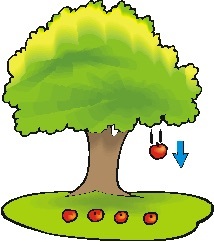
The FORCE that PULLS things down or back to EARTH.
a)
Speed
b)
Gravity
75.
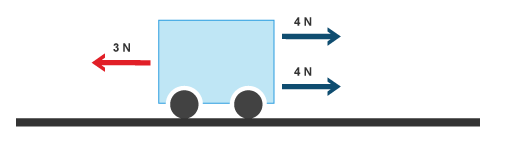
What is the net force?
a)
17 N Right
b)
3 N Right
c)
3 N Left
d)
17 N Left
76.
Calculate the net force of the object in the image shown.
a)
20N
b)
35N
c)
5N
d)
25N
77.
Calculate the net force of the object.
a)
10N
b)
2N
c)
15N
d)
5N
78.
Which direction will the object move?
a)
Right
b)
Left
c)
Up
d)
Down
79.
What is the net force of this object?
a)
0N
b)
50N
c)
25N
d)
5N
80.
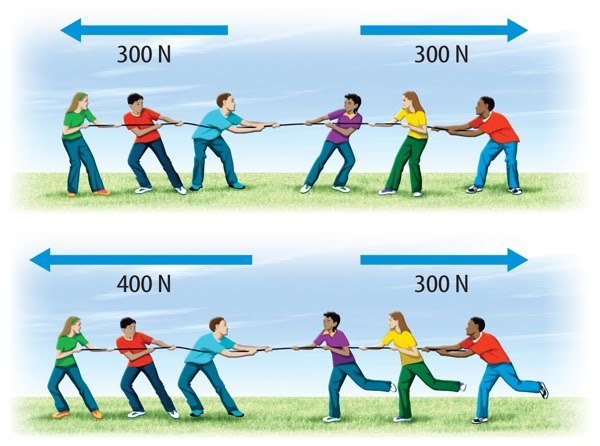
Students are playing tug-of-war. If group B pulls the rope to the right with a force of 400 N and group A pulls the rope to the left with a force of 250 N, what will happen to the ribbon in the middle of the rope?
a)
The ribbon will move to the left and group A will win the tug-of-war.
b)
The ribbon will move to the left and group B will win the tug-of-war.
c)
The ribbon will move to the right and group B will win the tug-of-war.
d)
The ribbon will move to the right and group A will win the tug-of-war.
81.
A cyclist traveling at 25 km/hr turns sharply to the left while continuing to move 25 km/hr. This means the forces involved are_____________________.
a)
Balanced, because the cyclist's speed did not change.
b)
Balanced, because he was still moving forward.
c)
Unbalanced, because it's the same bicycle.
d)
Unbalanced, because his direction changed.
82.
An airplane is travelling North through the sky at a constant speed when turbulence causes it to take a different route, changing its direction. Explain the forces at work on this plane.
a)
Unbalanced, because the plane is moving forward, not backwards
b)
Unbalanced, because the speed is constant and there is a change in direction
c)
Balanced, because the plane is not falling to a lower altitude
d)
Unbalanced, because the plane is in motion
83.
Imagine a bat swinging with a force of 1200 N, hitting a ball pitched with a force of 400 N. At what net force does the ball move away from the bat?
a)
1600 N
b)
800 N
c)
400 N
d)
Net force of 0 N
84.
The graph shows how the speed of an object changed over time. During which segments of this graph were the forces acting on the object balanced?
a)
R only
b)
Q and S
c)
R and T
d)
R, S and T
85.
A group of students places weights onto 4 different carts. The students pull each of the carts with the same amount of force. Which cart has the least change in speed?
a)
A
b)
B
c)
C
d)
D
86.

Force is a __________ quantity.

a)

Vector

b)

Scalar

87.
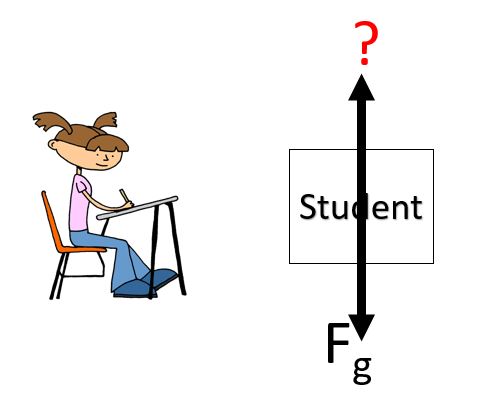
Name the missing force....
a)
weight force
b)
normal force
c)
frictional force
d)
tension force
88.
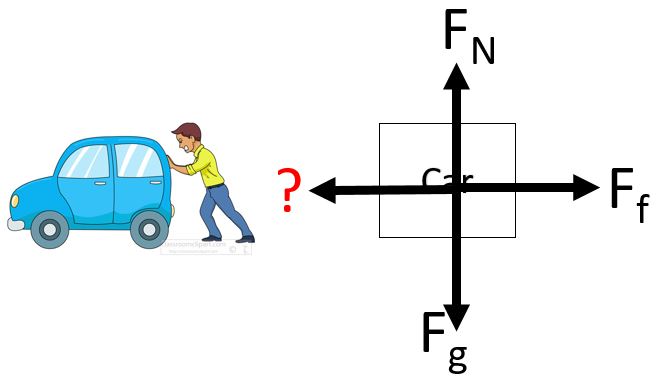
Name the missing force...
a)
frictional force
b)
weight force
c)
thrust
d)
buoyant force
89.
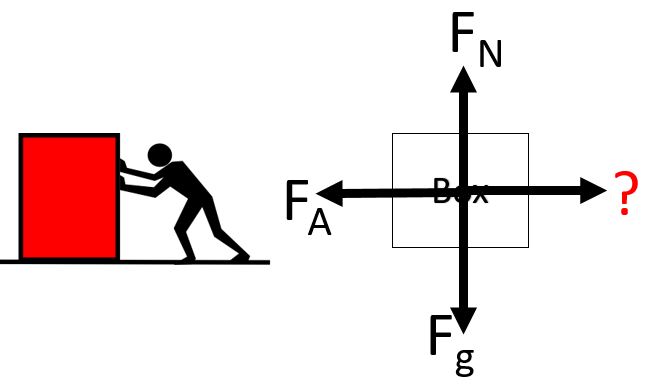
Name the missing force...
a)
applied force
b)
weight force
c)
tension force
d)
drag
90.

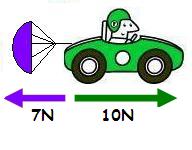
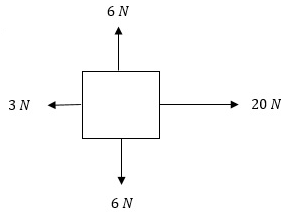
What is the NET FORCE of this diagram?

a)

17 N, right

b)

17 N, left

c)

23 N, right

d)

12 N, up

91.

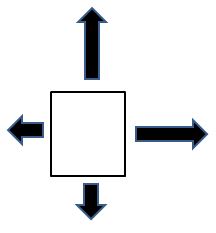
The down-arrow in this diagram is most-likely:

a)

gravity

b)

normal

c)

a push or pull

d)

friction

92.

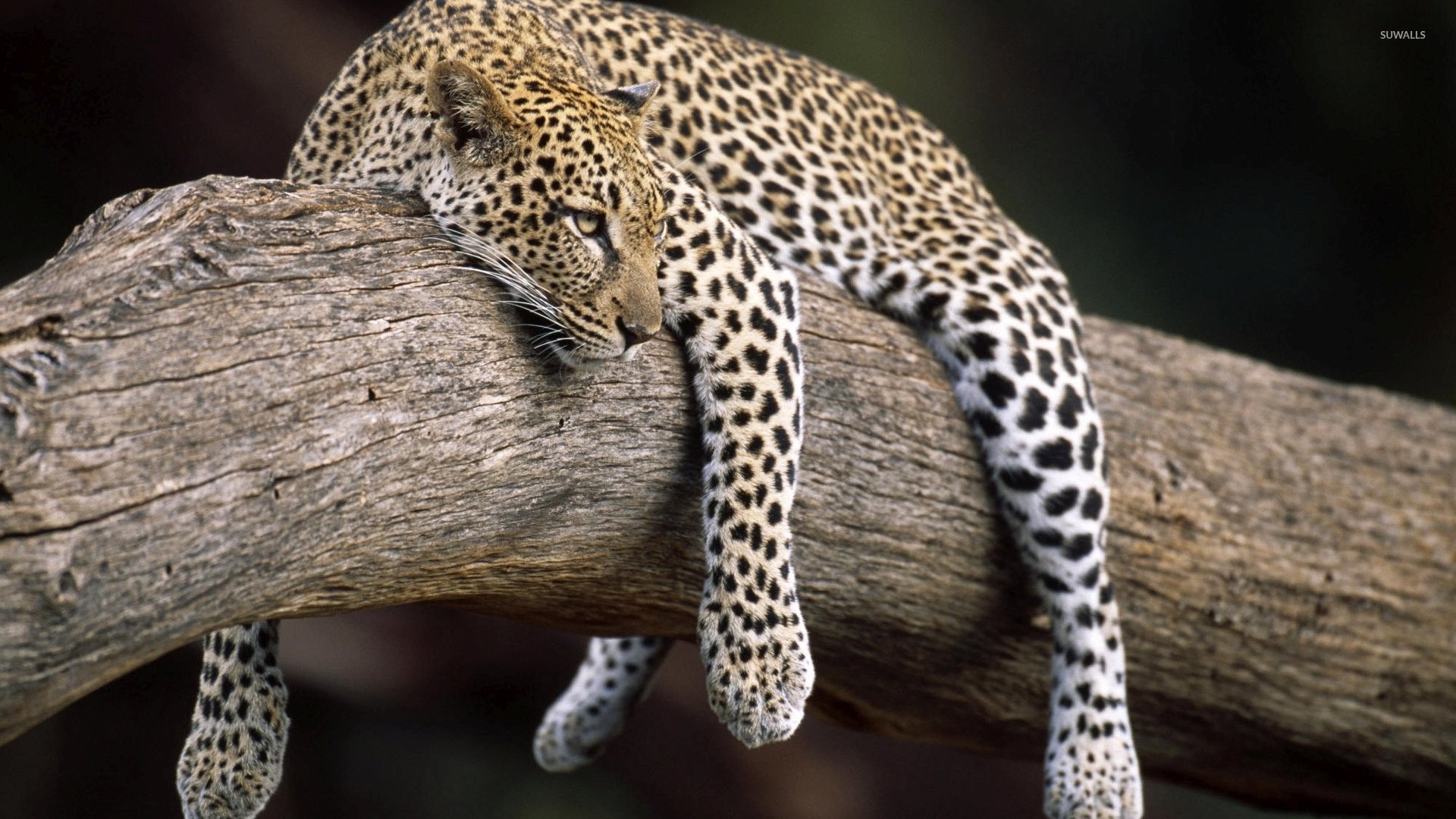
What forces are on a leopard laying on a log?

a)

Fg & Fapp

b)

Fb & Fg

c)

Fg & FN

d)

Ff & FN