wayground logo

Free Printable Worksheets

NEW

Font size

S
M
L
XL
Worksheets

QPA #3 Review

Total questions: 50

Worksheet time: 45mins

Name
Class
Date
1.

Which statement DOES NOT describe waxing moon phases

a)

The light is on the right

b)

It is the first half of the moon phase cycle

c)

The light is on the left

d)

The moon appears to be getting larger

2.
What phase comes AFTER this one?
a)
Waxing Crescent
b)
Waning Gibbous
c)
Waxing Gibbous
d)
Third Quarter
3.
What Moon phase is this?
a)
Waxing Gibbous
b)
Waning Crescent
c)
Waning Gibbous
d)
Full Moon
4.
What Moon phase is this?
a)
Old Moon
b)
Far Side of the Moon
c)
New Moon
d)
Waxing Gibbous
5.
What phase comes BEFORE this one?
a)
Full Moon
b)
Third Quarter
c)
New Moon
d)
First Quarter
6.
What is the difference between a gibbous moon and a crescent moon?
a)
The gibbous shows more than half of the bright side of the moon.
b)
The crescent shows more than half of the bright side of the moon.
c)
The gibbous shows less than half of the bright side of the moon. 
7.
A[n] ______________ tide occurs when the sun is at right angles to the line between Earth and the moon. 
a)
high
b)
neap
c)
low
d)
spring
8.
Which lunar phase will complete the pattern?
a)
Last quarter
b)
New moon
c)
Full moon
d)
Waxing gibbous
9.

Based on the information in this table, which moon phase was most likely visible on June 9, 2005?

a)

Waxing crescent

b)

Waxing gibbous

c)

Full moon

d)

New Moon

10.

How much time passes between Position "a" and Position "g"

a)

One Day

b)

One Week

c)

Two Weeks

d)

One Month

11.

Use the calendar to predict the moon phase on March 9th.

a)

New Moon

b)

Full Moon

c)

Third Quarter

d)

First Quarter

12.

Which lunar phase is occurring at S?

a)

New Moon

b)

Full Moon

c)

waning crescent

d)

waxing crescent

13.
Which lunar phase is visible when the moon is in this position?
a)
New moon
b)
Full moon
14.
What type of tides would this arrangement of earth-moon-sun create?
a)
neap tide
b)
spring tide
c)
new moon tide
d)
full moon tide
15.
Tides are caused mainly by what?
a)
Moon’s gravitational pull
b)
Sun’s gravitational pull
c)
Earth’s gravitational pull
16.
What happens when the area in which you live tilts away from the sun?
a)
It is summer.
b)
It is spring.
c)
It is winter.
d)
It is fall.
17.
Why does the area around the equator stay the same temperature all year?
a)
The equator rotates slower than the poles.
b)
The equator remains the same distance from the sun.
c)
The equator always receives direct sunlight.
d)
The equator has 18 hour days.
18.
What are the reasons for the seasons?
a)
Earth's tilt and rotation.
b)
Earth's rotation and revolution.
c)
Earth's tilt and revolution.
d)
Earth's tilt and resolution
19.
What season is it in the Southern Hemisphere when it is fall in the Northern Hemisphere?
a)
winter
b)
spring
c)
summer
d)
fall
20.
Which season is taking place in the Northern Hemisphere in Position 2?
a)
Winter
b)
Spring
c)
Summer
d)
Fall
21.
What would seasons be like if Earth's axis were straight up and down?
a)
Seasons would be the same.
b)
Seasons would be more extreme.
c)
There would be no seasons.
22.

The change of daytime into nighttime is caused by what phenomenon

a)

The Earth rotating on its axis

b)

The Earth revolving around the Sun

c)

The moon orbiting the Earth

d)

High tides

23.
The Northern Hemisphere gets __________ sunlight in the winter, which leads to _________ temperatures.
a)
less direct, hotter
b)
less direct, colder
c)
more direct, hotter
d)
more direct, colder
24.
At position C, which hemisphere would have winter?
a)
Northern hemisphere
b)
Southern hemisphere
25.
Where on Earth can you experience entire days of darkness?
a)
The equator
b)
The poles
c)
The Tropic of Cancer
d)
The Tropic of Capricorn
26.
What effect does the tilt of the earth have?
a)
It changes the angle that the sun strikes the earth in different land areas
b)
It causes the earth to be farther away from the sun at different times of the year
c)
When the earth is tilted away from the sun we have night
d)
When the earth is tilted away from the sun we have day
27.

When two oceanic plates collide, which of the following most correctly identifies what will occur?

a)

Trench, volcanic island arc, subduction zone

b)

subduction zone, rift valley

c)

volcanic island arc

d)

trench, volcanic island arc, subduction zone, rift valley

28.

What is the change in elevation from point A to point B?

a)

20 meters

b)

40 meters

c)

60 meters

d)

100 meters

29.

Which of the following causes Earth's tectonic plates to move?

a)

Energy from the Sun

b)

Magnetic Pole Reversal

c)

Convection currents in the asthenosphere

d)

Faults in Mountain Ranges

30.
What type of event will occur at this boundary?
a)
Earthquake
b)
Volcano Eruption
c)
Tornado
d)
Mountain Building
31.

The theory that says Earth's continents once made up an ancient supercontinent, and have been drifting apart ever since, is called the theory of...

a)

Pangea

b)

Continental Drift

c)

Seafloor Spreading

d)

Plate Tectonics

32.

Trenches are formed by _______ plate boundaries

a)

Convergent

b)

Transform

c)

Plate

d)

Divergent

33.
A fault is formed by the movement of a __________ plate boundary
a)
Transform
b)
Convergent
c)
Divergent
34.
What do contour lines that are farther apart represent?
a)
waterfall
b)
steep area
c)
gentle slope
d)
river
35.

What evidence did Wegener use in his theory?

a)

Continents and fossils fitting together/matching-up like puzzle pieces

b)

glacier scars and evidence from temperature

c)

mountain ranges and coal deposits line up across continents

d)

all of the above

36.

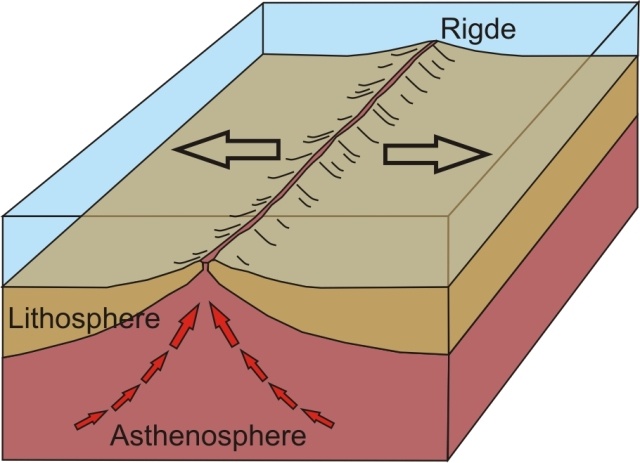
What kind of plate boundary is shown here?

a)

divergent

b)

convergent

c)

transform

d)

subducting

37.

What geologic feature/event would you most likely to find at a divergent boundary between two pieces of oceanic crust?

a)

Rift Valley

b)

Mid-Ocean Ridge

c)

Island Arc

d)

Flat land

38.

What geologic feature/event would you most likely to find at a divergent boundary between two pieces of continental crust?

a)

Mid-Ocean Ridge

b)

Mountain

c)

Rift Valley

d)

Island Arc

39.
What geologic feature/event would you most likely to find at a convergent boundary between two pieces of continental crust?
a)
Volcano
b)
Mountain
c)
Rift
d)
Island Arc
40.
A student stands at the point marked x on the topographic map.  What height is meters must the student climb to reach the top of the hill?
a)
300 m
b)
303 m
c)
253 m
d)
250 m
41.

Based on the map volcanic activity would most likely be found at...

a)

Boundary W

b)

Boundary Z

c)

Boundary Y

d)

Boundary X

42.

Rift valleys can form when fractures in Earth's crust widen. The valley walls slowly move at a rate of only a few millimeters a year. Which of these best describes the type of tectonic activity that forms rift valleys?

a)

Rift valleys form where a continental plate moves under an oceanic plate

b)

Rift valleys form where a plate slides horizontally past another plate

c)

Rift valleys form where two plates move away from each other

d)

Rift valleys form where an oceanic plate moves under another oceanic plate

43.

What is one condition that is necessary for a hurricane to form?

a)

Warm ocean water

b)

A strong cold front

c)

Cold ocean water

d)

A strong warm front

44.
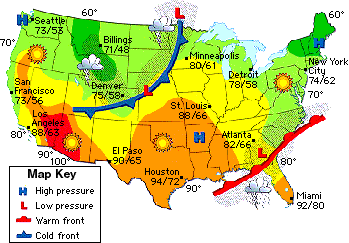
High Pressure is associated with this type of weather...
a)
Cloudy/Overcast Weather
b)
Cold Weather
c)
Warm Weather
d)
Fair Weather
45.
Low Pressure is associated with this type of weather...
a)
Cloudy/Overcast Weather
b)
Cold Weather
c)
Warm Weather
d)
Fair Weather
46.
A cold front moving into an area can bring this type of weather...
a)
Warmer Temperatures, Clear Skies
b)
Colder Temperatures, Clear Skies
c)
Warmer Temperatures, Clouds
d)
Colder Temperatures, Clouds, and Precipitation
47.
A warm front moving into an area can bring this type of weather...
a)
Warmer Temperatures, Clear Skies
b)
Colder Temperatures, Clear Skies
c)
Warmer Temperatures, Clouds, and steady precipitation
d)
Colder Temperatures, Clouds, and Precipitation
48.

A high pressure system is located north of New York City. What type of weather will be experienced there?

a)

clear, sunny skies

b)

cloudy and rainy

49.

Which factor below creates Earth's climate

a)

The sun causing an unevenly heated Earth

b)

Earth's oceans warm up/cool down slower than Earth's landmasses

c)

Ocean currents transfer heat all over the Earth

d)

Wind transfers heat all over the Earth

e)

All of the above create Earth's climate

50.

A front is moving towards Minneapolis, which changes would be expected

a)

Cooler temperatures with no rain

b)

Severe weather with warmer temperatures

c)

Severe weather and cooler temperatures

d)

Gentle rains with warmer temperatures