wayground logo

Free Printable Worksheets

Font size

S
M
L
XL
Worksheets

Chemistry: States, Transitions, Temperatures, and KMT

Total questions: 62

Worksheet time: 3hrs 6mins
Name
Class
Date
1.
What happens when my glass of water is sitting in the sun and disappears into a gas?
a)
evaporation
b)
burning
c)
melting
d)
freezing
2.
What term describes a solid changing to a gas?
a)
Deposition
b)
Sublimation
c)
Evaporation
d)
Freezing
3.
What term describes a liquid changing to a solid?
a)
Deposition
b)
Sublimation
c)
Evaporation
d)
Freezing
4.
______________________ takes place when a liquid changes to a solid.
a)
freezing
b)
melting
c)
boiling
d)
sublimation
5.
At higher temperatures
a)
particles in an object have less energy
b)
particles in an object move faster
c)
a gas contracts
6.
A gas
a)
has a definite shape but no definite volume
b)
has a definite volume but no definite shape
c)
has fast-moving particles
7.
The speed of the molecules determines the _____.
a)
volume
b)
density
c)
pressure
d)
temperature
8.

Particles in a ______________________ move quickly and are far apart.

a)

gas

b)

solid

c)

liquid

9.

Particles of a liquid

a)

are tightly packed together and stay in a fixed position.

b)

are free to move around one another but still touch.

10.
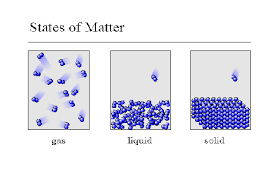
The molecules in the picture are tightly held together with little movement. They have shape and energy.  Therefore, the picture represents _________.
a)
solid
b)
liquid
c)
gas
d)
plasma
11.

What is the correct order of the states of matter? From the least amount of energy to the most amount of energy.

a)

Solid, Liquid, Gas

b)

Gas, Liquid, Solid

c)

Liquid, Gas, Solid

d)

Solid, Gas, Liquid

12.

Which is not true about the liquid state of matter?

a)

The liquid state has a definite volume and a definite shape.

b)

The liquid state takes on the shape of its container.

c)

The liquid state has a definite volume and an indefinite shape.

d)

The particles in a liquid can easily move past each other.

13.

Particles vibrate in place and do not change relative positions.

a)

solid

b)

liquid

c)

gas

14.

What happens to particles when their temperature increases?

a)

The particles move slower

b)

The particles move faster

c)

The particles lose mass

d)

The particles gain mass

15.
Water exists as a _____________ at 700 mmHg and 50 °C.
a)
solid
b)
liquid
c)
gas
d)
supercritical fluid
16.
At 10 atm, dry ice is heated from -100 °C to 30 °C.  What changes occur?
a)
freezing, then condensation
b)
melting only
c)
sublimation only
d)
melting, then boiling
17.
What state of matter is X?
a)
solid 
b)
liquid
c)
gas
d)
supercritical fluid
18.
What state of matter is Y?
a)
solid 
b)
liquid
c)
gas
d)
supercritical fluid
19.
What change occurs from F to E?
a)
sublimation
b)
deposition
c)
melting
d)
condensation
20.
What change occurs from E to C?
a)
sublimation
b)
freezing
c)
melting
d)
boiling
21.

When making ice cream, milk freezes and becomes a solid. What happens to the milk molecules as it is cooled?

a)

The milk molecules move faster as the temperature decreases.

b)

The speed of the molecules does not change.

c)

The average speed of the molecules decreases as the temperature decreases.

d)

The milk molecules move slower and slower until they stop moving at all.

22.
What is the melting point of water?
a)
212°C
b)
100°C
c)
32°C
d)
0°C
23.
How do you make matter change state?
a)
Add energy to it
b)
Take energy away from it
c)
Both of these
24.

What is the boiling point of water?

a)

212°C

b)

100°C

c)

32°C

d)

0°C

25.

A substance's melting point is the same as its

a)

freezing point.

b)

condensation point.

c)

boiling point.

26.

On a hot, humid summer day drops of water form on a can of cold soda. What process caused this to happen?

a)

condensation

b)

freezing

c)

vaporization

d)

deposition

27.
What does "#1" represent on the graph? 
a)
solid phase
b)
melting
c)
liquid phase
d)
boiling 
28.
What does "#2" represent on the graph? 
a)
solid phase
b)
melting
c)
liquid phase
d)
boiling
29.
What does "#4" represent on the graph? 
a)
melting 
b)
liquid phase
c)
boiling
d)
gas phase
30.
What does "#5" represent on the graph? 
a)
solid phase 
b)
melting
c)
boiling
d)
gas phase
31.
What does "#3" represent on the graph? 
a)
melting
b)
liquid phase
c)
boiling
d)
gas phase
32.

100 Celsius is ? Kelvin (K = Celsius + 273)

a)

173 K

b)

373K

c)

273 K

d)

0 K

33.
Measures how fast or how slow molecules are moving
a)
Thermometer
b)
Temperature
c)
Heat
d)
All of them
34.
A temperature scale that is used mostly in United States. 
According to it, water freezes at 32 degrees and boils at 212 degrees.
a)
Celsius
b)
Fahrenheit
c)
Kelvin
d)
All of them
35.
Scientists' favorite temperature scale, because it begins at the absolute coldest anything can get. 
a)
Celsius
b)
Fahrenheit
c)
Kelvin
d)
All of them
36.
There are 3 main scales by which temperature is measured. 
a)
True 
b)
False
37.
The temperature at which molecular energy is at a minimum (0 K on the Kelvin scale or -273.16 C) on the Celsius scale.
a)
Specific Heat
b)
Plasma
c)
Absolute Zero
d)
Conduction
38.

According the KMT, the particles are in

a)

different states

b)

organized patterns

c)

constant motion

d)

various containers

39.
What are the three states of matter?
a)
solid, volume, mass
b)
density, volume, mass
c)
solid, liquid, gas
d)
density, gas, volume
40.
You can measure ______ with grams.
a)
mass
b)
volume
c)
conductivity
d)
melting point
41.
The amount of matter something contains is its ______________.
a)
gas
b)
solid
c)
weight
d)
mass
42.
Matter has to main properties mass and volume
a)
True
b)
False
43.

Evaporates easily.

a)

VOLATILE

b)

Highly unstable; explosive

c)

VOLUME

d)

VELOCITY

44.
When a solid reaches the temperatures of its ___, it can become a liquid.
a)
melting point
b)
freezing point
c)
boiling point
d)
density
45.

At -190*C Fluorine is a ________.

a)

Solid

b)

Liquid

c)

Gas

d)

Plasma

46.

At -202*C Chlorine is a ________.

a)

Solid

b)

Liquid

c)

Gas

d)

Plasma

47.

Which region represents a solid?

a)

A

b)

B

c)

C

48.

At what temperature is the triple point?

a)

0 degrees

b)

0.01 degrees

c)

100 degrees

d)

374 degrees

49.
What state of matter is Z?
a)
solid 
b)
liquid
c)
gas
d)
supercritical fluid
50.
What change occurs from C to D?
a)
condensation
b)
vaporization
c)
melting
d)
sublimation
51.

If I can't change temperature enough to change states, I could also change the ________________.

a)

Pressure

b)

Substance

c)

Mass

d)

Container

52.

When something doesn't change it can be called ________.

Ex. Solids have a ____________ shape and volume.

a)

Changing

b)

Definite

c)

Indefinite

d)

Flexible

53.

When something does change it can be called ________.

Ex. Gases have a(n) ____________ shape and volume.

a)

Stable

b)

Definite

c)

Indefinite

d)

Fixed

54.

Perfume is an example of a ____________ substance

a)

Volatile

b)

Volume

c)

Definite

d)

Kelvin

55.

Which form of matter has a definite shape and takes up space (has definite volume)?

a)

liquid

b)

solid

c)

gas

d)

clay

56.

Plasma can be found in which of the following

a)

Auroras

b)

Lightening

c)

LED light bulbs

d)

Stars

e)

Moons

57.

In a plasma the electrons are no longer associated with a particular nucleus.

a)

True

b)

False

58.

anything that has mass and occupies space. It has three different states - solid, liquid, and gas - and is made up of many atoms.

a)

matter

b)

molecule

c)

atom

d)

variable

59.

Absolute Zero is ________________

a)

0*C

b)

0*F

c)

0 K

d)

0

60.
What is kinetic energy?
a)
energy of work
b)
energy of motion
c)
energy of gravity
d)
energy of power
61.
The amount of energy needed to change a material from a solid to a liquid state.
a)
Heat of Solids
b)
Heat of Liquids
c)
Heat of Fusion
d)
Heat of Vaporization
62.
The amount of energy needed to change a material from a liquid to a gas.
a)
Heat of Liquids
b)
Heat of Gas
c)
Heat of Fusion
d)
Heat of Vaporization