wayground logo

Free Printable Worksheets

NEW

Font size

S
M
L
XL
Worksheets

3rd quarter science exam review

Total questions: 76

Worksheet time: 2hrs 39mins

Name
Class
Date
1.

Which sphere includes all living organisms?

a)

geosphere

b)

hydrosphere

c)

biosphere

d)

atmosphere

2.
This part of the Earth System includes the crust, mantle, and core.
a)
Geosphere
b)
Atmosphere
c)
Hydrosphere
d)
Biosphere
3.
This part of the Earth System includes the gases that surround the earth.
a)
Geosphere
b)
Atmosphere
c)
Hydrosphere
d)
Biosphere
4.
This part of the Earth System includes all living things, including plants and animals.
a)
Geosphere
b)
Atmosphere
c)
Hydrosphere
d)
Biosphere
5.
This part of the Earth System includes the planet's water, including the oceans, lakes, rivers, ground water, ice, and vapor.
a)
Geosphere
b)
Atmosphere
c)
Hydrosphere
d)
Biosphere
6.
All of the living and non-living things in a place.
a)
Ecosystem
b)
Hydrosphere
c)
Grassland
d)
Organism
7.
A living thing
a)
Organism
b)
Geosphere
c)
Hydrosphere
d)
Original
8.

The part of the Earth that is made up of all solid and liquid water

a)

atmosphere

b)

biosphere

c)

geosphere

d)

hydrosphere

9.

Biotic factors include...

a)

living things like animals, fungi, and plants

b)

landfills

c)

nonliving things like soil, rocks, and water

d)

both living and nonliving things

10.

Abiotic factors include...

a)

living things like animals, fungi, and plants

b)

landfills

c)

nonliving things like soil, rocks, and water

d)

both living and nonliving things

11.

All living things need _________ and _________ factors to survive.

a)

food and plants

b)

biotic and abiotic

c)

sunlight and good weather

d)

cans of tuna and water

12.

What is a biosphere?

a)

A model of a sphere that looks like Earth

b)

The sum of all living matter on Earth

c)

A group of organisms

d)

A small part of the Earth

13.

All living things depends on the __________ to survive.

a)

sun

b)

jupiter

c)

the moon

d)

pizza

14.

In an ecosystem, abiotic factors include —

a)

plants, animals, microorganisms, and fungi

b)

all living and non-living things

c)

sunlight, water, temperature, and soil

d)

producers and consumers

15.

An ecosystem is a system consisting of all the interactions that occur between the abiotic and biotic factors of an environment.

a)

True

b)

False

16.
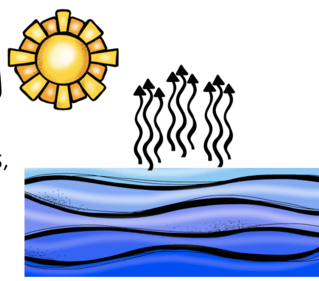
What part of the water cycle does this picture show?
a)
condensation
b)
precipitation
c)
evaporation
d)
transpiration
17.
Which of these is an example of precipitation?
a)
snow
b)
air
c)
clouds
d)
vapor
18.
What is it called when plants give off water vapor as a waste product?
a)
condensation
b)
evaporation
c)
sublimation
d)
transpiration
19.
Evaporation happens when the sun ___________ water and turns it into vapor.
a)
cools
b)
heats up
c)
freezes
d)
lights up
20.
When water condenses, the water vapor in the air gets ___________ and changes back into liquid.
a)
cold
b)
hot
c)
warm
d)
solid
21.
What is the water cycle?
a)
the 3 forms of water
b)
the movement of water on, above, or below the surface of the Earth
c)
when water melts
d)
when clouds form
22.
Precipitation happens when clouds of water droplets are too ______________.
a)
cold
b)
light
c)
heavy
d)
hot
23.
Where is most water found on Earth?
a)
glaciers
b)
lakes
c)
rivers
d)
oceans
24.
What source of energy evaporates the most water from Earth’s surface?
a)
volcanoes
b)
the sun
c)
lightning
d)
wind
25.
What is water doing when it is changed to water vapor? 
a)
Evaporating
b)
Condensing
c)
Precipitating
26.
A Fossil Fuel is
a)
Materials that are found on Earth that people use
b)
Rock that contains metal 
c)
Fuels that formed years ago from the remains of things that lived millions of years ago.
d)
Resources that cannot be replaced quickly enough to keep from running out. 
27.
Natural Resources are
a)
Materials that are found on Earth that people use. 
b)
Rocks that contain metal
c)
Resources that are continually being replaced and will not run out.
d)
Resources that cannot be replaced quickly enough to keep from running out. 
28.
Non renewable resources are
a)
Materials that are found on Earth that people use.
b)
Rock that contains metal
c)
Fuels that formed from the remains of things that lived millions of years ago
d)
Resources that cannot be replaced quickly enough to keep from running out. 
29.
Renewable resources are:
a)
Materials that are found on Earth that people use
b)
Rock that contains metal 
c)
Fuels that formed from the remains of things that lived millions of years ago.
d)
Resources that are constantly being replaced and will not run out. 
30.
Which of the following is not a natural cause of water pollution?
a)
Volcanoes
b)
Algae Blooms
c)
Oil Spills
d)
Animal Waste
31.
Around how much of the Earth's water is fresh water?
a)
1%
b)
5%
c)
10%
d)
15%
32.
Where is pollution found on the earth?


a)
only in the air 
b)
only on the land 
c)
only in the water 
d)
on land, in the air, and in the water 
33.
What is a renewable resource?


a)
 one that can be replaced quickly 
b)
one that is man-made
c)
one that comes from the sun 
d)
one that will never run out 
34.
Which one BEST describes a nonrenewable resource?

   
a)
It is one that will run out one day and can’t be replaced.
b)
It will last for about 100 years.
c)
  It can be replaced again and again.
d)
It will never run out.
35.
Which is one reason that trash and litter can hurt wildlife?

   
a)
Wildlife are afraid of human garbage.
b)
Trash covers the scent of other animals they are hunting.
c)
Wildlife may try to eat plastics and choke on them.
d)
Trash and litter removes their camouflage.
36.

What is one way you and your family can help to conserve water at home?

a)

watering the garden at the hottest time of the day

b)

using the longest cycle to wash clothes

c)

turning off the faucet while brushing your teeth

d)

letting the water run while washing dishes

37.

What has left tons of "space junk" in orbit around the earth?

a)

robots sent on space missions

b)

years of space exploration

c)

lack of recycling

d)

missiles in outer space

38.

There are more than 22,000 pieces of junk in space around the earth. There are also millions of smaller pieces of junk that we can't see.

a)

True

b)

False

39.
What is deforestation?
a)
Clearing Earth's forests on a massive scale
b)
Eating too much vegetables
c)
Going to a forest and pulling weeds
d)
Clearing the five trees in my backyard
40.
What does deforestation effect?
a)
Plants and animals
b)
Our biosphere
c)
Humans
d)
All of the above
41.
What are the effects of deforestation ?
a)
loss of habitat
b)
increased green house gasses 
c)
soil erosion and flooding
d)
all of the above
42.

Coal, natural gas, and petroleum are

a)

fossil fuels.

b)

geothermal fuels.

c)

biomass materials.

43.
Sunlight
a)
Nonrenewable resource
b)
Renewable resource
44.
Rocks and minerals
a)
Renewable resources
b)
Nonrenewable resources
45.
Wind
a)
Renewable resource
b)
Nonrenewable resource
46.
What are the 3 main fossil fuels?
a)
Coal, Oil, and Gasoline
b)
Coal, Oil, and Natural Gas
c)
Electricity, Gasoline, Petroleum
d)
Coal, Oil, Non-renewable Resources
47.
What must be present for Fossil Fuels to form?
a)
Bones and Sediment
b)
Dead Organisms and Layers of Sediment
c)
Dead Organisms, Layers of Sediment, and Heat & Pressure over time
d)
Bones, Layers of Sediment, and Heat & Pressure over time
48.
Takes millions of years to form.
a)
hydroelectric
b)
renewable
c)
solar
d)
fossil fuels
49.
A resource not easily replaced.
a)
nonrenewable
b)
renewable
c)
alternative
50.

What is a natural resource?

a)

a resource that occurs naturally

b)

a resource that is man-made

51.

Where are natural resources found?

a)

in the woods

b)

at the beach

c)

in nature

d)

under the ground

52.

You can make synthetic products from these things...

a)

Plant based resources

b)

Animal based resources

c)

Petroleum based resources

d)

All of the above

53.

What is another word for man-made?

a)

synthesize

b)

synthetic

c)

synth

54.

What is a synthetic resource?

a)

a resource made by humans from natural materials

b)

naturals resources such as trees and water

55.

What is the difference between natural and synthetic resources?

a)

Natural are man-made, synthetic are found in nature

b)

Natural occur in nature, synthetic are man-made

c)

There is no difference

d)

We don't use natural resources but we use synthetic resources

56.

Which is an example of a natural resource?

a)

pencils

b)

paper

c)

books

d)

trees

57.

What is an example of a natural resource?

a)

clothes

b)

cotton

c)

nylon

58.

Which is an example of a natural resource?

a)

bottled water

b)

the ocean

59.

What is an example of a natural resource?

a)

fish

b)

fish sticks

c)

fishing pole

60.

What is an example of a synthetic resource?

a)

plants

b)

potatoes

c)

potato chips

61.

What is an example of a synthetic resource?

a)

tree

b)

branch

c)

seed

d)

chair

62.

Why do we need synthetic resources?

a)

we don't

b)

to live life a certain way

63.

True or False: you can turn a synthetic resource into a natural resource.

a)

True

b)

False

64.

Which product is made from animal based resources?

a)

wool jacket

b)

cheese

c)

bear rug

d)

all of these

65.

Regions with large amounts of natural resources often are

a)

Poor

b)

Wealthy

66.

____ is when people tend to settle and cluster in regions that have resources they need to survive.

a)

Employment

b)

Conflict and Wars

c)

Human Settlement

67.

Countries with fertile land will have more employment related to

a)

fossil fuels

b)

industrial building

c)

farming and ranching

68.

What happens when larger and stronger countries would take and exploit smaller and weaker countries for natural resources?

a)

Employment

b)

Conflict and Wars

c)

Trade

69.

A country can exchange resources it has for the resources it wants by _____ with another country.

a)

Trading

b)

Fighting

c)

Stealing

70.

Countries that have a lack of natural resources can rely heavily on

a)

manufacturing products/technology

b)

Wars

c)

Take resources from other countries

71.

The United States of America has what types of natural resources?

a)

Fertile land, Coal, Natural Gas, and Gold

b)

Biodiversity, Uranium, and Gold

c)

Diamonds, Gold, Natural Gas, and Uranium

d)

Coal, Fertile Land, Gold, and Diamonds

72.
Air, water, trees, rocks and minerals, soil, coal and oil are all examples of which type of resource?
a)
Renewable resources
b)
Nonrenewable resources
c)
Natural resources
d)
Inexhaustible resources
73.
Which of the following natural resources are nonrenewable?
a)
Water
b)
Animals
c)
Natural gas
d)
Wind
74.
Metals, oils, and gas are nonrenewable resources. One day they could be all used up.
a)
True
b)
False
75.
Energy from the sun is called - 
a)
solar
b)
wind
c)
biomass
d)
geothermal
76.
What does it mean to convert something into reusable material?
a)
Reduce
b)
Reuse
c)
Hazardous waste
d)
Recycle