wayground logo

Free Printable Worksheets

NEW

Font size

S
M
L
XL
Worksheets

Genetics Review

Total questions: 63

Worksheet time: 47mins

Name
Class
Date
1.
Heterozygous is when...
a)
the alleles are the same
b)
the alleles are different
c)
the alleles are absent
d)
the alleles are present
2.
Genotype refers to the ...
a)
physical expression of the genes
b)
the possible combination of alleles in a gene
c)
whether an allele is dominant or recessive
d)
how an organism will appear
3.
What is a phenotype
a)
The genetic make up (code)
b)
The physical trait
4.
having two different genes for a trait (sometimes called hybrid).
a)
protein
b)
homozygous
c)
heterozygous
d)
genotype
5.
Where, in the eukaryotic cell, is DNA located?
a)
ribosomes
b)
nucleus
c)
E.R.
d)
cytoplasm
6.
What does heterozygous mean?
a)
An organism that has the same genes for a trait (TT or tt)
b)
An organism that has different genes for a trait (Tt)
c)
When neither gene is fully dominant; offspring is a mixture of both
d)
the different forms of a trait (hair color--> brown, blonde, red
7.
Which of the following is homozygous dominant?
a)
Yy
b)
Y
c)
yy
d)
YY
8.
What you see, or the physical appearance.
a)
Genotype
b)
Phenotype
c)
Homozygous
d)
Heterozygous
9.
How many alleles (letters) do each person carry for a trait?
a)
1
b)
2
c)
3
d)
4
10.
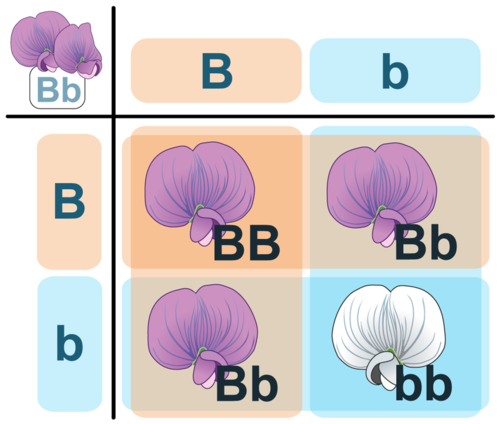
In this punnett square, which is the dominant trait?
The B stands for bud.
a)
purple flower bud
b)
white flower bud
c)
dominant
d)
recessive
11.
this image is an example of
a)
codominance
b)
dominance
c)
incomplete dominance
12.
Who is the father of genetics? 
a)
Charles Darwin 
b)
Gregor Mendel
c)
Dimitri Mendeleev 
d)
Hans Krebs 
13.
What organism did Mendel do his famous studies of genetics with? 
a)
bees
b)
carrots 
c)
peas 
d)
mice
14.
What is a factor that is covered up by another trait?
a)
Recessive
b)
Dominant
15.
What is a factor that covers up another trait?
a)
Recessive
b)
Dominate
16.
What is cross pollination?
a)
When pollen from a flower fertilizes itself or another flower on the same plant
b)
When pollen from one flower fertilizes a flower on a different plant
c)
A plant whose offspring share the same traits as the parent
d)
A plant whose offspring is genetically different from the parent.
17.
What is self-fertilization?
a)
When pollen from a flower fertilizes itself or another flower on the same plant
b)
When pollen from one flower fertilizes a flower on a different plant
c)
A plant whose offspring share the same traits as the parent
d)
A plant whose offspring is genetically different from the parent.
18.
What is true-breeding?
a)
When pollen from a flower fertilizes itself or another flower on the same plant
b)
When pollen from one flower fertilizes a flower on a different plant
c)
A plant whose offspring share the same traits as the parent
d)
A plant whose offspring is genetically different from the parent.
19.
What did Gregor Mendel do in his first experiment?
a)
Self-Pollinated two pea plants
b)
Self-Pollinated two true-breeding pea plants
c)
Cross-pollinated two pea plants
d)
Cross pollinated two true-breeding pea plants
20.
A trait that is not expressed when a dominant allele is present.
a)
Recessive
b)
Co-dominant
c)
Incomplete Dominant
d)
Dominant
21.
A trait that is expressed over other traits.
a)
Recessive
b)
Co-dominant
c)
Incomplete Dominant
d)
Dominant
22.
How can two parents with brown eyes have a child with blue eyes?
a)
The parents may both have recessive genes for blue eyes.
b)
The child was born during the winter
c)
Eye color in humans is not an inherited trait
d)
The child was deprived of oxygen during its birth
23.
What part of an organism's genetic makeup is received from its mother?
a)
25%
b)
50%
c)
75%
d)
100%
24.

A diagram used to predict the outcome of a particular cross or breeding experiment.

a)

Gregor Mendel

b)

Pea Plant

c)

Punnett Square

d)

Genotype

25.

Why were ratios important in Mendel's work?

a)

They showed that heredity does not follow a set pattern.

b)

They showed that some recessive traits are really dominant.

c)

They showed the relationship between two different things.

d)

They showed that some traits are never passed on.

26.

What trait appeared in Mendel's first experiment?

a)

the recessive trait.

b)

the dominant trait.

c)

both dominant and recessive trait.

d)

a blend of dominant and recessive trait.

27.

In Mendel's experiments, the recessive traits

a)

appeared in the second generation.

b)

were always hidden by the dominant trait.

c)

were altered after cross-pollination.

d)

disappeared.

28.

What step did Mendel take to be sure that his pea pants cross-pollinated?

a)

He used two white plants.

b)

He used plants that were not true breeding.

c)

He added anthers to both plants.

d)

He removed the anthers of one plant.

29.

What happens when a true-breeding plant self-pollinates?

a)

Some of its offspring have the same traits as the parent.

b)

None of its offspring have the same traits as the parent.

c)

All of its offspring have the same traits as the parent.

d)

One of its offspring has the same traits as the parent.

30.

An organism's appearance is its...

a)

genotype.

b)

phenotype.

c)

allele.

d)

gene.

31.

A plant with two dominant OR two recessive alleles is said to be...

a)

homozygous or true-breeding.

b)

heterozygous or cross-breeding.

c)

incomplete dominance.

d)

hybrid.

32.

A short true-breeding plant will always produce a short plant.

a)

True

b)

False

33.
Sperm from one plant fertilizes the eggs of the same plant in 
a)
cross-pollination
b)
cross-breeding
c)
self-pollination
d)
self-breeding
34.
Dominant traits are more common in a population then recessive traits
a)
true
b)
false
35.

When Mendel crossed a true-breeding purple pea plant with a true-breeding white pea plant, the result was only purple pea plants. Why?

a)

The color purple was the dominate trait

b)

The color white was the dominate trait.

c)

The white peas were sterile.

d)

The purple plants got more nutrients.

36.

When a(n) __________ plant self-pollinates, it always produces offspring with traits that match the parent.

a)

true-breeding

b)

cross-breeding

c)

self-pollinating

d)

offspring

37.

Self-pollination occurs when pollen from one plant lands on the pistil of a flower on the same plant.

a)

True

b)

False

38.

Pea plants were ideal for genetic studies because they reproduce quickly.

a)

True

b)

False

39.

For what is Gregor Mendel most well known?

a)

his experiments with pea plants which showed that certain traits followed predictable patterns of inheritance

b)

his research on the human genome project

c)

his research with Charles Darwin studying evolution and inheritance

d)

the creation of the Punnett square, a tool used by biologists to predict possible genotypes of offspring

40.

The first–generation purple-flowering plants are called _____ plants.

a)

hybrid

b)

cross-breeding

c)

self-breeding

d)

self-pollinating

41.
When parents with different traits are bred, a trait that reappears in the second generation after disappearing in the first generation is a
a)
dominant trait
b)
recessive trait
c)
true-breeding trait
d)
characteristic
42.

What is DNA made of?

a)

Sugar, Phosphate, nitrogen base

b)

Phosphate, Adenine, nitrogen base

c)

Thymine, Adenine, Cytomine

d)

Phosphate, Nitrogen, Adenine

43.
Adenine bonds with ______________.
a)
Guanine
b)
Thymine
c)
Cytosine
d)
Adenine
44.
Guanine bonds with ______________.
a)
Adenine
b)
Guanine
c)
Cytosine
d)
Thymine
45.

What are the 4 nitrogen bases?

a)

adenine, thymine, cytoplasm, and guanine

b)

adenine, thymine, cytosine, and guanine

c)

adenine, thymine, cytosine, and gylcerol

d)

adenine, thymine, cytosine, and glucose
46.
Which organelle is DNA usually found in?
a)
cell membrane
b)
vacuole
c)
chloroplast
d)
nucleus
47.
Why is DNA important?
a)
it is very small and very complicated
b)
it's in everything
c)
it serves as the blueprint for traits of all living things
d)
because we eat it every day for energy
48.

Which two scientists are credited with building the first DNA molecule model?

a)

Franklin and Roosevelt

b)

Watson and Crick

c)

Wilson and Collins

d)

Franklin and Crick

49.

The shape of the DNA molecule is called a _________________________.

a)

double helix

b)

spiral

c)

single helix

d)

protein

50.
A process in which DNA has the unique ability to make an exact copy of itself.
a)
Replication
b)
Translation
c)
Transcription
51.
Which of the following units are repeatedly joined together to form a strand of DNA?
a)
amino acids
b)
nucleotides
c)
fatty acids
d)
polysaccharides
52.
Which of the following is an example of a hurtful mutation? 
a)
Developing cancer
b)
Makes the organism faster
c)
Makes the organism a predator 
d)
Develops sharp claws
53.
What is the definition of DNA mutation? 
a)
The original DNA strand
b)
The strand with four pairs 
c)
A change in the DNA strand
d)
The strand in a double helix 
54.

What does adenine pair with in RNA?

a)

thymine

b)

cytosine

c)

guanine

d)

uracil

55.

This is the type of RNA that makes the ribosome.

a)

mRNA

b)

tRNA

c)

rRNA

d)

sRNA

56.

What is the shape of RNA?

a)

Double helix

b)

Triple hexagon

c)

Single Helix

d)

Quad bases

57.

Where is RNA found?

a)

In the nucleus

b)

In the ER

c)

In the chloroplast

d)

In the cytoplasm

58.

What is the first phase of making a protein?

a)

transcription

b)

DNA

c)

nucleotide

d)

chromosome

59.

What carries the code for making proteins from the nucleus to the ribosomes?

a)

RNA

b)

DNA

c)

the cell nucleus

d)

cytoplasm

60.

The three types of RNA are transfer RNA, ribosomal RNA, and ________________.

a)

translation

b)

amino acid

c)

messenger RNA

d)

nucleotides

61.

How many human chromosomes are there?

a)

46 (or 23 pairs)

b)

12

c)

2

d)

21

62.

Transcription is the process of making

a)

mRNA from DNA.

b)

DNA without the use of nitrogen bases.

c)

chemicals that link chains of amino acids.

63.

A molecule made of a nitrogen base, a sugar, and a phosphate group is a(n) .

a)

nucleotide

b)

ribosomes

c)

Transfer RNA

d)

genotype