wayground logo

Lembar Kerja Gratis yang Dapat Dicetak

BARU

Ukuran huruf

S
M
L
XL
Lembar kerja

Chemical Reactions

Total soal: 35

Worksheet time: 1hrs 4mins

Nama
Kelas
Tanggal
1.
A neutralisation reaction is a reaction between 
a)
Acid and a Base 
b)
Acid and water 
c)
Base and water 
d)
None of the above 
2.
An acid reacts with metal to produce 
a)
Carbon dioxide 
b)
Hydrogen gas
c)
Hydrogen gas and water 
d)
Salt and hydrogen gas 
3.
A neutralisation reaction produces 
a)
An acid 
b)
A neutral substance 
c)
Only water 
d)
Salt and water 
4.
An acid reacts with a metal carbonate to produce 
a)
Salt, water and hydrogen gas
b)
Salt, water and carbon dioxide
c)
Limewater
d)
Salt and water 
5.
What type of reaction is the following: 
HCl  + Zn --> ZnCl2 + H2
a)
Neutralisation
b)
Acid and a metal 
c)
Acid and a carbonate 
d)
Ionic 
6.
Complete the following reaction:
Sulphuric acid + sodium carbonate
--> 
a)
Carbon dioxide + water 
b)
calcium carbonate + water + carbon dioxide 
c)
Sodium sulphate + water + carbon dioxide 
d)
Sodium chloride + water + carbon dioxide 
7.
Complete the following reaction:
Hydrochloric acid + magnesium hydroxide --> 
a)
Magnesium chloride + water 
b)
Magnesium + water
c)
Magnesium chloride + hydrogen gas 
d)
Magnesium chloride + water + carbon dioxide 
8.
Pure water is _______ on the pH scale.
a)
Acid
b)
Base
c)
Neutral
9.
Values from 0-14 that determine the acidity of a solution
a)
Molarity
b)
Polarity
c)
pH scale
d)
Solubility
10.
If the pH of a solution is 9, it is a....
a)
acid
b)
base
c)
both
d)
none
11.
How do acidic solutions taste?
a)
Delicious
b)
Sweet
c)
Bitter
d)
Sour
12.
What is a property of bases?
a)
Slippery touch
b)
Sour taste
c)
Ability to dissolve metal
d)
Ability to form hydronium ions
13.
Which of the following substances is basic?
a)
soda
b)
lemon juice
c)
soap
d)
vinegar
14.
What are properties of acids?
a)
Bitter, slippery, ph above 7
b)
Sour, reacts with metals, ph below 7
c)
Sour, reacts with metals, ph above 7
d)
Bitter, ph of 7, does not react with metals
15.
When a scientist mixed two chemicals, an exothermic reaction takes place. Which of the following would be proof that the reaction was exothermic?
a)
a change of color
b)
a change of state
c)
a temperature decrease
d)
a temperature increase
16.
Which of the following is a chemical change?
a)
water freezes to form ice
b)
sugar dissolves in water
c)
gasoline burns in a car engine
d)
a piece of metal expands when it is heated
17.
In the reaction methane + oxygen turns into carbon dioxide + water, the methane and oxygen are called _______________.
a)
reactants
b)
products
c)
neutrals
d)
energizers
18.
Increasing the concentration of a reactant in a chemical reaction will _____________.
a)
decrease the rate of the reaction
b)
stop the reaction from happening
c)
increase the rate of the reaction
d)
have no effect on the rate of the reacion
19.
If you combine two substances in a beaker at room temperature and the beaker feels cold to the touch, it means that the substances:
a)
have not reacted with each other
b)
have undergone an endothermic reaction
c)
have undergone a physical change
d)
have undergone an exothermic reaction
20.
What is essential for a combustion reaction to begin?
a)
Carbon dioxide
b)
Fuel 
c)
Fuel, oxygen and heat
d)
Water and oxygen
21.
The initial energy required to start a combustion reaction is called
a)
Potential Energy
b)
Kinetic Energy
c)
Chemical Potential Energy
d)
Activation Energy
22.

8.7: Combustion is when a __________ reacts with oxygen

a)

petrol

b)

fuel

c)

fire triangle

d)

carbon dioxide

23.
What are the types of combustion?
a)
Complete & incomplete
b)
Incomplete & inexact
c)
Impossible & complete
d)
Computer & incompete
24.
Incomplete combustion is when there is a limited amount of oxygen.
a)
True
b)
False
25.
Which one of the following is not a fossil fuel?
a)
Wood
b)
Coal
c)
Petroleum
d)
Natural Gas
26.
All combustion reactions are 
a)
endothermic
b)
exothermic
c)
neutral
d)
fast
27.

What conditions are required for rusting?

a)

water only

b)

oxygen only

c)

water and oxygen

28.

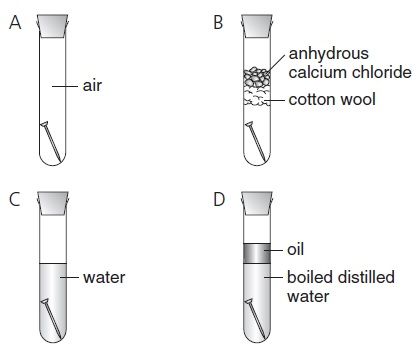
Which diagram shows the most favourable conditions for rust to appear on the nail?

a)

A

b)

B

c)

C

d)

D

29.
Which is the name of the kind of solid substance formed in this figure?  
a)
aqueous 
b)
precipitate
c)
acid
d)
synthesis 
30.

An aqueous solution is:

a)

any liquid with another compound dissolved in it.

b)

an ionic compound with water dissolved in it.

c)

water with another compound dissolved in it.

d)

none of the above

31.

Which of the following compounds is SOLUBLE?

a)

copper carbonate

b)

calcium carbonate

c)

potassium carbonate

d)

strontium carbonate

32.

In writing the chemical equation for a precipitation reaction, what abbreviation of the physical state must appear with one of the products?

a)

(s)

b)

(g)

c)

(l)

d)

(w)

33.

What would be the formula of the precipitate that forms when Pb(NO3)2 (aq) and K2SO4 (aq) are mixed?

a)

K(NO3)2

b)

PbSO4

c)

PbK2

d)

H2O

34.
What precipitate forms when you mix barium nitrate with sodium sulfate?
a)
sodium nitrate 
b)
barium nitrate
c)
barium sulfate
d)
sodium sulfate
35.
Zinc Carbonate
a)
Soluble 
b)
Insoluble